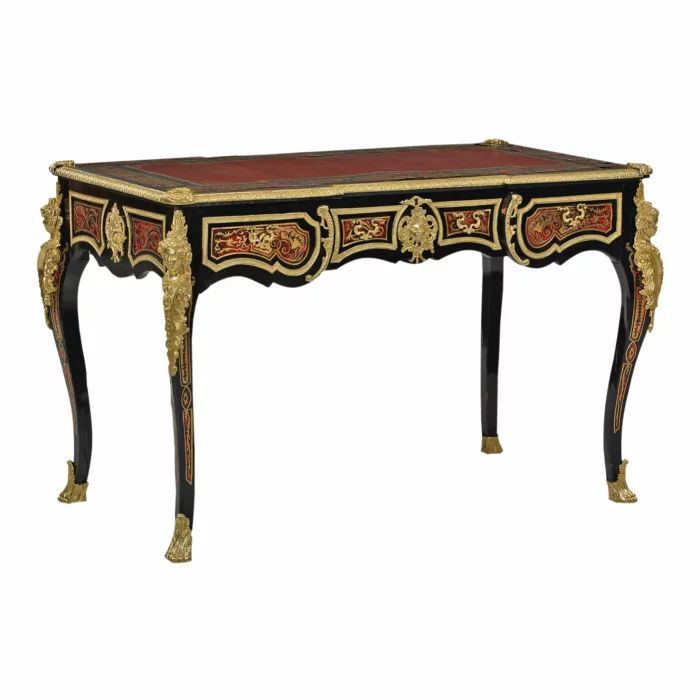
BOULLE STYLE WRITING DESK FRANCE, 19TH CENTURY
AntiqonART consultant will contact you within one business day after receiving your request.
Discover how the value of similar works has evolved over the past 10 years. Art is not only beauty — it's an investment.
Discover how the value of similar works has evolved over the past 10 years. Art is not only beauty — it's an investment.
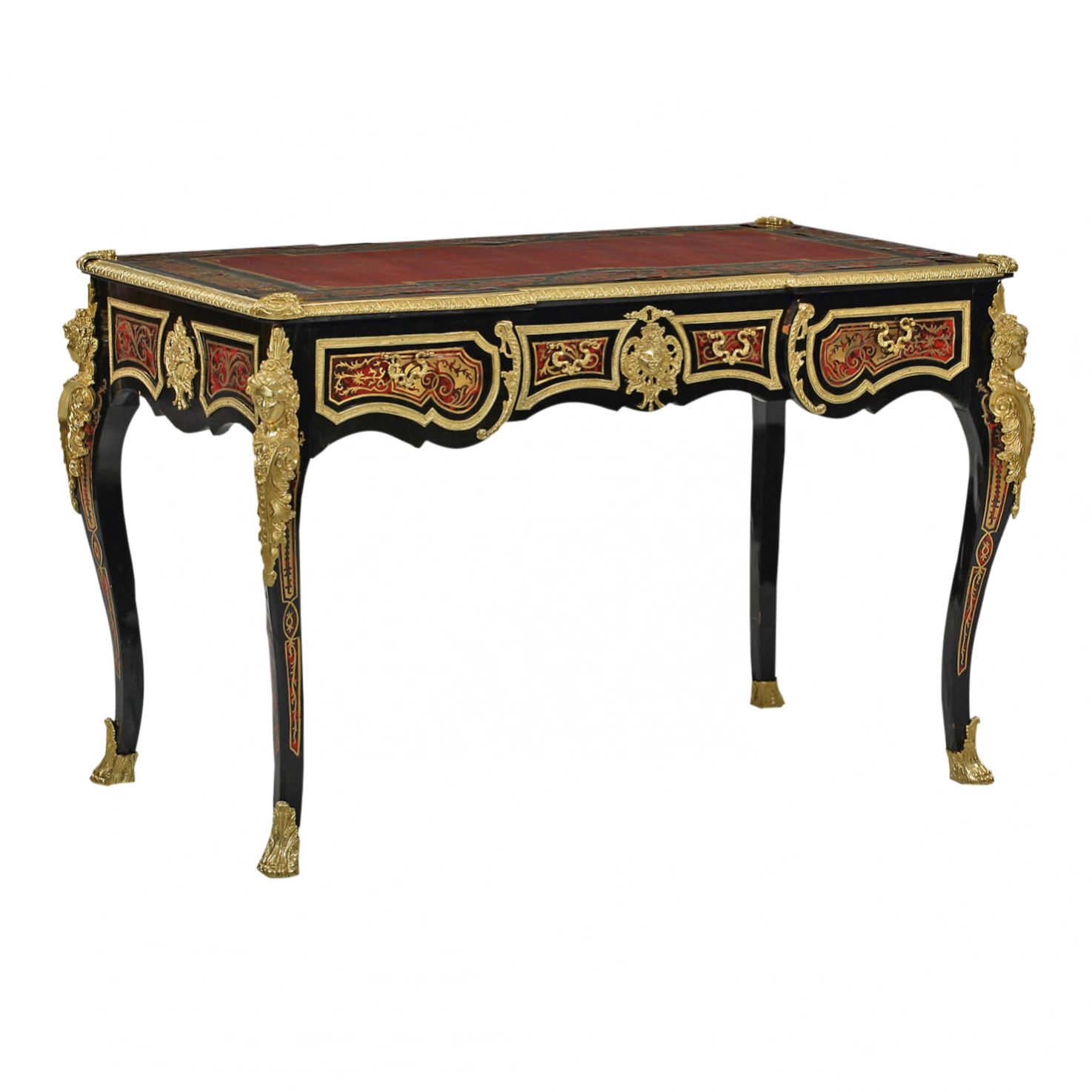
A refined cabinet writing desk in the Boulle style, executed in the finest traditions of 19th century French historicism, combining black lacquer, brass inlay, gilded bronze mounts and leather. The composition is defined by the striking contrast between the deep black ground and the intricate marquetry panels, where engraved brass forms elaborate arabesques against a red-toned lacquered background.
The rectangular top is fitted with a richly coloured red leather writing surface, framed by a gilt-tooled border, reinforcing the ceremonial character of the piece. The frieze is articulated with shaped cartouches adorned with scrolling foliage, framed by moulded gilt bronze mounts. The central section is highlighted by a sculptural mascaron set within a rocaille surround, forming a pronounced decorative focal point.
The cabriole legs, inspired by the Louis XV vocabulary, terminate in finely cast gilt bronze sabots. The sides are further embellished with applied figural gilt bronze mounts of remarkable modelling and chiselled detail, demonstrating a high level of Parisian bronze craftsmanship.
This desk embodies the aesthetic principles of the Boulle style, rooted in the legacy of André-Charles Boulle and revived during the 19th century, particularly under the Second Empire. Conceived for a grand cabinet interior, it would have served both as a functional writing table and as a statement of cultivated taste and social standing.
Dimensions: Height: 85 cm; Width: 125 cm; Depth: 70 cm.
Condition: Good. Professionally restored. Surfaces stabilised; marquetry and bronze mounts preserved.
Writing desks in the Boulle style occupy a significant position in the history of French decorative arts. The original technique of brass and tortoiseshell marquetry was perfected in the late 17th century by André-Charles Boulle, cabinetmaker to Louis XIV, whose works are preserved today in the Louvre, Versailles and other major museum collections.
During the 19th century, particularly in the period of the Second Empire, a renewed fascination with Baroque and Rococo splendour led to a revival of Boulle-inspired furniture. Parisian workshops produced sophisticated reinterpretations, combining engraved brass inlay, black lacquer grounds and elaborate gilt bronze mounts. These creations were not mere reproductions but scholarly adaptations based on museum exemplars and royal prototypes.
Such writing desks were destined for aristocratic residences and affluent bourgeois interiors, where they functioned as both utilitarian objects and symbols of cultural continuity and prestige. The presence of sculptural mascarons, rocaille cartouches and sinuous cabriole legs reflects close study of historic royal furniture preserved in Versailles and displayed in the Musée des Arts Décoratifs in Paris.
This desk therefore stands as a representative example of 19th century French historicism, uniting technical virtuosity, ornamental richness and a conscious revival of the grand royal style.
Professionally restored. Structure stable. Minor age-related wear to lacquer and leather surface. Gilt bronze mounts in good condition.
The condition report is provided for informational purposes only.
It is not comprehensive and may not reflect all defects, restorations, alterations, or adaptations, as Antiqon does not perform professional conservation-level assessments. The information is based on a qualified, yet subjective, evaluation by our specialists.Before purchasing, we recommend consultation with an independent expert.Please also consult our Terms and conditions and Glossary A-Z, which contain important information on lot characteristics and sale conditions.