


THE SMOLENSK MOTHER OF GOD ICON IN A SILVER AND ENAMEL OKLAD RUSSIA, MOSCOW, 1896
AntiqonART consultant will contact you within one business day after receiving your request.

Discover how the value of similar works has evolved over the past 10 years. Art is not only beauty — it's an investment.
Discover how the value of similar works has evolved over the past 10 years. Art is not only beauty — it's an investment.
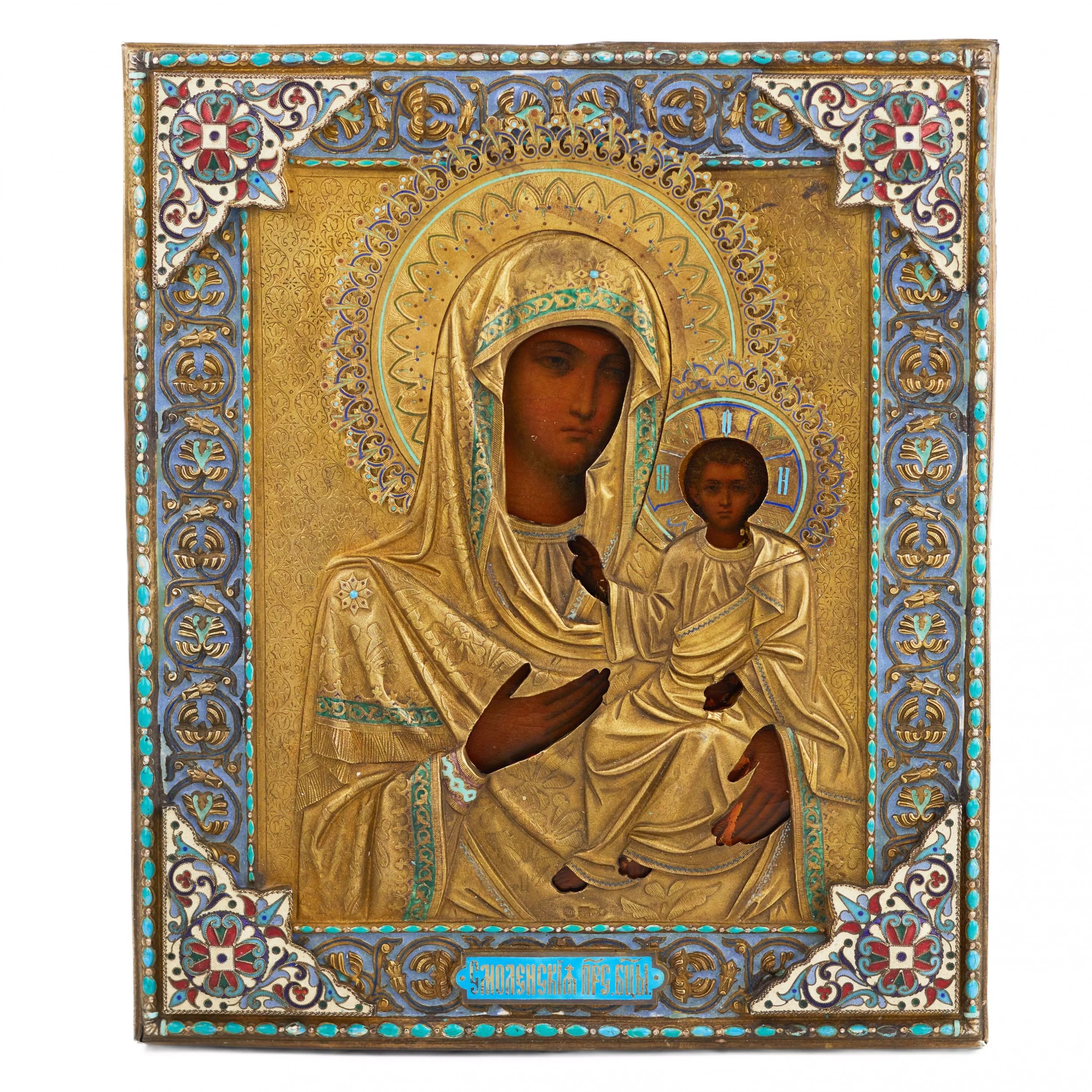
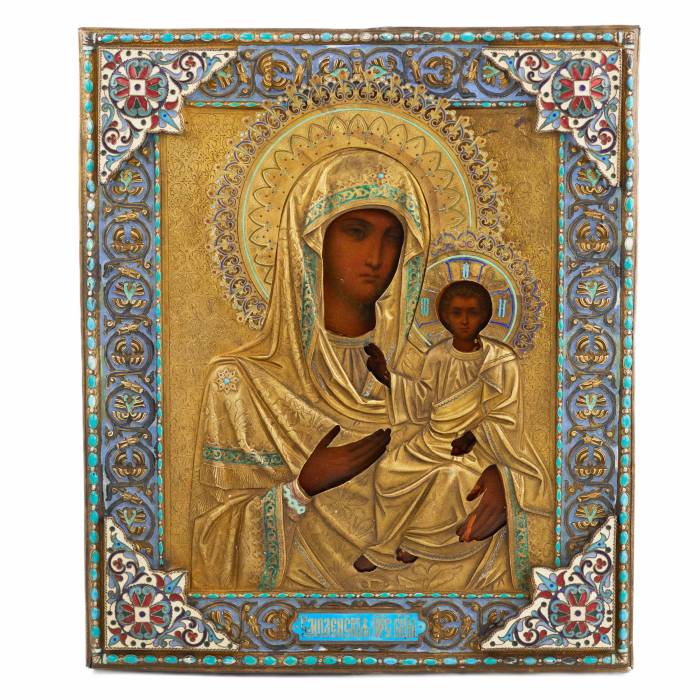
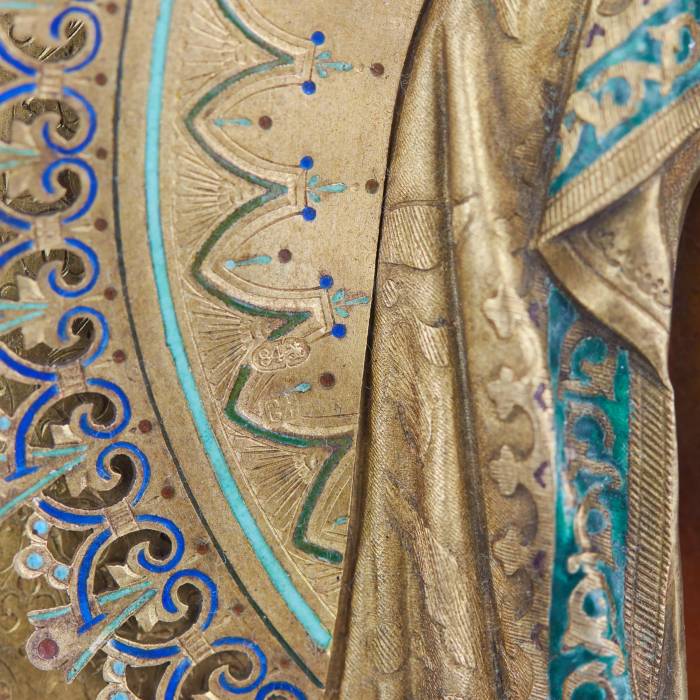
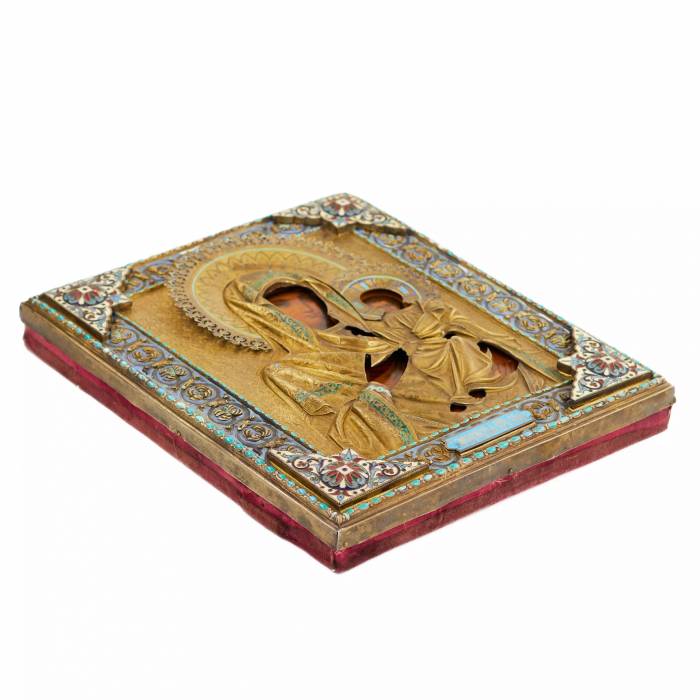
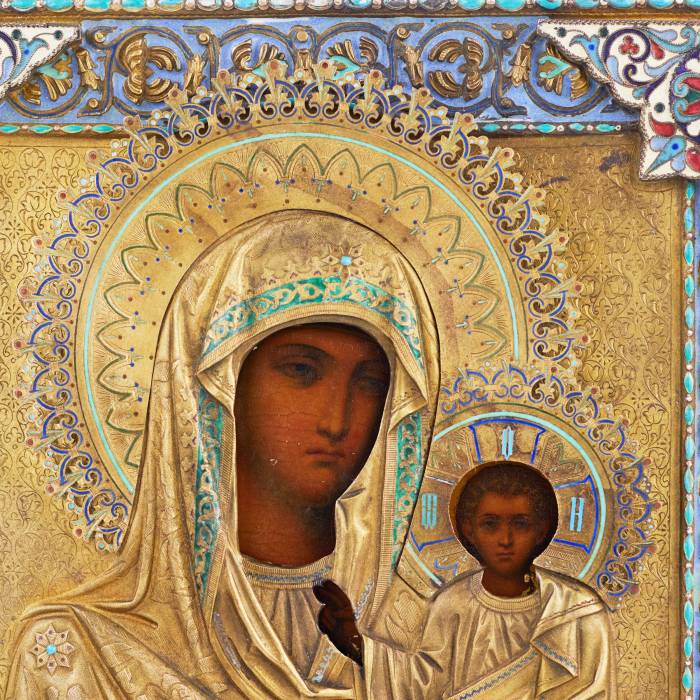
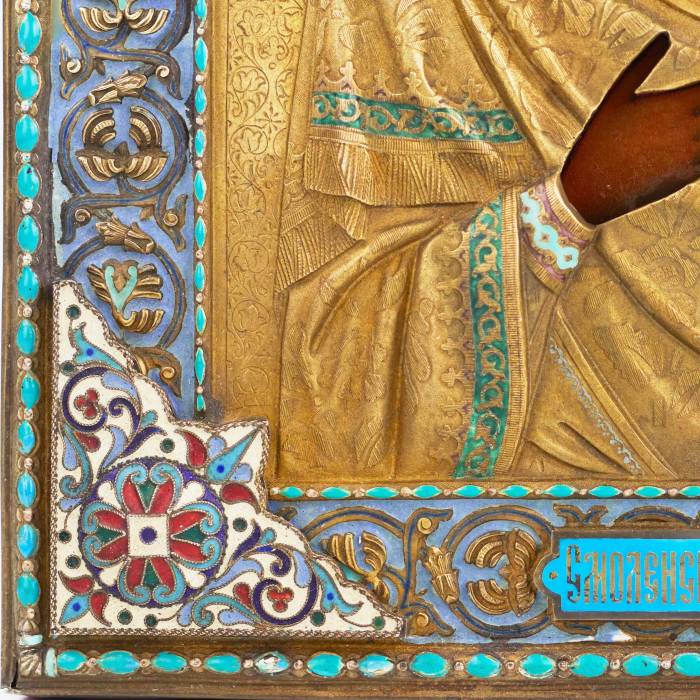
A rare icon of the Mother of God of Smolensk with a silver oklad, created in Moscow in the late 19th century. This work represents an outstanding example of fine Russian jewellery art, combining the canonical precision of icon painting with the ornamental richness of the Moscow school of silversmithing. The oklad is made of solid silver, decorated with chasing, engraving and polychrome enamel in shades of blue, turquoise, white and cobalt.
A distinctive decorative role within the ornamental structure of the oklad is given to polychrome enamel (finift). On this example, cloisonné, champlevé and painted enamels are used in various combinations, adding brightness and colour saturation to the composition. The central field is adorned with vegetal ornament, while the Virgin’s maphorion and tunic, and Christ’s himation and chiton, are executed in the trompe-l’œil technique — an optical illusion of embroidered textile achieved by combining chasing, engraving and enamel painting. The halos are framed with enamel borders, while the fields and corner plates feature intricate vegetal motifs in cloisonné and champlevé enamel. The lower bar bears an enamelled plaque inscribed: “Smolenskaya Presvyataya Bogoroditsa”.
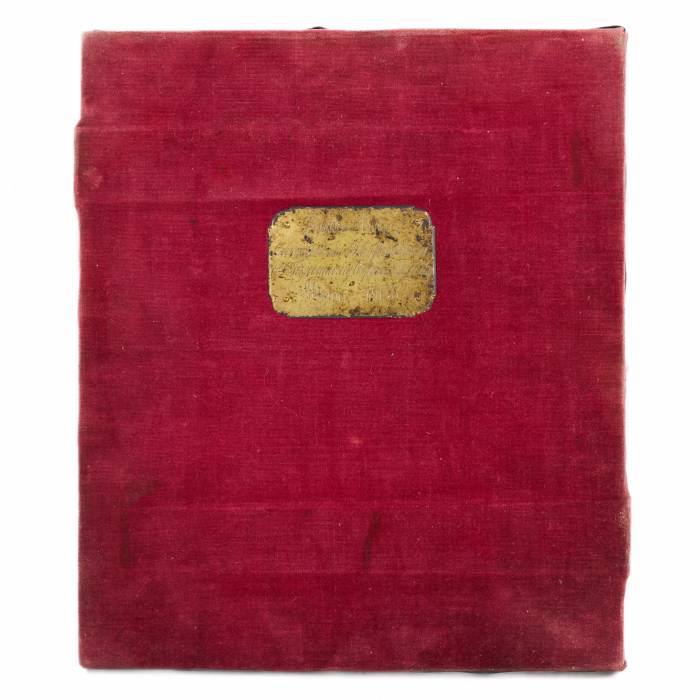
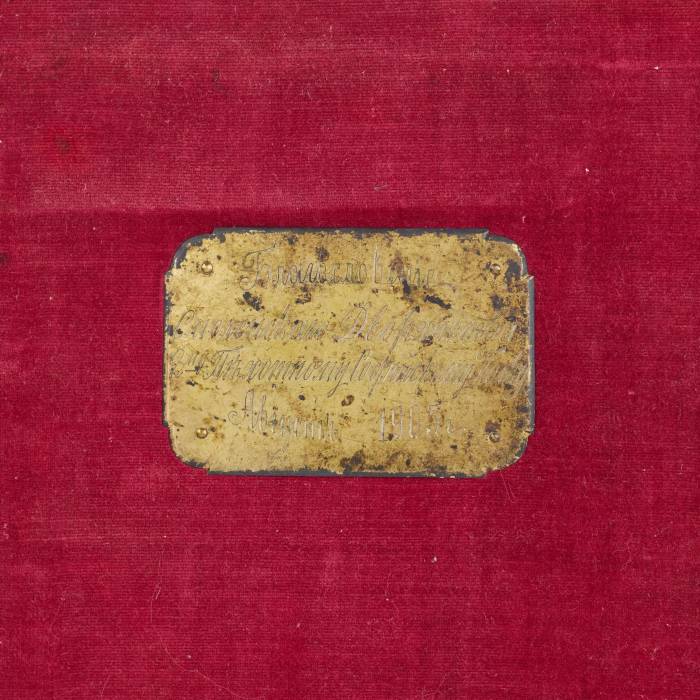
On the reverse remains the original brass dedicatory plaque engraved:
“A gift to the 24th Tikhvin Infantry Regiment. August 1905.”
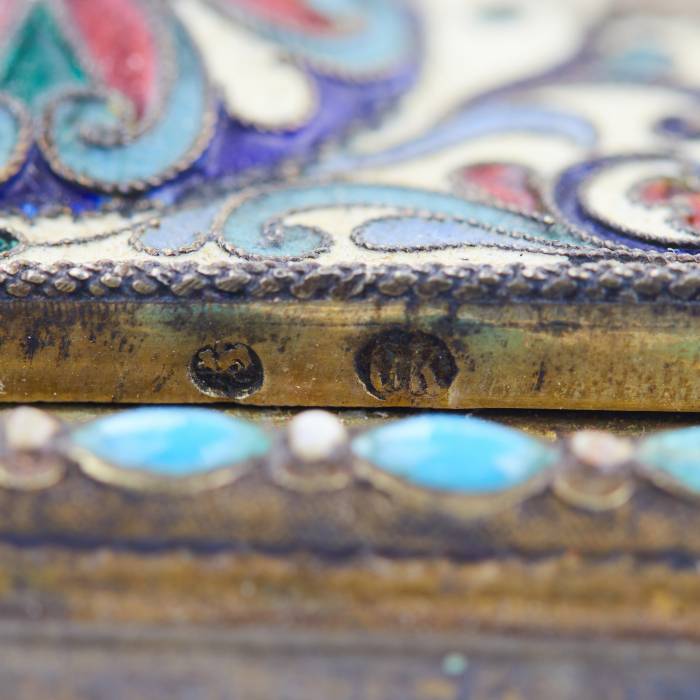
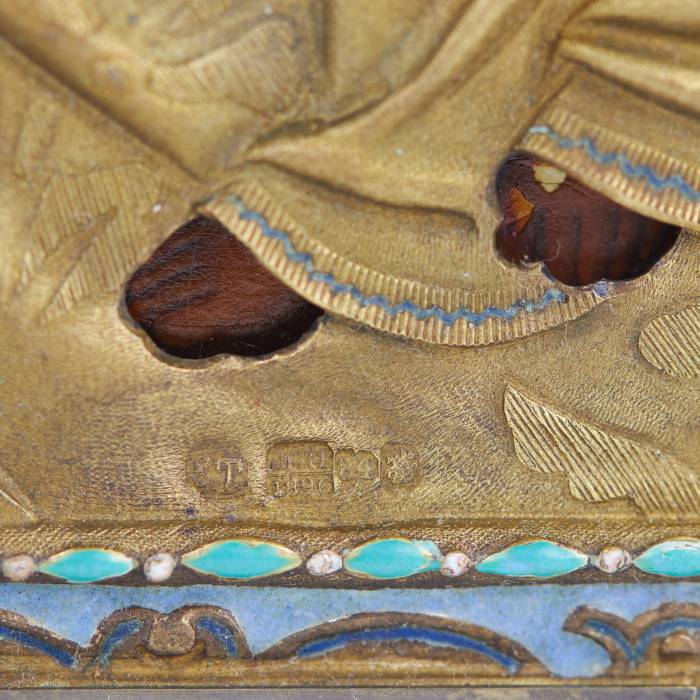
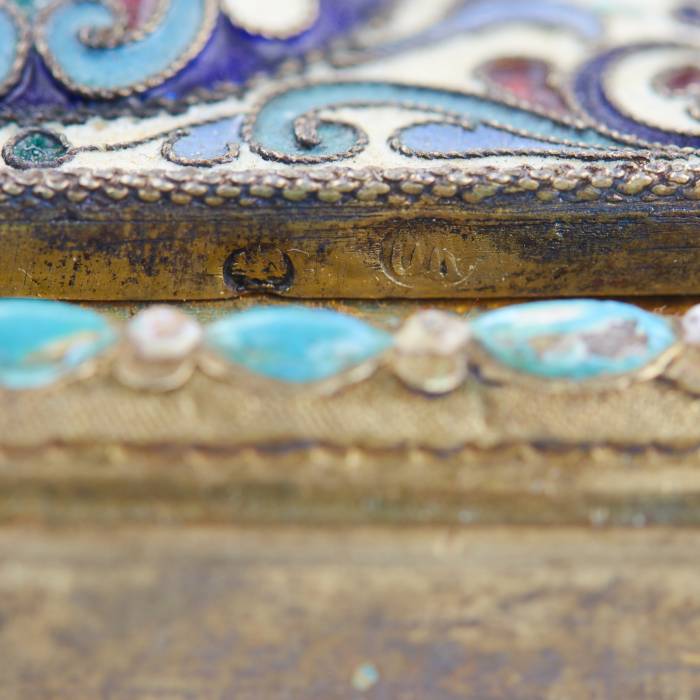
Marks:On the halo — maker’s mark “S.Zh.” in a rectangular cartouche — Sergei Ivanovich Zharov, owner of a Moscow silver workshop located on Semyonovskaya Street in the Rogozhskaya district. His workshop operated from the late 19th to the early 20th century, employing 12 craftsmen by 1905. Renowned for its exceptional quality and refined execution, Zharov’s firm is regarded among Russia’s leading silversmiths. His works (primarily oklads and kiots) are preserved in the State Hermitage Museum, the State Historical Museum, the Andrei Rublev Museum of Old Russian Art, and the Sergiev Posad Museum-Reserve.
On the robe — maker’s mark “S.T.” — Stepan Trunakov, Moscow silversmith active between 1894 and 1898.
Assay mark “L.O/1896” — Lev Fridrikhovich Oleks, Moscow District Assay Inspector.
State assay mark with the city arms of Moscow (Saint George) and “84” silver standard.
Material: Silver, 84 standard, enamel, partial gilding.
Technique: Casting, stamping, chasing, engraving, cloisonné, champlevé and painted enamel, trompe-l’œil, gilding, piercing.
Dimensions: 26 × 32 cm.
Condition: Satisfactory. Signs of age and use; minor surface wear and small damage in the upper right part of the central field; partial enamel rubbing.
Provenance: Gift to the 24th Tikhvin Infantry Regiment. Private European collection
The Mother of God of Smolensk is one of the most venerated icons of the Orthodox world, descending from a Byzantine prototype of the 11th–12th centuries. In Russian tradition, she was revered as the protectress of the land and guardian of soldiers.
The oklad belongs to the artistic revival of the late 19th century during the reign of Alexander III (1883–1896), when Russian craftsmen sought inspiration in the national artistic and architectural heritage of the 17th century. Within this context, polychrome enamel (finift) played a leading decorative role, combining cloisonné, champlevé and painted techniques. The bright palette — from sky blue to deep cobalt — symbolises the purity and heavenly protection of the Virgin.
In style and colour, the oklad corresponds to the finest works of Moscow silversmithing from the last quarter of the 19th century. The marks of Sergei Zharov and Stepan Trunakov highlight the high level of craftsmanship typical of the Moscow school of metalwork. The dedicatory inscription “A gift to the 24th Tikhvin Infantry Regiment” lends this piece historical and memorial significance, linking it to the Imperial Russian tradition of regimental icons.
Satisfactory condition. Even silver patina; enamels partially rubbed, with no major losses. Minor surface wear in the upper right area of the central field. Preserved with original decorative integrity and expressive enamel tones.
The condition report is provided for informational purposes only.
It is not comprehensive and may not reflect all defects, restorations, alterations, or adaptations, as Antiqon does not perform professional conservation-level assessments. The information is based on a qualified, yet subjective, evaluation by our specialists.Before purchasing, we recommend consultation with an independent expert.Please also consult our Terms and conditions and Glossary A-Z, which contain important information on lot characteristics and sale conditions.