
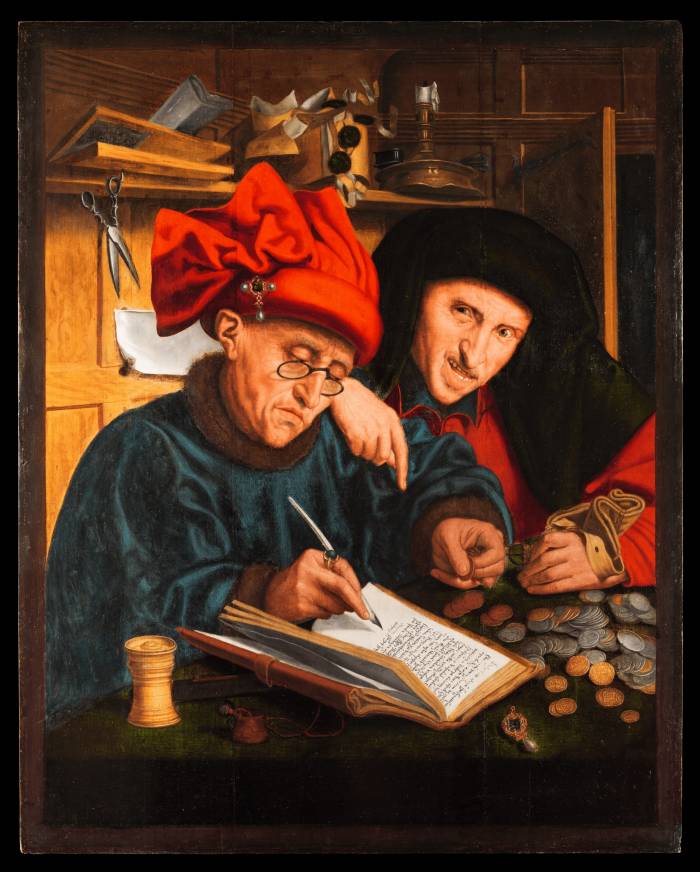
THE TAX COLLECTORS (OR PUBLICANS). FOLLOWER OF QUINTEN MASSYS FLANDERS, LATE 16TH CENTURY
AntiqonART consultant will contact you within one business day after receiving your request.
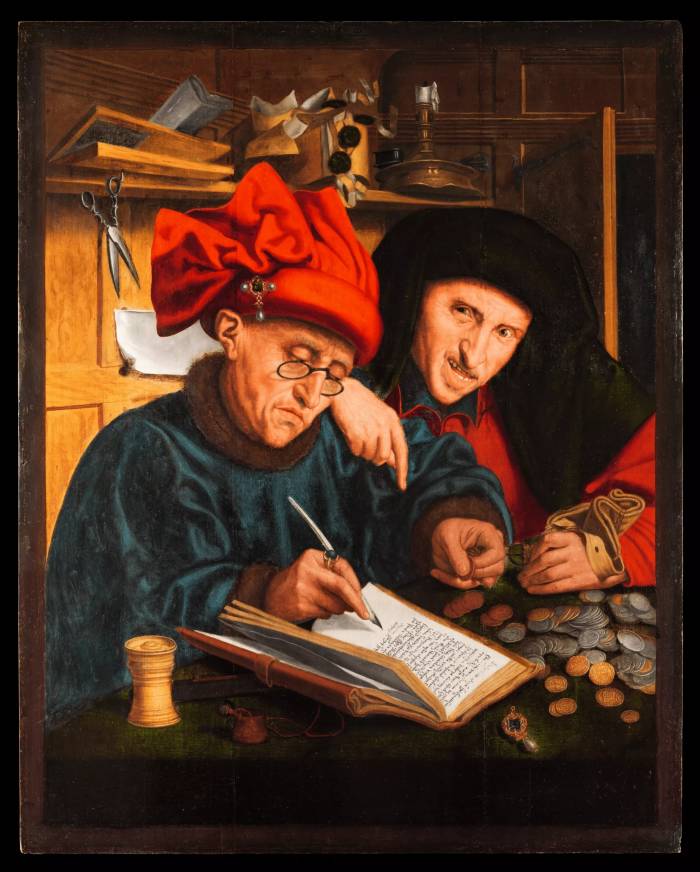
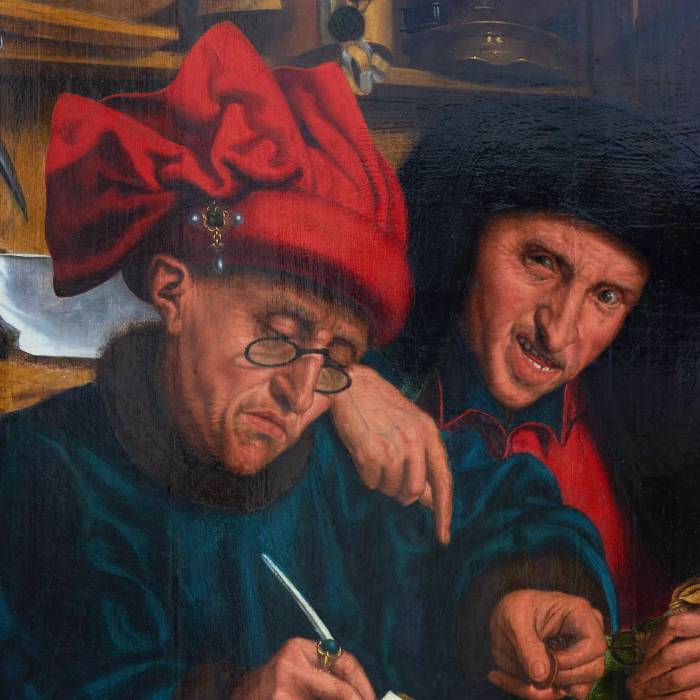
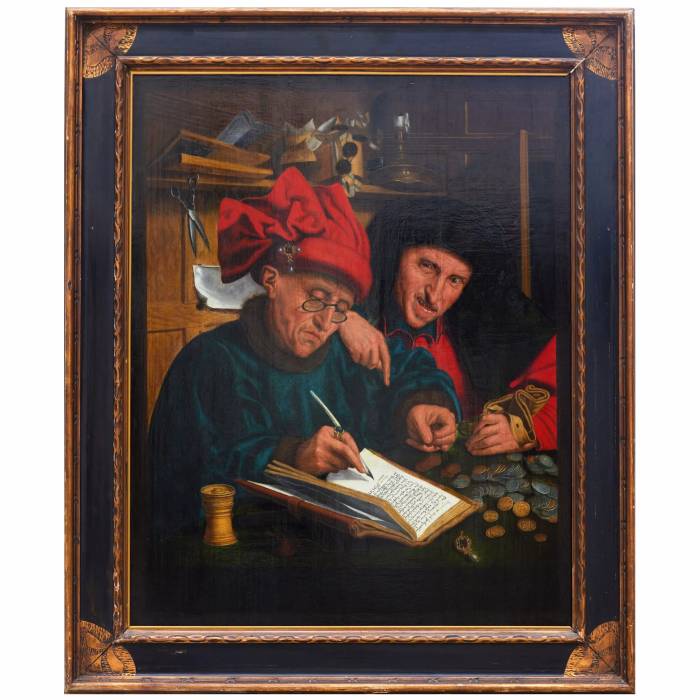
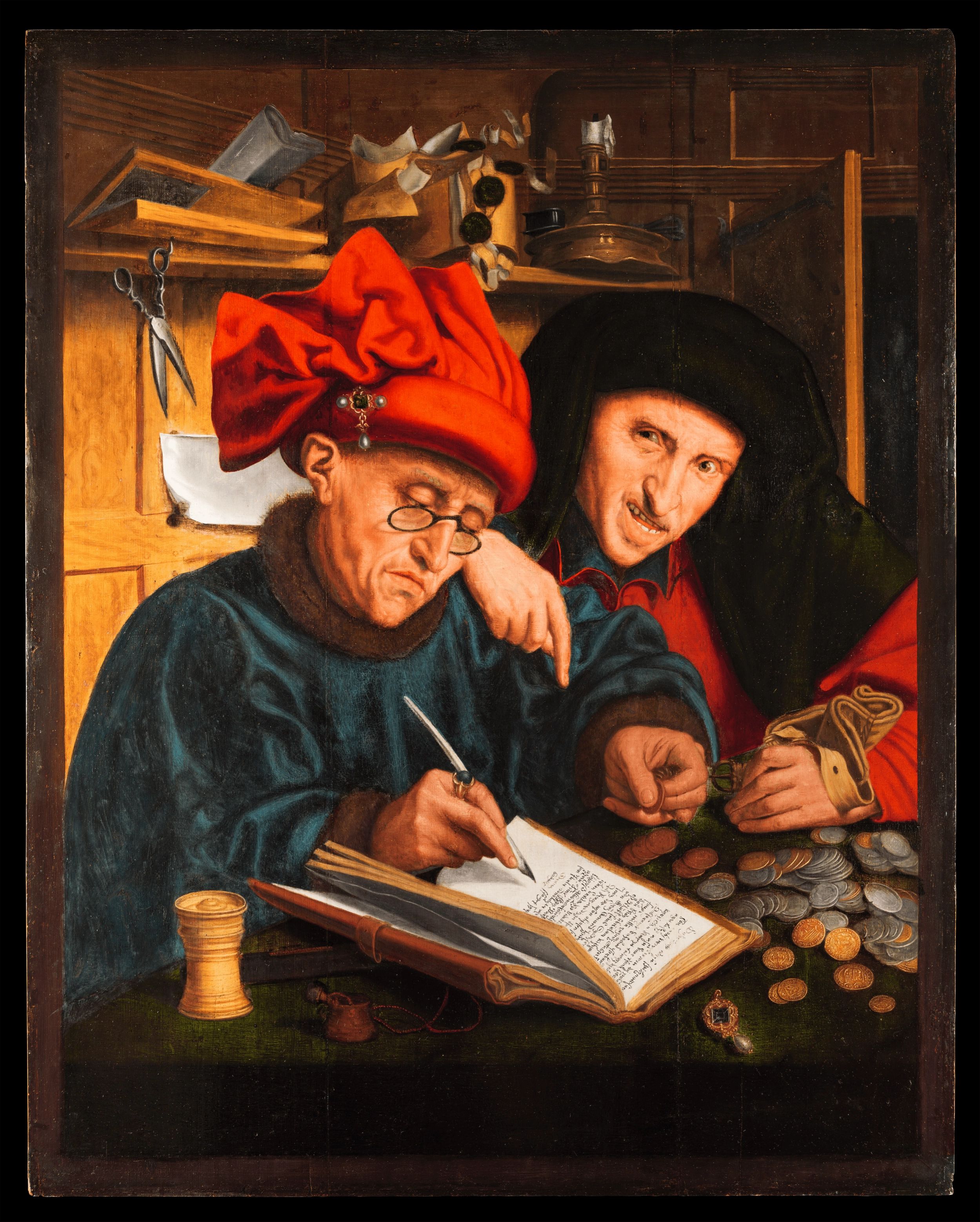
An exceptional work of the Flemish school of painting, the genre scene “The Tax Collectors” or “The Publicans”, created in the late sixteenth century by a follower of Quinten Massys, the great master who was among the first to transform painting into a mirror of human greed and the power of capital. Massys, the founder of the Antwerp school, established the tradition of secular moralising painting of the Northern Renaissance, in which an everyday scene became a visual treatise on sin, temptation and human weakness. The present work represents a rare and expressive continuation of this tradition, executed in the characteristic manner of the late sixteenth century.
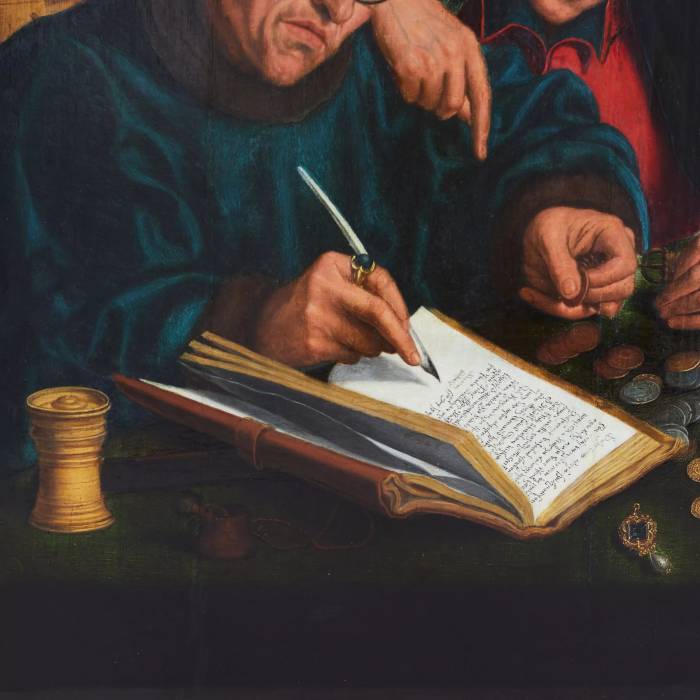
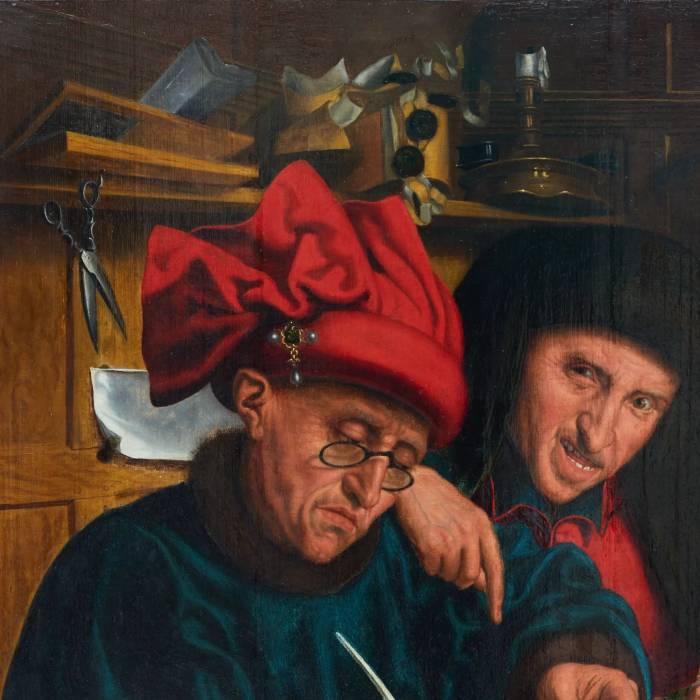
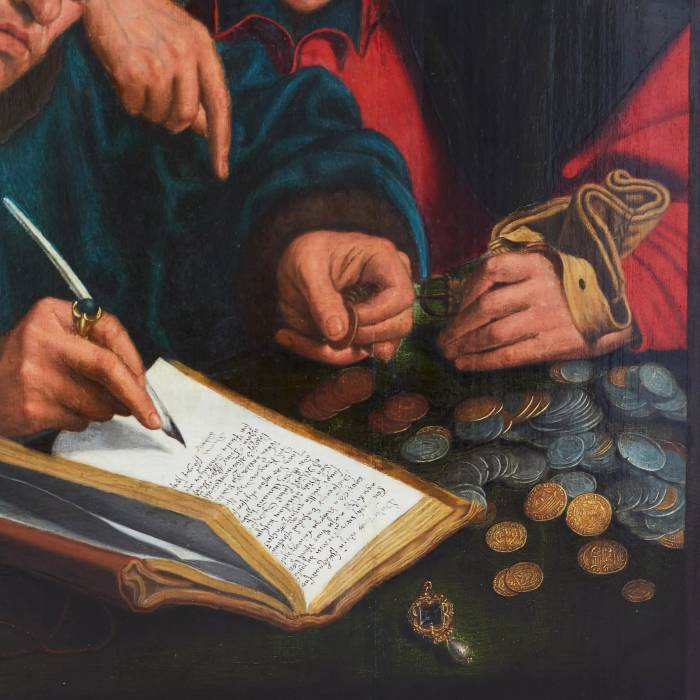
The artist depicts a scene charged with tension, sarcasm and latent dramaturgy. Two elderly men, confined within the narrow space of an office, are engaged in monetary calculations. One, wearing a vivid red headdress adorned with a pearl pendant, spectacles on his nose and a severe expression, methodically records figures in an account book with a long quill pen. His figure embodies authority, control and unemotional calculation. The other, dressed in a dark hood and bearing a crooked smile, points insistently at the book, as if demanding that a sum be recorded or expressing doubt about the honesty of the reckoning. Between them unfolds a silent yet highly charged dialogue, revealing a profound conflict of greed, mistrust and control.
The massive counting table is strewn with silver and gold coins, copper pieces, and accompanied by a leather purse, a pearl brooch, a sand shaker, counting tools, seals and an open ledger. These details do more than evoke the bureaucratic atmosphere of the sixteenth century, they serve a clear allegorical function. Wealth and jewellery signify temptation, the book becomes a document of guilt, the scissors hanging on the wall symbolise cutting or exclusion, the extinguished candle alludes to vanity and futility, while the rolled ribbons suggest distortion of order and loss of transparency. The entire interior is transformed into a theatre of human greed and a moralising statement.
The manner of execution points to an artist working within the circle of Massys. Dense brushwork, expressive modelling of faces, pronounced elements of grotesque and meticulous attention to detail reinforce the allegorical resonance of the painting, elevating a domestic scene into a moral mirror of its age.
Dimensions: 104 × 83 cm (panel); 130 × 106 cm (framed)
Medium: Oil on oak panel
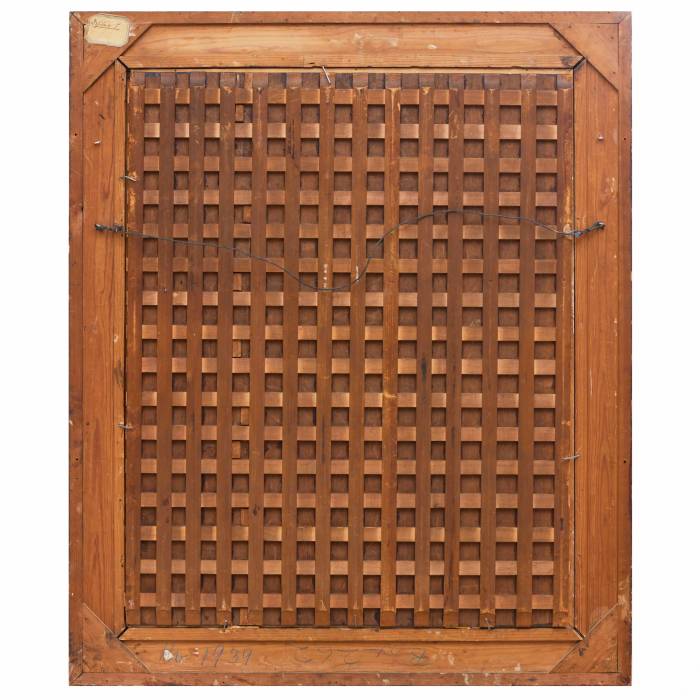
Condition: Good. The paint surface is stable. Natural craquelure consistent with age. An early professional restoration has been carried out, including consolidation of the paint layer, stabilisation of the surface and parquetting to support the integrity of the oak panels.
Provenance: Bukowski Auction, Stockholm, April 1950, lot no. 122.5; acquired in May 1950 from an antiquarian on Tegnérgatan, Stockholm, Sweden; thereafter in a private collection.
Expertise: Stéphane Pinta, Cabinet Turquin, Paris
The painting belongs to the circle of Flemish painters active at the end of the sixteenth century whose work developed under the artistic legacy of Quinten Massys (circa 1466–1530), one of the key masters of the Northern Renaissance and the founder of the Antwerp school. Massys established the canons of secular moralising painting, in which scenes of everyday life became arenas for ethical reflection. His innovative approach combined the Netherlandish tradition of refined detail with a critical view of social vices such as greed, avarice and hypocrisy, giving rise to a new visual language of moral satire embedded in familiar settings.
Following the appearance of the celebrated painting “The Moneychanger and His Wife” (1514, Louvre), as well as numerous versions of the subject of tax collectors produced within the workshop of Massys and by his followers, scenes depicting the financial agents of the time, moneychangers, usurers, customs officers and publicans, gained remarkable popularity. These images resonated strongly with contemporary audiences, as they not only reflected the realities of the emerging bourgeois class but also exposed the hidden mechanisms of economic power, the substitution of duty by profit and the moral temptations inherent in everyday routine.
The present work, executed in the last quarter of the sixteenth century, represents a mature example of this iconography. Unlike earlier versions, in which the moral message was often underscored by inscriptions or exaggerated gestures, the emphasis here is more subtle. It is conveyed through facial expressions, carefully articulated gestures and the dense system of symbolic objects scattered across the counting table. This refined approach aligns the painting with later works from the circle of Marinus van Reymerswale, an artist traditionally associated with the development of the “Tax Collectors” theme, although the attribution of many versions remains the subject of scholarly debate.
The composition is closely related to a number of museum works held in the Louvre, the Royal Collection at Windsor, the Pushkin State Museum of Fine Arts in Moscow, the National Gallery in London (inv. NG 944), the Liechtenstein Collection in Vienna, as well as paintings in the Prado and the Stibbert Museum. While these works share common elements, a pair of figures, a scene of financial reckoning and a compact interior filled with allegorical objects, none repeats another exactly. The present panel is distinguished by its original arrangement of details, including the pearl brooch, the prominently rendered scissors, the varied placement of sealed scrolls and subtle nuances in the treatment of the faces. Particularly noteworthy is the interaction between the figures, where instead of overt condemnation one encounters a dramatic ambiguity, calculation and suspicion, authority and unease locked in silent confrontation.
The painting demonstrates a mature pictorial language with a strong focus on psychological characterisation, a high level of material culture in depiction and an underlying philosophical tension characteristic of the finest examples of late Renaissance moralising painting. It belongs to a stable group of sixteenth century subjects and may be regarded as an authorial variation within the Flemish tradition that developed after Massys and prior to the Baroque expressiveness of Rubens.
The attribution, stylistic analysis and dating of the work are confirmed by the expert opinion of Stéphane Pinta, Cabinet Turquin, Paris, one of the leading European specialists in sixteenth century Flemish painting.
Good collector’s condition. The paint surface is stable, without losses. Natural craquelure consistent with age. A museum quality restoration has been carried out, with consolidation of the paint layer and stabilisation of the surface. The wooden panel has been reinforced with parquetting to preserve the integrity of the oak boards.
The condition report is provided for informational purposes only.
It is not comprehensive and may not reflect all defects, restorations, alterations, or adaptations, as Antiqon does not perform professional conservation-level assessments. The information is based on a qualified, yet subjective, evaluation by our specialists.Before purchasing, we recommend consultation with an independent expert.Please also consult our Terms and conditions and Glossary A-Z, which contain important information on lot characteristics and sale conditions.