SILVER SALT THRONE WITH PROVERB. MASTER S. M. IKONNIKOV RUSSIA, MOSCOW, 1880
AntiqonART consultant will contact you within one business day after receiving your request.
Discover how the value of similar works has evolved over the past 10 years. Art is not only beauty — it's an investment.
Discover how the value of similar works has evolved over the past 10 years. Art is not only beauty — it's an investment.
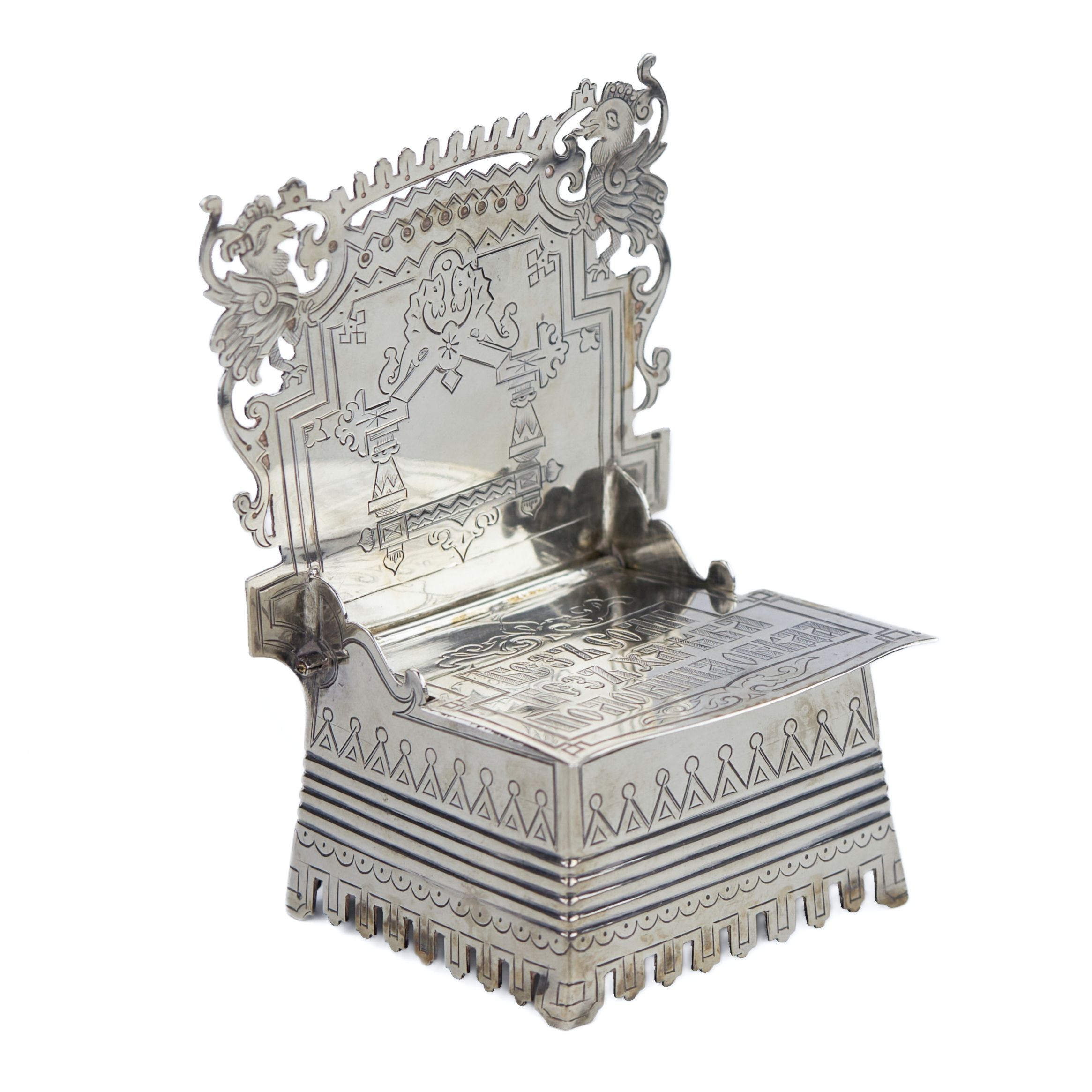
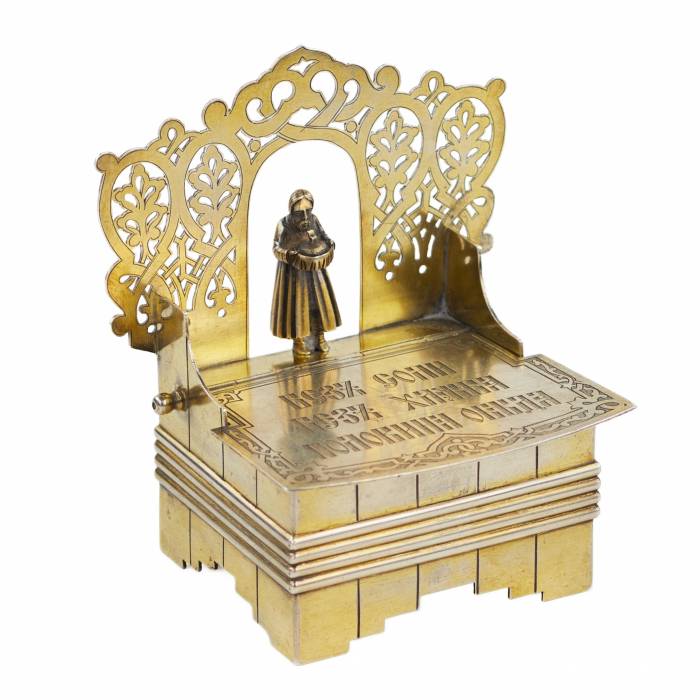
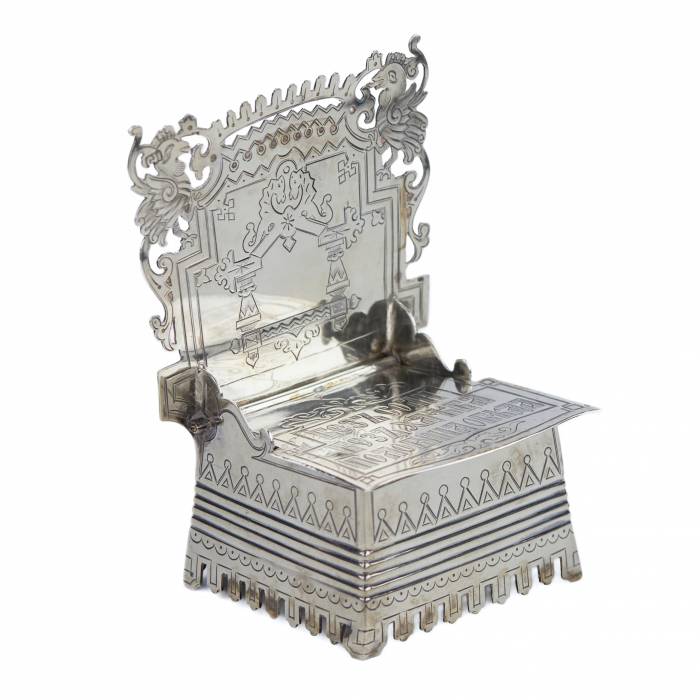
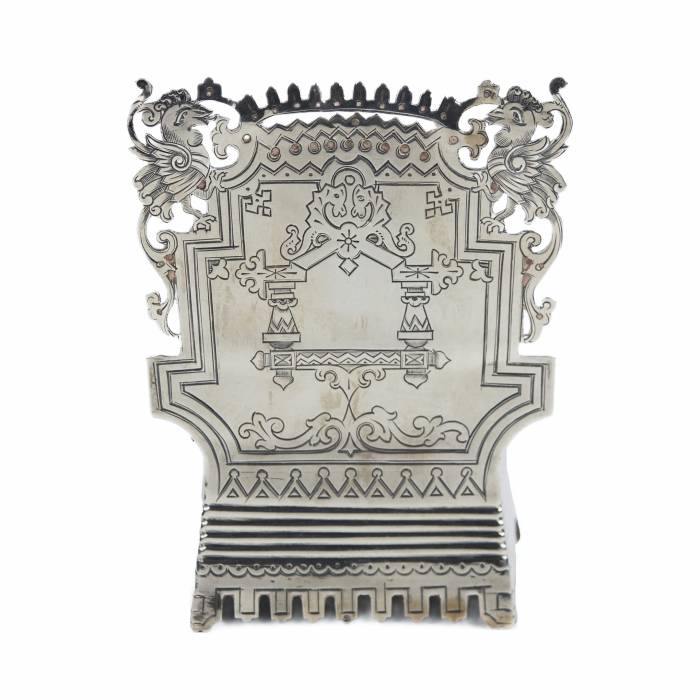
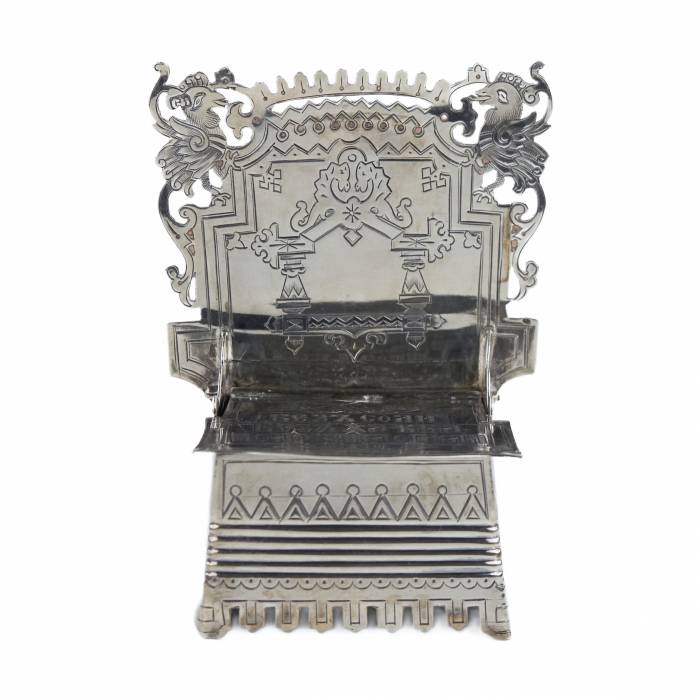
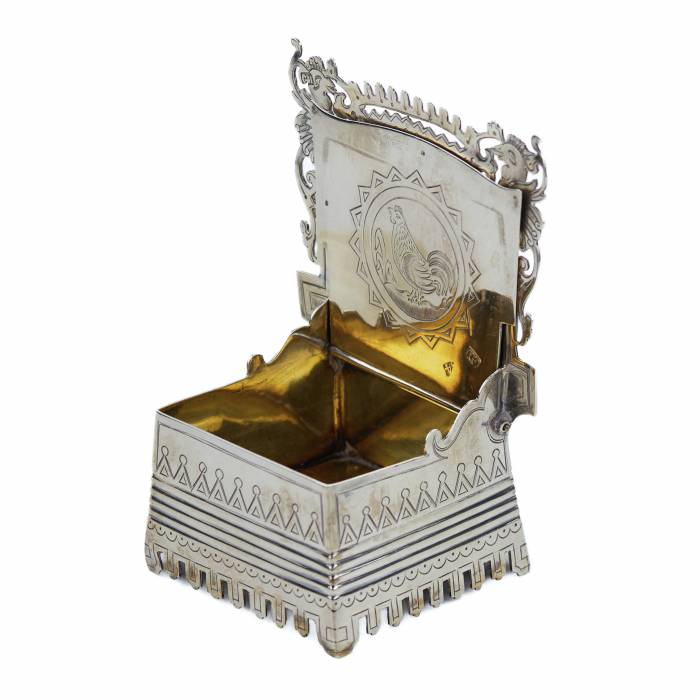
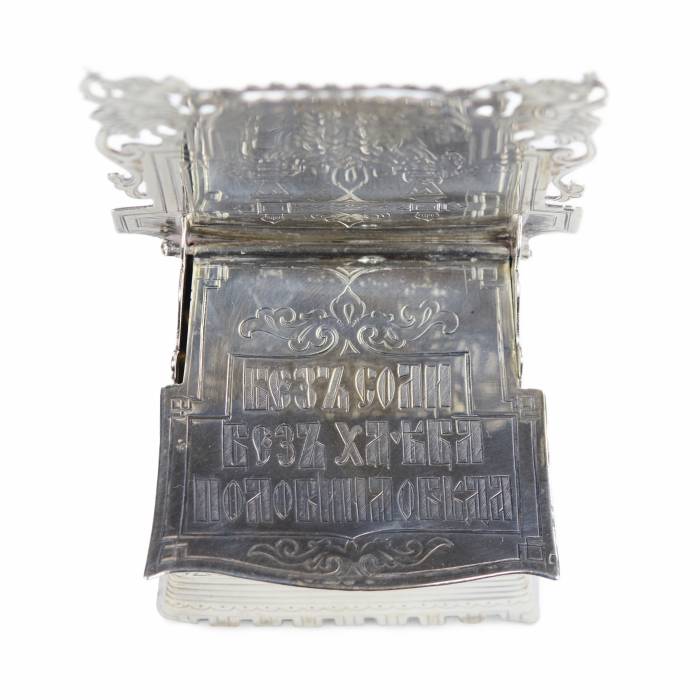
An expressive example of Russian silverware from the second half of the 19th century, executed in the form of a ceremonial throne with a high sculptural back and a hinged lid. The salt throne derives from ancient Russian dining traditions, where salt occupied a position of honor at the table as a symbol of prosperity, hospitality, and domestic well-being. The composition is architecturally conceived, featuring a stepped base, a pronounced pedestal, and a richly articulated ornamental program.
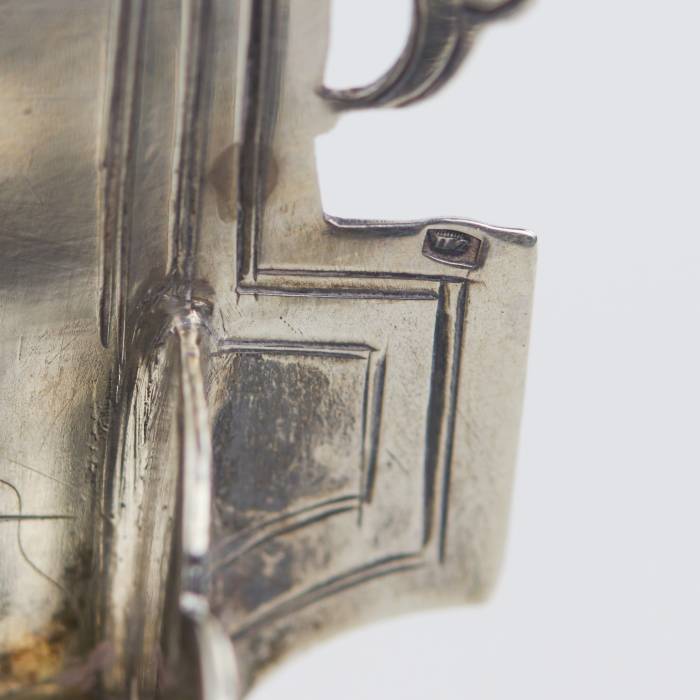
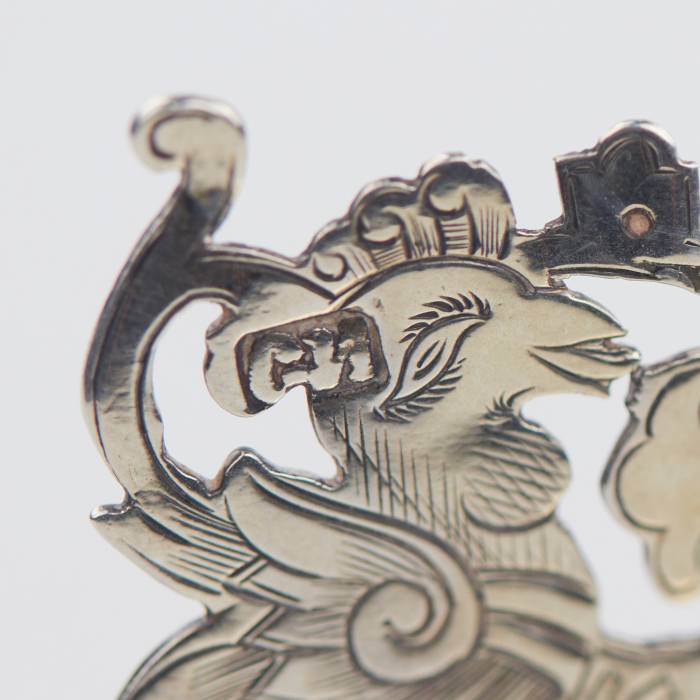
The decoration is executed in fine engraved technique and incorporates geometric bands, stylized vegetal motifs, and elements characteristic of the Pan-Slavic Revival. The sides of the backrest are adorned with fantastical birds rendered in a Neo-Russian ornamental idiom. The central field of the back is organized as an architectural portal with symbolic motifs referencing Old Russian decorative vocabulary. The interior of the salt compartment is fully gilded, emphasizing the ceremonial nature of the object.
The inner surface of the hinged lid bears an engraved proverb:
“Without salt and bread, a meal is only half complete,”
highlighting the philosophical and folkloric significance of the piece and its connection to traditional customs and domestic rituals.
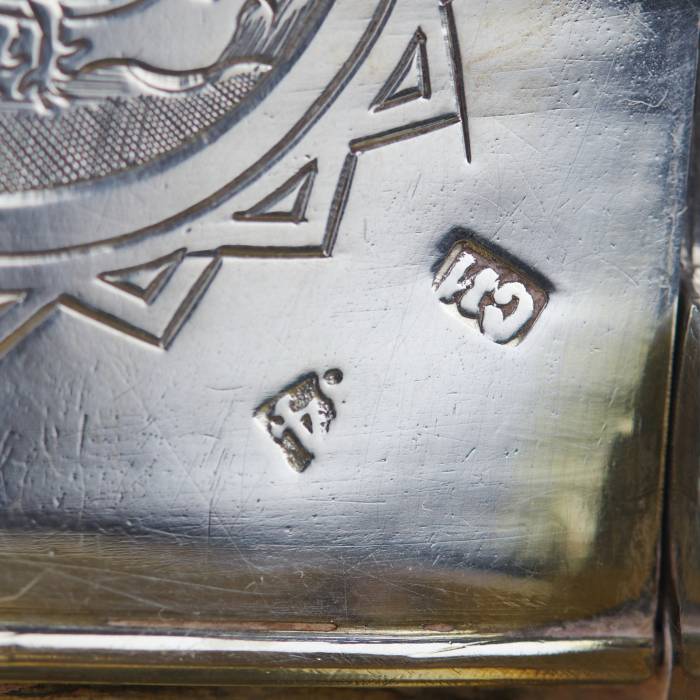
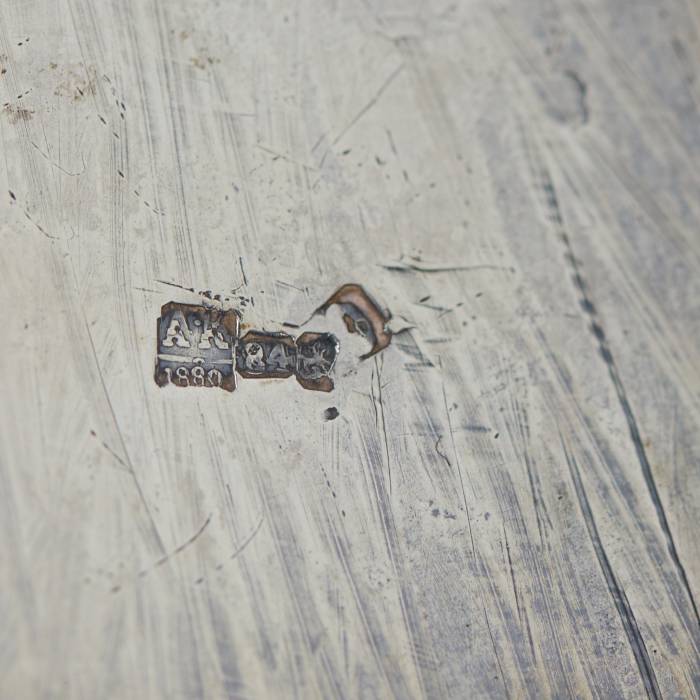
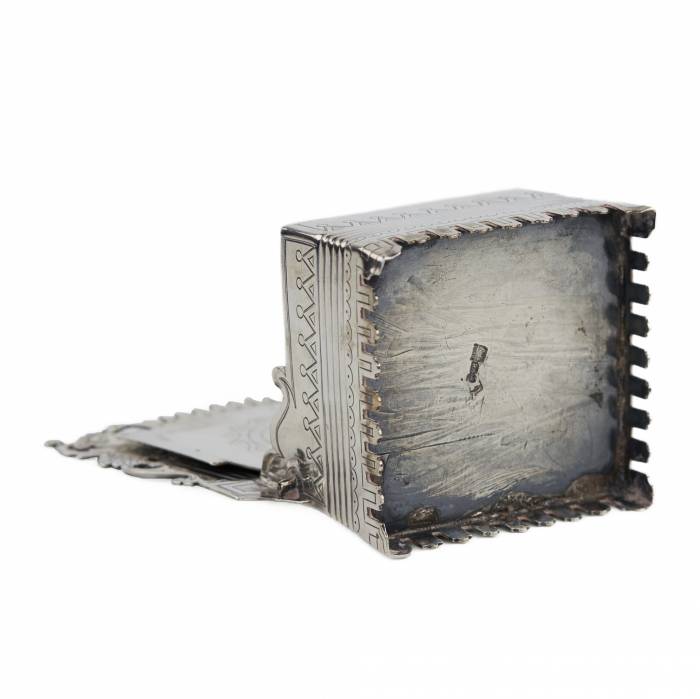
Marks:
Maker’s mark “СИ” in a square - S. M. Ikonnikov, Moscow silversmith; Assayer’s mark with initials “A.A” above the date “1880” - Anatoly Apollonovich Artsybashev, Moscow assayer; Silver standard mark “84”; Moscow city mark depicting Saint George slaying the dragon.
Dimensions: Height 10.5 cm; width 8.5 cm; depth 6 cm.
Weight: 160 g.
Condition: Good condition. Silver with natural patina. Gilding to the interior well preserved. Minor signs of age and careful use consistent with the period.
Provenance: Private European collection.
Salt cellars in the form of thrones occupy a distinctive place in the history of Russian table silver of the 19th century. Their iconography originates in ancient Russian customs, where salt held a symbolic and almost sacred role as the foundation of hospitality and household protection. By the 19th century, this tradition was reinterpreted through decorative and applied arts, transforming utilitarian objects into carriers of cultural memory.
During the second half of the 19th century, amid a growing interest in national history and folk culture, Pan-Slavic and Neo-Russian artistic idioms emerged in Russia. These movements found expression in architecture, graphic arts, and decorative objects, including silverware. Characteristic features included archaizing forms, references to medieval ornament, mythological imagery, and the inclusion of proverbs and aphorisms as semantic accents.
Moscow silver workshops played a leading role in the development of this tradition. Master S. M. Ikonnikov, who maintained a workshop with trained craftsmen and apprentices, belonged to a generation of silversmiths who sought to unite functionality with symbolic meaning. His works are distinguished by precise engraving, architectural clarity, and a refined balance between form and decoration.
Salt thrones of this type were often commissioned for affluent merchant households, prestigious taverns, or presented as symbolic gifts conveying wishes of prosperity and abundance. Today, such objects are regarded as significant examples of Russian national romanticism in decorative arts and are highly valued by museums and private collectors.
Silver with an even natural patina. The structure is stable and free from deformation. Interior gilding preserved. Minor surface wear consistent with age and historical use.
The condition report is provided for informational purposes only.
It is not comprehensive and may not reflect all defects, restorations, alterations, or adaptations, as Antiqon does not perform professional conservation-level assessments. The information is based on a qualified, yet subjective, evaluation by our specialists.Before purchasing, we recommend consultation with an independent expert.Please also consult our Terms and conditions and Glossary A-Z, which contain important information on lot characteristics and sale conditions.