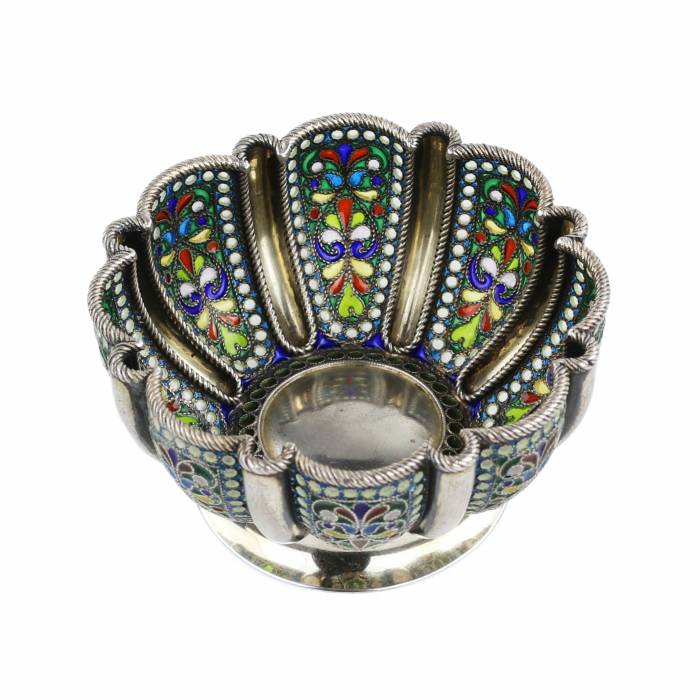
RUSSIAN SILVER BOWL WITH PLIQUE-À-JOUR ENAMEL. KHLEBNIKOV FIRM. MOSCOW, EARLY 20TH CENTURY
AntiqonART consultant will contact you within one business day after receiving your request.
Discover how the value of similar works has evolved over the past 10 years. Art is not only beauty — it's an investment.
Discover how the value of similar works has evolved over the past 10 years. Art is not only beauty — it's an investment.
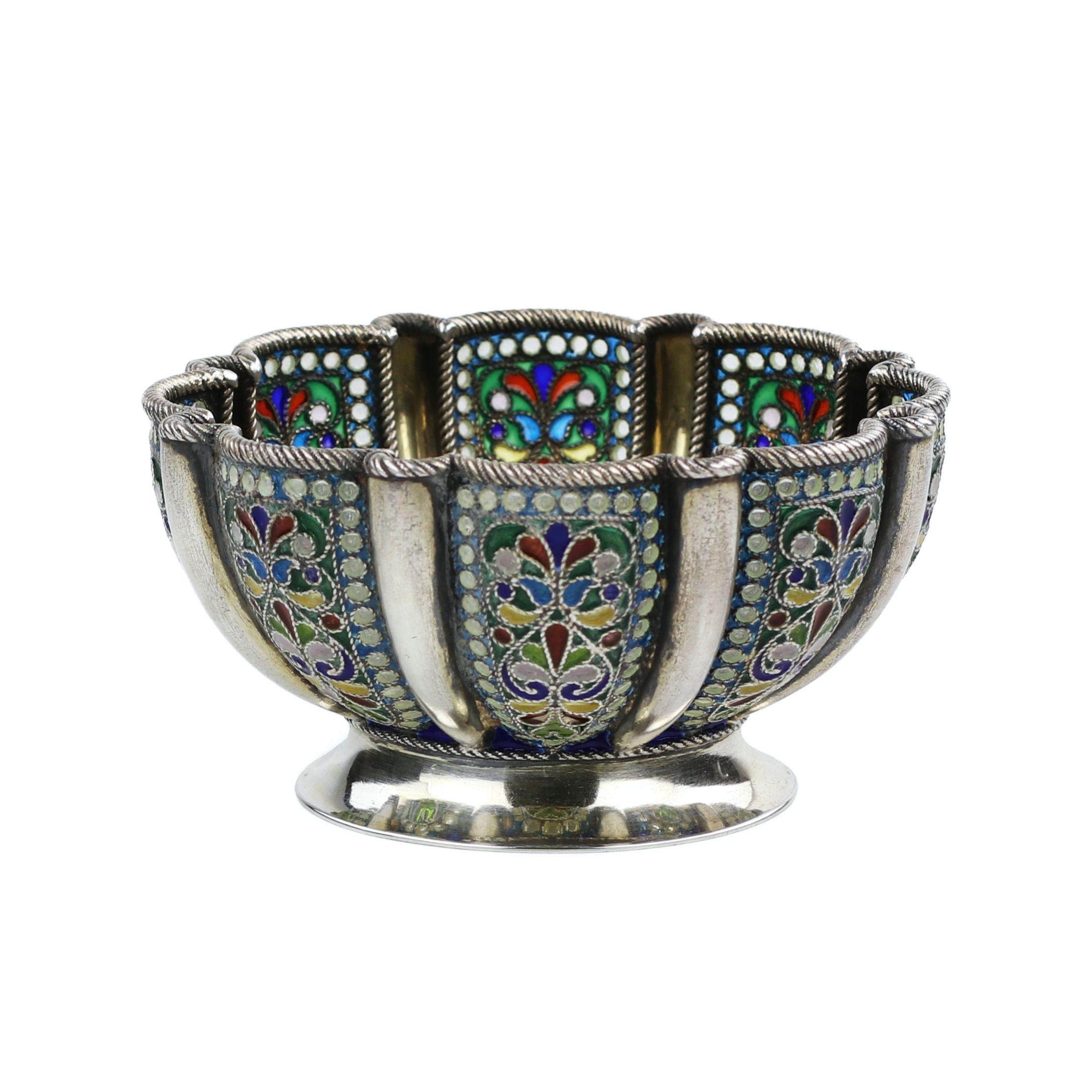
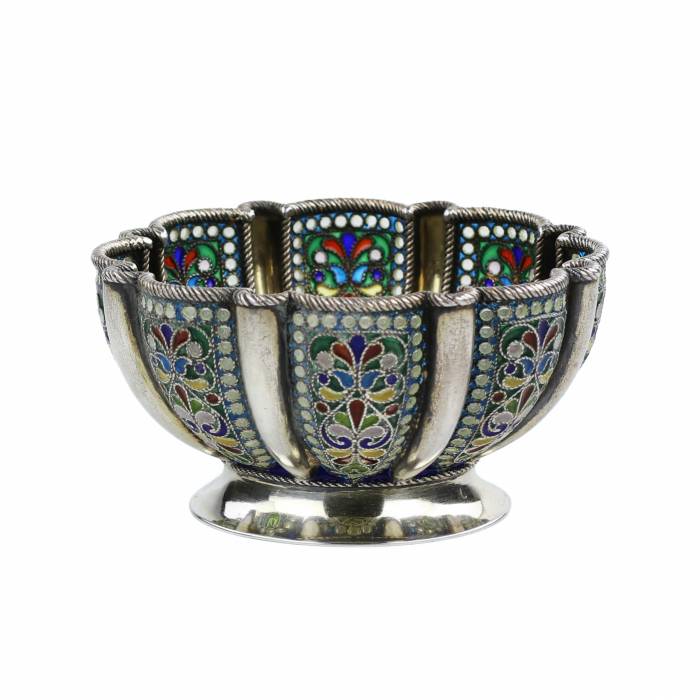
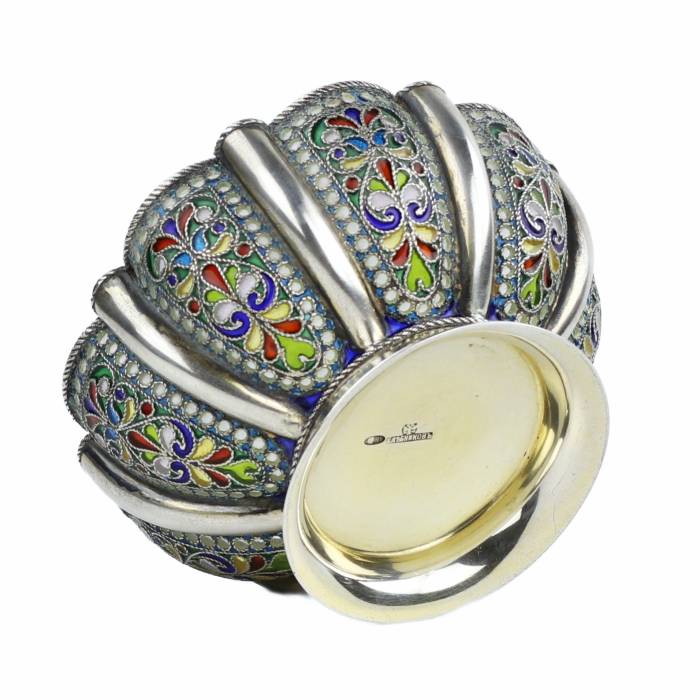
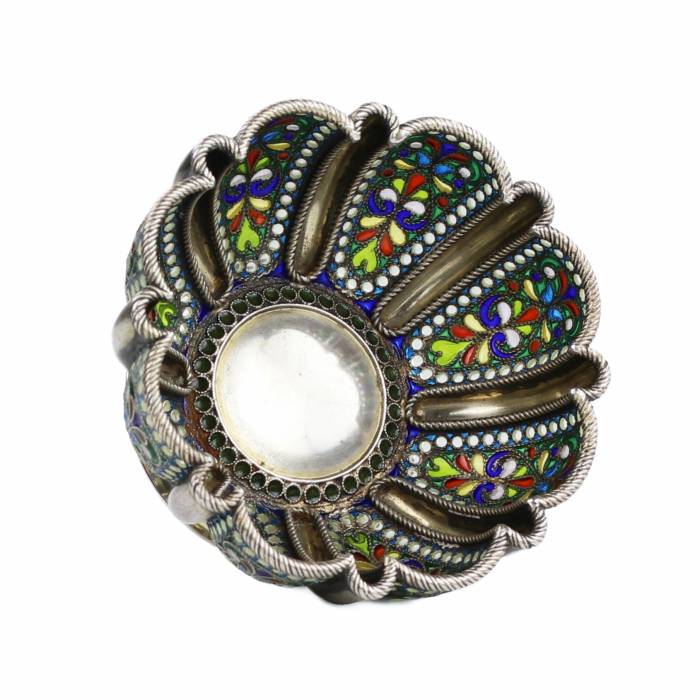
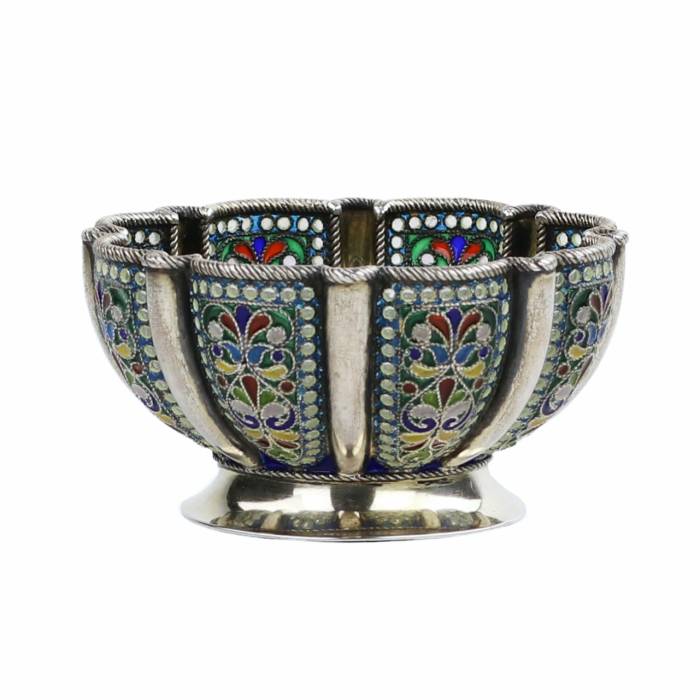
An elegant lobed silver bowl executed in plique-à-jour enamel over filigree, representing a refined example of Moscow jewellers’ art of the early 20th century. The body is composed of rhythmically alternating petal-shaped segments divided by smooth convex ribs, creating an architecturally structured silhouette.
Each panel is adorned with stylised foliate scrollwork rendered in a насыщенной palette of cobalt blue, emerald green, ruby red and milky white tones. The translucent enamel produces an effect of inner luminosity characteristic of the plique-à-jour technique. A delicate twisted rope border frames the segments, enhancing the graphic precision and decorative rhythm. The bowl rests on a low circular foot providing stability and formal balance.
The piece demonstrates the high level of enamelling craftsmanship achieved by the Khlebnikov firm, combining traditions of the Russian Revival style with the refined aesthetics of the Modern period.
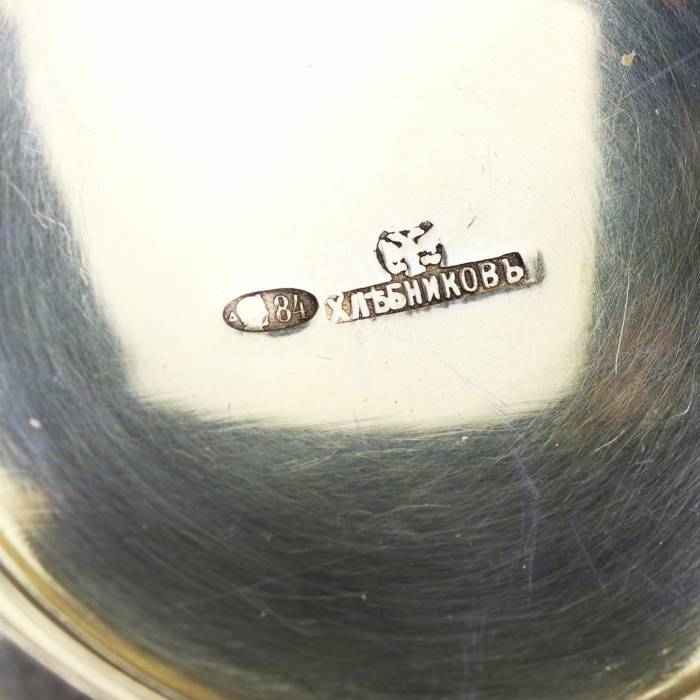
Marks: Maker’s mark “Khlebnkov” beneath the Imperial double-headed eagle - official Supplier to the Imperial Court; Moscow assay office mark with the kokoshnik head turned left and silver standard “84”, dated 1908-1917.
Dimensions: Height: 4.8 cm.
Weight: Gross: 140.7 g.
Condition: Good. Enamel intact with minor traces of handling. Silver with light natural patina. No deformations or restorations observed.
Provenance: Private collection.
In the early 20th century, the Moscow firm of Khlebnikov occupied a leading position among the producers of artistic silver in the Russian Empire and held the prestigious title of Official Supplier to the Imperial Court. Founded in the second half of the 19th century, the enterprise achieved particular distinction for the exceptional quality of its enamelling workshops, which successfully revived and reinterpreted ancient Russian decorative traditions within the refined aesthetic language of the Modern style.
The plique-à-jour enamel technique employed in this bowl represents one of the most technically demanding methods in metalwork. In this process, translucent enamel is applied within delicate filigree cells without a solid metal backing, allowing light to pass through the composition in a manner comparable to stained glass. The resulting effect of luminosity and chromatic depth requires extreme precision in firing and control of temperature, as the absence of a supporting ground increases the fragility of the structure during production. Mastery of this technique was considered a hallmark of the highest professional level among Russian enamellers of the period.
Works of the Khlebnikov firm were regularly presented at major national and international exhibitions, including All-Russian industrial and art exhibitions, where Russian enamelled silver was widely praised for its technical sophistication and decorative brilliance. Museum collections in Moscow, notably the State Historical Museum and the Armoury Chamber of the Moscow Kremlin, preserve important examples of Khlebnikov production. These holdings demonstrate the synthesis of traditional Old Russian ornamental motifs, intricate filigree workmanship and vibrant polychrome enamel that became characteristic of Moscow silversmithing at the turn of the century.
During the period 1908-1917, to which this bowl belongs, Moscow workshops increasingly sought compact, functional forms while maintaining the richness of surface decoration. This balance between practicality and ornamental complexity reflects broader artistic tendencies of the era, in which historicist revival, national romanticism and elements of Modern style coexisted within the decorative arts. Pieces bearing the maker’s name beneath the Imperial double-headed eagle signify the firm’s official court status and confirm its participation in the system of prestigious state and aristocratic commissions. As such, objects of this type possess not only aesthetic value but also significant historical and collector importance within the field of Russian silver and enamel of the early 20th century.
Overall condition good. Enamel preserved without cracks or losses. Minor surface wear and natural silver patina consistent with age. Structure stable and without distortion.
The condition report is provided for informational purposes only.
It is not comprehensive and may not reflect all defects, restorations, alterations, or adaptations, as Antiqon does not perform professional conservation-level assessments. The information is based on a qualified, yet subjective, evaluation by our specialists.Before purchasing, we recommend consultation with an independent expert.Please also consult our Terms and conditions and Glossary A-Z, which contain important information on lot characteristics and sale conditions.