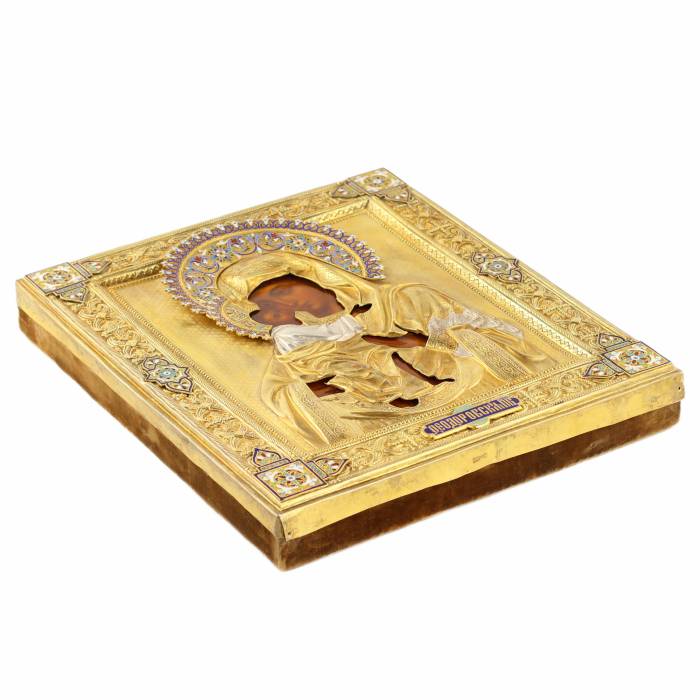
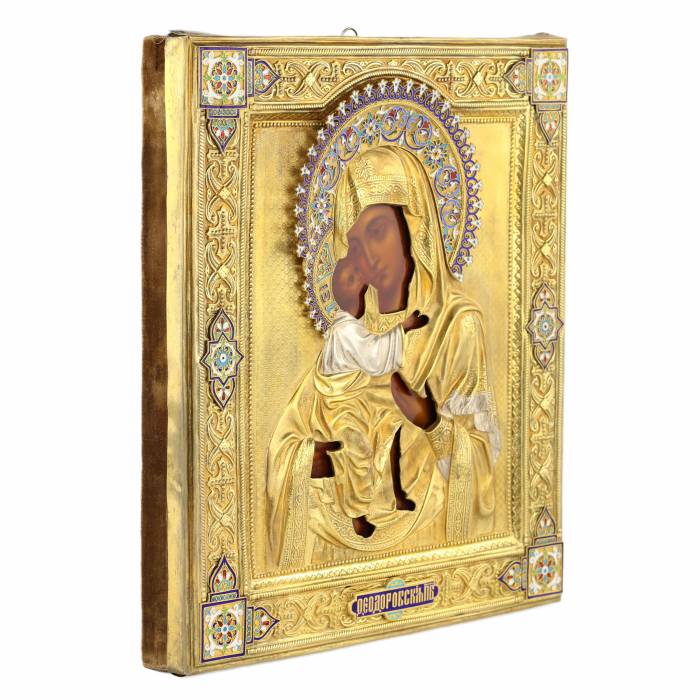
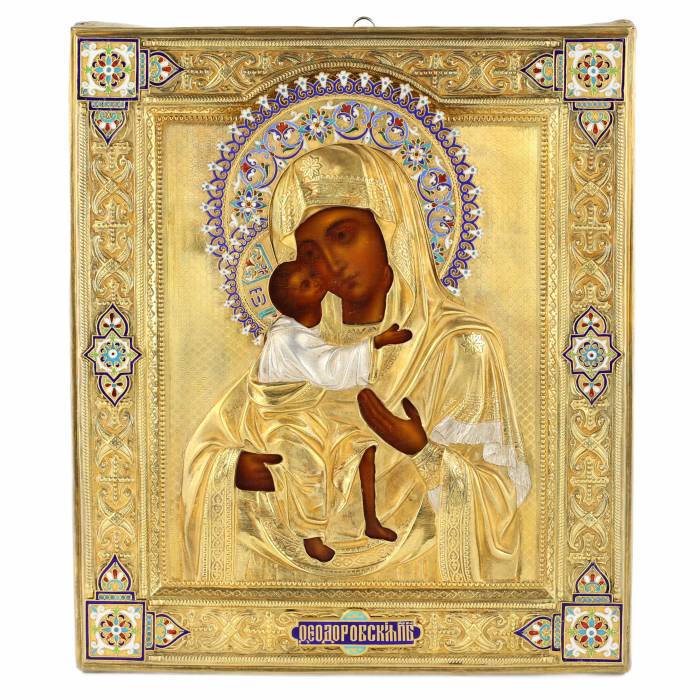
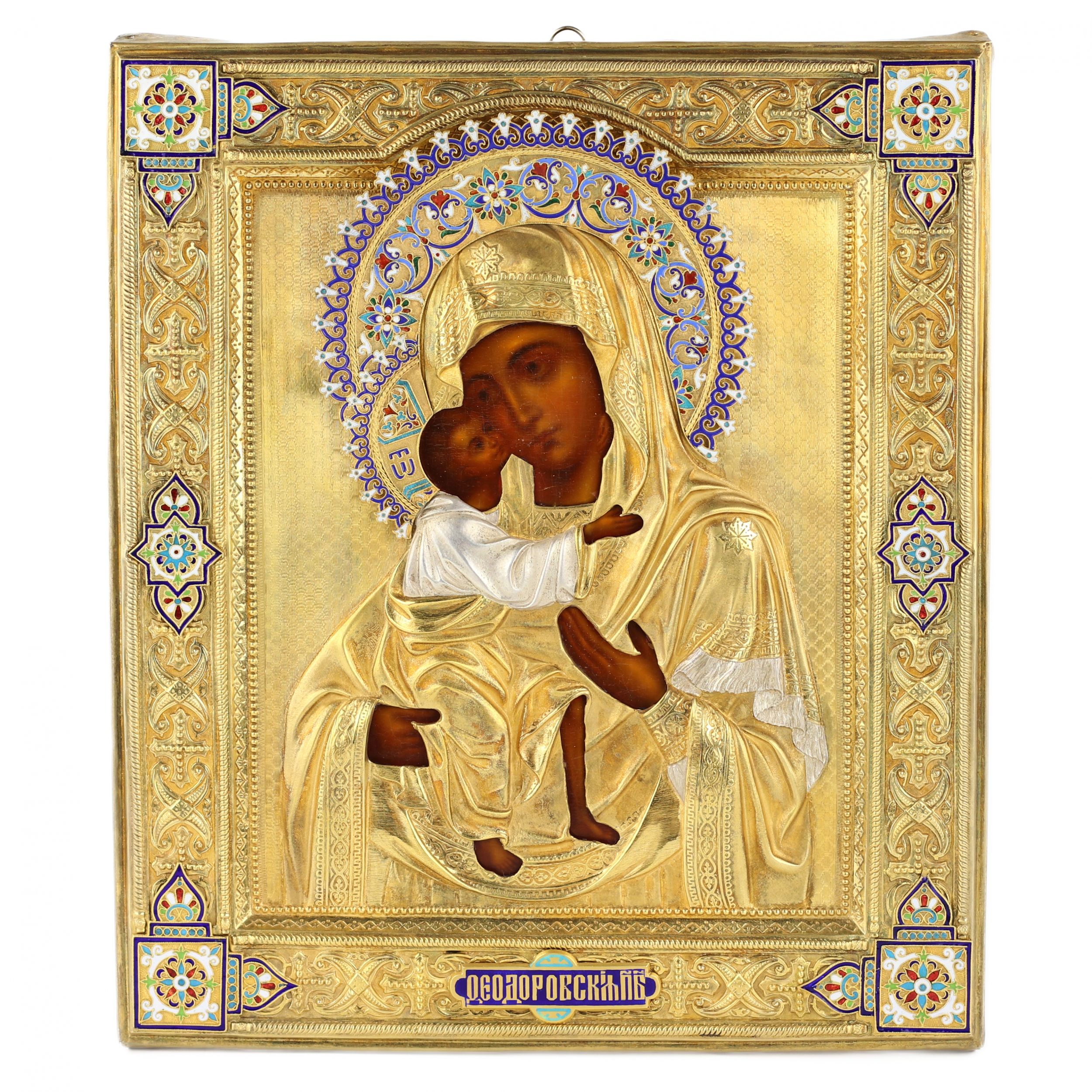
A solemn analogion icon of the Feodorovskaya Mother of God, created in Moscow in 1890. The image belongs to the most venerated Marian shrines traditionally associated with the protection of the family and dynastic continuity. The Virgin is depicted with the Christ Child in the iconographic type known as “Eleusa,” where the gentle touching of their faces emphasizes intimacy and prayerful contemplation. The faces are executed in a warm ochre-brown palette with subtle modeling of light and shadow characteristic of Moscow icon painting of the late nineteenth century.
The icon is encased in a gilt silver mount executed at the factory of Vasily Semyonov in Moscow. The mount represents a highly refined example of Moscow silversmithing of the late nineteenth century. The repoussé work on silver forms a sculptural pattern of the folds of the maphorion and chiton, creating a striking interplay of light across the metal surface. The crowns, borders, and corner elements are decorated with polychrome enamels featuring delicate vegetal and geometric ornamentation, rendered in the characteristic decorative manner of the Moscow school.
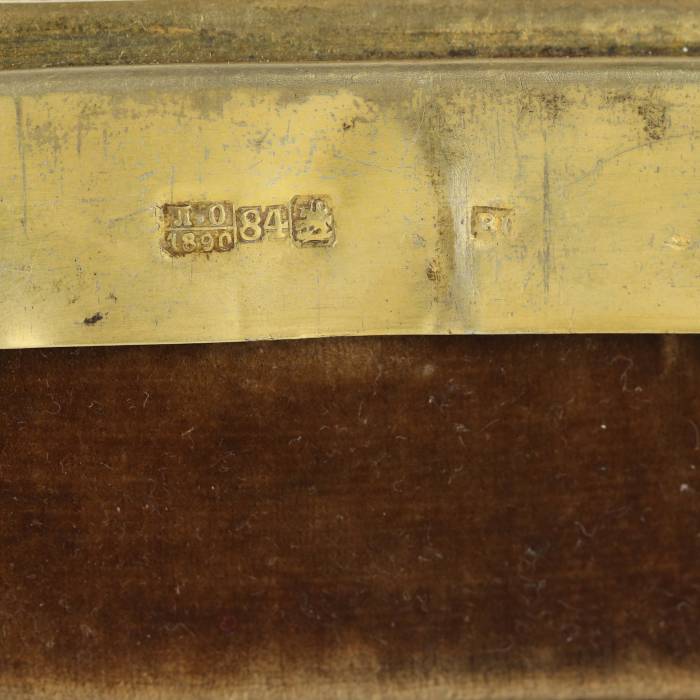
Marks: Maker’s mark “VS” in Cyrillic for Vasily Semyonov; Moscow silver hallmarks of 84 standard; Assay mark with the initials “L.O” beneath a dividing line and the date “1890” for Olex Lev Fyodorovich, assay master of Moscow; State assay mark with the coat of arms of the city of Moscow.
Dimensions: 31 x 27 centimeters.
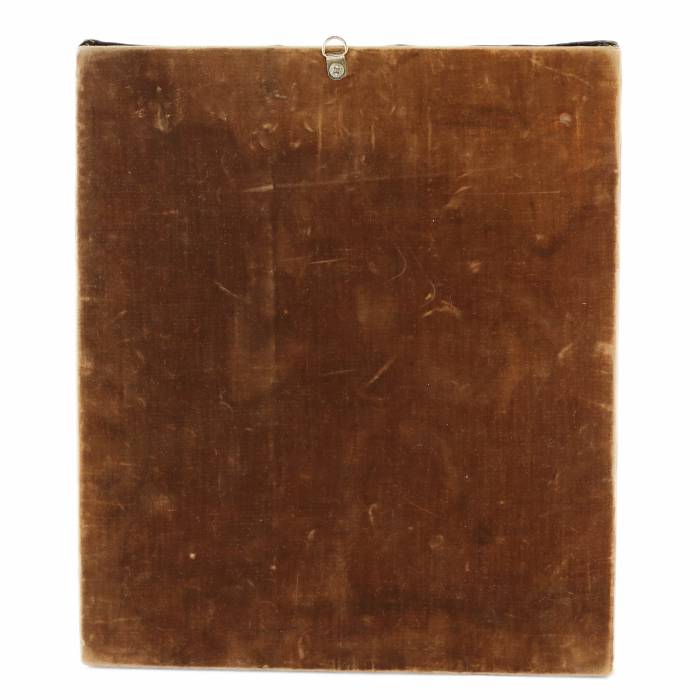
Material: Wood, tempera painting; gilt silver, enamel.
Condition: Good.
Provenance: Private collection.
Material:
Silver 84, Cloisonné enamel, Gilding
The Feodorovskaya Mother of God icon occupies a special place in the history of Russian Orthodoxy and in the dynastic symbolism of the Russian Empire. Since the seventeenth century this image has been venerated as the patron of the House of Romanov and as a symbol of divine protection over the state. In the nineteenth century, amid growing interest in historical forms and national artistic tradition, richly decorated silver mounts became an integral part of both ecclesiastical and domestic devotion, uniting sacred painting and silversmithing craftsmanship.
The factory of Vasily Semyonov, founded in Moscow in 1852, belonged to the stable and significant enterprises of Moscow silver production. By 1873 the factory employed approximately forty craftsmen, and its annual turnover reached considerable sums for that period. The enterprise specialized in the production of table silver, niello works, church utensils, and icon mounts. Production combined traditional hand techniques of repoussé work, engraving, and enameling with an organized factory system of labor, ensuring a high artistic level and consistent quality of execution.
It is known that Vasily Semyonov collaborated with major Moscow silver firms and fulfilled commissions for the firm of Pavel Ovchinnikov, one of the leading producers of artistic silver in the Russian Empire. Such cooperation reflects the characteristic model of workshop interaction within Moscow production, in which individual enterprises carried out specialized stages of work or produced items under contract for prominent houses.
In the second half of the nineteenth century, the Moscow school of silversmiths was distinguished by a clear ornamental structure, deeply modeled repoussé relief, and the use of polychrome enamels as decorative accents. Mounts created at the Semyonov factory demonstrate a balance between the canonical austerity of the ecclesiastical image and the decorative expressiveness of late Historicism. In the early twentieth century, the enterprise continued its activity under the direction of Maria Vasilyevna Semyonova, which testifies to the continuity of the family tradition and the stability of its artistic direction.
The icon and the mount are in good preserved condition. The paint layer is stable, without lifting or losses. The enamels are preserved without significant chips. The silver mount shows no deformation and retains a natural patina consistent with age.
The condition report is provided for informational purposes only.
It is not comprehensive and may not reflect all defects, restorations, alterations, or adaptations, as Antiqon does not perform professional conservation-level assessments. The information is based on a qualified, yet subjective, evaluation by our specialists.Before purchasing, we recommend consultation with an independent expert.Please also consult our Terms and conditions and Glossary A-Z, which contain important information on lot characteristics and sale conditions.