×
Create account and receive
15% DISCOUNT
your first acquisition
or

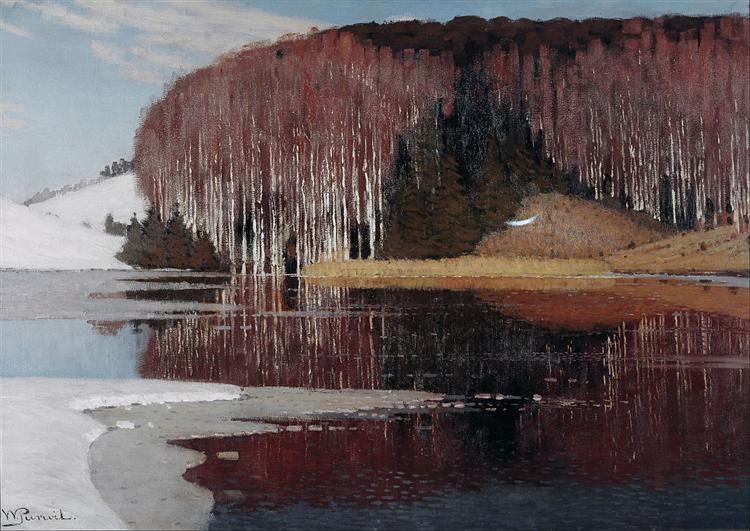
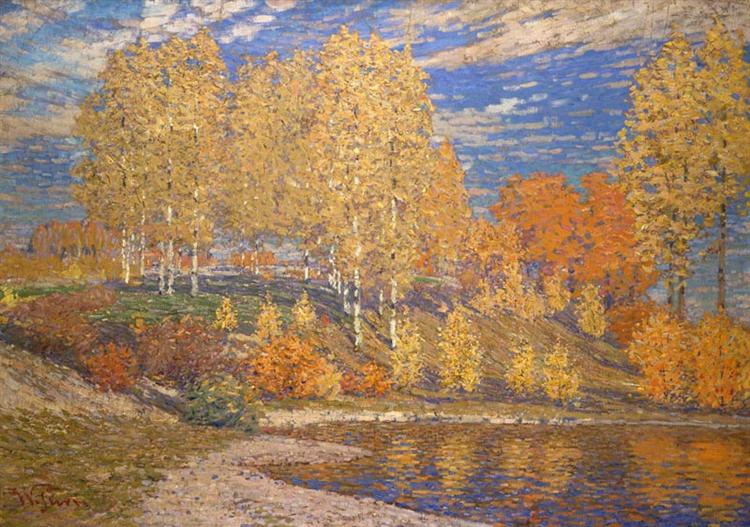
Wilhelm Karlis Purvitis - Latvian painter and educator, one of the founders of the national school of landscape painting in Latvia. A representative of Northern Impressionism and Symbolism at the turn of the 19th and 20th centuries. His winter and early spring landscapes became a visual symbol of Latvian nature and played an important role in shaping the country’s artistic culture.
We will only share latest what our month on the WILHELM KARLIS PURVITIS.
BIOGRAPHY
Wilhelm Karlis Purvitis was born in 1872 in Vidzeme, in present-day Latvia. He received his artistic education at the Imperial Academy of Arts in Saint Petersburg, where he studied in the studio of Arkhip Kuindzhi. The academic tradition and the influence of Kuindzhi played an important role in shaping his artistic vision, based on a careful study of light and atmospheric effects.
During the 1890s the artist actively participated in exhibitions in Russia and Europe. His early landscapes quickly attracted the attention of critics due to their distinctive interpretation of northern nature. After returning to Latvia, Purvitis became a central figure in the country’s artistic life.
In 1919 he was appointed the first director of the Latvian Academy of Arts in Riga and held this position for many years, playing a decisive role in establishing professional art education in Latvia.
CAREER MILESTONES
The early stage of Purvitis’s career is connected with his studies in Saint Petersburg and participation in academic exhibitions of the late nineteenth century. During this period his interest in northern landscapes and complex light conditions of nature was formed.
In the early twentieth century the artist exhibited widely in Riga, Saint Petersburg, Berlin and Munich. His works received international recognition. Landscapes of this period are characterized by a freer painterly manner and a stronger emphasis on the atmosphere of nature.
After the establishment of the Latvian Republic, Purvitis became one of the leading figures of the country’s artistic life. He participated in organizing exhibitions, shaped the academic system of art education and trained a new generation of Latvian artists.
STYLE, TECHNIQUE AND ARTISTIC VISION
Purvitis occupies a distinctive place in the development of Northern European landscape painting of the early twentieth century. His art combines the traditions of the Russian academic school with the influence of Impressionism and a Symbolist interpretation of nature.
The central theme of the artist’s work became the Latvian landscape - spring floods, melting snow, rivers, forests and rural scenery. A particularly important place is occupied by winter and early spring landscapes in which the artist explored the interaction of light, water and snow.
Purvitis’s painting technique is based on a subtle treatment of colour and complex lighting conditions. He used a soft brushwork texture and a restrained palette, creating the impression of moist air and the changing atmosphere of northern nature.
LEGACY AND MASTERPIECES
Works by Wilhelm Karlis Purvitis are held in the collections of major museums in Latvia and Eastern Europe.
Among his best known works are:
“Spring Waters” (circa 1910) - Latvian National Museum of Art, Riga
“Last Snow” (1900s) - Latvian National Museum of Art
“Spring” (1910s) - one of the characteristic examples of his symbolic landscapes
“Early Spring” (1930s)
These works demonstrate the artist’s distinctive interpretation of northern nature and his particular attention to seasonal states of the landscape.