Price:
22500 €
Add to cart
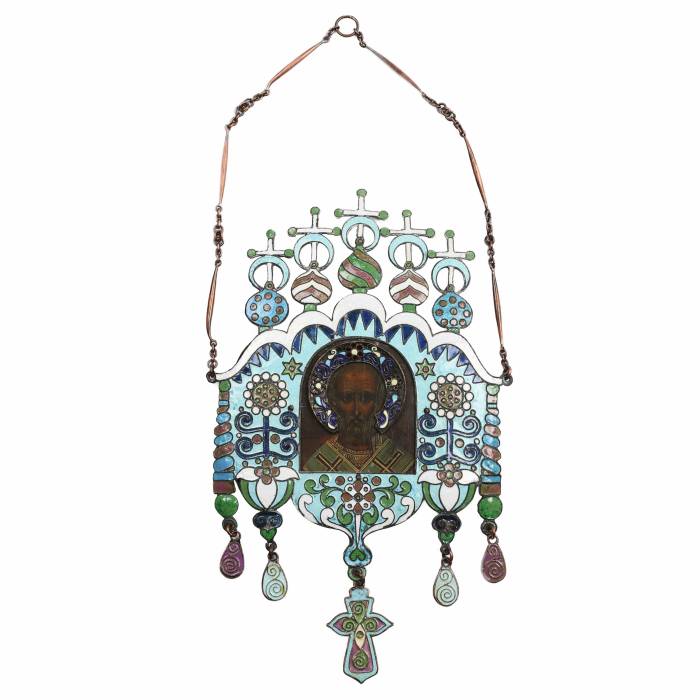
The Imperial Stroganov School of Industrial and Applied Arts was one of the principal educational institutions of the Russian Empire in the field of decorative and applied arts. Founded in Moscow, it played a decisive role in shaping generations of jewellers, enamellers, stone carvers and designers, exerting a lasting influence on leading workshops and factories of the late 19th and early 20th centuries.
We will only share latest what our month on the IMPERIAL STROGANOV SCHOOL OF INDUSTRIAL AND APPLIED ARTS.
HISTORY AND DEVELOPMENT
The school was founded in 1825 by Count Sergei Grigorievich Stroganov as a Drawing School for Arts and Crafts. Initially focused on training skilled craftsmen for applied industries, it gradually evolved into a major centre of industrial art education. In the second half of the 19th century, it was granted Imperial status and became a key institutional force in the modernisation of artistic production within the Russian Empire. In 1901, the curriculum was reorganised into specialised departments devoted to metalwork, enamel, hardstone carving, wood and textiles.
TITLES, AWARDS AND COMMISSIONS
The Imperial status of the school reflected its direct involvement in state and court commissions. Its graduates and professors contributed to the decoration of imperial residences, ecclesiastical interiors and ceremonial objects. Works produced within the educational framework were regularly exhibited at major national and international exhibitions, including Paris, Vienna and Milan, where they received numerous awards and distinctions.
ARTISTIC SPECIFICITY AND TECHNIQUES
The educational model combined academic drawing with intensive practical training in applied techniques. Particular emphasis was placed on metalwork, cloisonné, champlevé and painted enamel, hardstone carving, sculptural miniature and ornamental design. The school fostered a professional environment centred on the synthesis of artistic conception and technical execution, forming the foundation for close collaboration between its graduates and the leading jewellery firms of Moscow and Saint Petersburg.
LEGACY AND MASTERPIECES
Works by graduates of the Stroganov School are held in major museum collections in Russia and Europe. Canonical examples include jewellery and decorative objects created for imperial commissions, as well as teaching models demonstrating a high level of design culture and craftsmanship. The school’s influence is evident in the formation of the Moscow jewellery school and in the development of realist decorative sculpture in the early 20th century.
MARKET ANALYSIS
Exceptional Works: Fully attributed works by Stroganov-trained masters, particularly those connected with imperial commissions or leading artistic workshops, are regarded as museum-level objects and are valued in the range of €200,000-1.2 million. Market demand is confirmed by results achieved at major international auction houses.
Rare Works: Early or educational works associated with prominent graduates demonstrate stable collector interest and are typically valued between €50,000 and €300,000.
Series Works: Decorative objects produced in series after designs by Stroganov graduates occupy the lower market segment, with prices generally ranging from €1,000 to €50,000.