


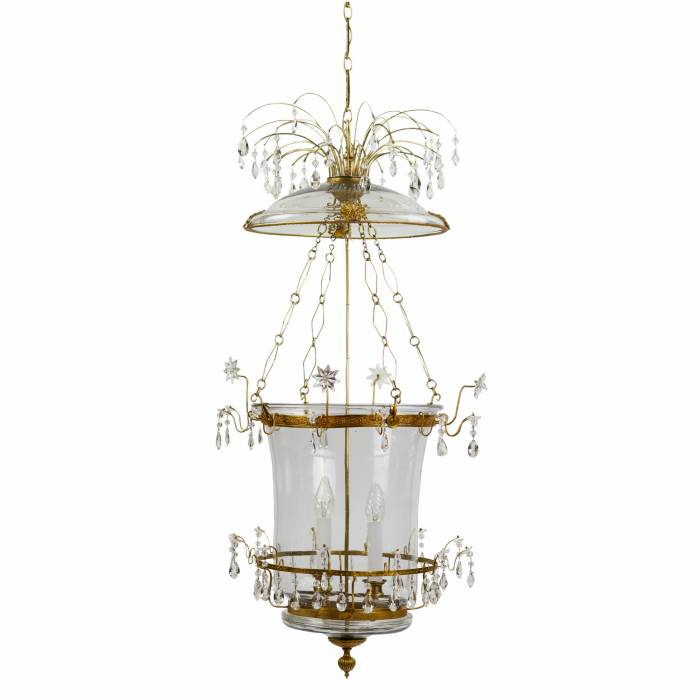
GRANDE LANTERNE SUSPENDUE À DOUBLE LUMIÈRE RUSSIE, DÉBUT DU XIXᵉ SIÈCLE
AntiqonART consultant will contact you within one business day after receiving your request.
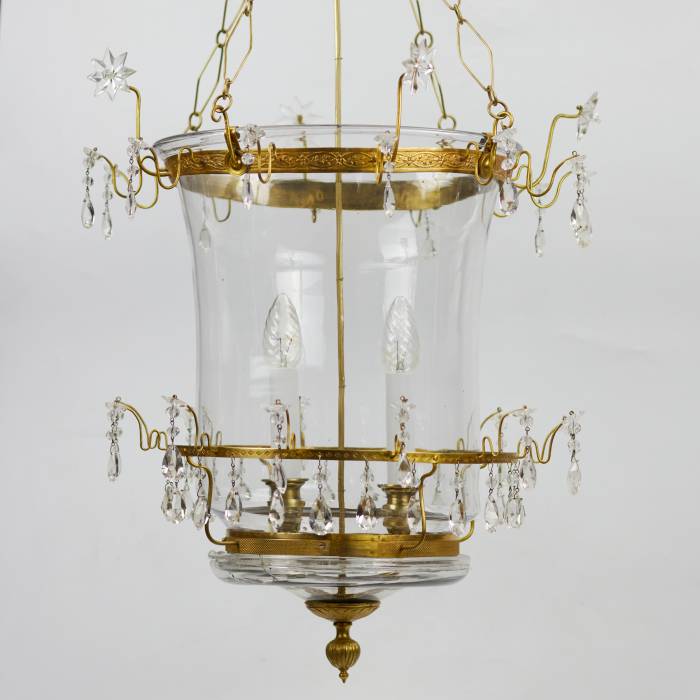
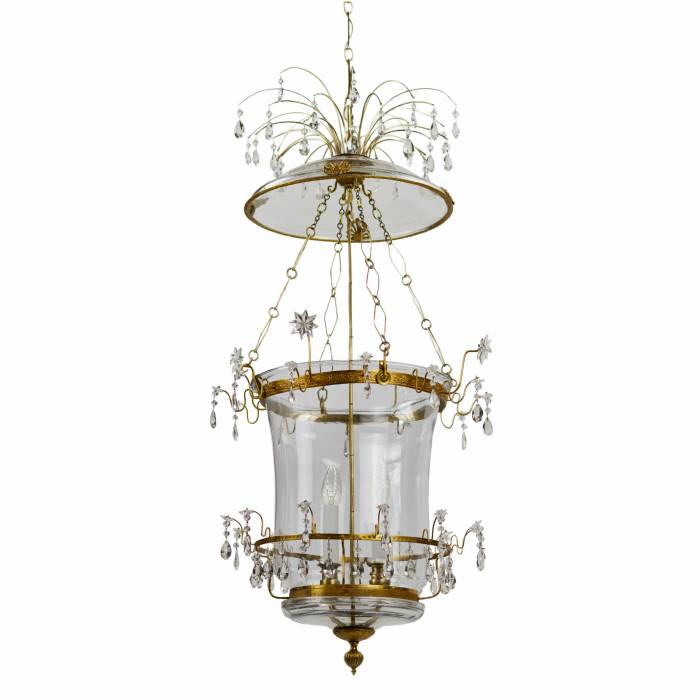
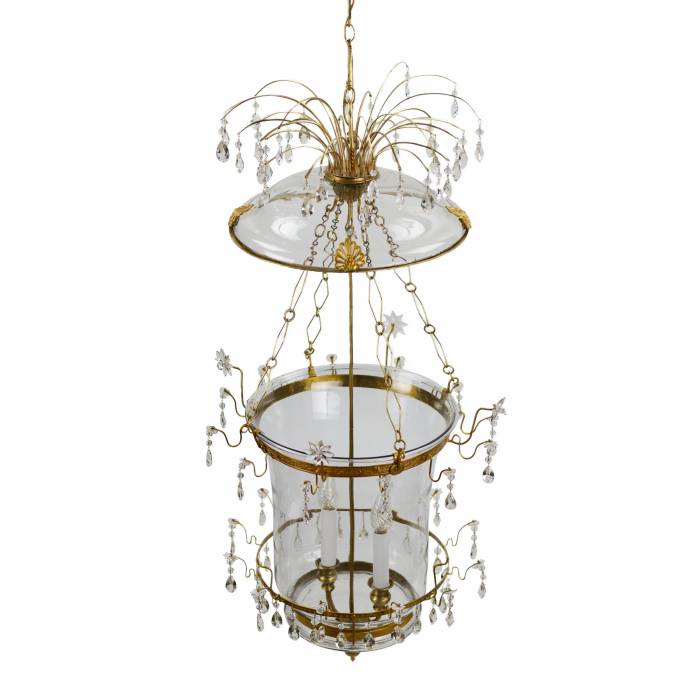
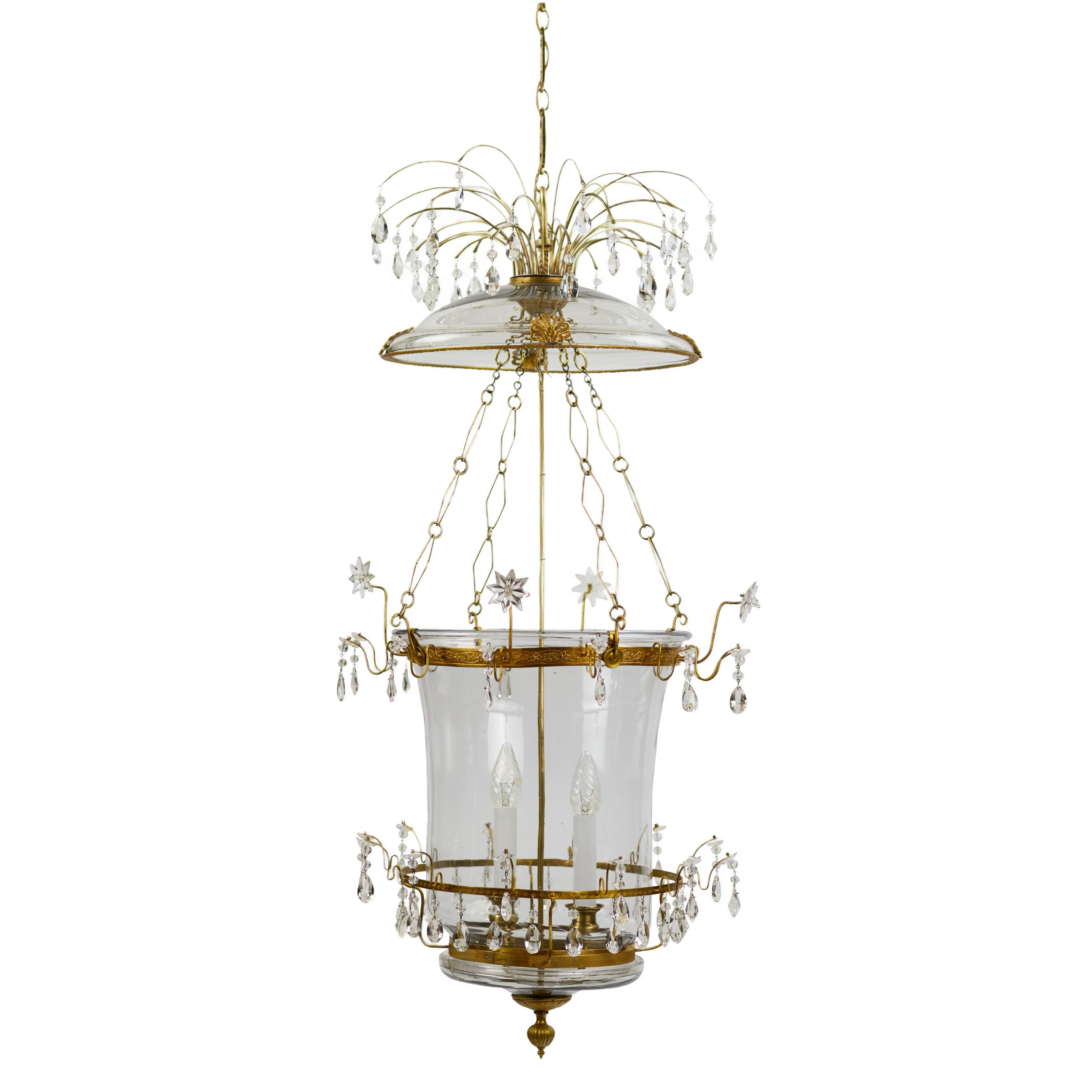
Grande lanterne suspendue russe à double lumière, représentative de l’éclairage d’apparat des intérieurs du début du XIXᵉ siècle. La composition est centrée sur un corps cylindrique en verre transparent incolore, enchâssé dans une monture en bronze doré formant la ceinture décorative principale. Le cylindre en verre est fixé dans un cerclage métallique et suspendu par quatre chaînes à l’élément supérieur, soulignant la verticalité stricte et le caractère monumental de la forme.
La lanterne est équipée de deux douilles en bronze destinées aux bougies, attestant de son usage d’origine à l’époque de l’éclairage à la chandelle. Une tige métallique verticale centrale traverse l’ensemble de la structure, reliant la suspension supérieure à la partie inférieure et assurant stabilité et cohérence visuelle.
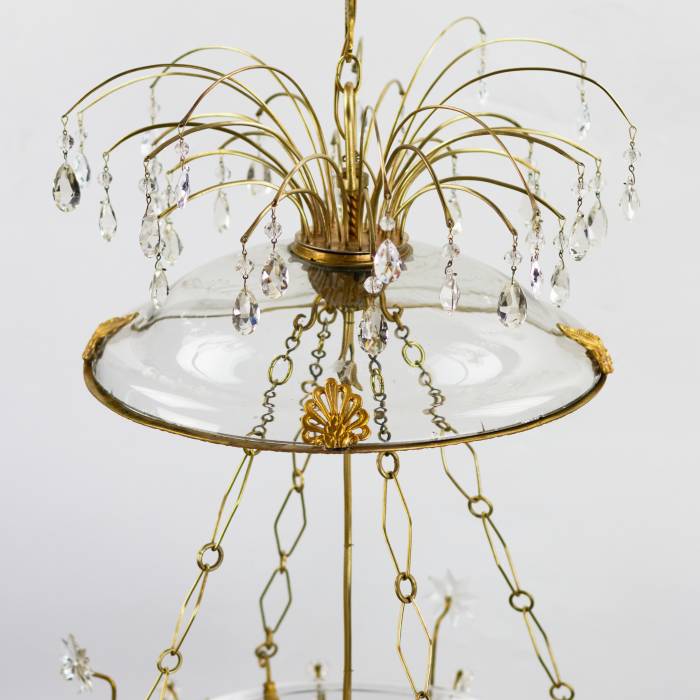
La partie supérieure est surmontée d’un dôme en verre monté dans une armature métallique, terminé par un crochet de suspension au plafond. Autour du dôme se déploient des bras métalliques incurvés ornés de pendeloques en cristal en forme de goutte, produisant un effet scintillant.
Le pourtour est enrichi de bras en bronze décorés de pendeloques en cristal et d’éléments en verre étoilé. Les ceintures décoratives présentent un décor en relief rehaussé de dorure. La partie inférieure est fermée par un fond en verre, centré par un élément circulaire décoratif servant de terminaison à la tige verticale.
L’ensemble associe la rigueur des formes classiques à une richesse décorative raffinée, caractéristique des intérieurs palatiaux et aristocratiques de la première moitié du XIXᵉ siècle.
Matériau: Bronze doré, fonte et forge; verre transparent; cristal.
Dimensions: Hauteur – 90 cm; diamètre – 55 cm.
État: Bon. Traces du temps conformes à l’âge.
Provenance: Russie. Attribuée à la Manufacture impériale de verre.
La Manufacture impériale de verre occupe une place majeure dans l’histoire des arts décoratifs russes et du développement du verre artistique. Fondée au XVIIIᵉ siècle pour répondre aux besoins de la cour impériale, elle devint le principal centre de production de verre et de cristal de haute qualité. Au début du XIXᵉ siècle, durant l’essor du néoclassicisme et de l’esthétique Empire, la manufacture fixa les standards artistiques des intérieurs de cour.
Les lanternes suspendues de ce type étaient largement utilisées dans les galeries, salons de réception et espaces de représentation des palais. Le corps cylindrique en verre protégeait la flamme des bougies tout en diffusant une lumière douce et homogène. Le bronze doré soulignait le prestige de l’intérieur, tandis que les pendeloques en cristal accentuaient les effets lumineux par réflexion et réfraction.
Aujourd’hui, ces lanternes sont considérées comme des exemples rares et précieux de l’art de l’intérieur russe du début du XIXᵉ siècle.
État général bon. Tous les éléments structurels sont conservés. Les parties en verre sont transparentes, avec de légers éclats et microfissures n’altérant ni l’intégrité ni la perception visuelle de l’objet. Les éléments en bronze présentent une patine naturelle d’âge, la dorure est conservée. L’électrification a été réalisée ultérieurement.
The condition report is provided for informational purposes only.
It is not comprehensive and may not reflect all defects, restorations, alterations, or adaptations, as Antiqon does not perform professional conservation-level assessments. The information is based on a qualified, yet subjective, evaluation by our specialists.Before purchasing, we recommend consultation with an independent expert.Please also consult our Terms and conditions and Glossary A-Z, which contain important information on lot characteristics and sale conditions.