


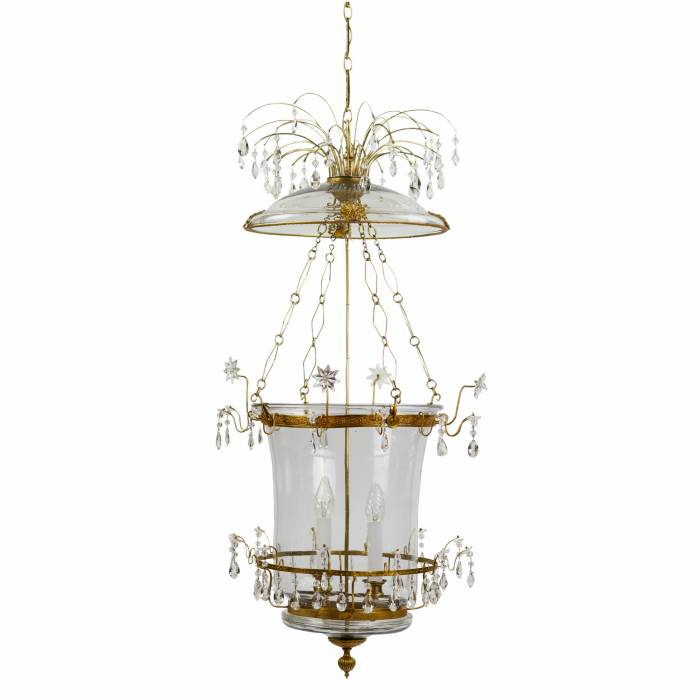
LARGE DOUBLE-LIGHT HANGING LANTERN RUSSIA, EARLY 19TH CENTURY
AntiqonART consultant will contact you within one business day after receiving your request.
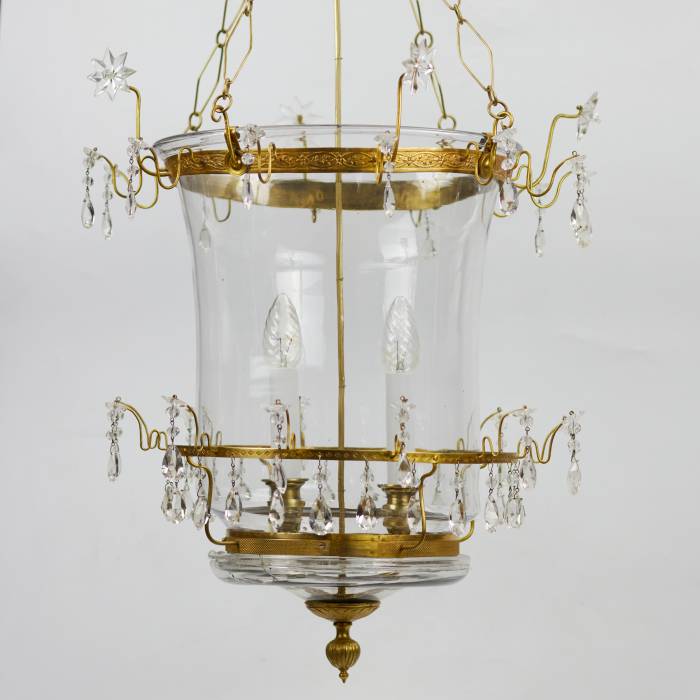
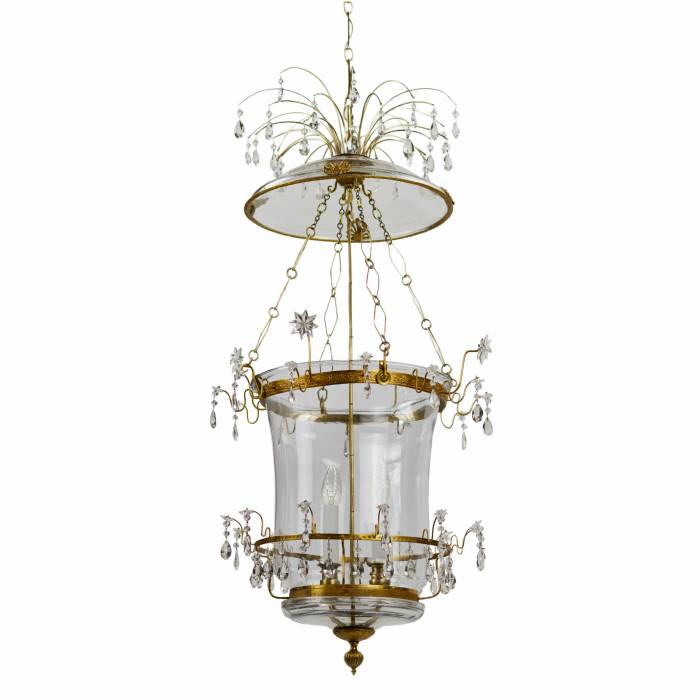
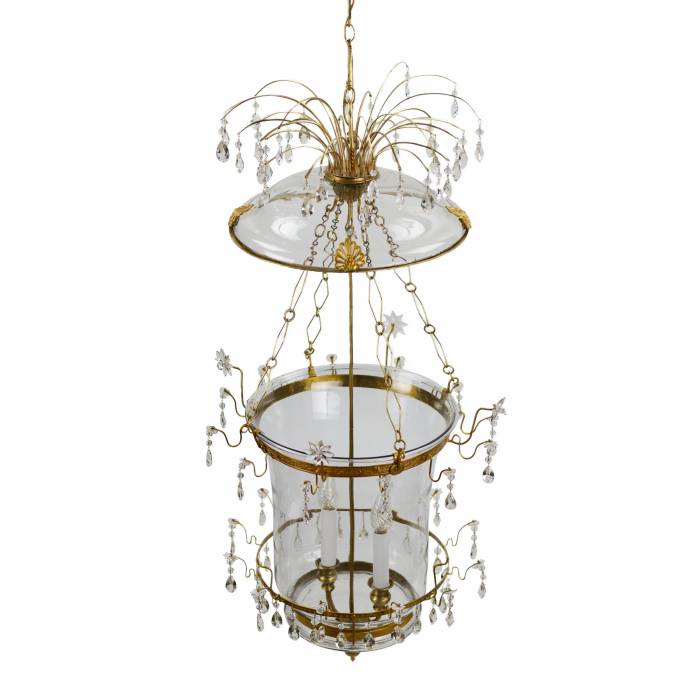
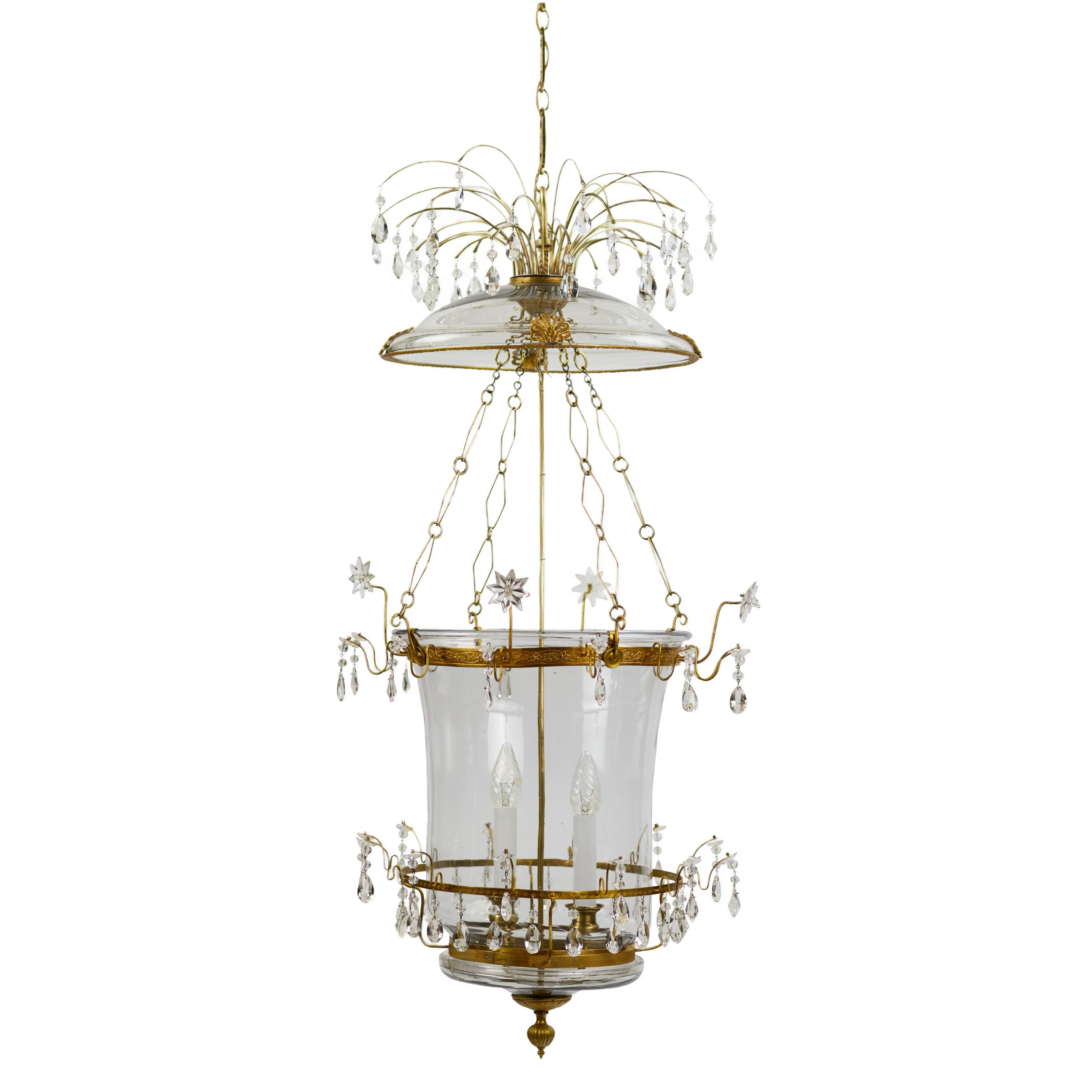
A large Russian double-light hanging lantern, representing a characteristic example of ceremonial interior lighting of the early 19th century. The composition is centered around a cylindrical body of clear transparent glass, enclosed within a gilt bronze framework forming the main decorative belt of the structure. The central glass cylinder is secured within a metal hoop and suspended by four chains from the upper mount, emphasizing the strict vertical orientation and monumental silhouette of the piece.
The lantern is fitted with two bronze candle sockets intended for light sources, indicating its original use during the period of candle illumination. A central vertical metal rod runs through the entire structure, connecting the upper suspension element with the lower section, ensuring structural stability and visual coherence.
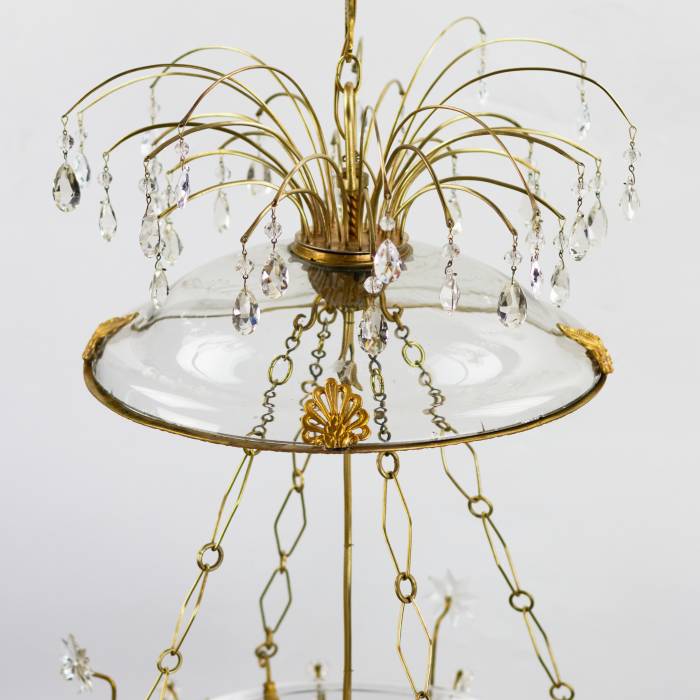
The upper section is crowned with a glass dome set within a metal mount, surmounted by a hook for ceiling suspension. Surrounding the dome are curved metal rays adorned with drop-shaped crystal pendants, creating a shimmering play of light.
Additional bronze arms with crystal pendants and star-shaped glass elements are arranged around the perimeter. Decorative metal belts are enriched with relief ornamentation and gilding. The lower section is completed with a glass base, centrally fitted with a decorative circular element serving as the terminal of the vertical rod.
The overall appearance combines the disciplined clarity of Classical form with refined decorative richness, characteristic of grand palace and aristocratic interiors of the first half of the 19th century.
Material: Gilt bronze, cast and forged; clear transparent glass; crystal glass.
Dimensions: Height – 90 cm; diameter – 55 cm.
Condition: Good. Minor signs of age consistent with period.
Provenance: Russia. Attributed to the Imperial Glass Factory.
The Imperial Glass Factory occupies a central position in the history of Russian decorative arts and the development of artistic glass production. Founded in the 18th century to supply the needs of the Imperial Court, the factory became the leading producer of high-quality glass and crystal objects. In the early 19th century, during the flourishing of Neoclassicism and the emergence of the Empire style, the Imperial Glass Factory set the artistic standards for court interiors.
Hanging lanterns of this type were widely used in ceremonial enfilades, reception halls and representative spaces of palaces and noble residences. The cylindrical glass body protected candle flames from drafts while producing an even, diffused light. Gilt bronze elements emphasized the prestige of the interior, while crystal pendants enhanced the luminous effect through reflection and refraction.
Typical early 19th-century compositional features include strict symmetry, vertical emphasis and balanced proportions. Relief-decorated belts, star-shaped glass details and drop-shaped crystal pendants reflect the aesthetics of late Neoclassicism and early Empire style.
The Imperial Glass Factory collaborated closely with leading bronze foundries, enabling the creation of complex ensembles combining glass, metal and crystal into a unified artistic whole. Such lanterns were often made to individual commissions for specific interiors, accounting for their exceptional quality and refined detailing.
Today, lanterns from the early 19th century are regarded as rare and highly valuable examples of Russian interior art, reflecting the aesthetic ideals of the Alexander I era and the ceremonial culture of the Russian Empire.
Overall condition is good. All structural elements are preserved. The glass components are clear, with minor chips and micro-cracks that do not affect the integrity or visual perception of the piece. Bronze elements display a natural age-related patina, with gilding preserved. Electrification was carried out at a later date.
The condition report is provided for informational purposes only.
It is not comprehensive and may not reflect all defects, restorations, alterations, or adaptations, as Antiqon does not perform professional conservation-level assessments. The information is based on a qualified, yet subjective, evaluation by our specialists.Before purchasing, we recommend consultation with an independent expert.Please also consult our Terms and conditions and Glossary A-Z, which contain important information on lot characteristics and sale conditions.