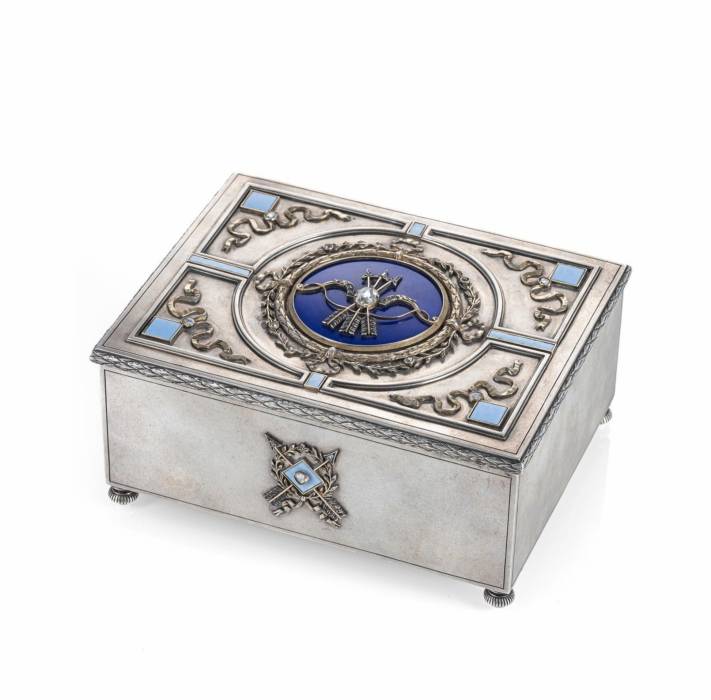
SILVER CASKET WITH ENAMEL AND DIAMONDS, WORKSHOP OF KARL FABERGÉ, MOSCOW, CIRCA 1900 RUSSIA
AntiqonART consultant will contact you within one business day after receiving your request.

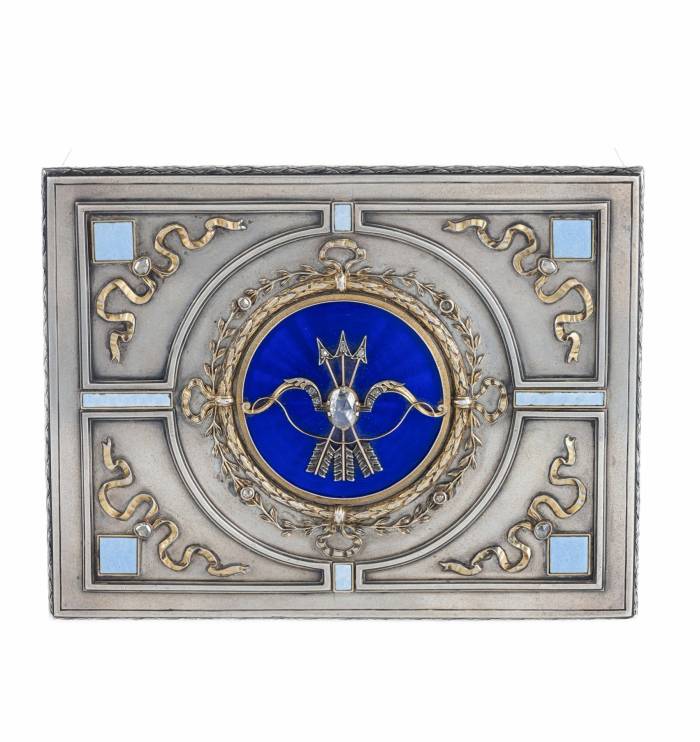
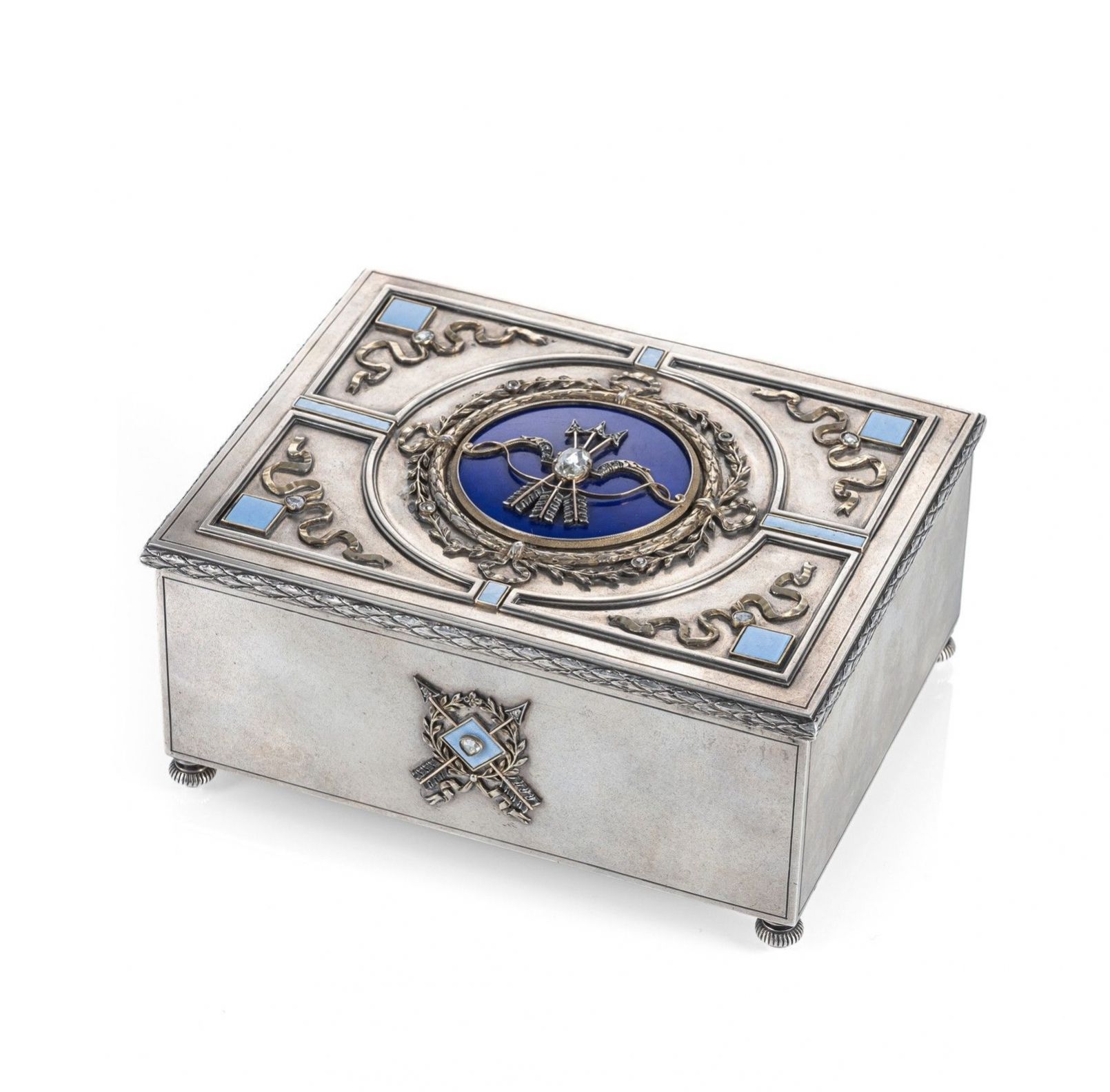
An outstanding creation of decorative art from the Moscow workshop of Karl Fabergé, executed around 1900, this piece represents a rare and refined example of the neoclassical style in Russian jewelry art. The casket demonstrates the distinctive features of the Moscow Fabergé school – strict proportions, architectural clarity, and the exquisite craftsmanship characteristic of pieces produced on private aristocratic commissions.
Made of silver with a gilt interior, the casket is adorned with guilloché enamel, gold ornamental details, and old-cut diamonds. The lid’s composition is centered around a circular medallion of translucent blue enamel on a guilloché ground. At its center lies an oval diamond of approximately 1 carat (10.5 × 7.5 × 4.5 mm), set in a gold bezel and framed by three crossed arrows and a curved bow in gold, embellished with small diamonds. These motifs are enclosed within a laurel wreath tied with golden ribbons, symbolizing valor, honor, and nobility – traditional emblems of the late 19th century.
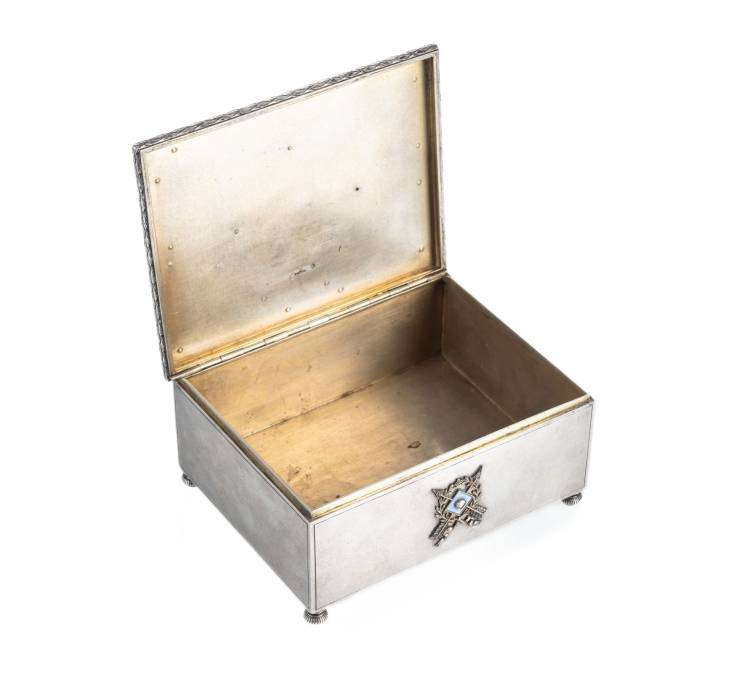
At each corner of the lid, square panels of sky-blue enamel are set with miniature diamonds, bordered by gilt ribbon-like reliefs. The front panel of the body bears a motif of crossed arrows with a diamond rosette at the center. The interior is fully gilded and polished to a mirror finish.
The chromatic harmony – silver, gold, deep blue, sky-blue, and the white brilliance of diamonds – creates a luminous and elegant visual effect characteristic of Fabergé’s finest works.
Materials: Silver (84 zolotniks), gold (56 zolotniks), guilloché enamel in shades of blue, and old-cut diamonds. The central oval diamond weighs approximately 1.0 carat; the surrounding 18 small stones together weigh about 0.65 carat. Total diamond weight ≈ 1.65 carats.
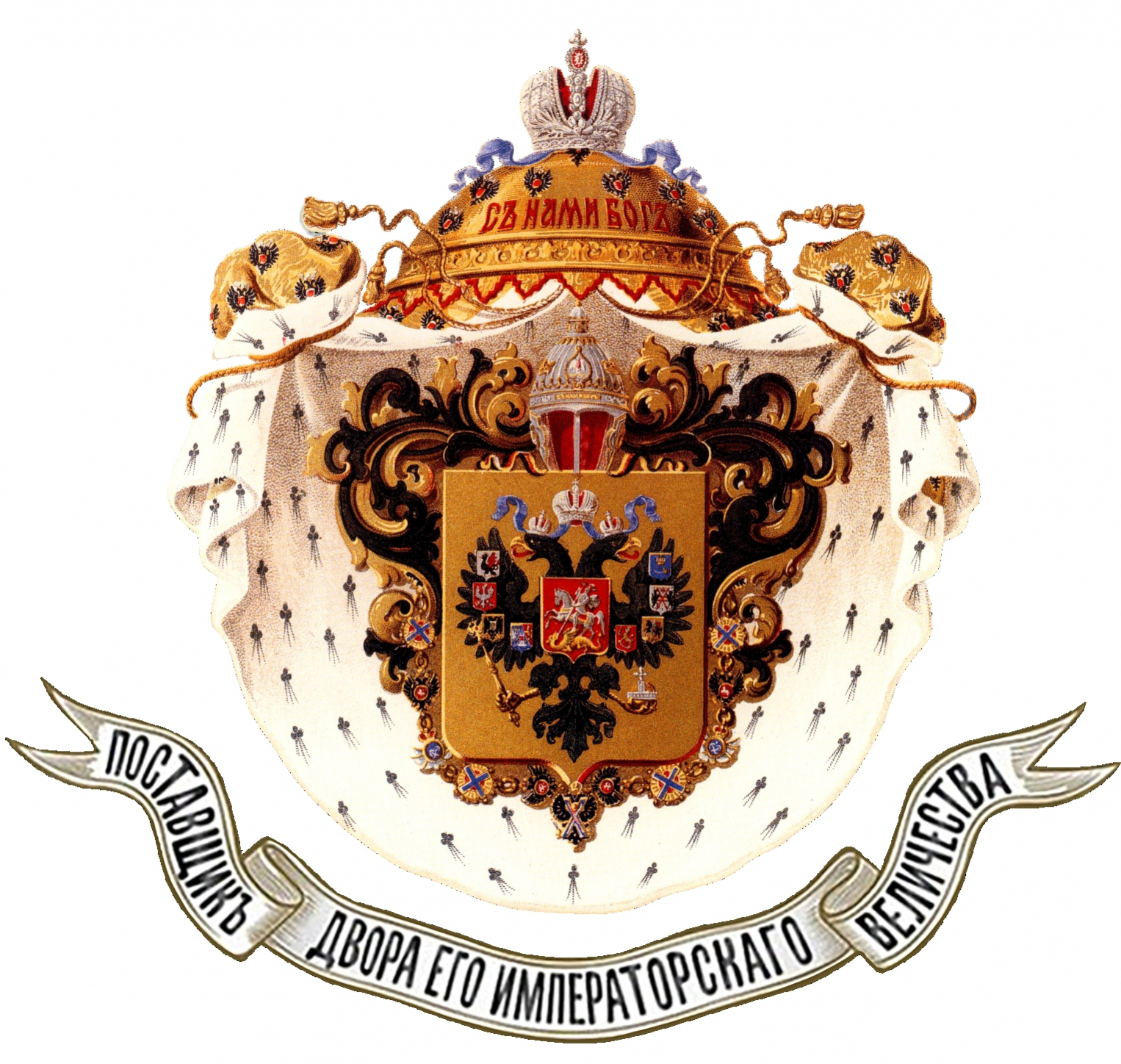
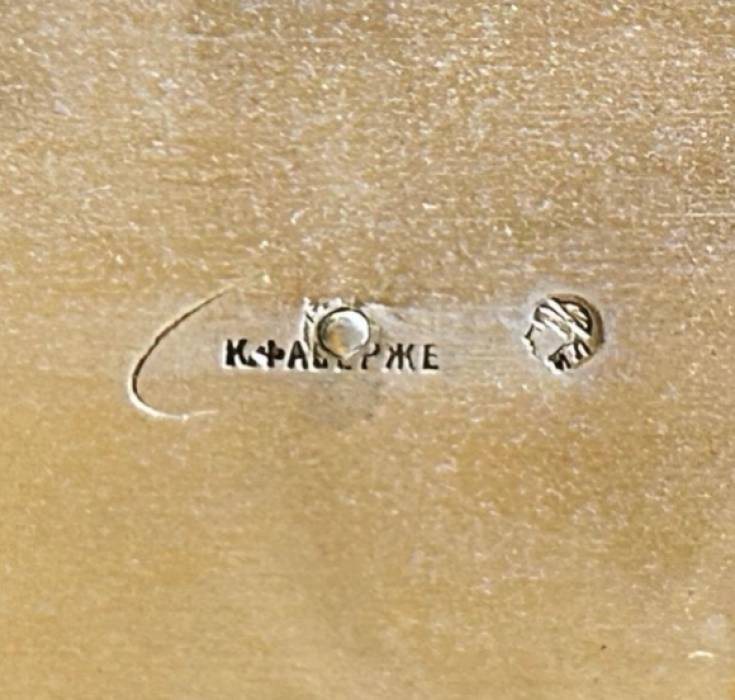
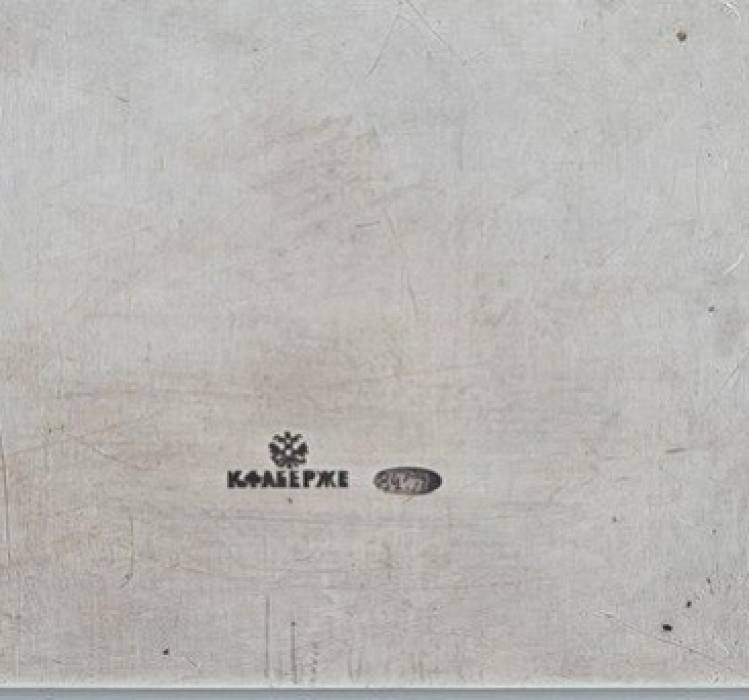
Marks: Full mark of the Imperial Court Supplier “K. FABERGÉ” beneath the double-headed eagle; state assay mark with a woman’s head in a kokoshnik, fineness “84,” and initials “I.L.” (Ivan Lebedkin, Moscow, 1896–1908); additional small mark “ML.” All marks are original, clearly legible, and correspond to the Moscow assay district of the late 19th – early 20th century.
Dimensions: 14.7 × 11.3 x 7,5 cm
Weight: 657 g
Condition: Excellent. Enamel and gilding completely preserved, with no losses or restorations. Minor traces of age do not affect the artistic integrity.
Provenance: Private European collection. Originating from the estate of Biała Cerkiew, formerly owned by Princess Maria Aniela Branicka (née Sapieha-Różańska).
The Moscow branch of Fabergé between 1896 and 1908 cultivated a restrained neoclassical style distinguished by architectural logic of form, cool-toned enamels, and symbolic cartouches. This aesthetic appealed to major landowners and court circles seeking representative yet refined works for private use. The stylized motif of a bow and three arrows within a heart-shaped shield set with a diamond refers to a specific historical and geographical context – the estate of Biała Cerkiew and the palace-park ensemble “Alexandria” near Kiev, the beloved residence of the Branicki family.
The symbolism operates on two levels. Heraldically, the bow and three arrows reproduce the device of the city’s historical coat of arms, approved in 1620 and long associated with the Branicki domain. Mythologically, the motif evokes Cupid’s bow and arrows – a sign of love much favored in the aristocratic culture of the 19th century and frequently featured in the romantic pavilions and sculptures of the Alexandria park.
By the late 19th century, the estate belonged to Princess Maria Aniela Branicka (née Sapieha-Różańska), widow of Count Władysław Michał Branicki, marshal of the nobility of the Vasylkiv district and chamberlain at the Imperial Court. After her husband’s death in 1884, she inherited Biała Cerkiew – approximately 131,000 hectares yielding an annual income of about one million rubles. In addition to residences in Rome and on the French Riviera, “Alexandria” remained the princess’s principal seat and spiritual home. Between 1900 and 1903 the estate underwent extensive modernization and landscaping, and the casket was likely commissioned or presented at that time as a distinguished gift to its owner, purchased through Fabergé’s Moscow store or one of its branches in Kiev or Odessa. The design unites the personal heraldic symbolism of the Branicki family with the metropolitan taste for Fabergé’s disciplined neoclassical elegance.
Family tradition further connects the piece with the 1906 wedding in Rome of Princess Róża Paulina Gabriela Radziwiłł and Prince Ludwik Rudolf Światopełk-Czetwertyński, when the casket likely passed to them as a marriage gift. Later provenance remains partly documented: the prince perished in 1941, and Princess Róża died in 1949. The casket’s remarkable preservation, untouched gilding, and original marks attest to careful inheritance within the family. Comparable Moscow-made Fabergé caskets reside in the Hermitage, the Armoury Chamber, and the Victoria and Albert Museum; their appearance on the market is exceedingly rare, underscoring the significance of this example as a testament to the taste of late-imperial aristocracy and the enduring legacy of the Branicki lineage.
Excellent preservation. Enamels intact, gilding even, marks clear. Minor handling wear on metal surfaces – insignificant and not affecting presentation.
The condition report is provided for informational purposes only.
It is not comprehensive and may not reflect all defects, restorations, alterations, or adaptations, as Antiqon does not perform professional conservation-level assessments. The information is based on a qualified, yet subjective, evaluation by our specialists.Before purchasing, we recommend consultation with an independent expert.Please also consult our Terms and conditions and Glossary A-Z, which contain important information on lot characteristics and sale conditions.