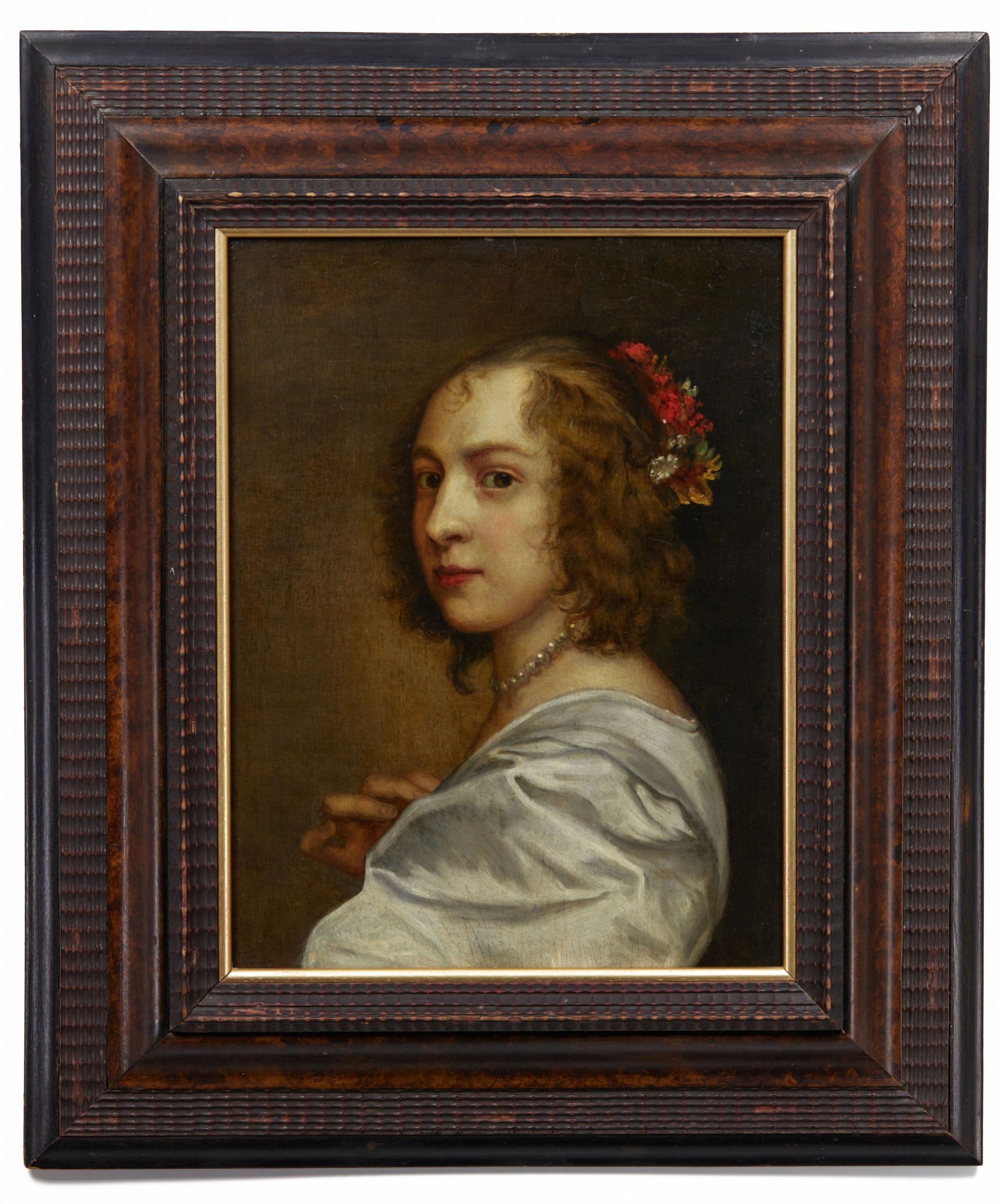
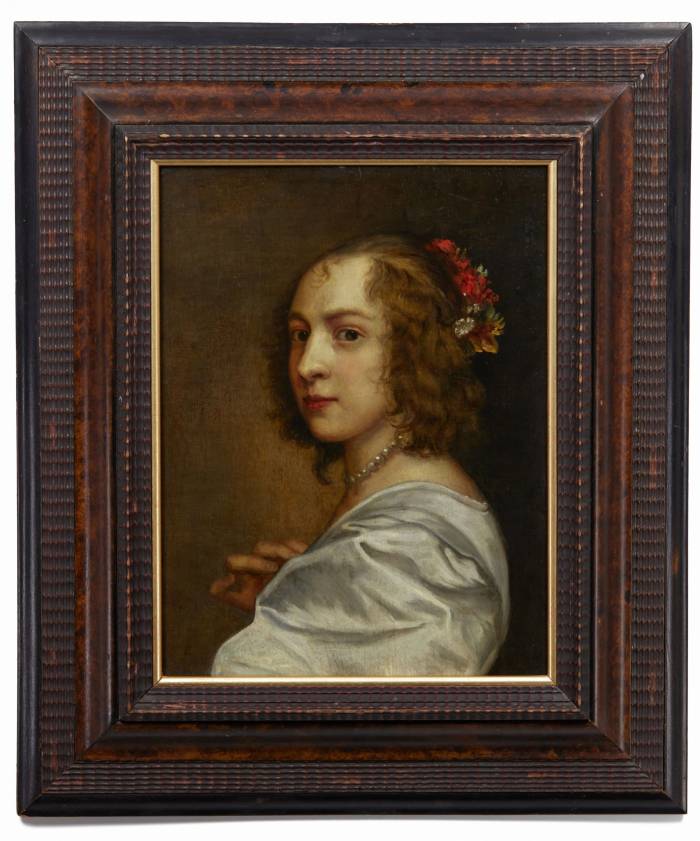
PORTRAIT OF MARGARET LEMON. WORKSHOP OF ANTHONY VAN DYCK. ENGLAND, CIRCA 1635-1640
AntiqonART consultant will contact you within one business day after receiving your request.
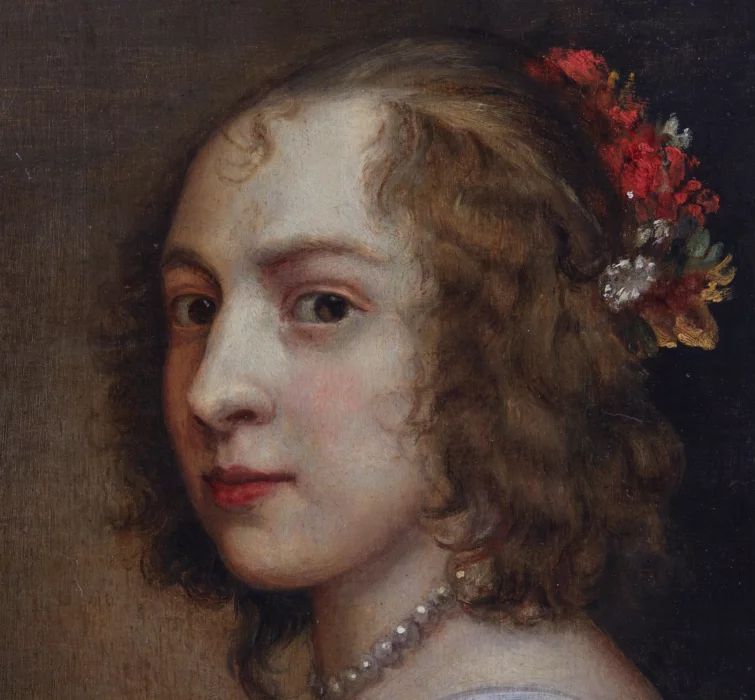
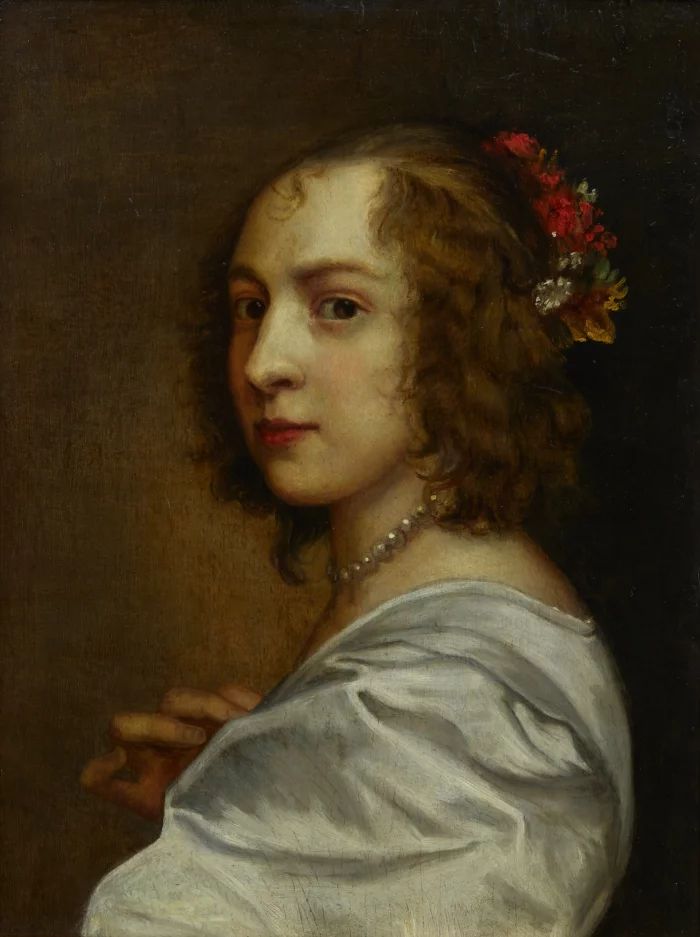
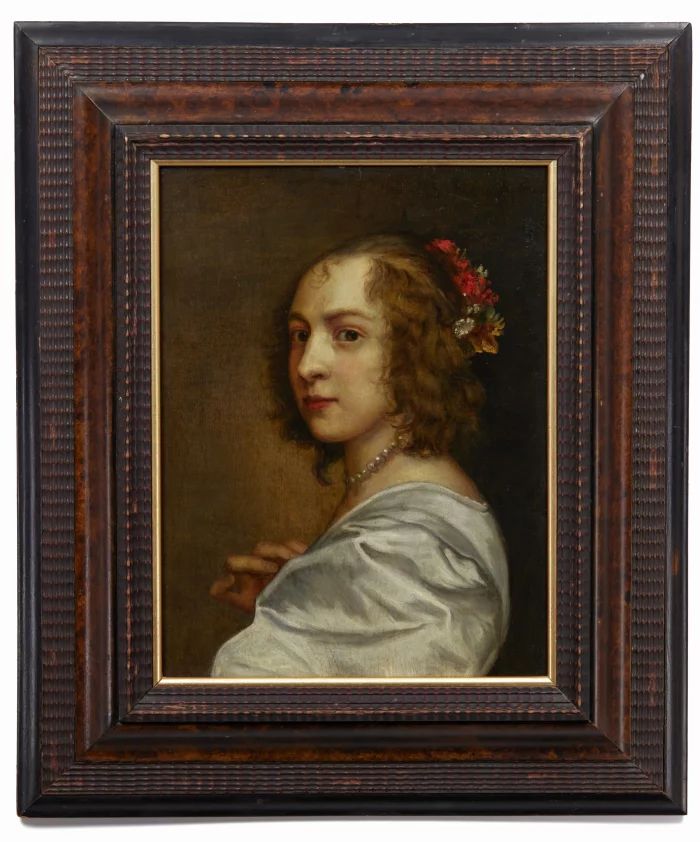
A half-length portrait of a young woman, traditionally identified as Margaret Lemon, the beloved of the Flemish painter Anthony van Dyck, executed in his London workshop circa 1635-1640. The sitter is depicted in a three-quarter turn, almost in profile, yet directing her gaze straight toward the viewer. Her hand with slender fingers is pressed to her chest, while her face is illuminated by a soft light that emphasizes the velvety texture of her skin, the rosy tones of her cheeks, and the delicate curve of her lips.
Flowers in her hair and a pearl necklace form a symbolic chain representing purity, fleeting beauty, and an awareness of the transience of life. The composition is immersed in a mysterious shimmering background that intensifies the psychological depth of the image and introduces a sense of sacred presence. The gesture of the hand, as an inward indication of the soul, transforms this portrait into a meditation on mortality and dignity. The light drapery, almost sculptural in its plasticity, creates an atmosphere of lightness and inner stillness.
The painting demonstrates refined technique: smooth and transparent layering of paint, the nacreous luster of the pearls, and the gentle modeling of volumes. All these features are characteristic of studio works created under the direct supervision of Van Dyck. The portrait possesses all the qualities of a work of high circle: accomplished technique, subtle iconography, and a rare emotional register.
Expertise: The work is accompanied by authoritative attribution and expert opinions, and has parallels with compositions recorded in the catalogue raisonné of Van Dyck by Susan J. Barnes, catalogue number IV 156.
Dimensions: Framed 60 × 50 centimeters, unframed 40 × 30 centimeters
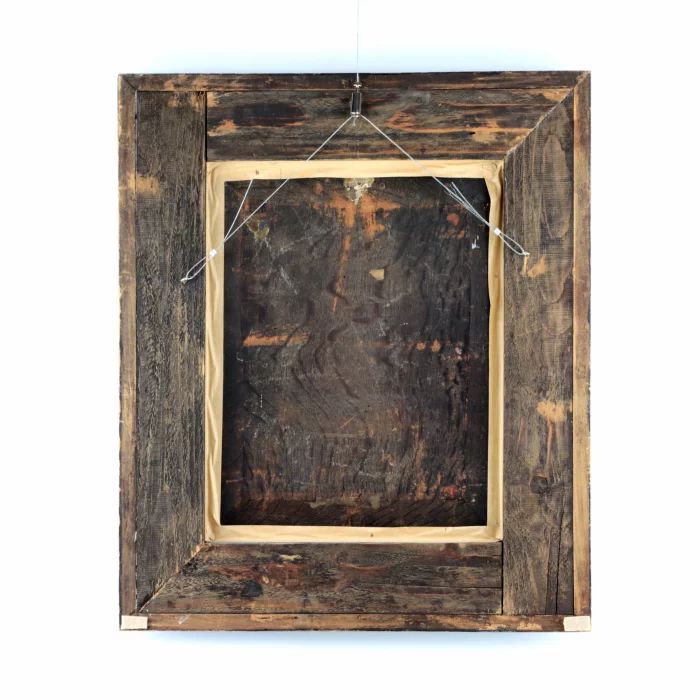
Material: Oil on oak panel
Provenance: Private collection, Europe
Anthony van Dyck, born in 1599 in Antwerp and deceased in 1641 in London, was one of the most influential portrait painters of the Baroque period. A pupil of Peter Paul Rubens, he early developed his own artistic language, striving not for decorative grandeur but for the revelation of human individuality. After travels in Italy and the Netherlands, in 1632 Van Dyck received an invitation to the court of King Charles the First of England, where he became court painter and was knighted. His English period marked the summit of his portrait art.
It was in London that he met Margaret Lemon, a young Englishwoman who became his beloved and muse. She entered his life not only as a companion but also as a principal model. Van Dyck painted several portraits of her, ranging from intimate representations to compositions of mythological or allegorical character. All of them are united by a sincere interest in her inner world. She appears not as a court lady but as a living woman, proud, sensual, slightly ironic, and open.
The portrait presented here is distinguished by particular lyricism and symbolism. It belongs to that group of works in which painting becomes a language of the soul. There is no courtly pomp; instead there is presence, the gaze, the necklace, the flowers, and the hand seemingly suspended in a moment of eternity. All this renders the portrait universal in interpretation. It may be read as an image of Love, Memory, or Fading Youth. Such imagery brings it close to the tradition of vanitas and at the same time to new, more intimate forms of seventeenth century portrait painting.
Beyond its aesthetic and emotional qualities, the context of the workshop is also important. Such works were often created in collaboration with pupils and under the supervision of the master, which in no way diminishes their artistic value. In this case we are dealing with a work from the circle of Van Dyck, clearly embedded in the aesthetics and iconography of his English period.
Expert Opinion
The expertise is provided in the form of a handwritten letter by the distinguished art historian Doctor Max J. Friedländer, born in 1867 and deceased in 1958, Director of the Picture Gallery in Berlin and one of the foremost specialists in Old Master painting. In his text he states that before him stands a spiritually conceived, expressive, and sensitive work related to the finest creations of Anthony van Dyck’s English period.
A second opinion is presented in the form of a letter by Doctor Jan Kosten, curator at the Netherlands Institute for Art History in The Hague, dated 12 February 2009. He confirms that the portrait, in composition and emotional treatment, is close to known images of Margaret Lemon and was probably created in Van Dyck’s workshop. Doctor Kosten emphasizes that certain details of the hairstyle and costume may have been supplemented at a later date, yet the foundation and painterly execution correspond to the attribution as a studio work from the circle of the master. He also notes the high artistic value and emotional expressiveness of the painting.
The painting is correlated with the composition recorded under catalogue number IV 156 in Susan J. Barnes, “Van Dyck: A Complete Catalogue of the Paintings,” one of the most authoritative sources on the artist’s oeuvre.
Oil on oak panel in good condition. Minor natural craquelure and slight varnish toning consistent with age. No visible signs of restoration. Structure and surface well preserved.This condition report is provided for information purposes only.It is not a comprehensive report and may not reflect all imperfections, restorations, or alterations. Antiqon does not perform professional conservation-grade evaluations. The information is based on the qualified, yet subjective, assessment of our specialists.We recommend consultation with an independent expert before making a purchase decision.Please also consult the Auction Rules and Glossary, which contain important information about the characteristics and terms of sale for presented lots.
The condition report is provided for informational purposes only.
It is not comprehensive and may not reflect all defects, restorations, alterations, or adaptations, as Antiqon does not perform professional conservation-level assessments. The information is based on a qualified, yet subjective, evaluation by our specialists.Before purchasing, we recommend consultation with an independent expert.Please also consult our Terms and conditions and Glossary A-Z, which contain important information on lot characteristics and sale conditions.