PORCELAIN INKWELL “LISETTE” FRANCE, JACOB PETIT MANUFACTORY, CIRCA 1840
AntiqonART consultant will contact you within one business day after receiving your request.
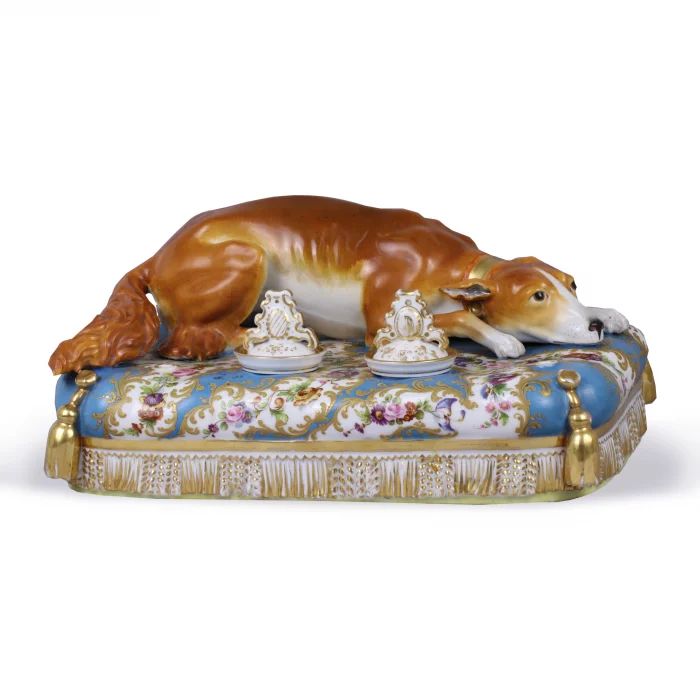
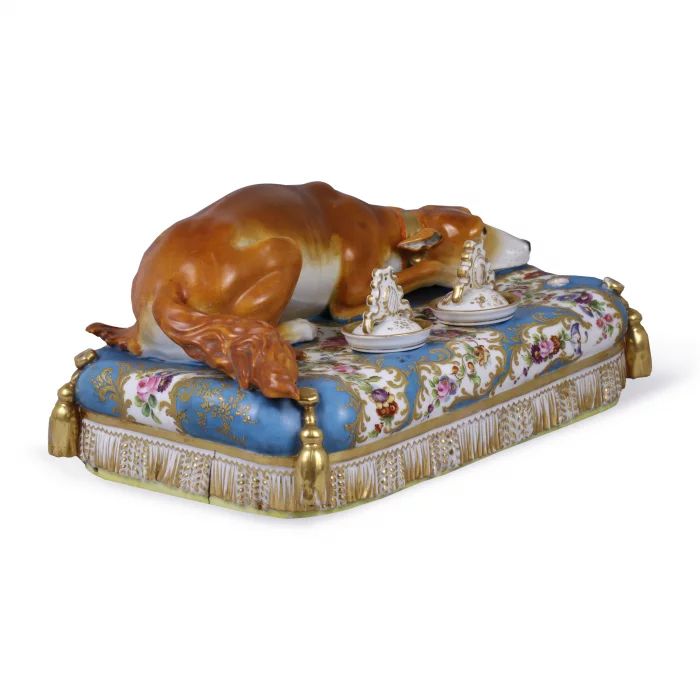
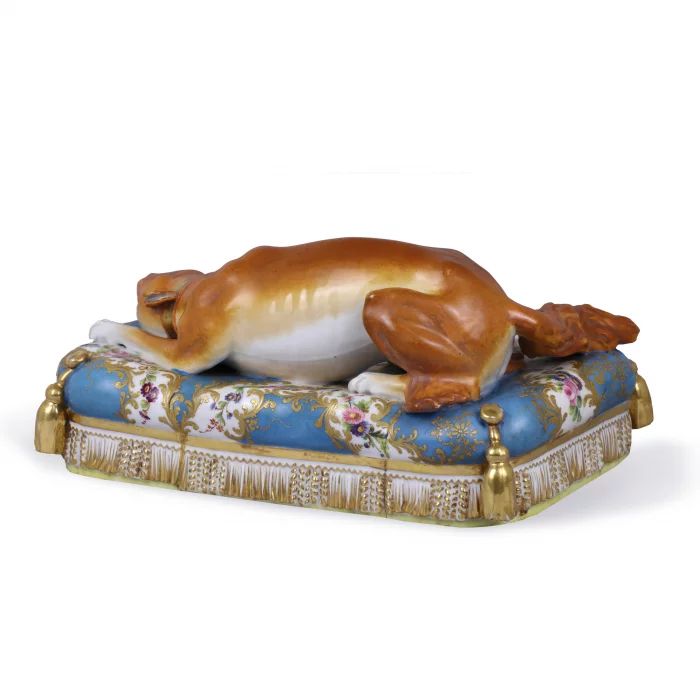
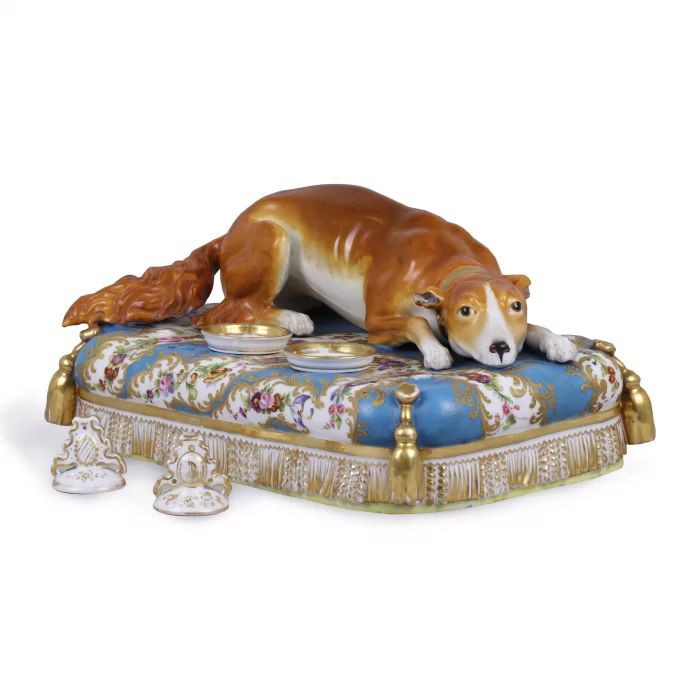
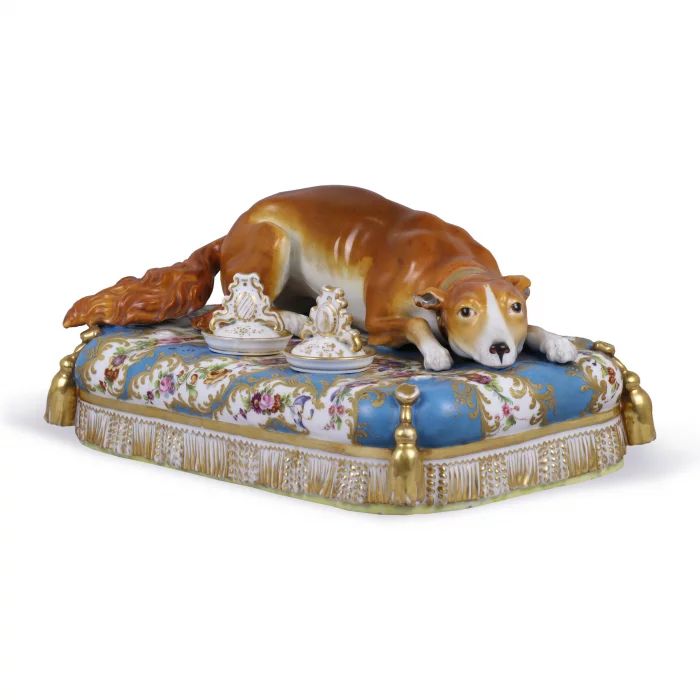
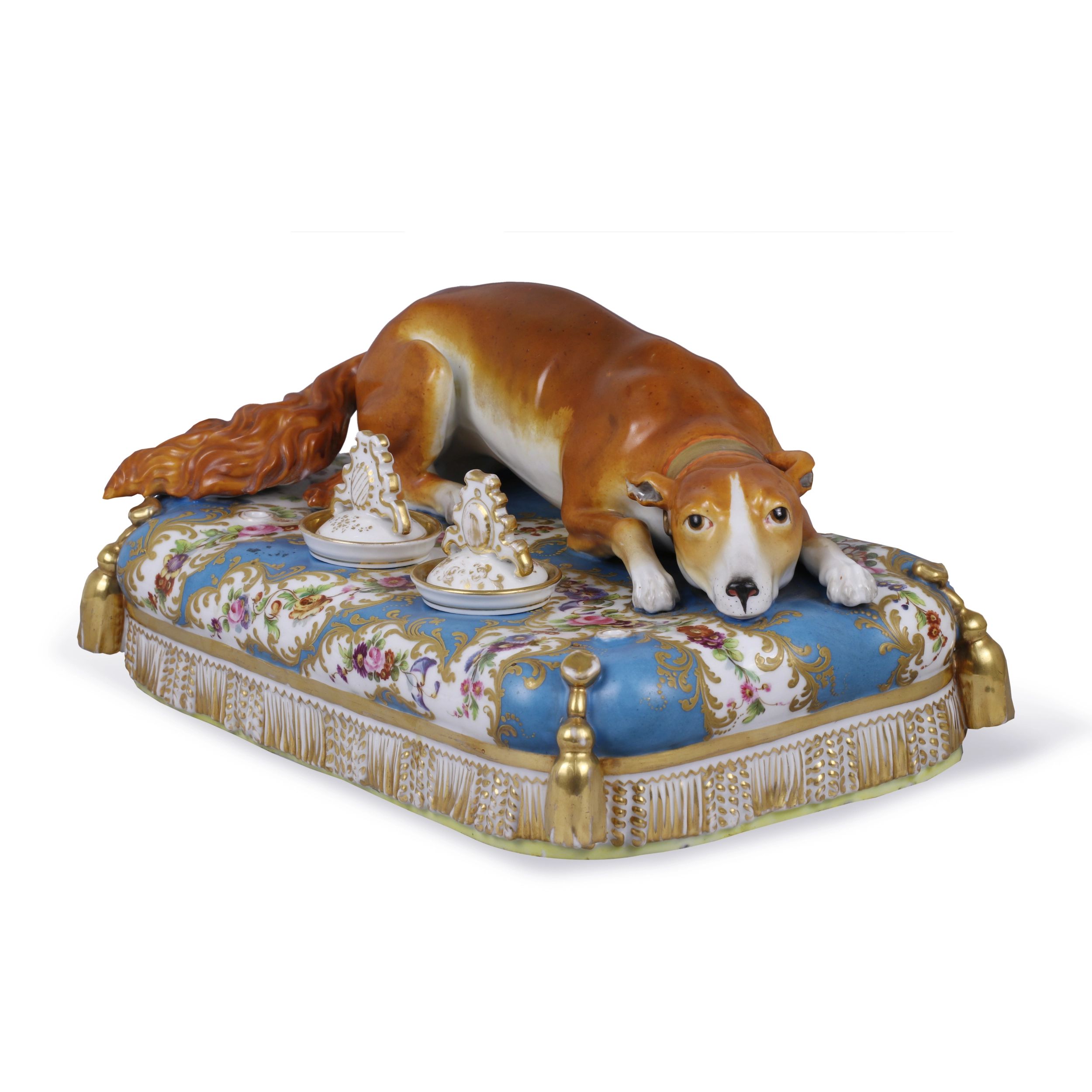
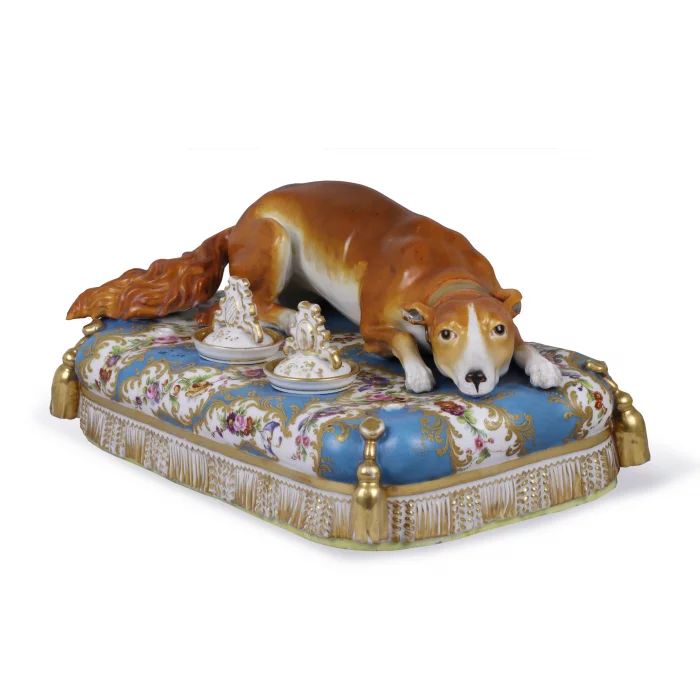
An exceptionally rare porcelain inkwell depicting Lisette, the beloved Italian greyhound of Empress Catherine II, reclining on a luxurious silk-effect cushion. The figure is rendered with remarkable lifelike accuracy, capturing the dog’s relaxed pose and expressive gaze. The cushion is richly decorated with hand-painted floral bouquets, gilded scrolls, and voluminous fringe with gilded tassels at the corners. Two removable porcelain inkwells are integrated into the surface of the cushion as part of the composition.
The original model was created in 1766 by Johann Joachim Kändler at the Meissen manufactory on personal commission from Catherine II, who had sent a drawing of her dog to Saxony. Kändler noted in his report:
“Modeled a large dog from a drawing sent from Moscow… The pillow, 21 inches long, embroidered with gold and decorated with tassels on all four corners.”
The French version, produced in the Jacob Petit workshop in the late 1830s – early 1840s, stands out for its rich palette, vivid painting, and theatrical flair, characteristic of Parisian Romanticism.
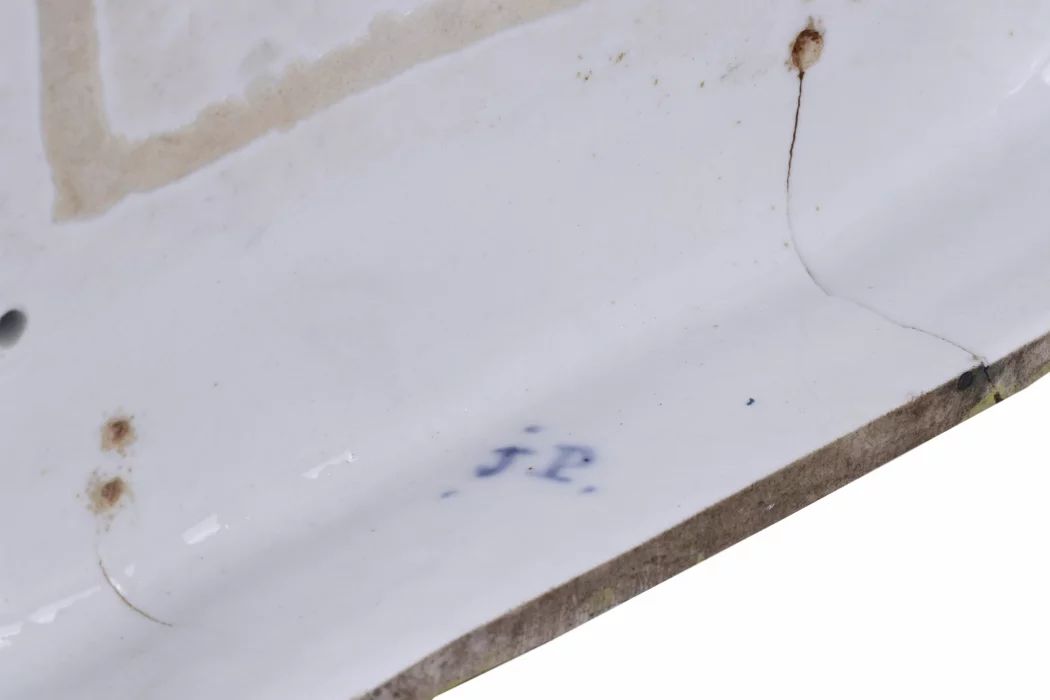
Marks: Underglaze blue monogram “JP” – mark of the Jacob Petit porcelain manufactory, France, circa 1840.
Dimensions: Height: 17 cm; Width: 36 cm; Depth: 22 cm
Material: Polychrome porcelain, hand-painted, gilded.
Condition: In good collector’s condition. Minor signs of age to the base.
Provenance: Sotheby’s Auction, 2002
The porcelain model of Lisette is among the most touching and personalized works of 18th-century decorative art, created at the intersection of imperial sentiment and European craftsmanship. It was first commissioned by Empress Catherine II from the Meissen manufactory, Europe’s leading porcelain producer, known for the work of sculptors Johann Joachim Kändler and Friedrich Elias Meyer. Catherine sent a drawing of her favorite greyhound, Lisette, to Saxony, asking that her likeness be immortalized in porcelain. Kändler, Meissen’s chief sculptor, created a realistic figure of the dog resting on an elaborately embroidered cushion, into which inkwells were ingeniously built – combining functionality and symbolic meaning.
This form expressed not only the Empress’s personal affection but also elevated the pet to the status of a cultural icon of Enlightenment taste. The model quickly gained popularity, reproduced in various formats and featured on objects such as snuffboxes. One notable example by Johann Scharff is held in the Hermitage Museum.
In France, the motif was reimagined in the 1830s–1840s by the Jacob Petit manufactory, renowned for its eclectic Rococo revival style and vibrant ornamentation. Petit interpreted the Lisette figure with special finesse – rich colors, theatrical staging, and decorative exuberance infused the model with Parisian Romantic elegance.
Jacob Petit, one of the most prominent French porcelain makers of the 19th century, created iconic objects now housed in the Louvre, the Musée des Arts Décoratifs in Paris, and The Metropolitan Museum of Art in New York. His version of the “Lisette” inkwell combines German Rococo influences with the decorative refinement of the Louis-Philippe period, making it a masterpiece of both historical and artistic significance.
In good collector’s condition. Minor signs of age to the base.
The condition report is provided for informational purposes only.
It is not comprehensive and may not reflect all defects, restorations, alterations, or adaptations, as Antiqon does not perform professional conservation-level assessments. The information is based on a qualified, yet subjective, evaluation by our specialists.Before purchasing, we recommend consultation with an independent expert.Please also consult our Terms and conditions and Glossary A-Z, which contain important information on lot characteristics and sale conditions.