CEREMONIAL PRESENTATION SWORD RUSSIAN EMPIRE, FIRST HALF OF THE 19TH CENTURY
AntiqonART consultant will contact you within one business day after receiving your request.
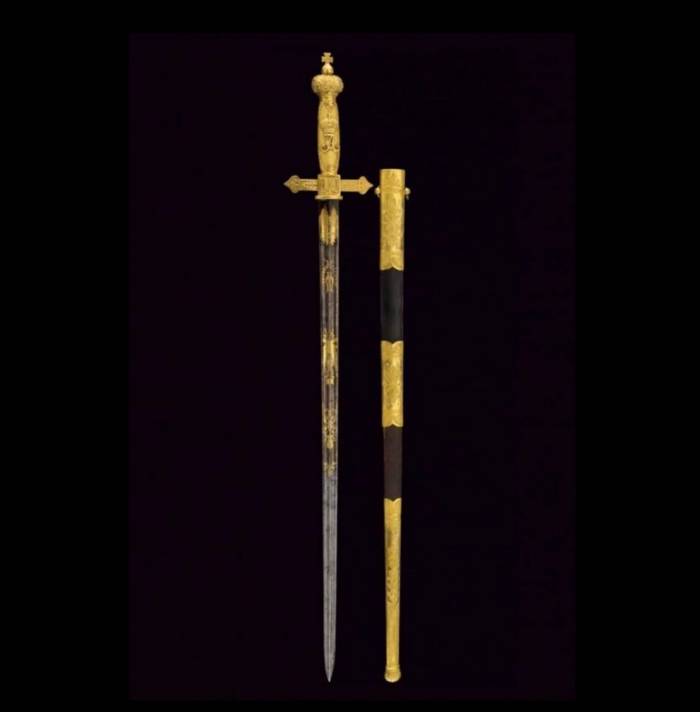
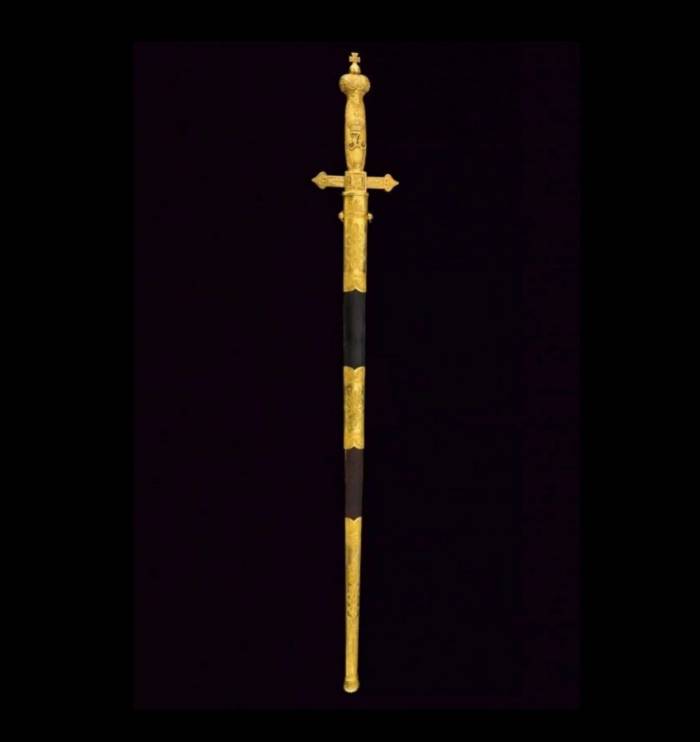
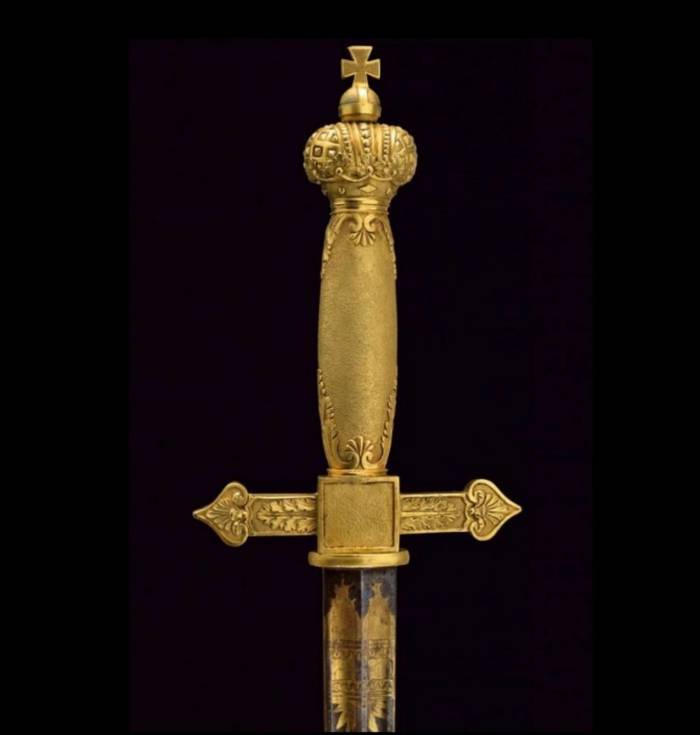
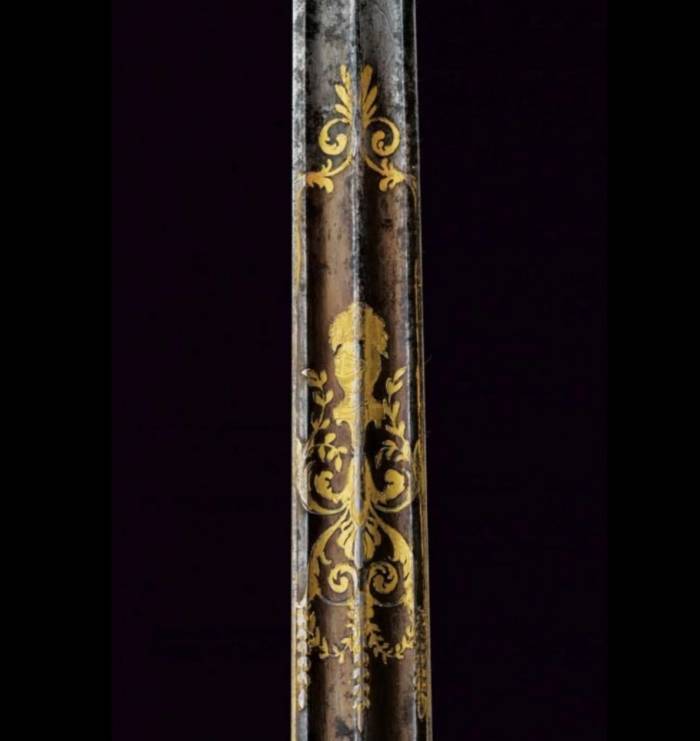
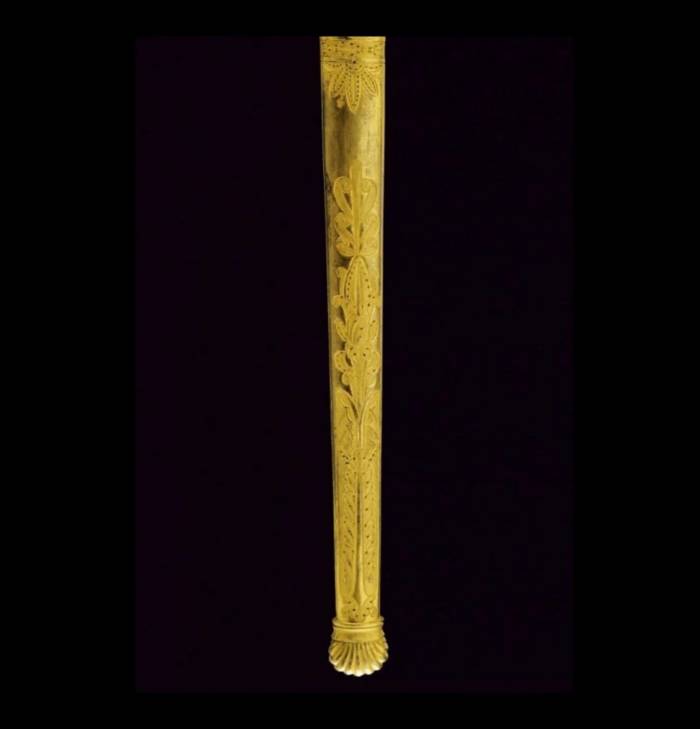
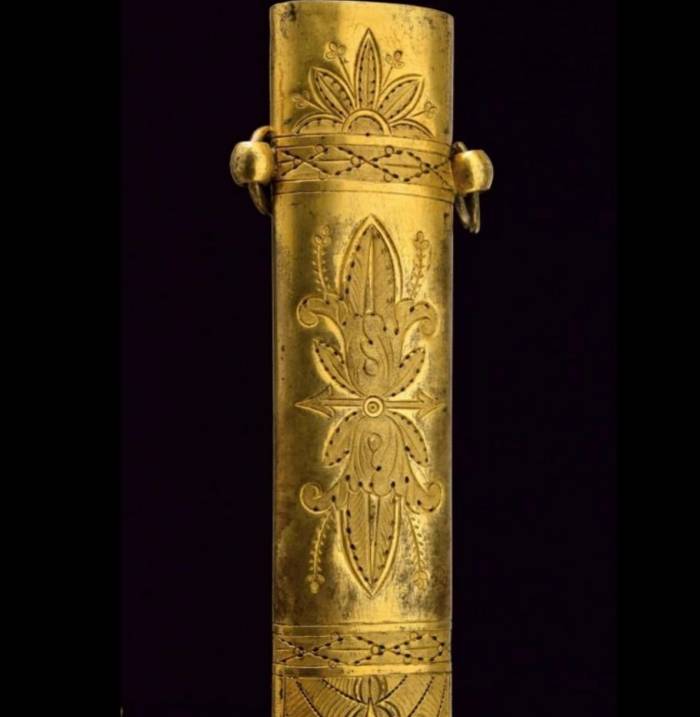
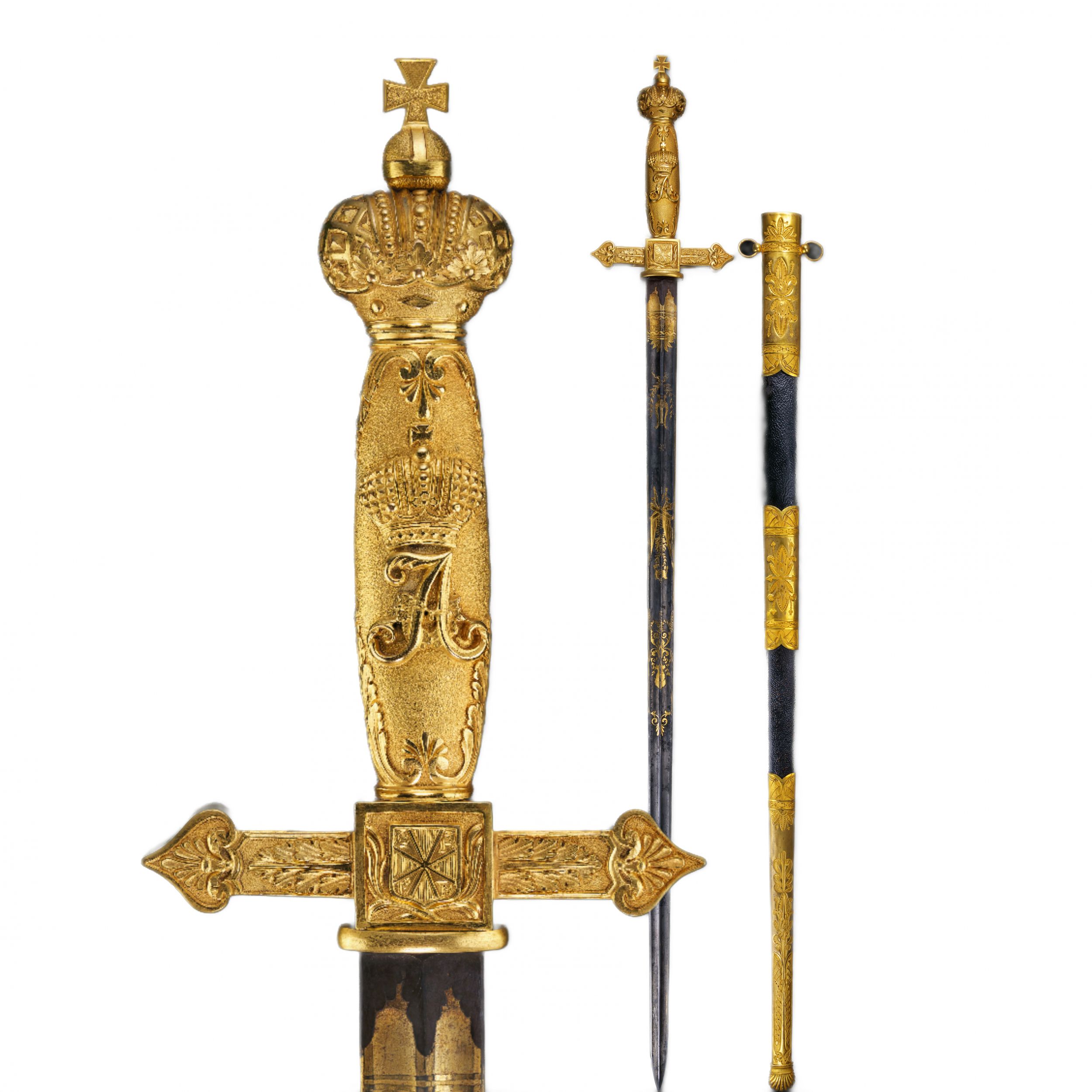
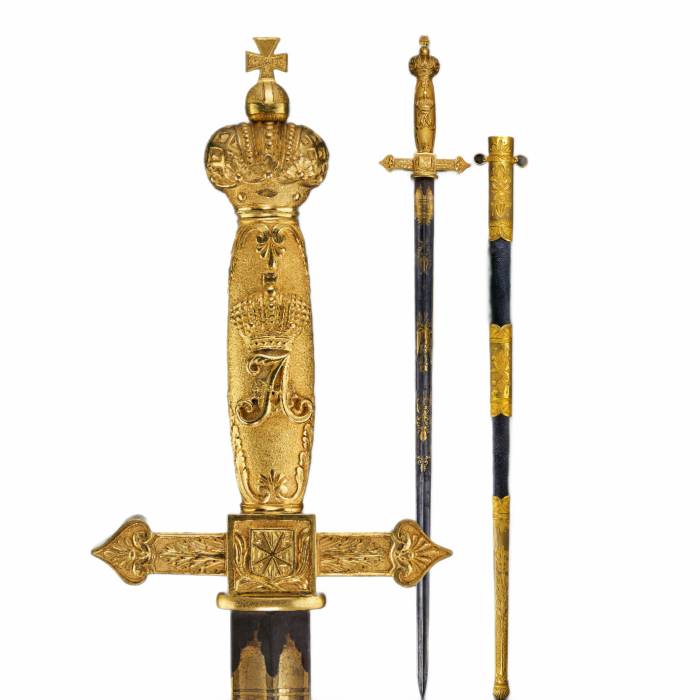
A rare ceremonial presentation sword of non-regulation type, executed in the first half of the 19th century and intended for parade and commemorative use within the system of imperial representation. Such objects occupied a special place in the culture of award and representative weaponry of the Russian Empire and were used as honorary gifts associated with the highest forms of distinction for state and military service. In this context, the sword functions not as a utilitarian weapon but as a historical and artistic object reflecting the status, personal merits, and close association of its owner with state authority.
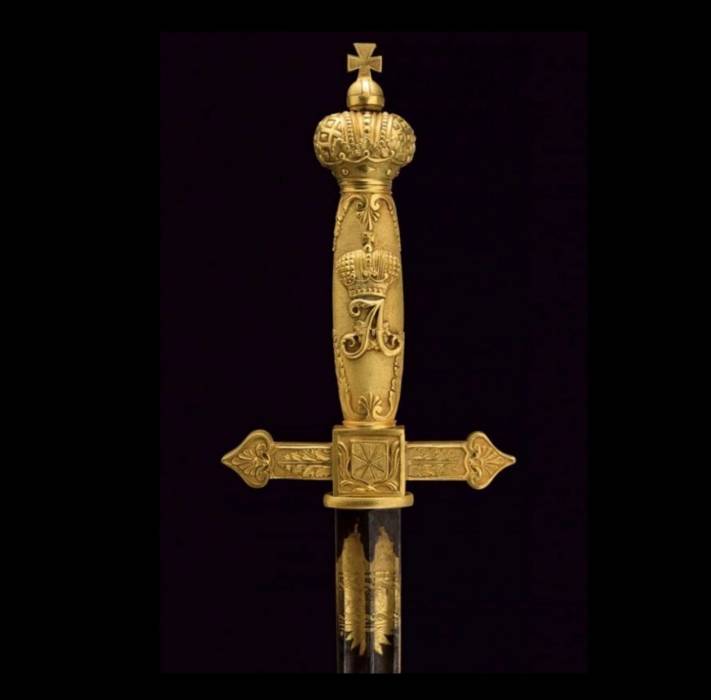
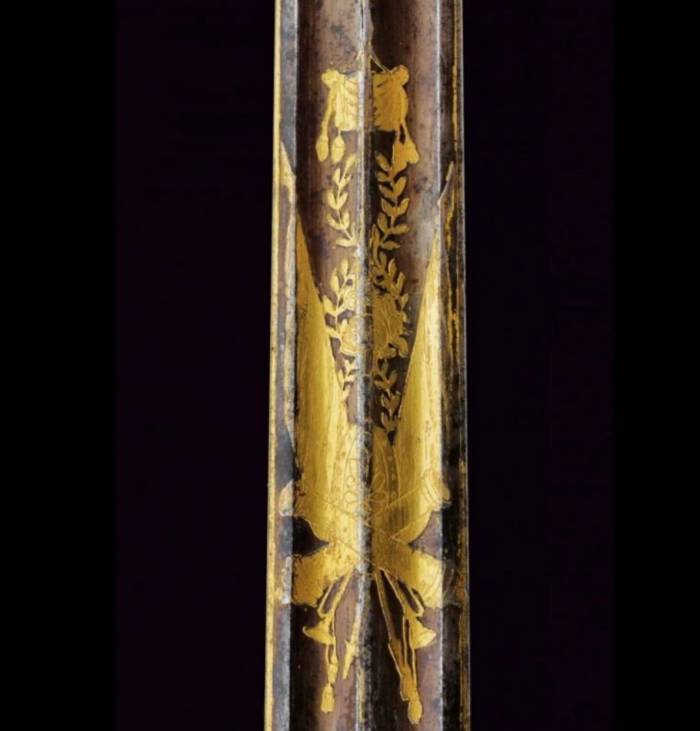
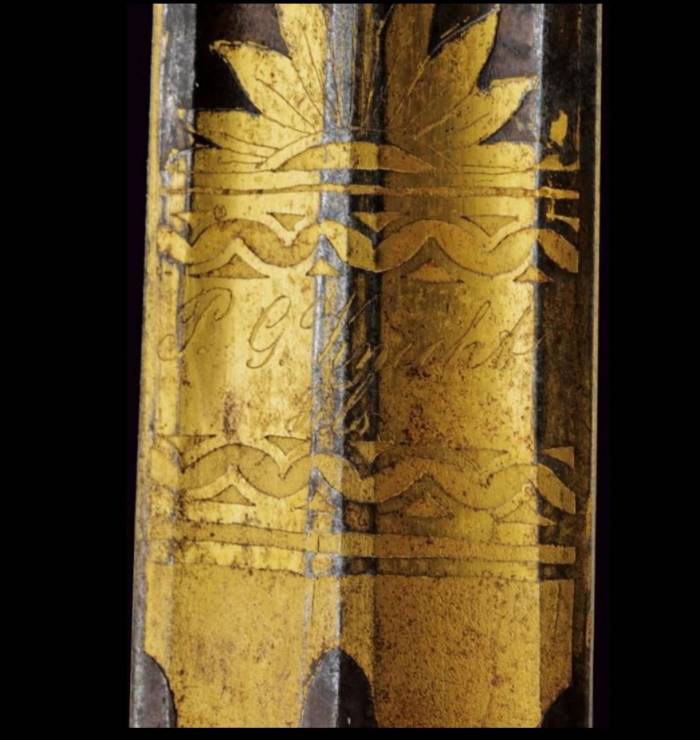
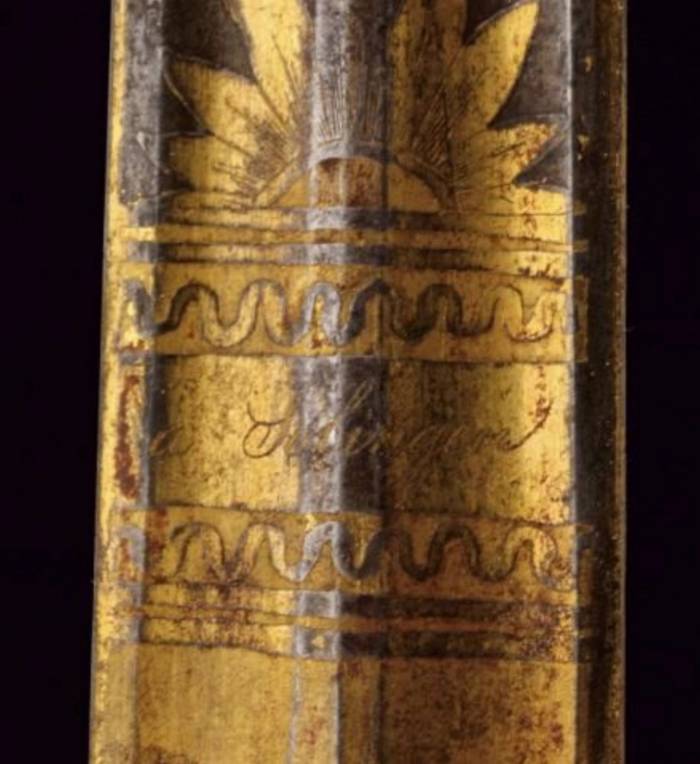
The blade is straight, double-edged, with two longitudinal fullers, and belongs to the production of Solingen sword-making workshops of the late 18th – first quarter of the 19th century. One side of the blade bears the engraved signature “P.G. Knecht fecit,” while the reverse is inscribed “Solingen,” indicating both the maker and the center of manufacture. The blade surface is decorated with fine engraving on a blued ground, enhanced with fire-gilt details. The ornamental repertoire includes images of a lyre, laurel wreaths, military trophies, banners, and elements of military heraldry. This decorative language is characteristic of parade weapons formed under the influence of Empire aesthetics in the first quarter of the 19th century.
The hilt is executed in brass with uniform fire gilding and belongs to the parade-ceremonial, non-regulation tradition. At the center of the crossguard is a stylized depiction of an order medallion featuring an eight-pointed cross and the Cyrillic letters “С Р К В,” forming an acronym of the Order of Saint Vladimir Equal-to-the-Apostles. This emblem is used as evidence of personal merit acquired in military service, in accordance with the principles and practices established by the Statute of the Order.
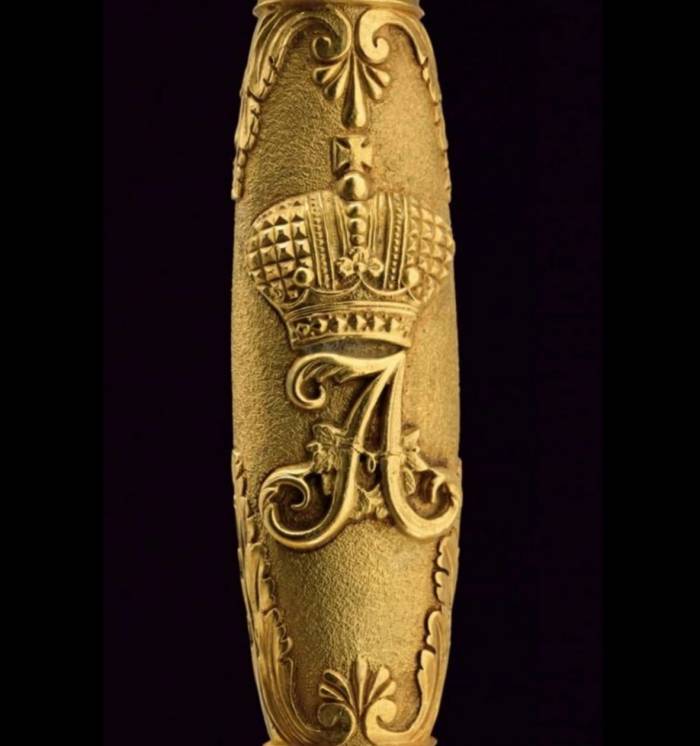
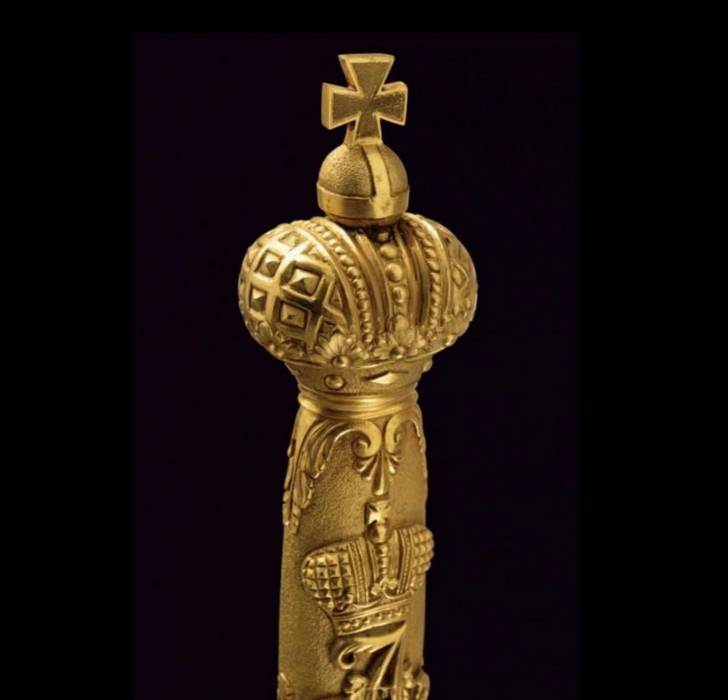
The decorative program of the hilt includes a stylized monogram in the form of a cast letter “A,” surmounted by the Lesser Imperial Crown and enclosed within a cartouche formed by acanthus leaves. By its design, this monogram corresponds to the official cipher of Empress Alexandra Feodorovna (1798–1860), consort of Emperor Nicholas I, crowned in 1826. The pommel is formed as a fully modeled cast representation of the Lesser Imperial Crown with cross. All elements of the hilt are conceived within a unified artistic system and emphasize the solemn and representative character of the weapon.
The scabbard is wooden, covered with dark leather, and fitted with gilded brass mounts and two suspension rings. Its decorative treatment corresponds closely with the artistic solution of the blade and hilt, forming a coherent ensemble of ceremonial parade weaponry.
Materials: Steel, brass, wood, leather.
Techniques: Forging, engraving, bluing, fire gilding, casting.
Dimensions: Length 89.5 cm; Width 12.5 cm.
Condition: Good collectible condition.
Provenance: Private European collection.
Ceremonial presentation weapons of the Russian Empire in the first half of the 19th century constituted a distinct category of non-combat objects intended for parade and commemorative use and endowed with a pronounced symbolic and representative function. Unlike regulation military weapons, such swords were created outside the framework of official military standards and were not intended for practical combat use. Their purpose lay in the visual expression of state authority, the formalization of merits in military or civil service, and the demonstration of imperial favor.
The artistic conception of presentation weaponry developed within the framework of a pan-European tradition of parade arms, adapted to the symbolic system of the Russian Empire. Blades were frequently commissioned from leading Western European centers, primarily Solingen, a centuries-old center of metallurgy and edged-weapon production, whose products were highly valued for the quality of steel and the sophistication of decorative workmanship. Hilts and decorative elements were typically produced in Russia, taking into account contemporary court tastes and established systems of order and monogram iconography.
The blade of the present sword was manufactured in the workshop of Pierre Guillaume Knecht (1798–1852), a representative of a dynasty of hereditary Solingen blade makers. Founded by him in 1819, the workshop continued a family tradition tracing back to his father, Peter Wilhelm Knecht (1772–1806), and his grandfather, Pierre Knecht (1718–1814). Blades bearing the name of Pierre Guillaume Knecht are generally dated to circa 1825–1850 and were typically executed using burin engraving rather than etching. Knecht accepted commissions not only for regulation weapons, but also for high-grade parade and presentation blades.
Of particular importance within the system of imperial representation were order and monogram symbolism. The combination of a monogram with the Small Imperial Crown underscores its belonging to the system of imperial insignia and excludes its interpretation as the initial of a private individual. The depiction of the order medallion serves as an indication that the owner of the sword was awarded the Order of Saint Vladimir for military merit, in full accordance with the Statute of the order and established award practice of the Russian Empire.
Overall condition is good. The blade shows no deformation or significant losses, with the blue-blued ground well preserved and the gilded engraving clearly legible; minor traces of metal corrosion are present, consistent with the age of the object and its history of use. Fire gilding on the hilt and brass scabbard fittings is even, without noticeable losses. All elements of the ensemble are well coordinated and remain in original condition, with natural signs of age. The scabbard exhibits a tight fit of the blade, consistent with the commemorative, non-combat function of ceremonial presentation weapons. Minor traces of earlier restoration are present.
The condition report is provided for informational purposes only.
It is not comprehensive and may not reflect all defects, restorations, alterations, or adaptations, as Antiqon does not perform professional conservation-level assessments. The information is based on a qualified, yet subjective, evaluation by our specialists.Before purchasing, we recommend consultation with an independent expert.Please also consult our Terms and conditions and Glossary A-Z, which contain important information on lot characteristics and sale conditions.