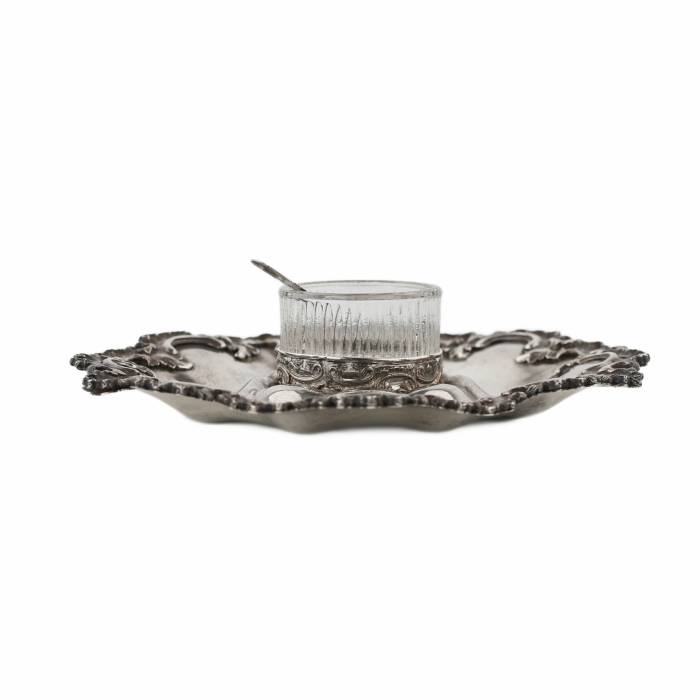

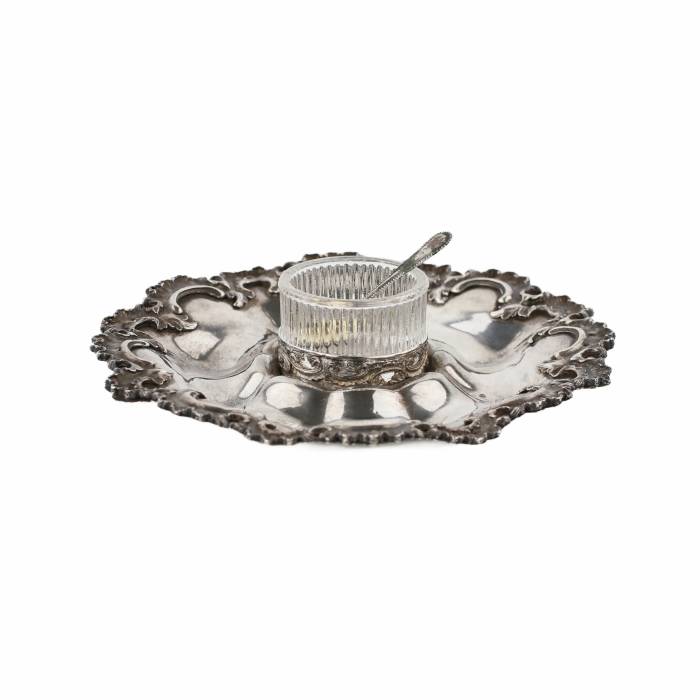
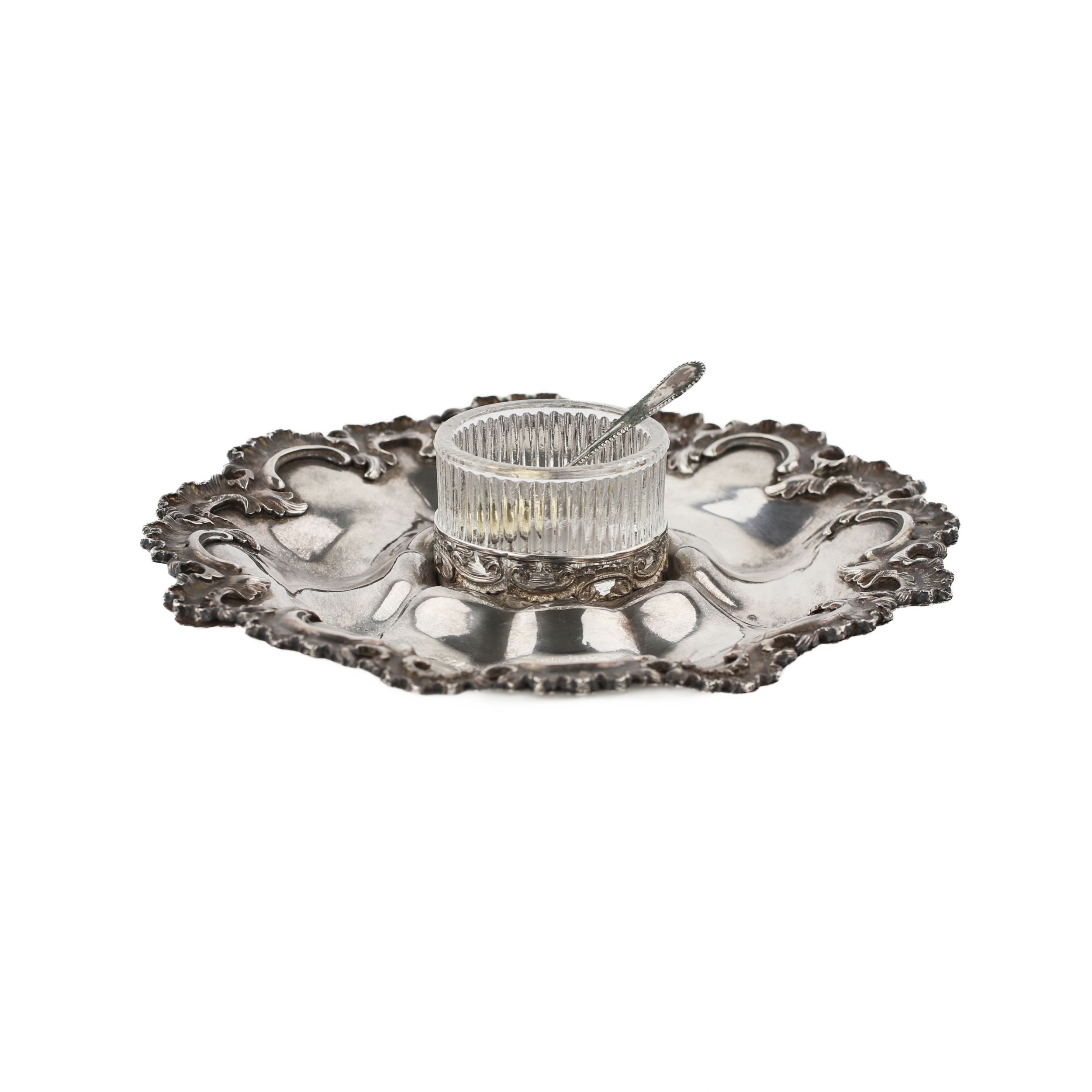
Russian silver caviar bowl with glass tray and silver spoon. 1843.

Russian silver caviar bowl with glass tray and silver spoon. 1843.

ID-ANTQ-8339
November 25, 2023 10:00 AM GMT+02:00
Live auction is finished
Estimate
150 - 200 EUR
Lot Sold
 
Lot sold
Use our cost calculator

Discover how the value of similar works has evolved over the past 10 years. Art is not only beauty — it's an investment.

Price History

Discover how the value of similar works has evolved over the past 10 years. Art is not only beauty — it's an investment.

Request a Shipping Quote
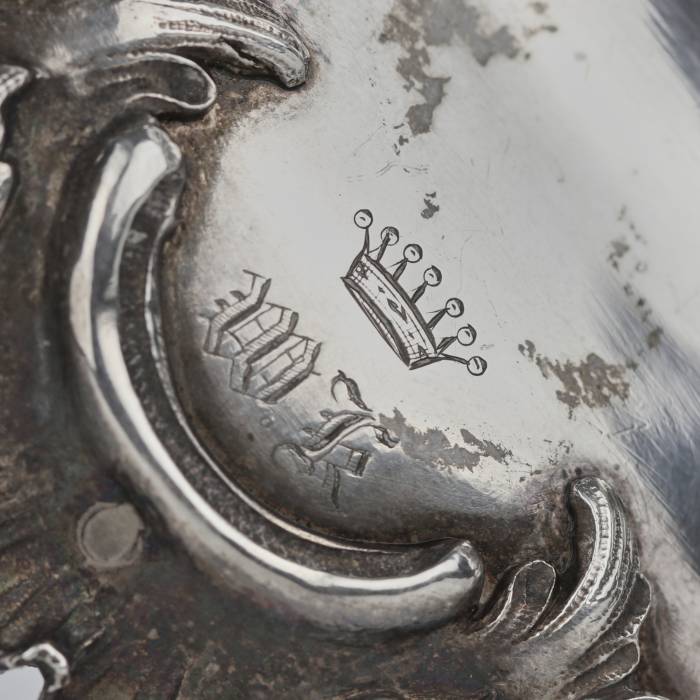
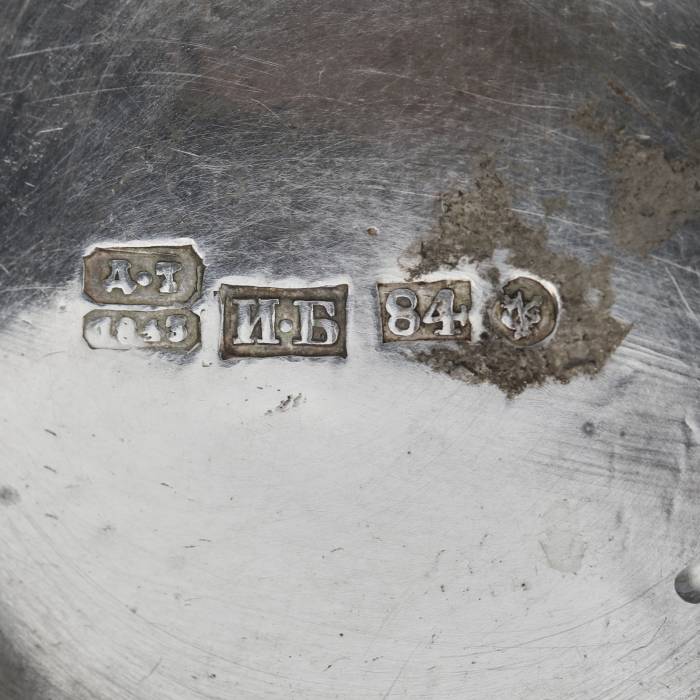
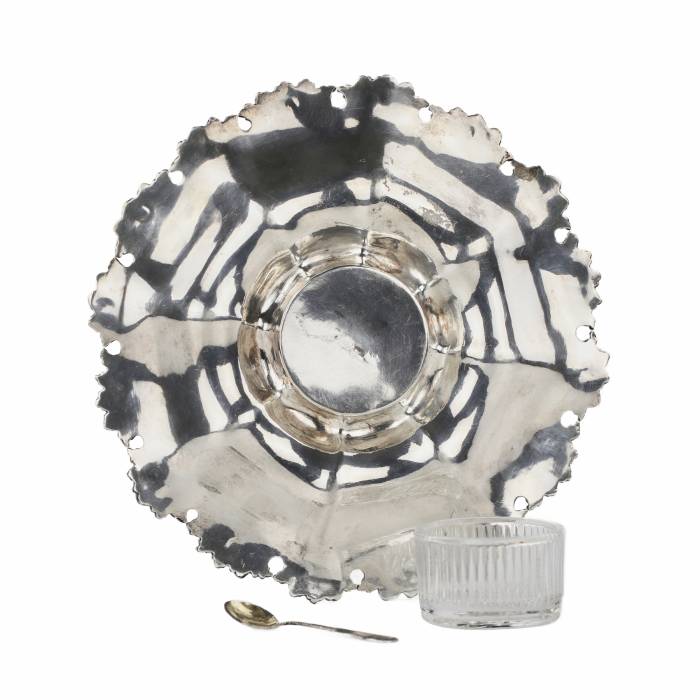
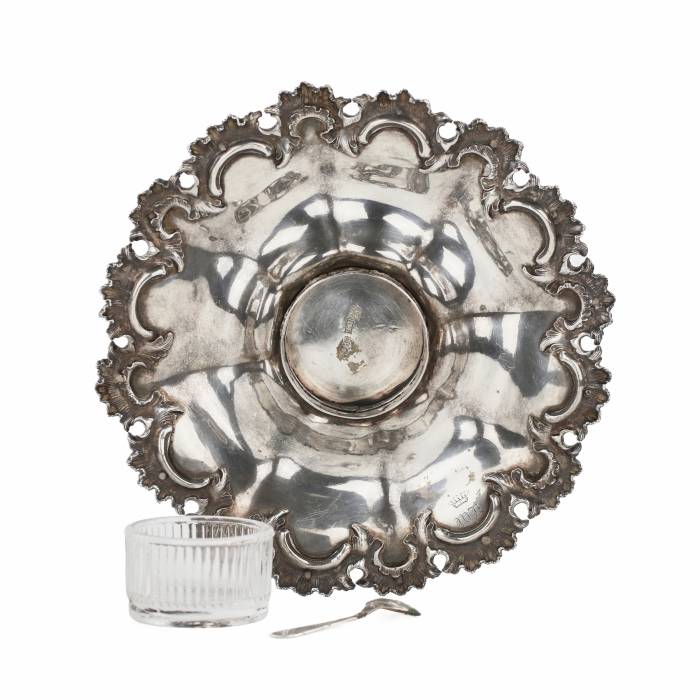
Russian silver caviar bowl in the shape of a round flower with a glass tray and a silver spoon. Decorated along the edge of the saucer with a roccaille pattern of waves and cartouches. In one of which, the Gothic monogram MO under the crown. Under the glass insert is the St. Petersburg mark of 84 silver, 1843, of the assayer Dmitry Ilyich Tverskoy and the mark of the master I.B in a rectangular shield - Ivan Bednyakov. Known for dishes and salt shakers in 1825-1848. European sterling silver spoon 800. Ø - 17.5 cm, Silver weight: 183 g. Total weight: 235 gr.
Art:
russia
Height:
17 cm
Width:
17 cm
Depth:
2 cm
Period:
19th century
Style:
Neo-baroque
Country:
Russia, St. Petersburg
Material:
Silver 84, Glass
Condition:
Revive
Fair
Good
Very good
Like new

The condition report is provided for informational purposes only.

It is not comprehensive and may not reflect all defects, restorations, alterations, or adaptations, as Antiqon does not perform professional conservation-level assessments. The information is based on a qualified, yet subjective, evaluation by our specialists.Before purchasing, we recommend consultation with an independent expert.Please also consult our Terms and conditions and Glossary A-Z, which contain important information on lot characteristics and sale conditions.
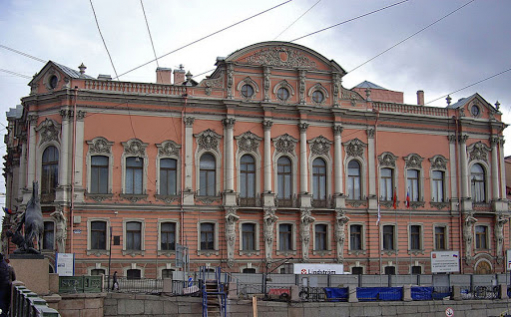
Neo-Baroque.
Neo-baroque is one of the neo-styles that developed in 19th century European art during the period of historicism. Has several different regional variations. In St. Petersburg, the most European city of the Russian Empire, the period of historicism of artistic thinking and neo-styles of the 19th century began to reproduce or, as they said at that time, "renewal in their previous form" of the monuments of the "Peter′s Baroque" period and buildings "in the taste of Count Bartholomew Rastrelli" ... These samples are not baroque architecture in the classical sense, but a special fusion of the Renaissance, Baroque and Mannerist architecture of the Nordic countries, and in Elizabethan time - a bizarre combination of elements of classicism, baroque and French rococo. Neo-baroque features are evident in the interior of St. Isaac′s Cathedral in St. Petersburg (O. Montferrand, 1818-1858), in the Mariinsky Palace, built in the neo-Renaissance style by A.I. Stackenschneider (1839-1844) and in the most important work of the "second baroque": the Beloselsky-Belozersky palace (1846-1848) on the Nevsky Prospect of the Russian capital. In the facades of the Beloselsky-Belozersky palace, the architect Stakenschneider followed the general composition of the Stroganov palace, erected by F.B. Rastrelli was also on Nevsky Prospekt a century earlier. However, Stackenschneider′s powerful plasticity of Rastrelli′s decor turned into refined, but petty "dry" ornamentation, which was positively evaluated by the critics of that time as an improvement in style. Graphic rigidity, refinement and fragmentation, as a rule, distinguish any neo-style from its historical prototype. Such are also many other neo-baroque monuments in St. Petersburg of the middle and second half of the 19th century.
... Read More

Stay up to date with new arrivals
Save Russian silver and we let you know when new listings appears in this category
Save

Related items