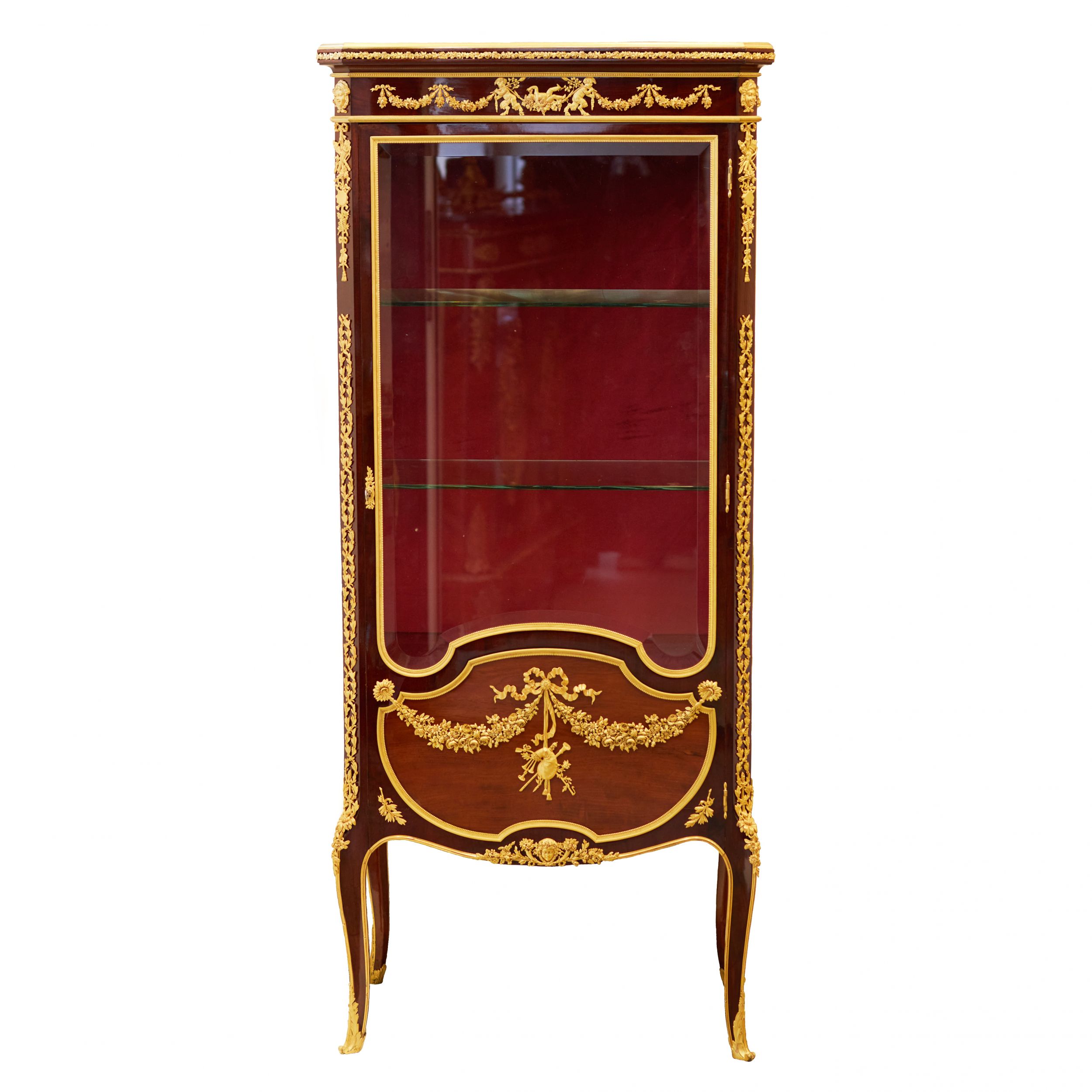
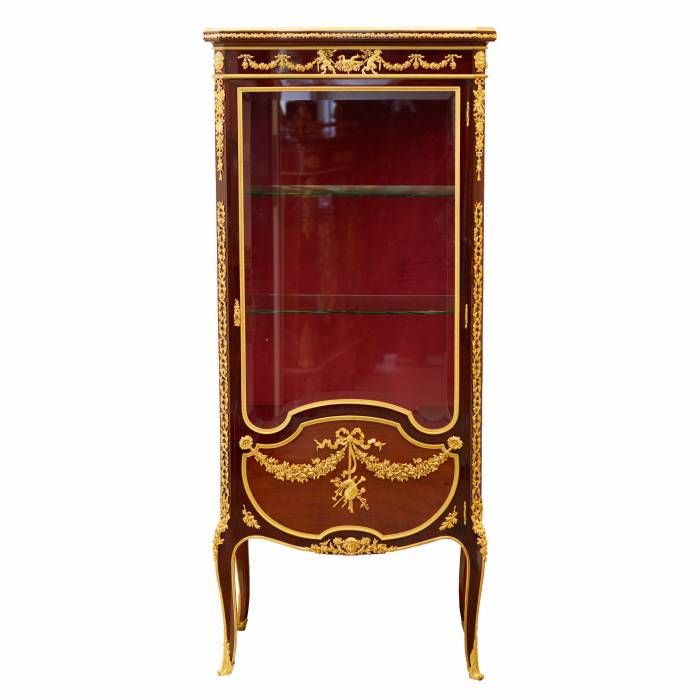
MAHOGANY AND GILT BRONZE DISPLAY CABINET IN THE STYLE OF SORMANI FRANCE, LATE 19TH CENTURY
AntiqonART consultant will contact you within one business day after receiving your request.
Discover how the value of similar works has evolved over the past 10 years. Art is not only beauty — it's an investment.
Discover how the value of similar works has evolved over the past 10 years. Art is not only beauty — it's an investment.
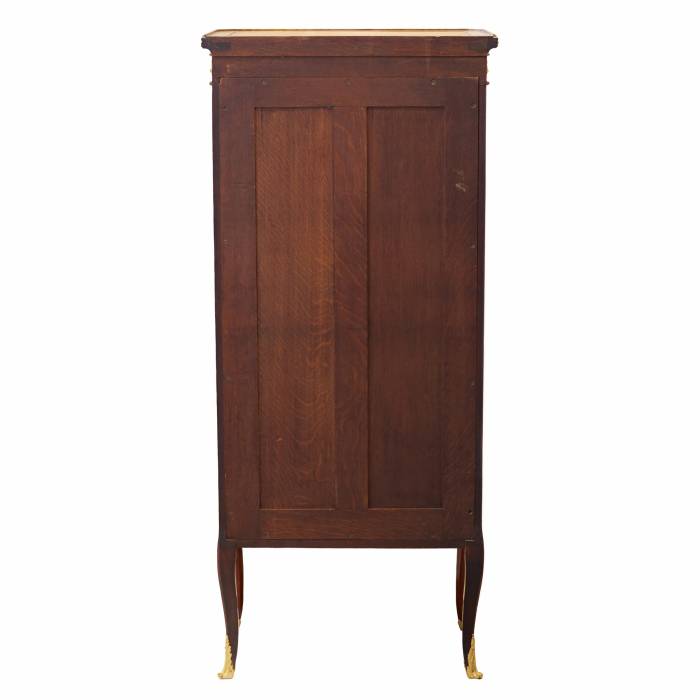
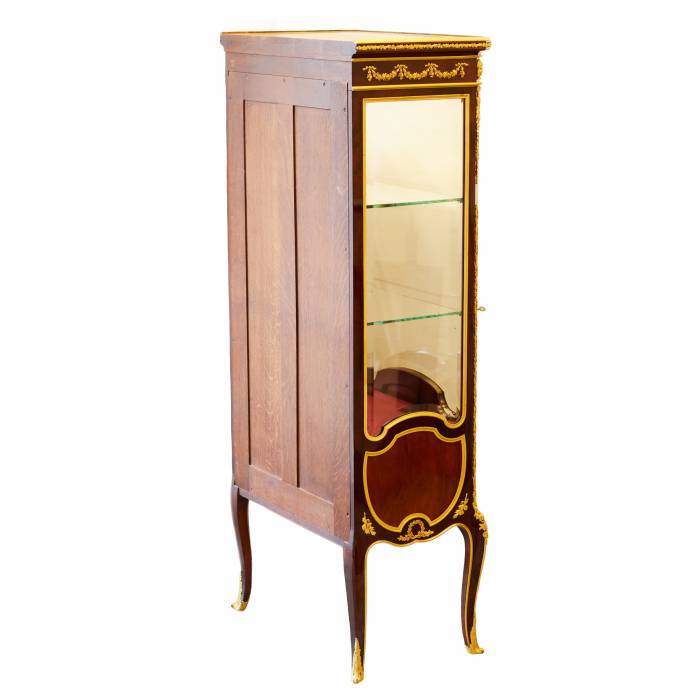
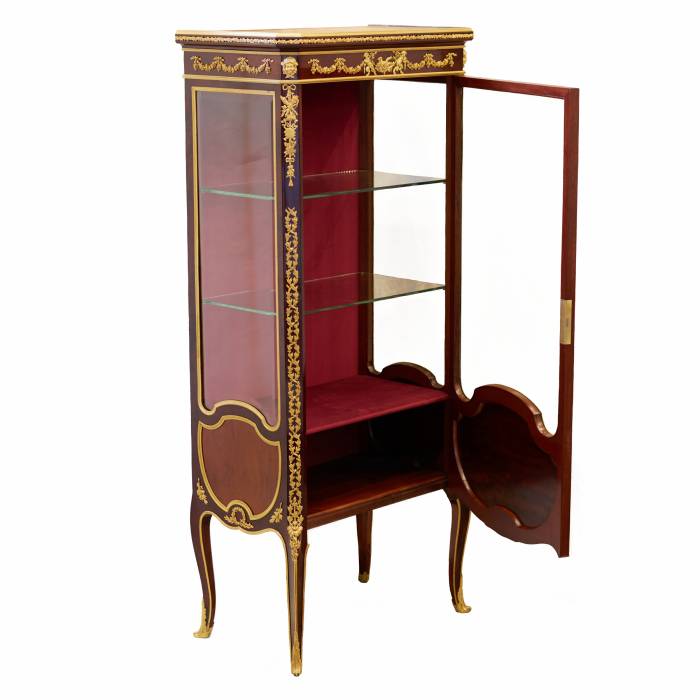
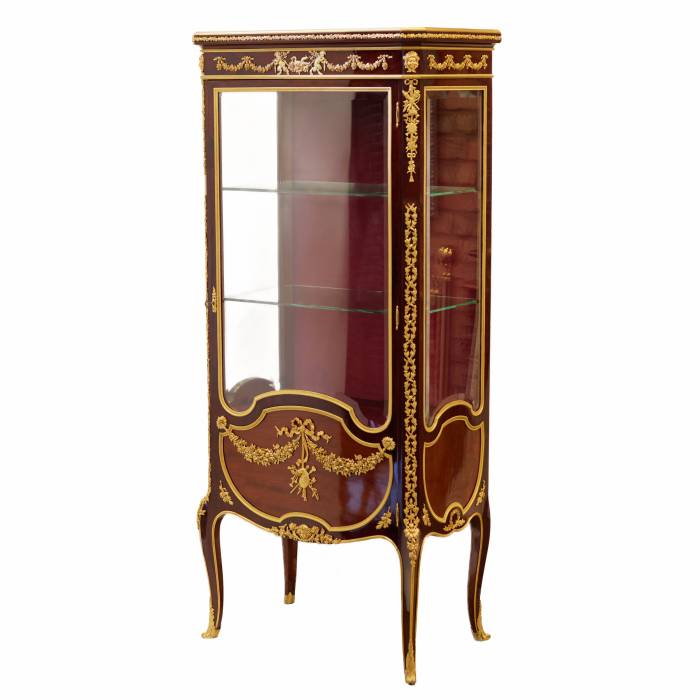
An elegant single-door display cabinet with lock, executed in mahogany and richly mounted with gilt bronze, represents a brilliant example of French historicism of the second half of the 19th century in the spirit of the Sormani workshop. The proportions of the elongated rectangular body with chamfered corners are distinguished by exceptional harmony and architectural refinement. The piece stands on slender cabriole legs fitted with bronze mounts that emphasize the lightness of its silhouette.
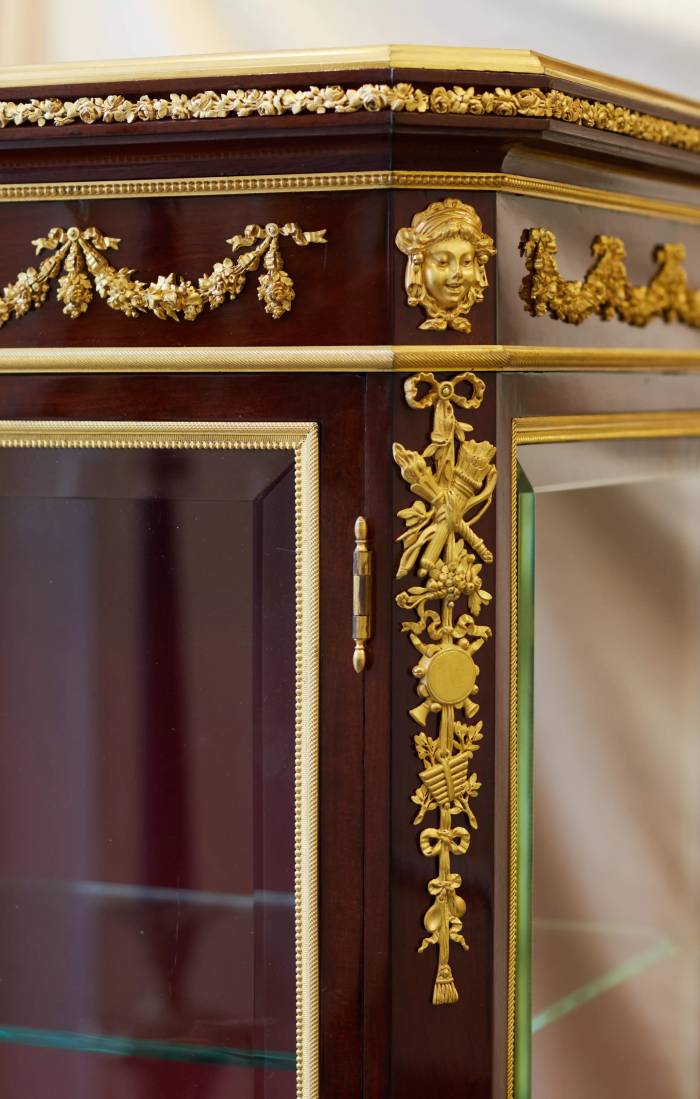
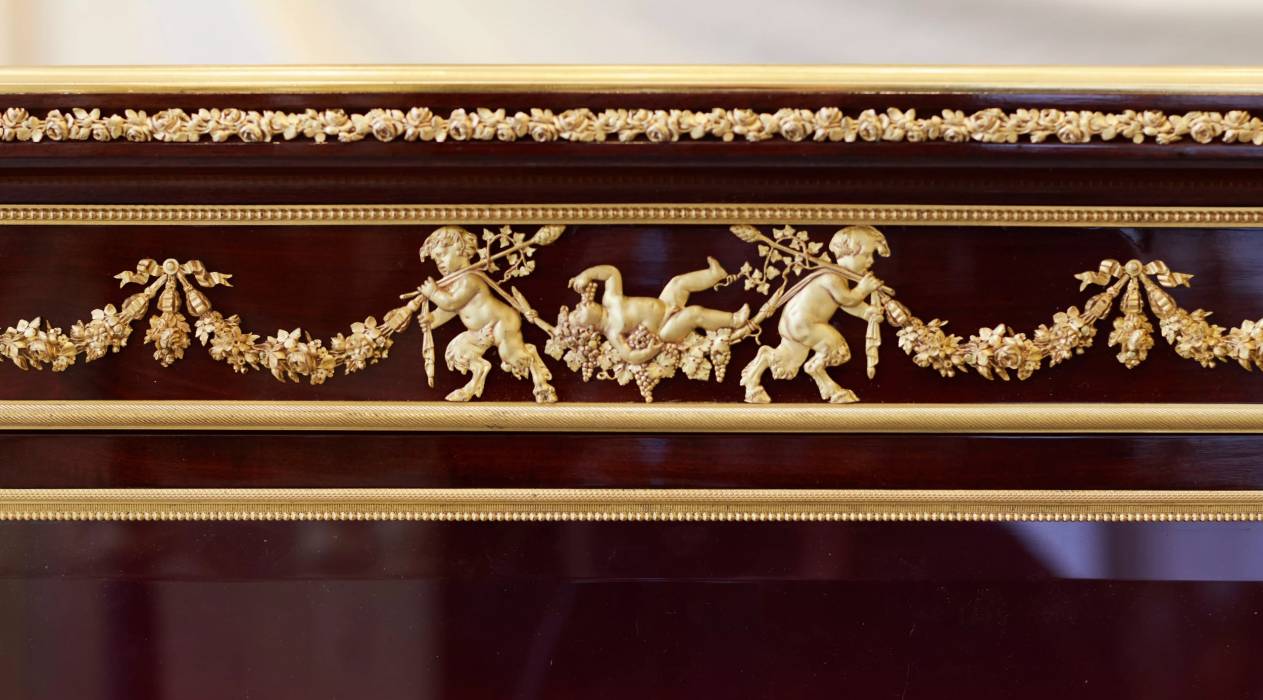
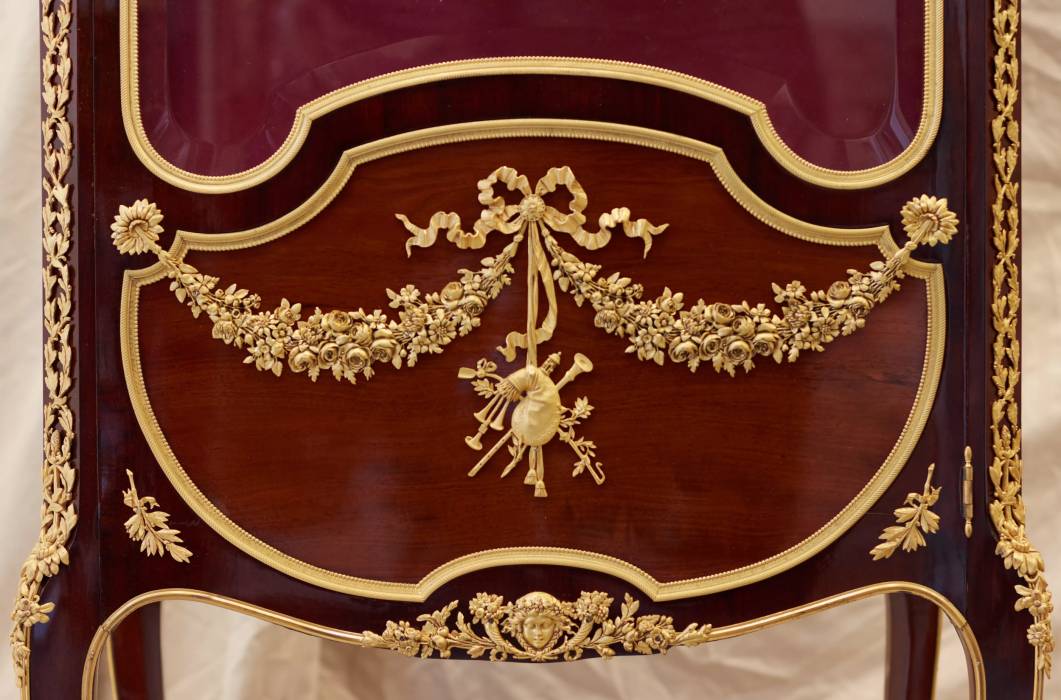
The frieze is adorned with a finely chased gilt bronze garland featuring youthful satyrs carrying their inebriated companion, lending the composition playful dynamism and an allusion to 18th-century Bacchic scenes. The chamfered angles are decorated with laurel wreaths and musical grotesques. The central panel is enriched with luxuriant floral garlands tied with ribbon, suspending a bagpipe and attributes of pastoral music. The compositional nodes are accentuated with refined mascarons. Particular attention should be drawn to the delicate graphic quality of the bronze bands, the pearl-beaded molding of the panels, and the exquisite modeling of floral motifs, forming a harmonious decorative ensemble.
The glazing is beveled on three sides. The interior is lined with deep red fabric and fitted with two glass shelves. The top is composed of pink marble with natural veining, enhancing the decorative effect and underscoring the status of the piece.
Dimensions: 149 × 64.5 × 38.5 cm.
Material: Mahogany, gilt bronze, glass, pink marble.
Condition: Good. Minor wear to the gilding consistent with age.
Provenance: Private collection.
French furniture of the second half of the 19th century developed within the broader movement of historicism that defined the artistic character of the Second Empire and the decades that followed. Under Napoleon III, Paris became the acknowledged center of European decorative arts. The Universal Expositions of 1855, 1867, and 1878 played a decisive role in disseminating French taste and in establishing a concept of luxury grounded in technical virtuosity, the richness of materials, and scholarly reinterpretations of 18th-century styles. Parisian workshops turned to the models of Louis XV and Louis XVI not as mere reproductions, but as refined reinterpretations adapted to the expectations of contemporary interiors.
Among the most distinguished houses was Maison Sormani, founded by Paul Sormani, whose production was celebrated for the excellence of its cabinetmaking, the exceptional quality of its gilt bronze mounts, and the precision of its proportions. Furniture created in this spirit is characterized by the use of carefully selected mahogany, finely chased and gilded bronze mounts, and an ornamental vocabulary derived from Rococo and Neoclassical traditions. Floral garlands, laurel wreaths, mascarons, and musical attributes reflect a cultivated decorative language inherited from the great masters of the 18th century.
Display cabinets held a particular position within the formal interiors of aristocratic and bourgeois residences at the end of the 19th century. They corresponded to a new mode of living in which the collection of porcelain, bronzes, and works of art became an expression of social status and cultural refinement. Equipped with beveled glass and marble tops, such pieces combined functionality with prestige, transforming furniture into refined exhibition cases. Today, display cabinets executed in the spirit of Sormani are regarded as significant examples of elite French furniture of the 19th century and occupy an esteemed place in collections of decorative arts from this period.
Good. The condition corresponds to the age and class of the piece. Minor wear to the gilding consistent with age. The structure is sound with no deformations.
The condition report is provided for informational purposes only.
It is not comprehensive and may not reflect all defects, restorations, alterations, or adaptations, as Antiqon does not perform professional conservation-level assessments. The information is based on a qualified, yet subjective, evaluation by our specialists.Before purchasing, we recommend consultation with an independent expert.Please also consult our Terms and conditions and Glossary A-Z, which contain important information on lot characteristics and sale conditions.