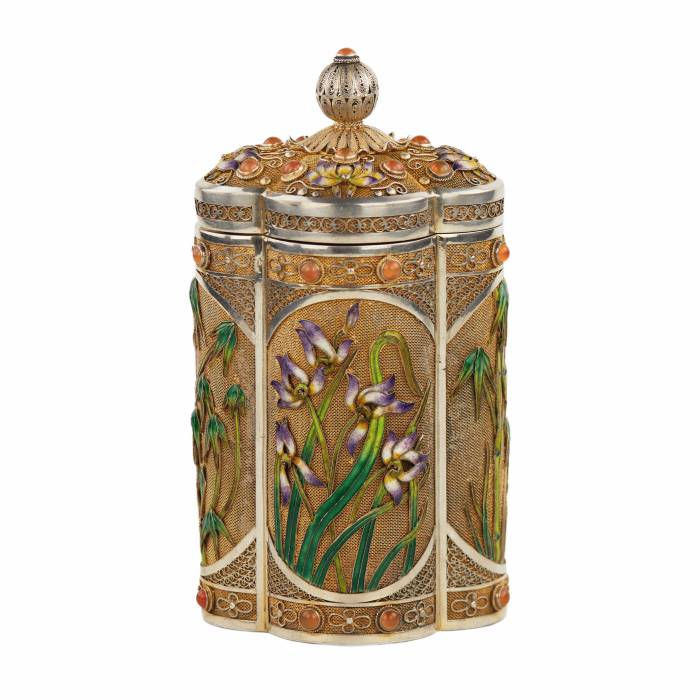
SILVER TEA CADDY WITH ENAMELS AND CABOCHONS CHINA, 20TH CENTURY
AntiqonART consultant will contact you within one business day after receiving your request.
Discover how the value of similar works has evolved over the past 10 years. Art is not only beauty — it's an investment.
Discover how the value of similar works has evolved over the past 10 years. Art is not only beauty — it's an investment.
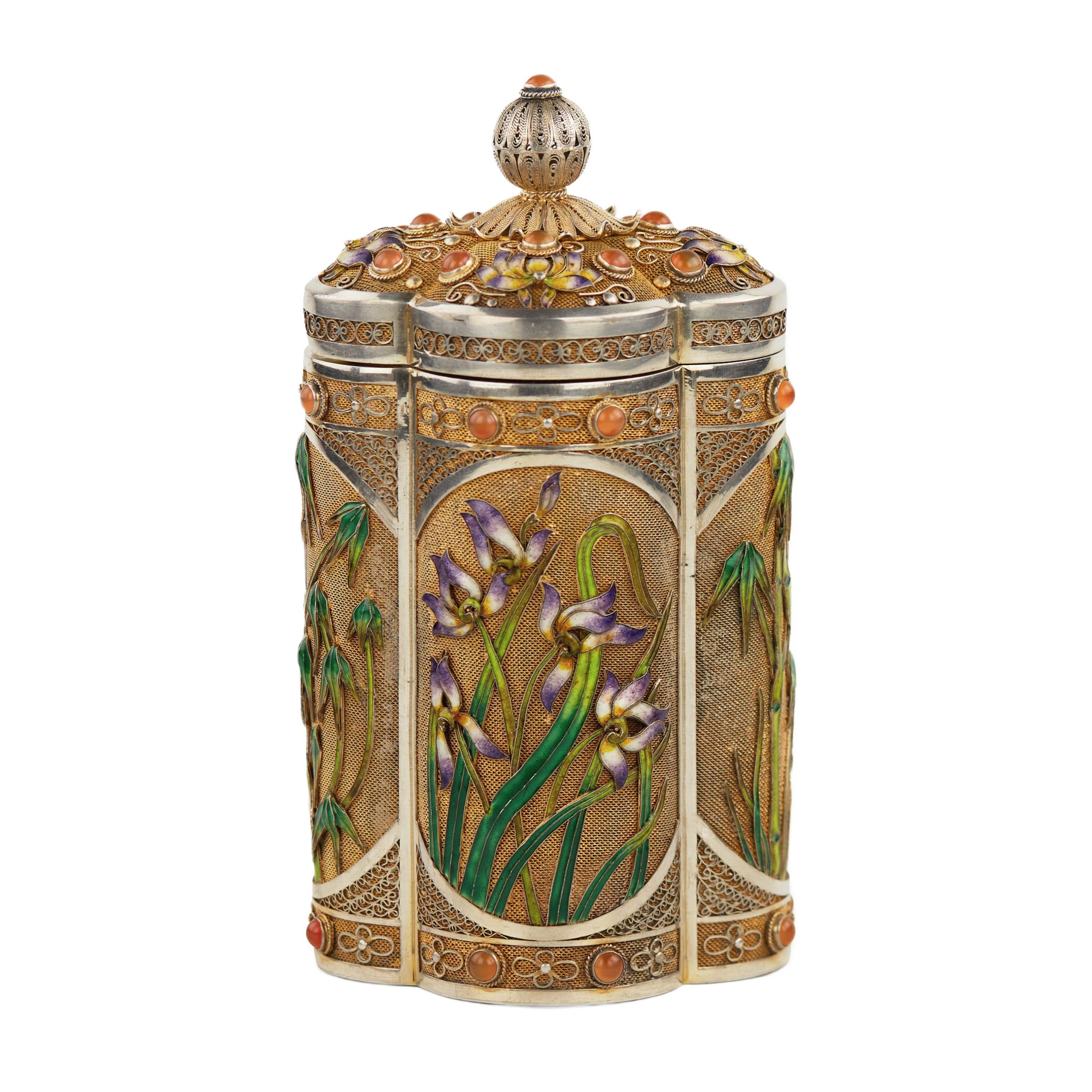
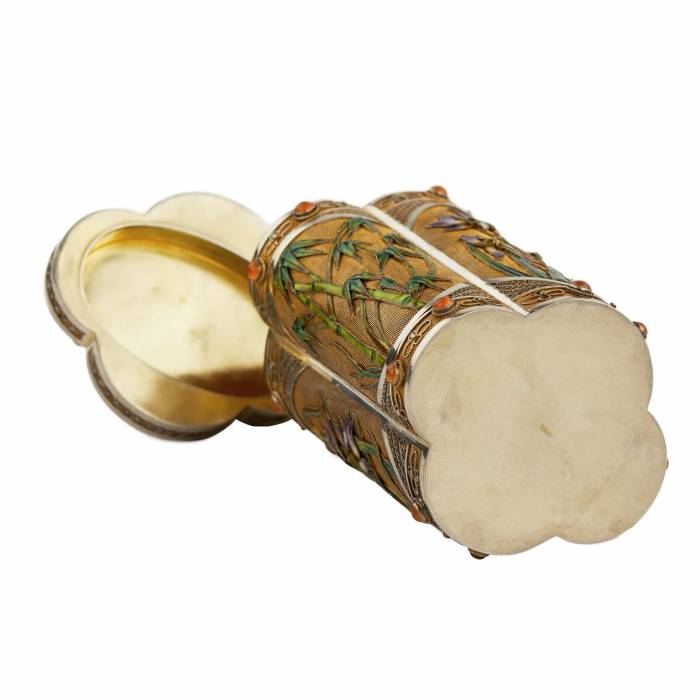
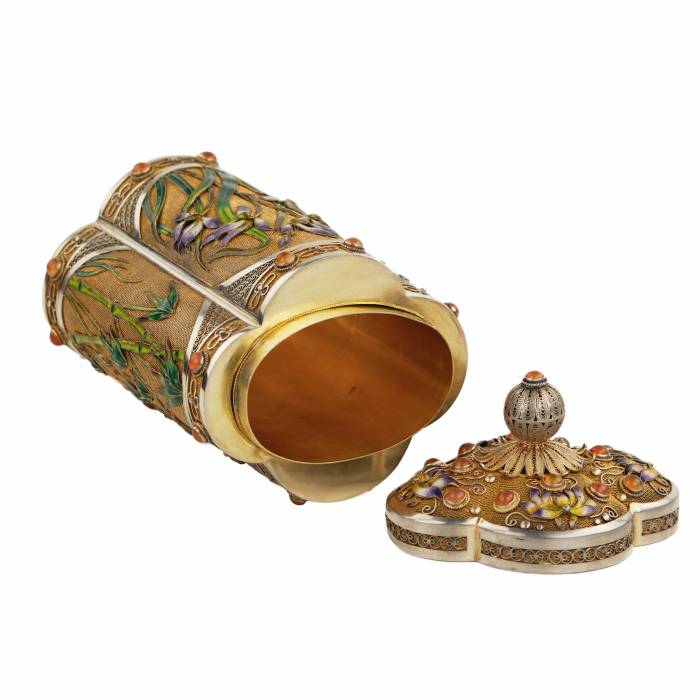
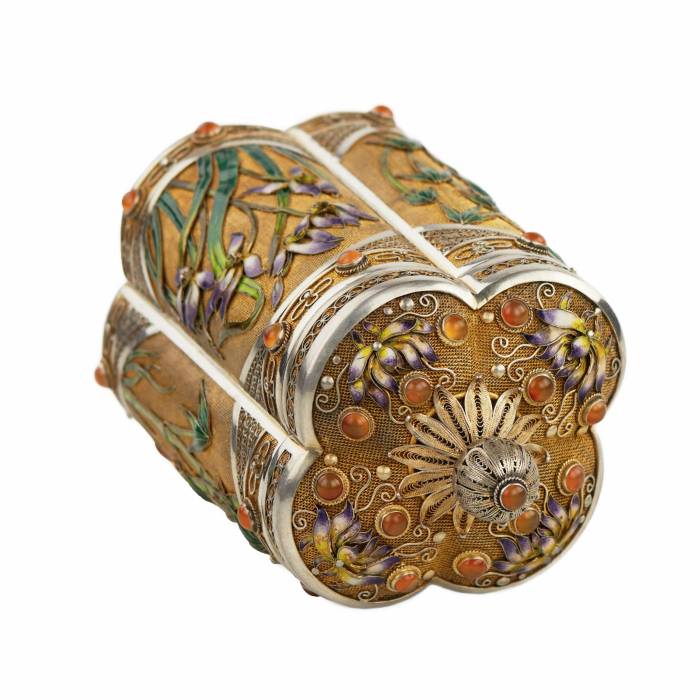
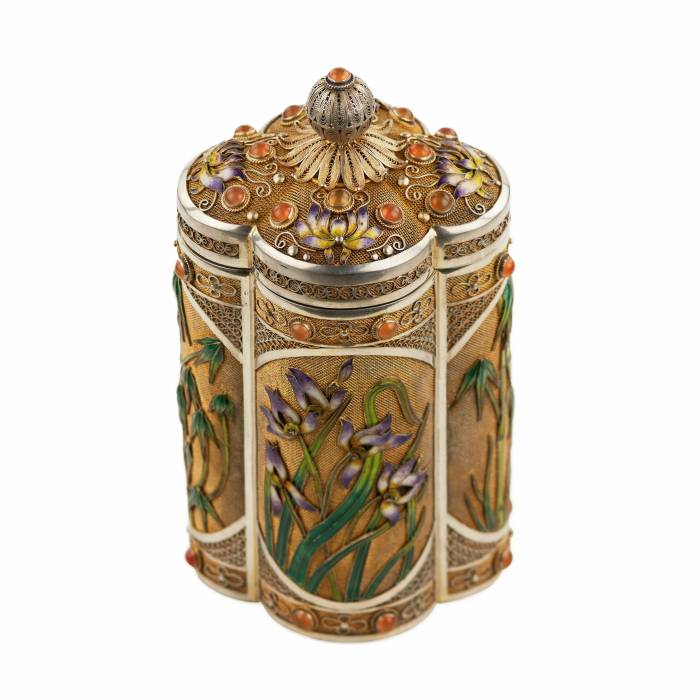
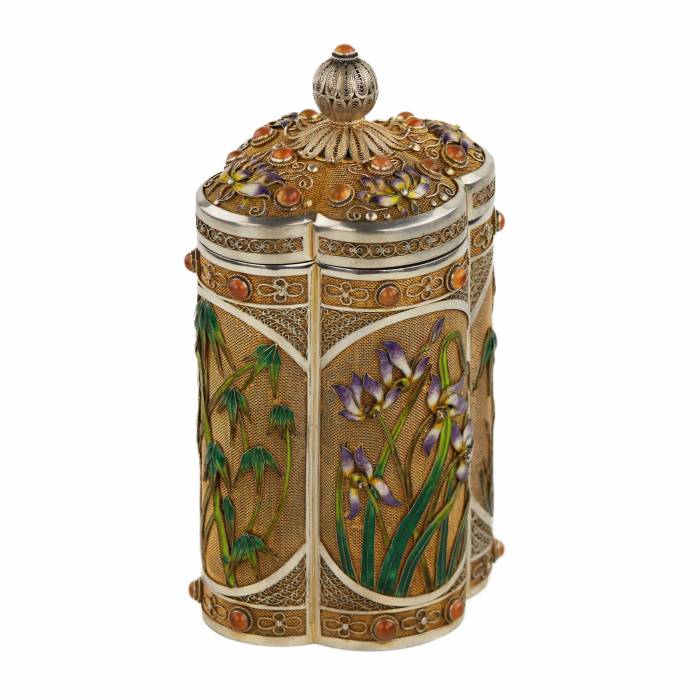
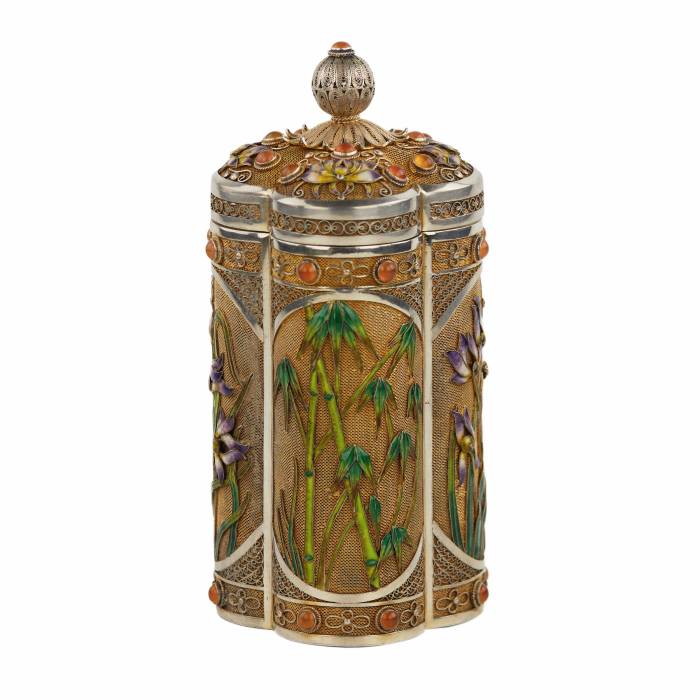
A silver tea caddy decorated with applied ornamental elements and polychrome enamels. The body is executed in a clover-shaped form with four harmoniously convex panels, each adorned with finely painted enamel compositions depicting irises and bamboo set within silver reserves. The silver surface is further enriched with delicate granulation and refined filigree work, enhancing the decorative richness of the object.
Rounded orange cabochons are applied along the perimeter of the body and lid, creating a rhythmic ornamental accent. The lid is surmounted by a central finial and decorated with stylized lotus flowers, echoing traditional Eastern symbolism of purity and harmony. The interior surface of the caddy is fully gilded. The base is executed with openwork filigree, lending the piece visual lightness and refined elegance.
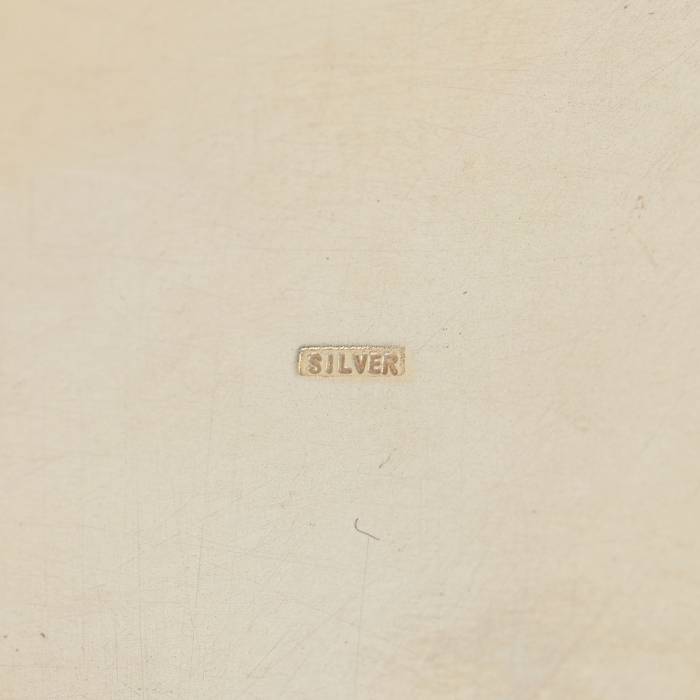
Hallmarks: Marked “SILVER” on the interior, corresponding to silver of 800 standard.
Dimensions: Height 17 cm. Width 9 cm.
Weight: 442.4 g.
Condition: Good.
During the 20th century, Chinese decorative silver developed at the intersection of long-established artistic traditions and the demands of the international market. Tea caddies and storage vessels occupied a significant place in Chinese material culture, as tea was regarded not merely as a beverage but as an essential element of philosophy, ritual, and social interaction. The container itself often carried symbolic and aesthetic meanings extending beyond its utilitarian function.
The use of silver emphasized the status of the owner and served a practical purpose, as the metal was valued for its protective properties and its ability to preserve the aroma and quality of tea. In the first half of the 20th century, many such objects were produced in workshops oriented toward export markets, which explains the presence of English-language hallmarks and standardized silver grades.
The decorative program of this tea caddy combines classical motifs of Chinese iconography with elements adapted to the tastes of foreign clientele. Iris and bamboo traditionally symbolize elegance, resilience, and spiritual harmony, while the lotus represents purity, renewal, and enlightenment. The use of polychrome enamels, colored cabochons, and filigree reflects the influence of southern Chinese jewelry traditions as well as broader decorative trends of the early 20th century.
Today, silver tea caddies of this type are regarded as expressive examples of 20th century Chinese applied art, in which functionality, symbolism, and a high level of craftsmanship are seamlessly combined.
Good. The gilding and enamels are preserved with minor traces of age.
The condition report is provided for informational purposes only.
It is not comprehensive and may not reflect all defects, restorations, alterations, or adaptations, as Antiqon does not perform professional conservation-level assessments. The information is based on a qualified, yet subjective, evaluation by our specialists.Before purchasing, we recommend consultation with an independent expert.Please also consult our Terms and conditions and Glossary A-Z, which contain important information on lot characteristics and sale conditions.