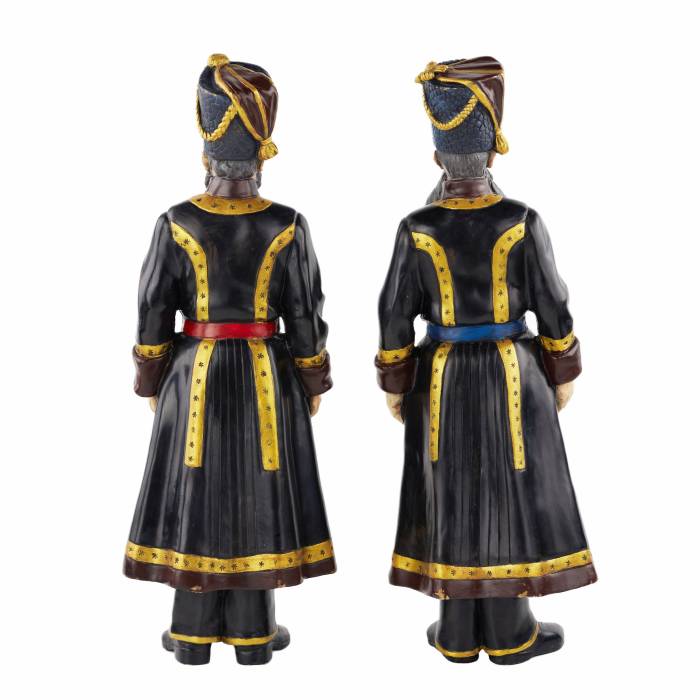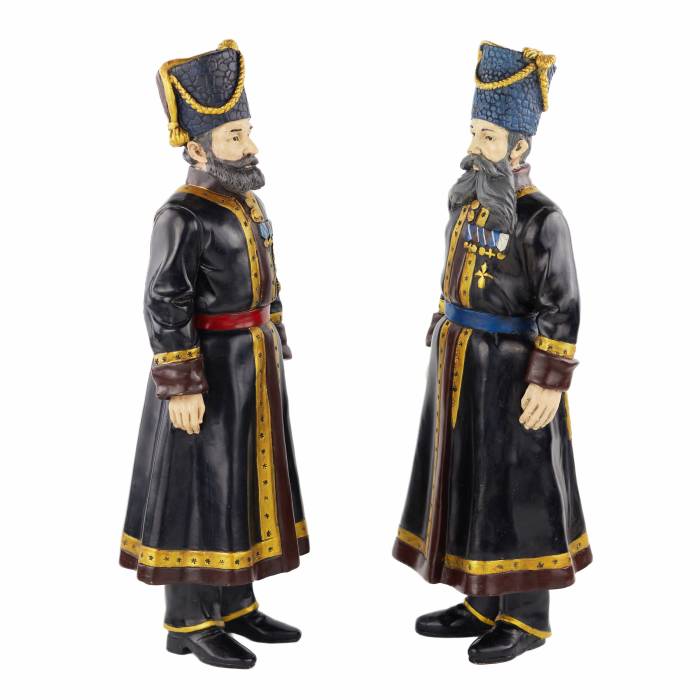
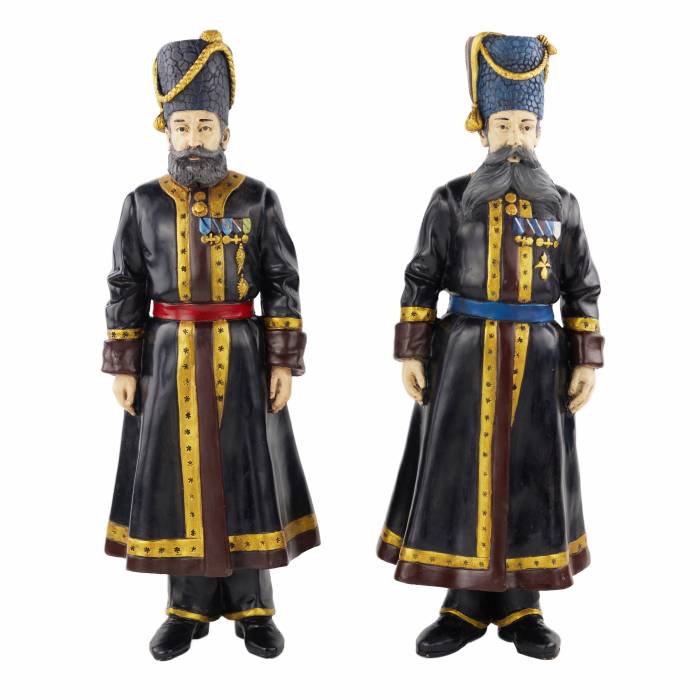
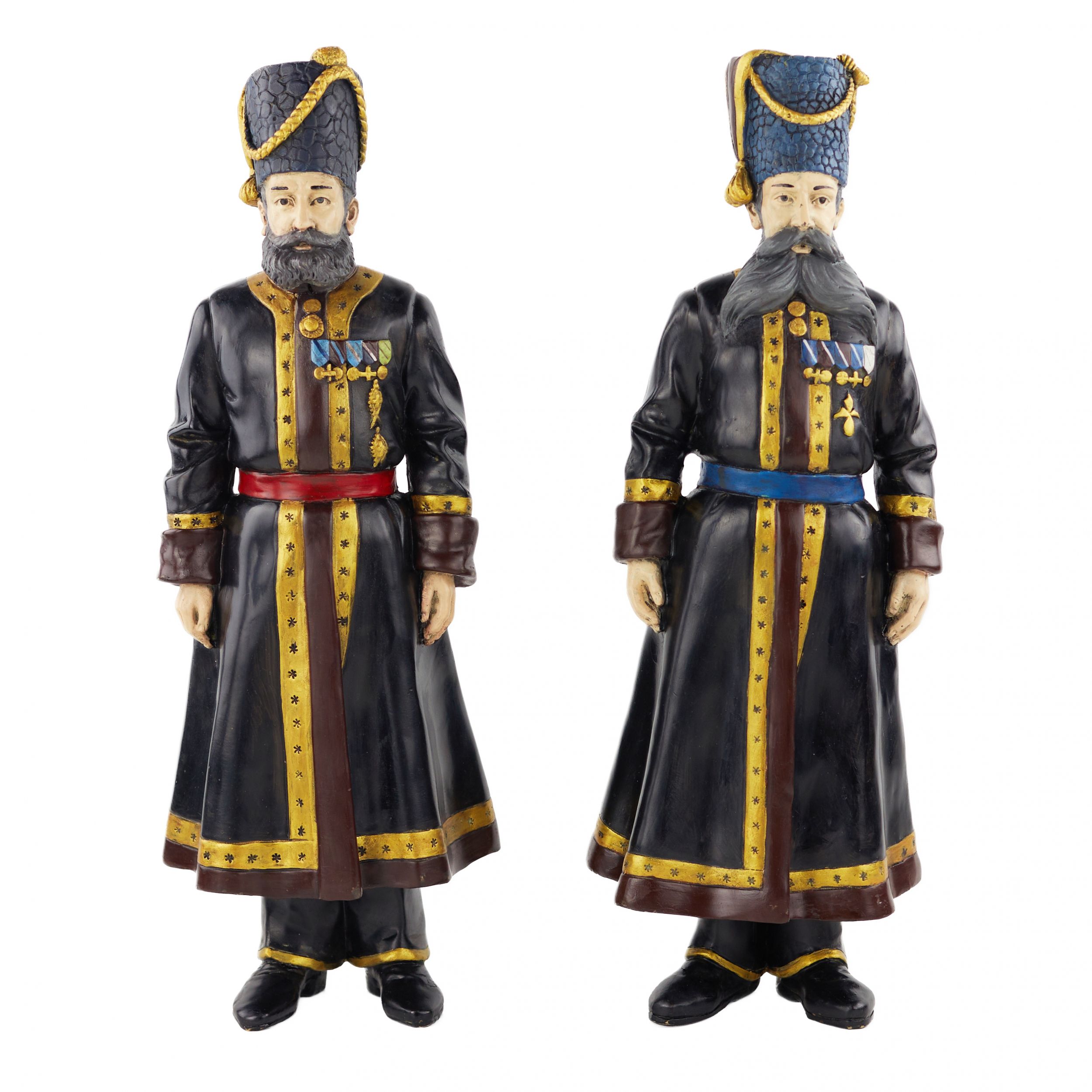
PAIR OF BRONZE FIGURES OF THE IMPERIAL FAMILY’S COSSACK GUARDS RUSSIA, ST PETERSBURG, 1912

PAIR OF BRONZE FIGURES OF THE IMPERIAL FAMILY’S COSSACK GUARDS RUSSIA, ST PETERSBURG, 1912

ID-ANTQ-15605
Live auction begins in:
| April 3, 2026 2:43 AM GMT+03:00
Estimate
1000 - 1500 EUR
Current Bid
EUR
 
0 bids
Register for bidding
Request more info
Use our cost calculator

Discover how the value of similar works has evolved over the past 10 years. Art is not only beauty — it's an investment.

Price History

Discover how the value of similar works has evolved over the past 10 years. Art is not only beauty — it's an investment.

Request a Shipping Quote

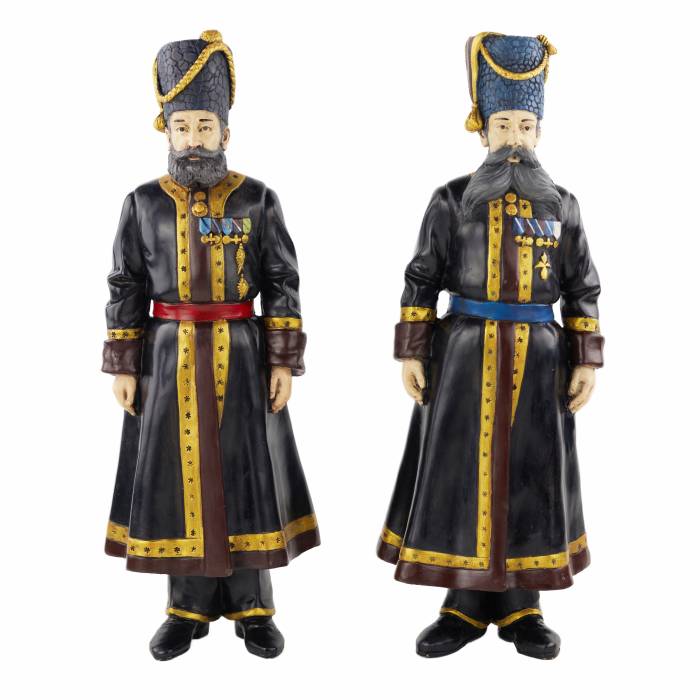
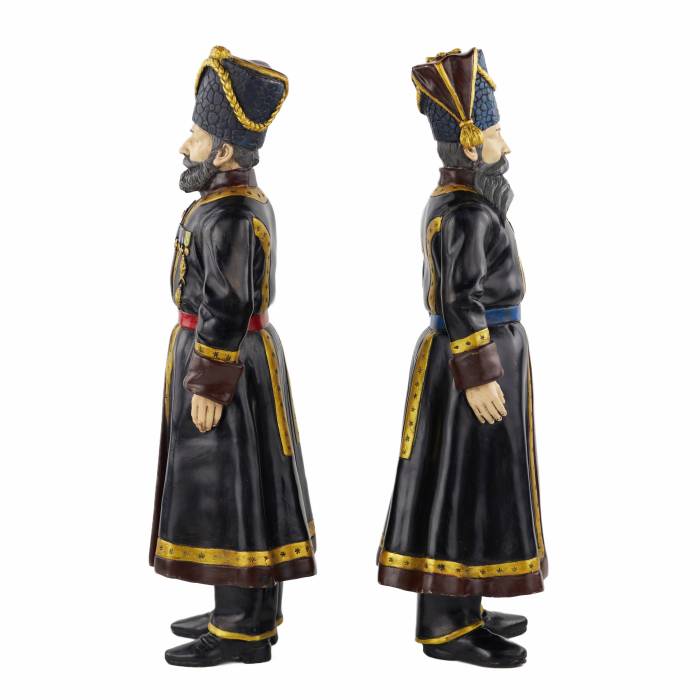
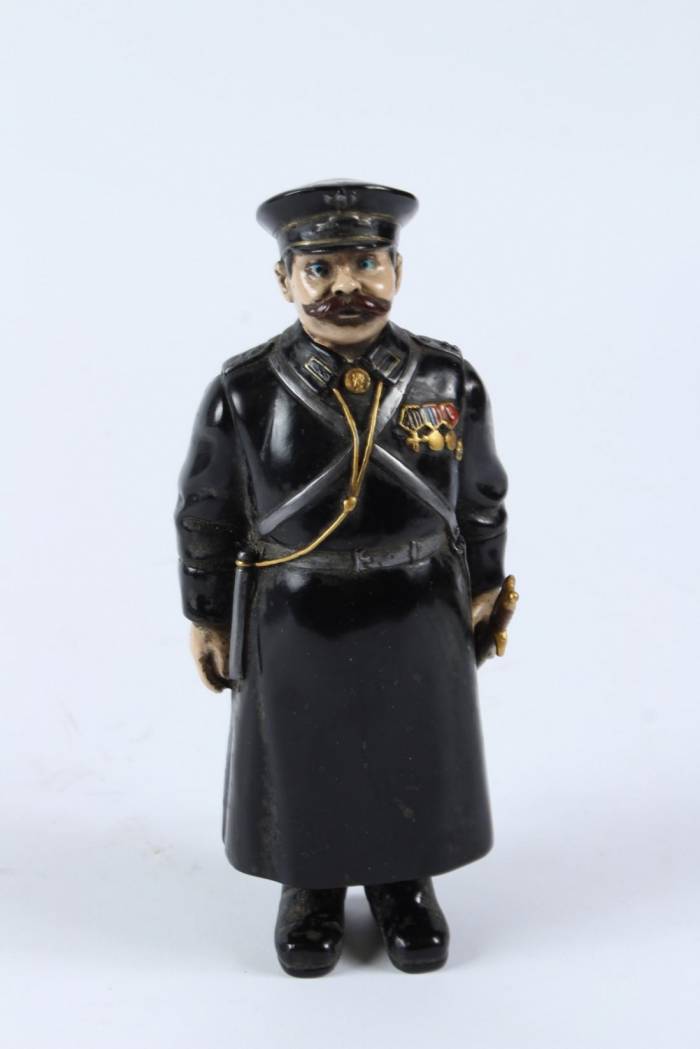
A rare pair of full-height bronze figures, executed in cold-painted technique, depicting the Kamer-Cossacks of the Russian Imperial Family’s personal guard A.A. Kudinov and N.N. Pustynnikov. The figures are shown in full ceremonial uniform with medals and decorations, wearing tall papakha hats and long kaftans enriched with gilt ornament. The composition was inspired by the celebrated commission of Emperor Nicholas II, for whom Henrik Wigström, chief jeweller of Fabergé, created gem-carved miniatures of the Kamer-Cossacks in 1912, presented respectively to the Dowager Empress Maria Feodorovna and the reigning Empress Alexandra Feodorovna.

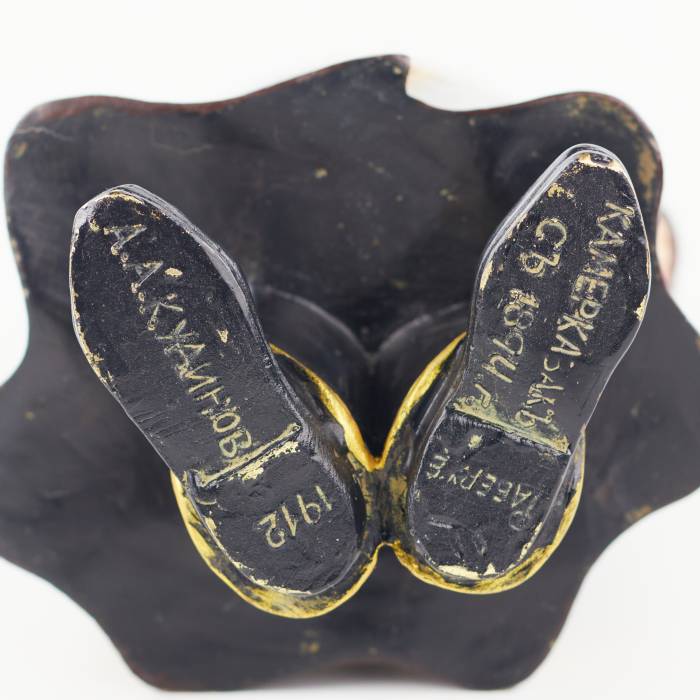
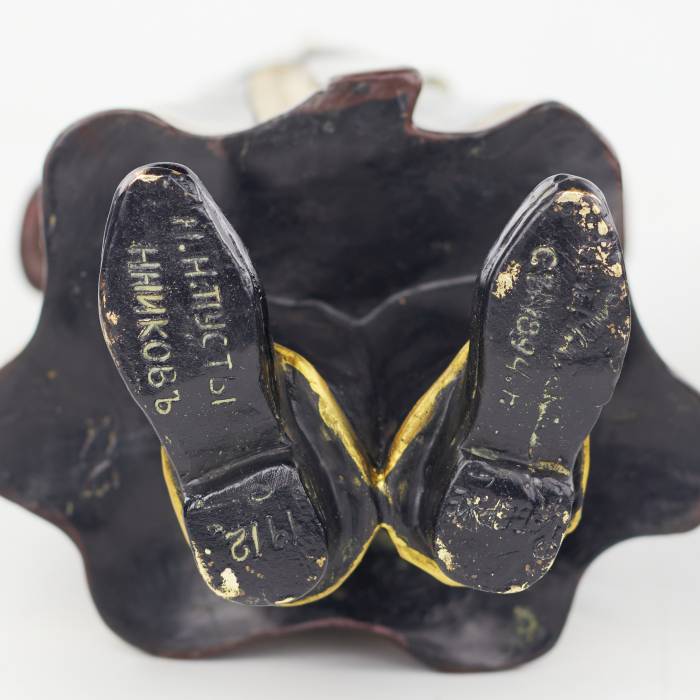
The soles bear inscriptions: “Kamer-Kazakh SV 1894”, “A.A. Kudinov”, “N.N. Pustynnikov”, “Fabergé 1912”.

Marks: Cast inscriptions on the soles: “KAMER-KAZAKH SV 1894”, “A.A. Kudinov”, “N.N. Pustynnikov”, “FABERGÉ 1912”.

Dimensions: Height 40 cm.

Condition: Good. Minor wear to gilding and painted surfaces, without visible losses. Figures preserve the sharpness of details and their collectible quality.

Provenance: Private European collection.

Art:
russia
Height:
40 cm
Width:
30 cm
Depth:
24 cm
Period:
Early 20th century
Country:
Russia
Condition:
Revive
Fair
Good
Very good
Like new

The Kamer-Cossacks formed part of the Russian emperors’ personal guard, serving both ceremonial and protective functions at court. Established in 1827, this corps included Cossack representatives dressed in highly ornate ceremonial uniforms. At the turn of the 20th century, they became inseparable from court etiquette, accompanying the sovereigns at parades, processions, and state occasions.

A.A. Kudinov and N.N. Pustynnikov played a unique role in the memory of the Romanov dynasty. In 1912, on the occasion of the Romanov Tercentenary, Emperor Nicholas II ordered Fabergé to create gem-carved miniatures of these guards, executed by Henrik Wigström. They were presented as imperial gifts to Maria Feodorovna and Alexandra Feodorovna, linking the guards’ service with Fabergé’s artistry.

These bronze cold-painted figures continue Fabergé’s tradition of “living portraits,” reflecting the artistry of early 20th-century Russian decorative art and its connection to Imperial court traditions. Rare and museum-worthy, they remain significant testimonies to the splendour of the Romanov era.

Good. Minor wear to gilding and painted surfaces, without visible losses. The figures retain sharp detail and collectible quality.

The condition report is provided for informational purposes only.

It is not comprehensive and may not reflect all defects, restorations, alterations, or adaptations, as Antiqon does not perform professional conservation-level assessments. The information is based on a qualified, yet subjective, evaluation by our specialists.Before purchasing, we recommend consultation with an independent expert.Please also consult our Terms and conditions and Glossary A-Z, which contain important information on lot characteristics and sale conditions.

Faberge (1872–1917)
FabergeFrance is considered to be the birthplace of the Faberge family. In 1800, Pierre Faberges grandfather Carl Faberge moved to Pernau, in Livonia (the Russian province of the Baltic), where he received Russian citizenship. In the following years, the son of Pierre Faberge, Gustav Faberge, an ambitious young jeweler, decided to move to St. Petersburg where he continued to engage in jewelry On May 30, 1846, Carl Faberge was born into the Faberge family, at that moment his father was already heading a successful business in which several craftsmen from Northern Europe and Germany worked. At the age of 18, Carl Faberge travels to Europe to learn jewelry craft from the best professionals of that time. Throughout his stay, he explores the decorative arts created by his predecessors, imbued with new ideas that will fuel him for the rest of his career. In 1872, Carl Faberge returned to St. Petersburg and joined his fathers business. In 1882, after the death of Gustav Faberge, Karl took over the management of the company. In a short time, Karl surpasses the achievements of his own father: in the same year he receives the official title of master of jewelry, and the exhibition in Moscow leads to the fact that the Emperor Alexander III notices Faberges talent, who soon elevates to the rank of court jeweler. At this time, Faberge received his first order from the monarch: the emperor orders Easter gift for his wife, Maria Feodorovna, an original gift of a piece of jewelry and of art - an Easter egg, which became the beginning of a series of Faberge Easter eggs that imperial family ordered yearly. The Empress was so fascinated by the gift that Fabergé was turned into a court jeweler, he received an order to make an egg every Easter ; the product had to be unique and contain some kind of surprise, that was the only condition. The next emperor, Nicholas II, kept this tradition, each spring giving, two eggs as a gift - one to Maria Feodorovna, his widowed mother, and the second to Alexandra Feodorovna, the new empress. The production of each egg took almost a year. As soon as the sketch was approved, a whole team of the firms jewelers took over the work, the names of some of them survived. The contribution of the master Mikhail Perkhin is especially great. Also important jewelers were August Holstrom, Henryk Wigstrom, Eric Collin. The series of imperial eggs had such fame and success that the Fabergé company made several products for private customers (15 are known). Among them, a series of seven eggs, presented by the gold miner Alexander Ferdinandovich Kelkh to his wife, stands apart. The rest of the famous eight Fabergé eggs were custom-made for Felix Yusupov, Emmanuel Nobel, the Rothschilds, the Duchess of Marlborough and unidentified individuals. They are not as luxurious as the imperial ones, and they are not unique, they often repeated already invented for royal family. Having received the patronage of the royal family and the title of “jeweler of His Imperial Majesty and jeweler of the Imperial Hermitage”, the Faberge firm became famous in Europe. Many relatives of the imperial family in Great Britain, Denmark, Greece and Bulgaria received items as gifts. In 1900, in Paris, Faberge received the title of "Master of the Paris Guild of Jewelers", and he was also awarded the Order of the Legion of Honor. The war of 1914 significantly undermines the financial affairs of the Faberge company. In 1917, after the beginning of the soviet revolution, the Faberge family completely stopped production and went to immigration to the city of Riga, then moved to Switzerland.Carl Faberge died in 1920 in Swiss city of Lausanne.

Stay up to date with new arrivals
Save Bronze sculptures and we let you know when new listings appears in this category
Save

Related items