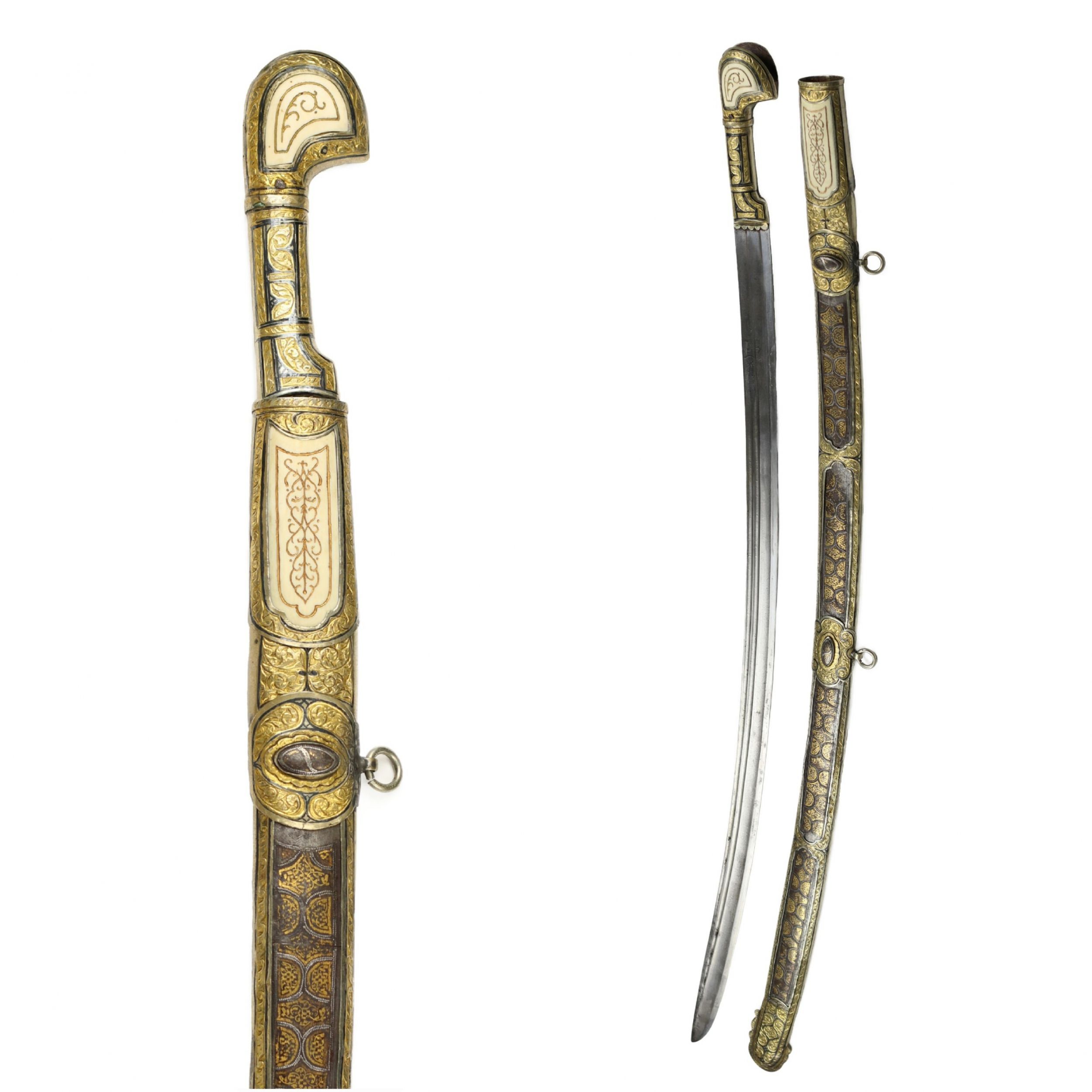
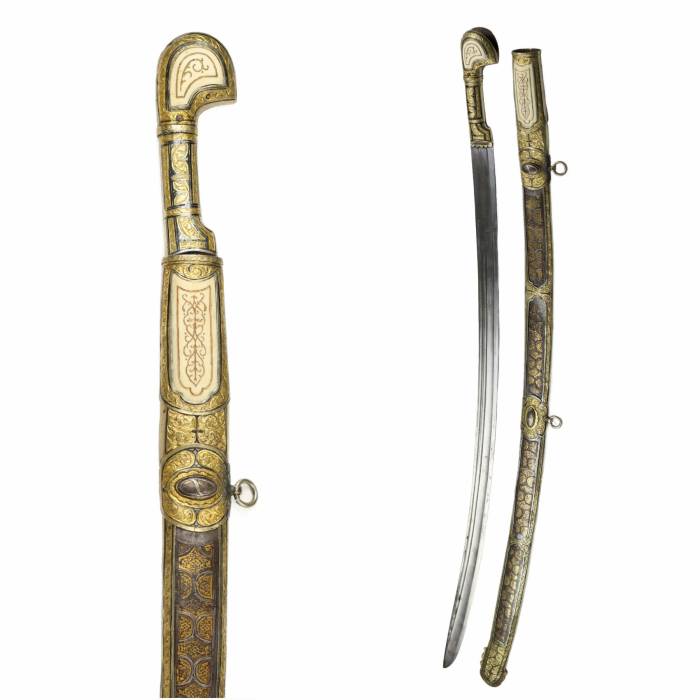
CAUCASIAN SHASHKA WITH GILT SILVER AND BONE DECORATION RUSSIA, 19TH CENTURY
AntiqonART consultant will contact you within one business day after receiving your request.
Discover how the value of similar works has evolved over the past 10 years. Art is not only beauty — it's an investment.
Discover how the value of similar works has evolved over the past 10 years. Art is not only beauty — it's an investment.
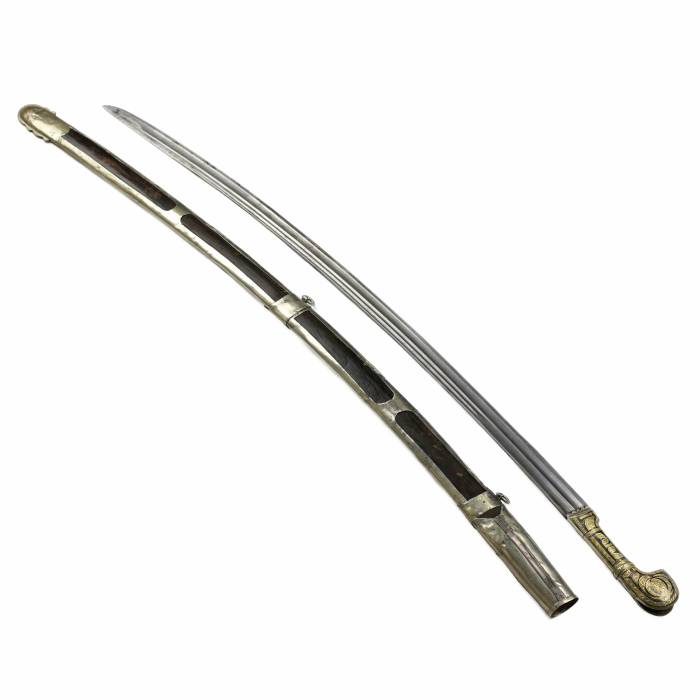
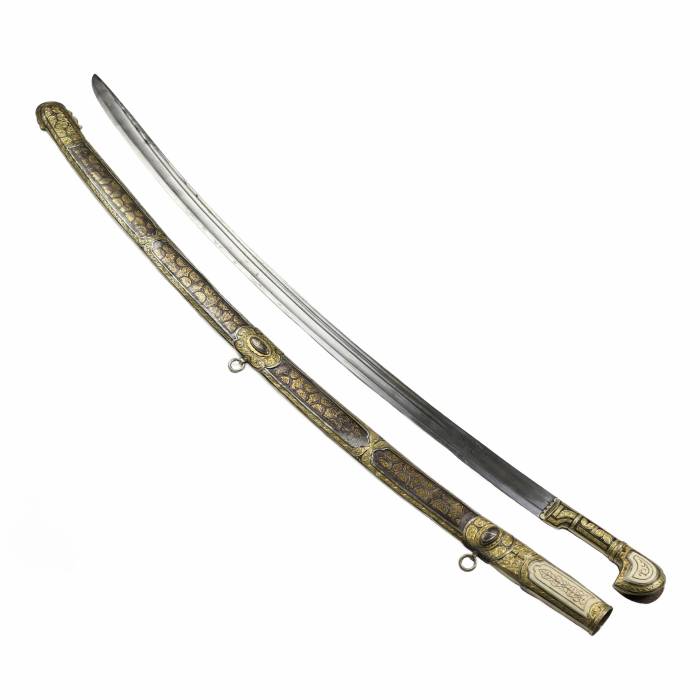
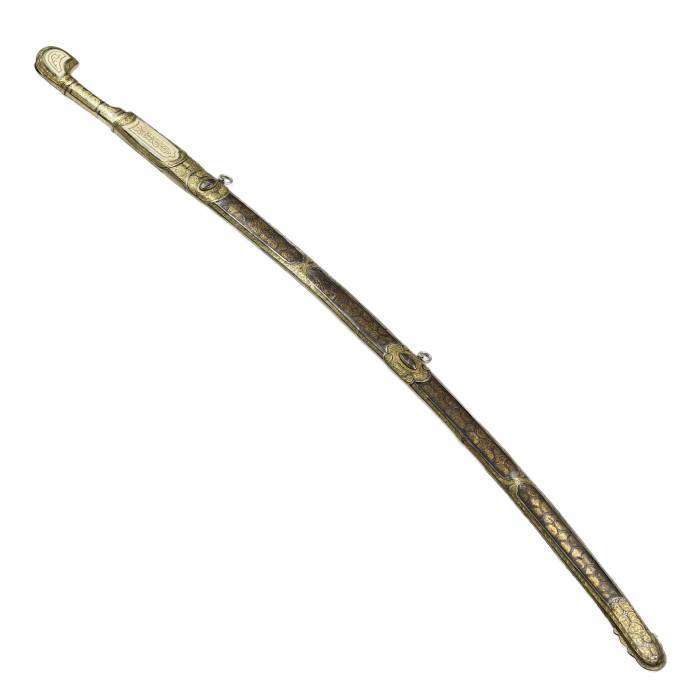
A ceremonial Caucasian shashka executed in the traditions of the North Caucasian arms workshops of the second half of the 19th century. The piece represents a distinguished example of edged weaponry of the Russian Empire, combining martial functionality with refined metal craftsmanship characteristic of Dagestan and related regional centres.
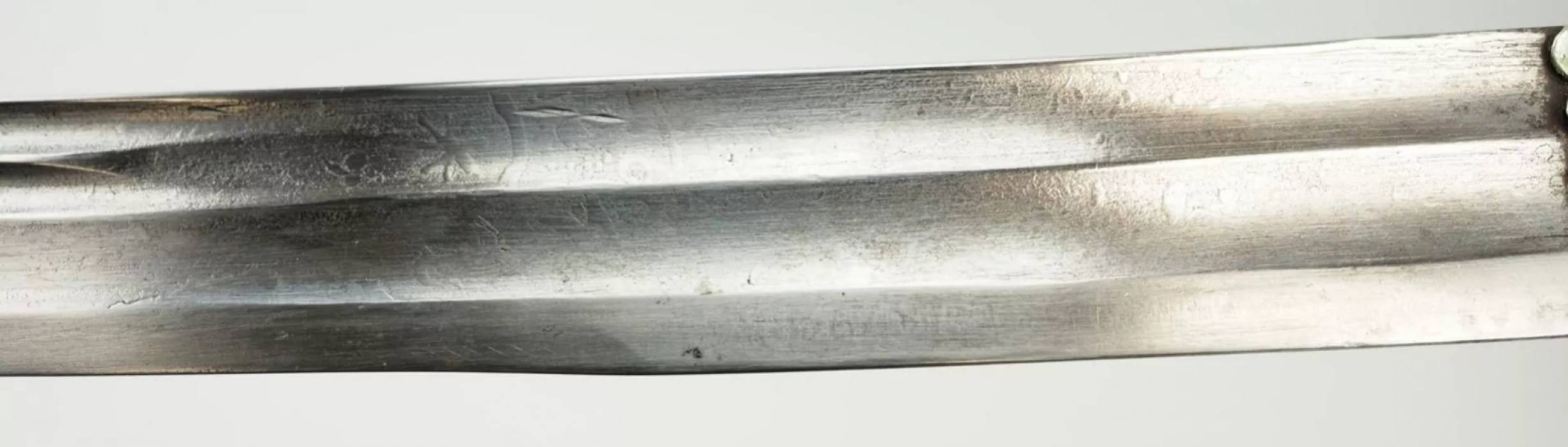
The blade is steel, single-edged and moderately curved, with fullers providing both structural strength and lightness. The surface is free of etched ornament, bearing engraving on one side only. Its geometry corresponds to the classical Caucasian shashka type, designed for powerful cutting strokes with extended draw, distinguishing it from European sabres.
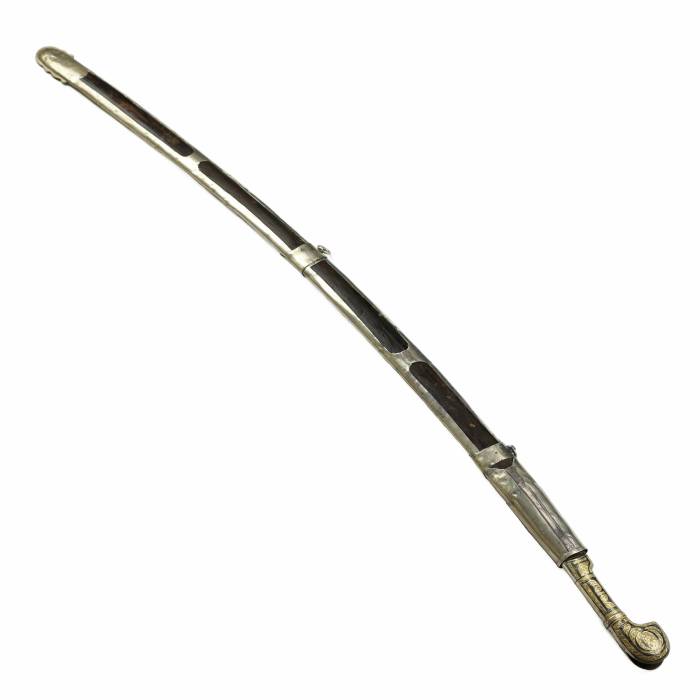
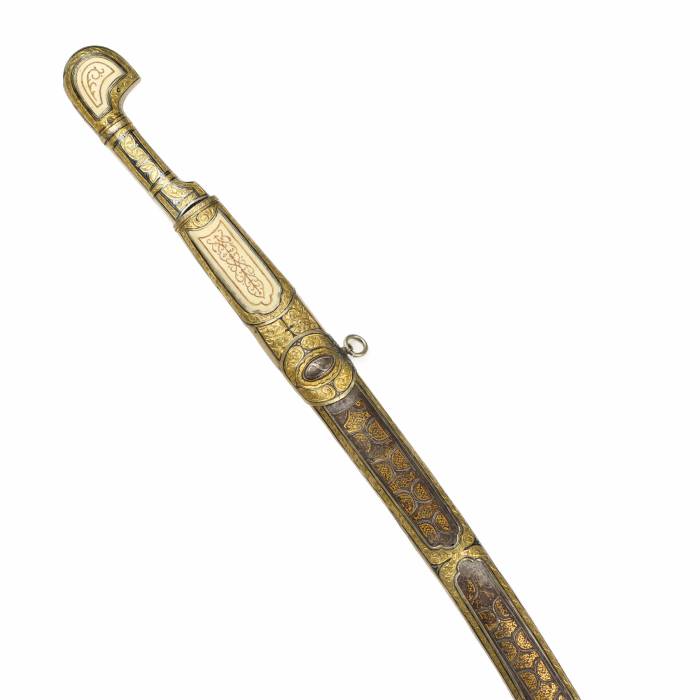
The hilt is without a guard and features the characteristic “goose-neck” pommel. The grip scales are made of bone and secured with gilt silver mounts. The silver elements are decorated with niello ornament and stylised vegetal motifs, executed in traditional engraving filled with blackened alloy. The contrast between gilt silver, deep niello and light bone creates a striking decorative effect and emphasises the ceremonial nature of the weapon.
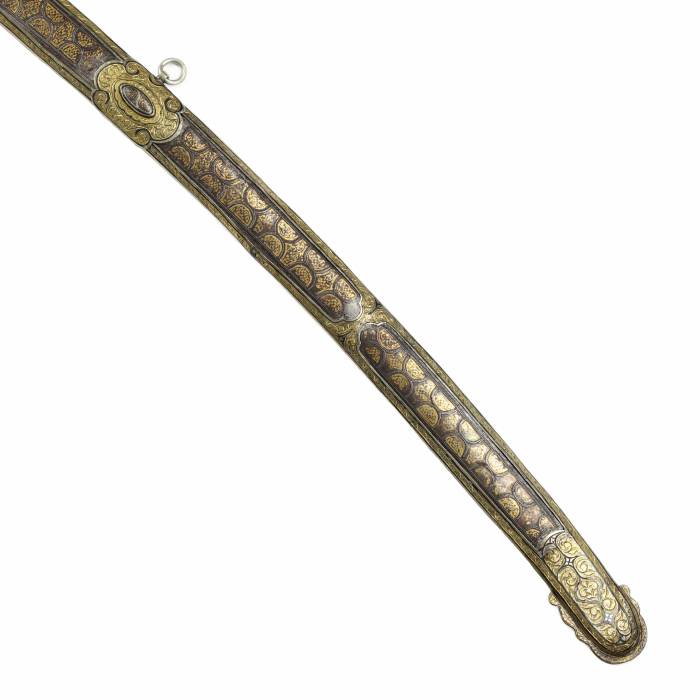
The scabbard is wooden, leather-covered, and fitted with richly decorated gilt silver mounts. The ornamental system is structured around repeating medallions and stylised vegetal motifs typical of 19th-century Caucasian metalwork. Suspension rings for a sword belt are present. The construction corresponds to the Cossack method of wear adopted after the official inclusion of the shashka into the armament of the Russian Army.
The artistic quality of execution, together with the use of gilt silver and bone inlay, suggests a ceremonial or officer’s weapon intended not only for service but also for the display of social rank.
Marks: No marks observed on the visible elements.
Dimensions: Overall length - 104 cm; Width - 9 cm.
Condition: Good. Natural patina to the silver mounts, minor traces of age and light surface scratches to the blade. Decorative elements preserved.
Provenance: Private collection.
The Caucasian shashka of the 19th century occupies a distinguished position in the history of Russian edged weapons and in the broader narrative of imperial military culture. Preserved examples in the collections of the State Historical Museum in Moscow, the Moscow Kremlin Museums and the State Hermitage Museum demonstrate the technical evolution and artistic refinement of this weapon type. Originally developed among the peoples of the North Caucasus, the shashka emerged as a highly efficient cutting weapon distinguished by the absence of a cross-guard, a feature that allowed exceptional freedom of wrist movement and rapid unsheathing.
By the mid-19th century, the Russian Empire formally adopted the shashka for Cossack regiments and later for regular cavalry units. This institutional recognition led to partial standardisation of dimensions and blade curvature; however, regional workshops retained considerable autonomy in the decoration of hilts and scabbards. As a result, alongside regulation military patterns, richly ornamented ceremonial and officer’s examples were produced, reflecting both personal prestige and regional artistic identity.
Dagestani centres, particularly Kubachi, became synonymous with high-quality silver-mounted weaponry. Museum research published by curators specialising in Caucasian decorative arts emphasises the importance of niello technique in these workshops. Niello involved engraving the silver surface and filling the incised lines with a black alloy composed primarily of silver, copper and lead, then firing and polishing the object to achieve a sharp graphic contrast. The interplay of gilt silver, dark niello and light organic materials such as bone or ivory created a distinctive visual language immediately recognisable in museum collections.
The integration of bone elements in the hilt construction further enhanced the ceremonial status of the weapon. Such materials were valued not merely for durability but for their aesthetic refinement and symbolic associations. In the social and military hierarchy of the Russian Empire, elaborately mounted shashkas functioned as visible markers of rank, honour and affiliation. They were frequently worn as part of formal attire and appeared in portraiture of officers and representatives of the Caucasian nobility.
Thus, the 19th-century Caucasian shashka represents more than a functional arm. It embodies the intersection of indigenous Caucasian martial traditions and imperial Russian military structure, while simultaneously reflecting the high artistic standards of regional metalworking schools. Within museum scholarship, these weapons are regarded as significant artefacts of material culture, documenting both the evolution of cavalry armament and the flourishing of Caucasian decorative metal art under imperial patronage.
Condition consistent with age. Blade with light traces of use and minor surface scratches. Silver mounts with even patina and no significant losses to decoration.
The condition report is provided for informational purposes only.
It is not comprehensive and may not reflect all defects, restorations, alterations, or adaptations, as Antiqon does not perform professional conservation-level assessments. The information is based on a qualified, yet subjective, evaluation by our specialists.Before purchasing, we recommend consultation with an independent expert.Please also consult our Terms and conditions and Glossary A-Z, which contain important information on lot characteristics and sale conditions.