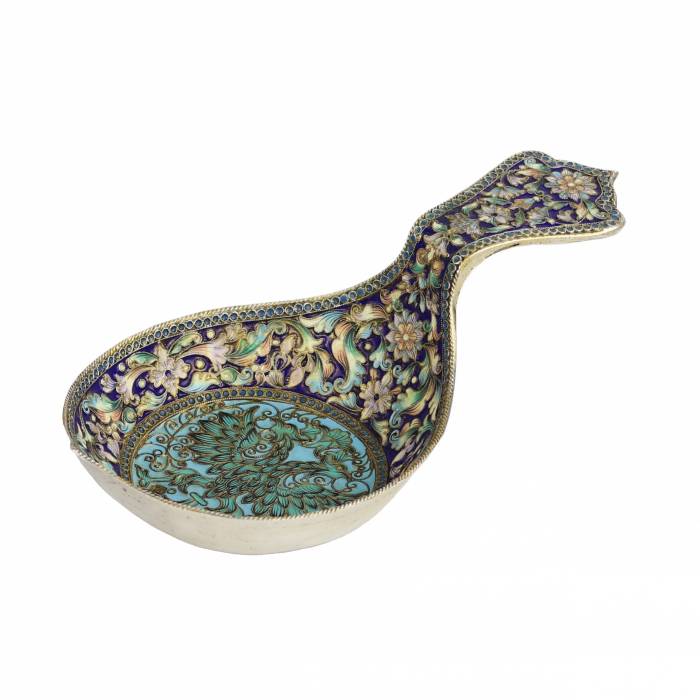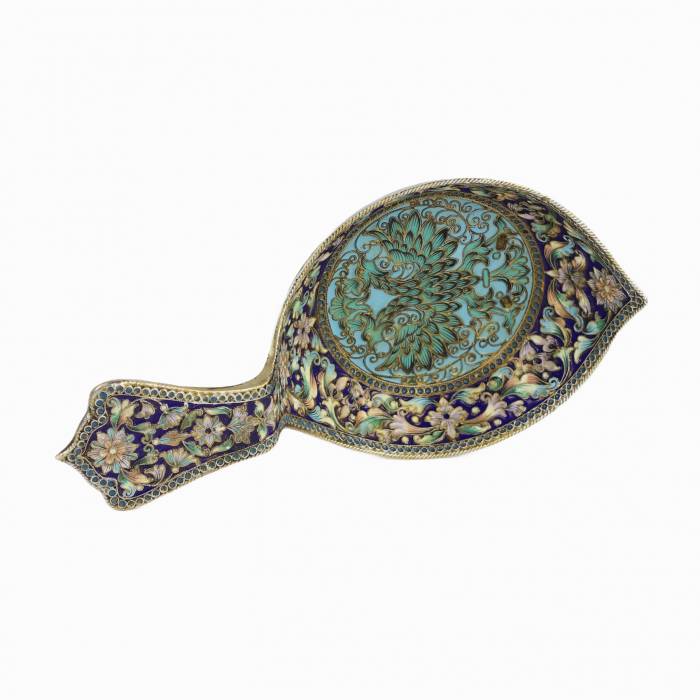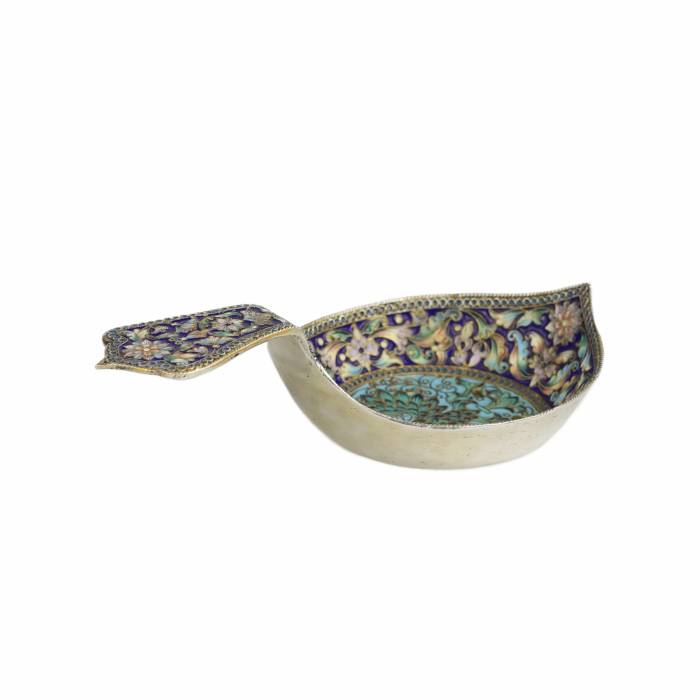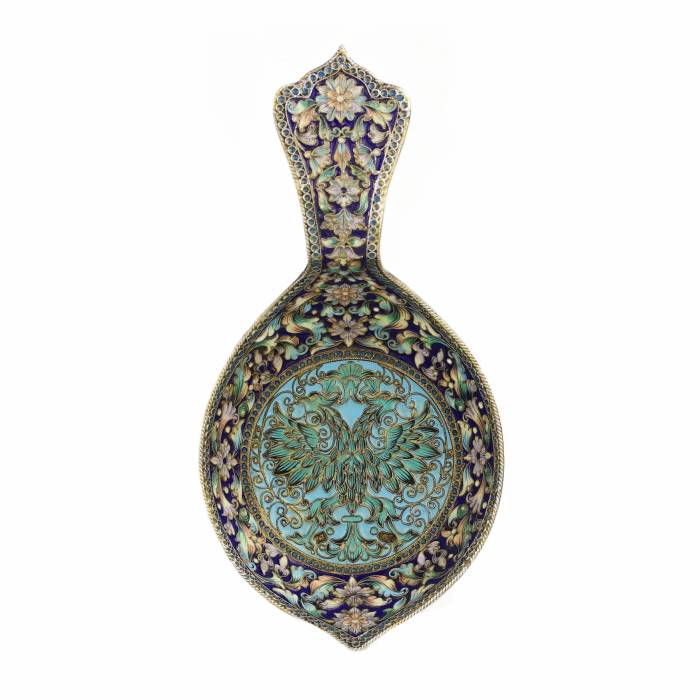

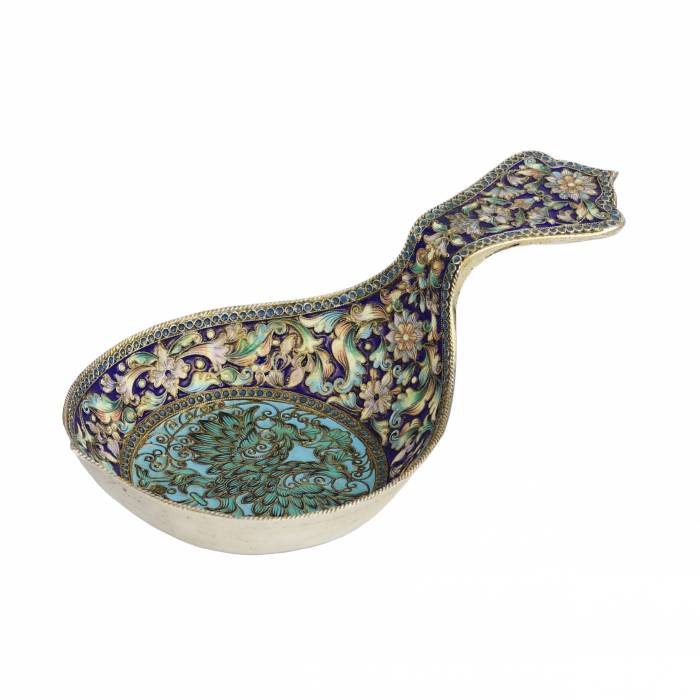
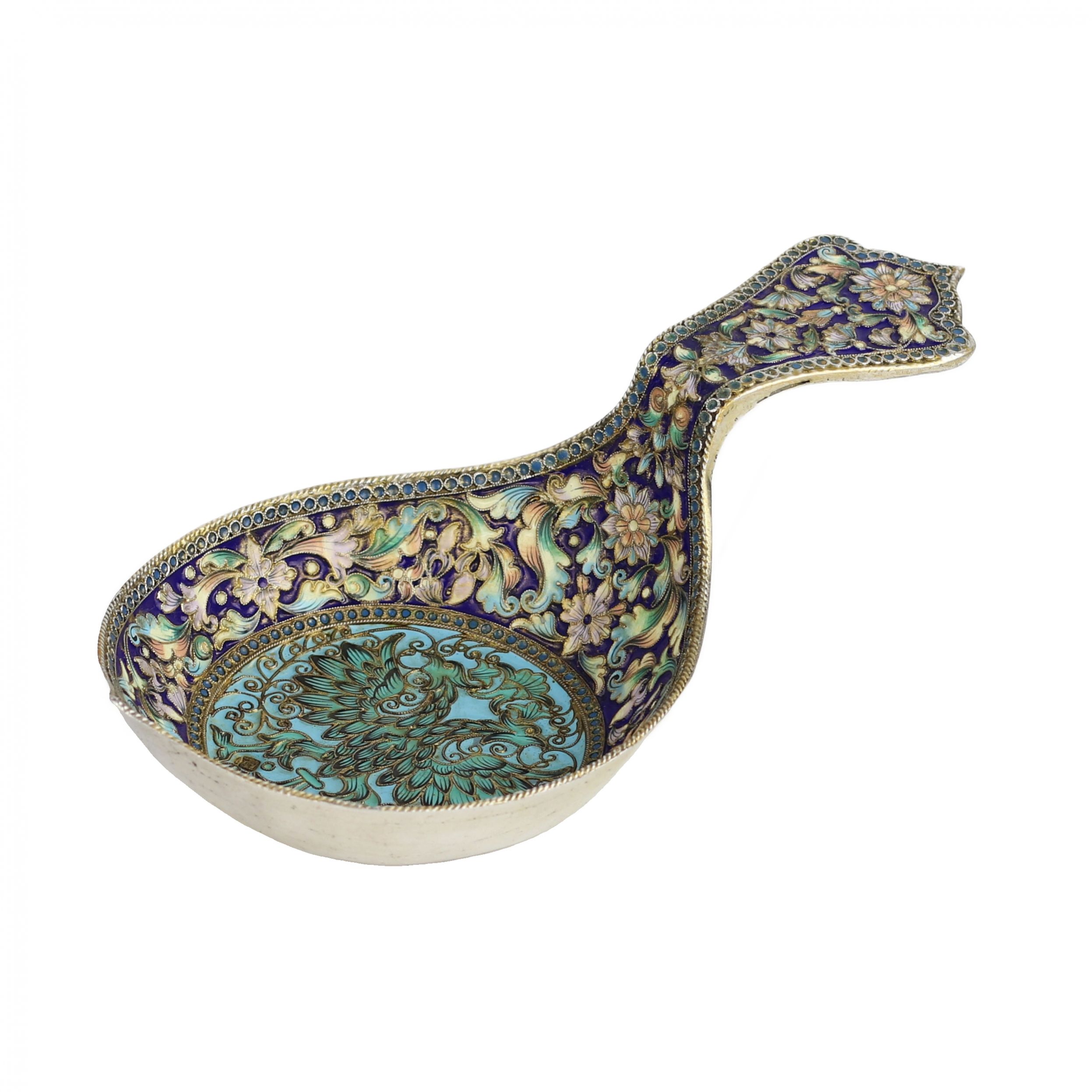
Silver ladle with enamel. St. Petersburg, last quarter of the 19th century.

Silver ladle with enamel. St. Petersburg, last quarter of the 19th century.

ID-ANTQ-12185
November 29, 2025 12:00 PM GMT+02:00
Live auction is finished
Estimate
2000 - 3000 EUR
Bidding is closed
Use our cost calculator

Discover how the value of similar works has evolved over the past 10 years. Art is not only beauty — it's an investment.

Price History

Discover how the value of similar works has evolved over the past 10 years. Art is not only beauty — it's an investment.

Request a Shipping Quote
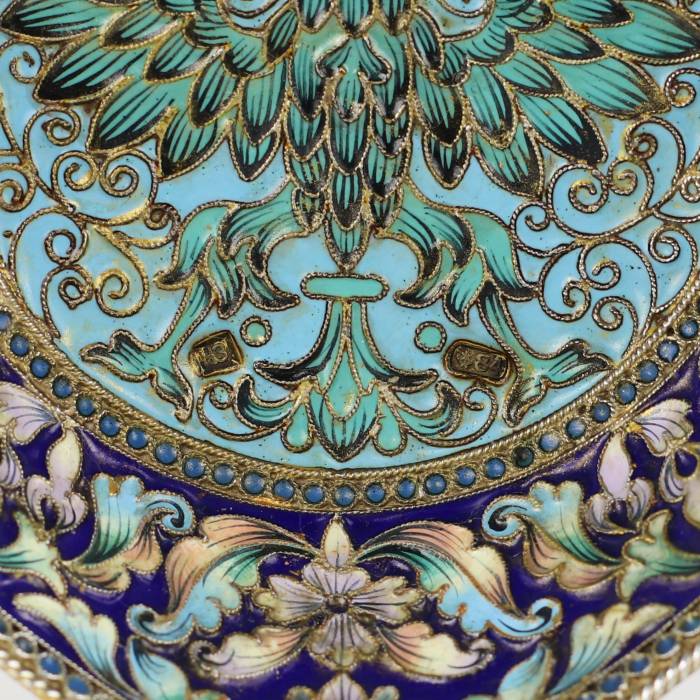
An exquisite silver ladle, made in the shape of a boat, is a magnificent example of decorative and applied art of the late 19th – early 20th centuries, created in the neo-Russian style. This artistic tradition combines elements of ancient Russian architecture and ornamentation, which is clearly evident in the design of the ladle. The inside of the ladle and the curved handle are decorated with an elegant floral ornament made using the cloisonné enamel technique. The central element of the composition is a double-headed eagle, the official symbol of the Russian Empire, skillfully decorated with turquoise enamel and framed by a refined gilded edging. The composition is complemented by a complex floral pattern made in rich and pastel shades, creating a harmonious balance and emphasizing the sophistication of the work. Hallmarks: The master`s name in Cyrillic letters NZ. Assay mark of Saint Petersburg with the image of the city coat of arms and the number 84, in an oval shield, corresponding to the last quarter of the 19th century. Dimensions: Length: 17 cm, Width: 9 cm, Height: 5 cm. Weight: 216 g.
Art:
russia
Height:
9 cm
Width:
17 cm
Depth:
5 cm
Period:
At the turn of 19th -20th century
Style:
Romanticism
Country:
Russia, St. Petersburg
Material:
Silver 84, Cloisonné enamel, Gilding
Condition:
Revive
Fair
Good
Very good
Like new

The condition report is provided for informational purposes only.

It is not comprehensive and may not reflect all defects, restorations, alterations, or adaptations, as Antiqon does not perform professional conservation-level assessments. The information is based on a qualified, yet subjective, evaluation by our specialists.Before purchasing, we recommend consultation with an independent expert.Please also consult our Terms and conditions and Glossary A-Z, which contain important information on lot characteristics and sale conditions.

Neo-Russian style.
The neo-Russian or pseudo-Russian style is part of the aesthetics of historicism and national identity of the 1815-1880s. It arose as an official position and an internal response of society to the victory of 1812. Concerned about all types of artistic creation, social and philosophical life of society. Determined the type of official architecture, private brick ward architecture, historical graphics and painting, the theme of decorative and applied art. The formation of the style is associated with the question of the originality of Russian history, developed by the Slavophiles. The main forms and techniques of decoration are borrowed from wooden architecture. Geometric definiteness and ethnographic fragmentation of the decor prevail. The style was especially popular in silver. Ladles, brothers, saltcellars in the form of thrones-towers, etc. expanded the range of Russian craftsmen of the second half of the 19th century. The neo-Russian style became a stable form of thought for most of the 19th century until the advent of modernity.
... Read More

Stay up to date with new arrivals
Save Russian silver and we let you know when new listings appears in this category
Save

Related items