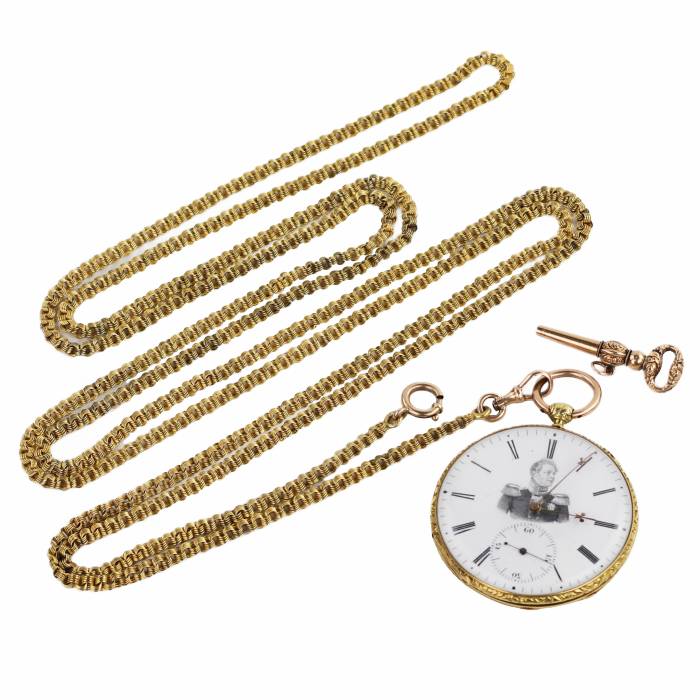
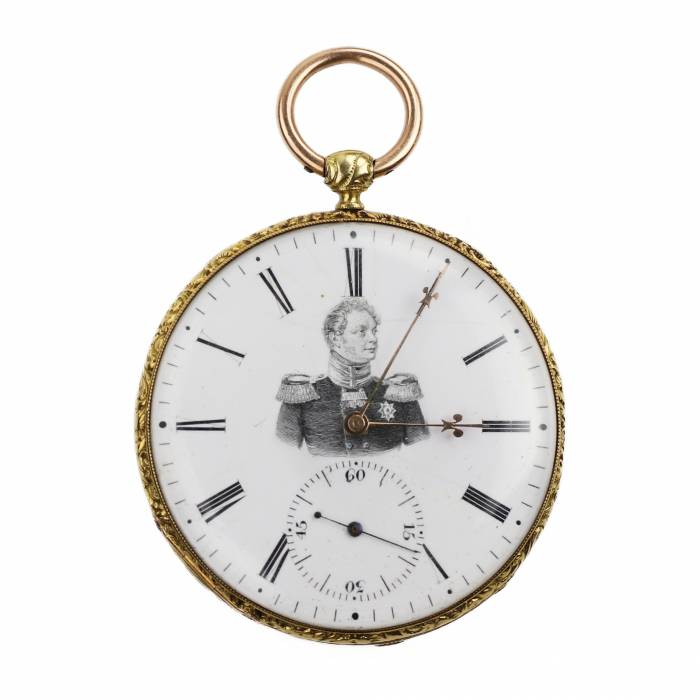
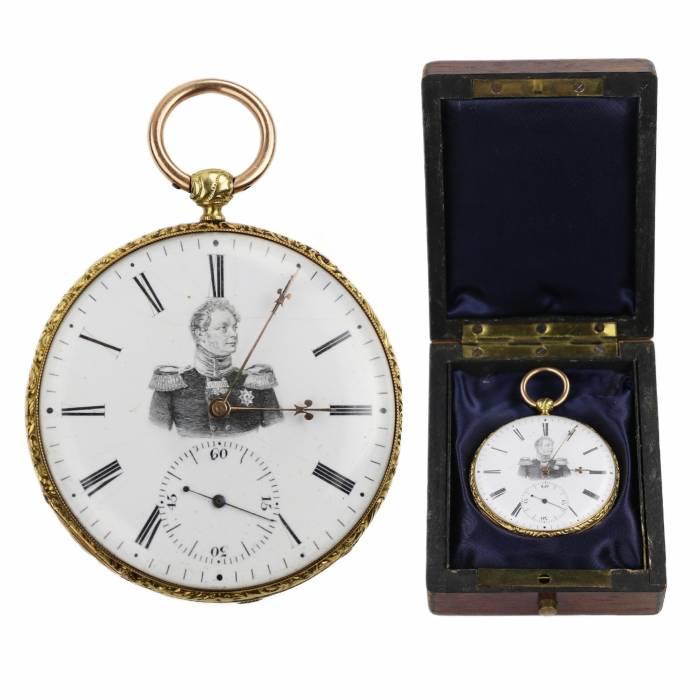
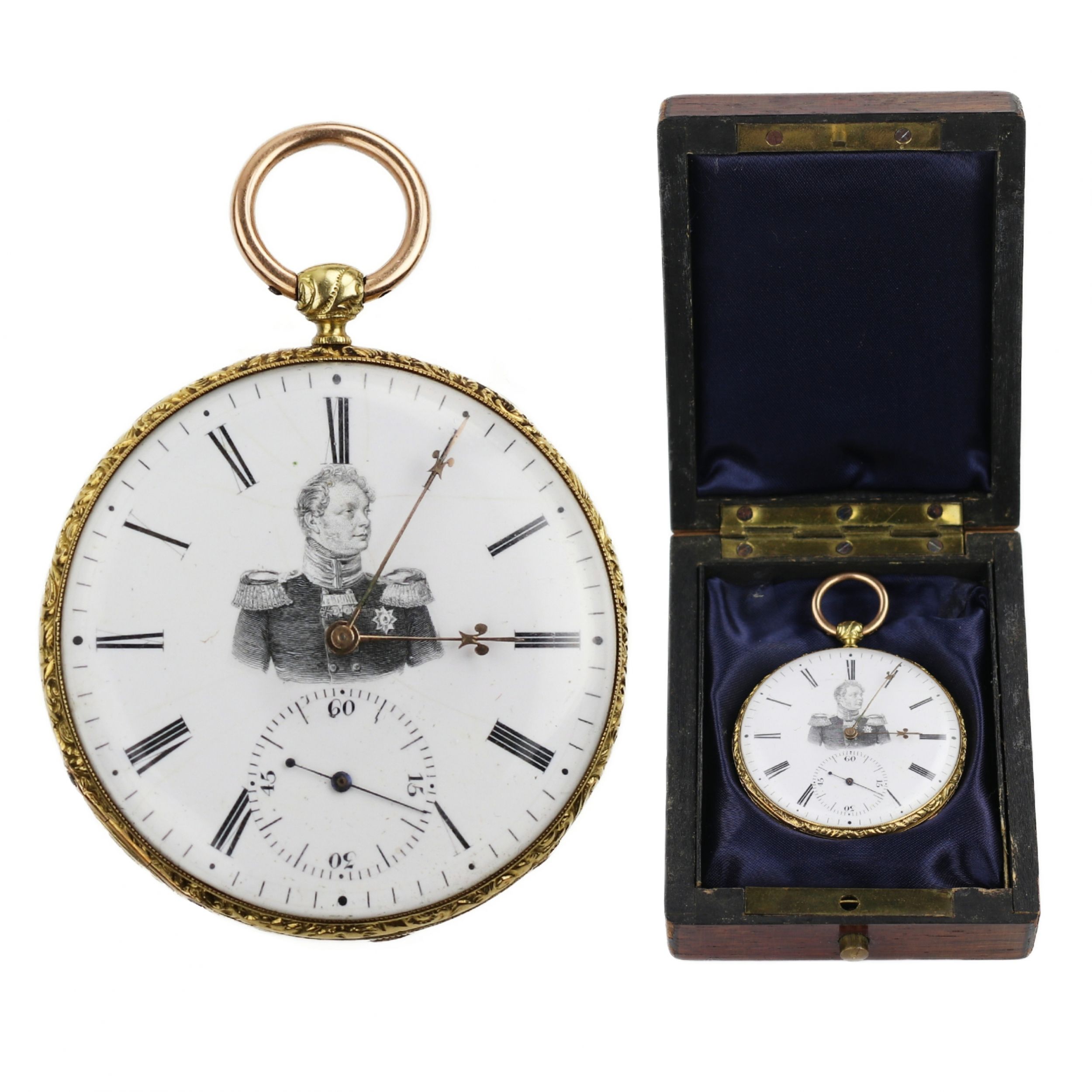
Portrait pocket watch depicting Emperor Alexander I in a gold case with its original Russian dress chain, representing a rare memorial and artistic testament to the era of the Napoleonic Wars and the subsequent Congress of Vienna. An outstanding example of Swiss horological art of the first quarter of the 19th century, created in the workshop of Courvoisier Fils in Chaux-de-Fonds, combining mechanical precision with the political iconography of its time.
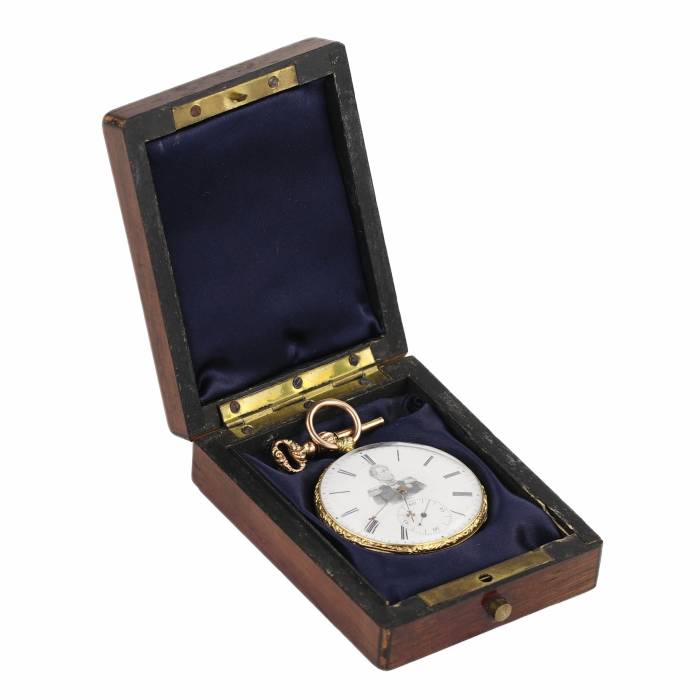
The enamel dial features a finely executed miniature portrait of Alexander I in full ceremonial uniform adorned with orders, rendered with remarkable detail in delicate enamel painting. Roman numerals, a subsidiary seconds dial at the 6 o’clock position, and elegant gilt hands lend harmonious balance to the composition. The portrait is seamlessly integrated into the surface of the dial, forming a unique synthesis of memorial medallion and functional timepiece.
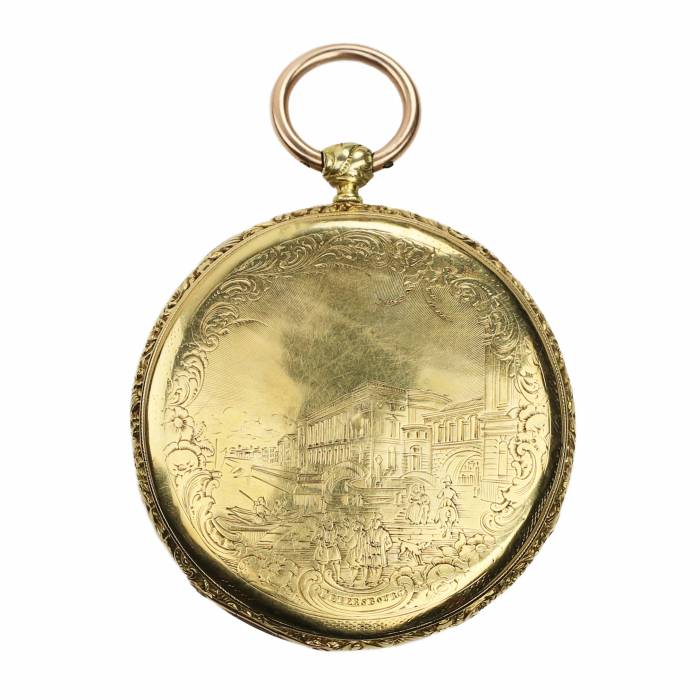
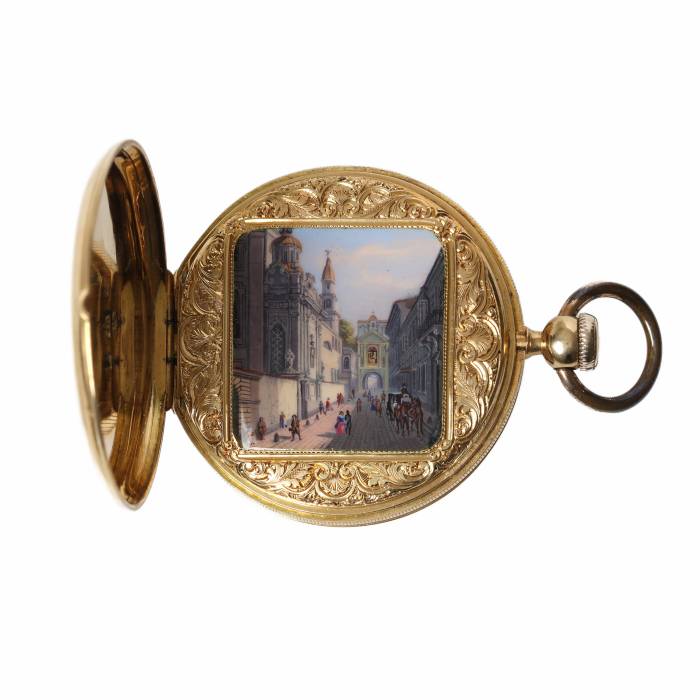
The reverse cover is decorated with an exquisitely engraved panoramic view of Saint Petersburg, depicting the Winter Palace, the embankment of the Neva River and the architectural ensemble of the imperial capital. The inscription PETERSBOURG is engraved below. The ornamental frame is executed in the Empire style with a vegetal border and a radiating sunburst motif emerging from the center of the composition.
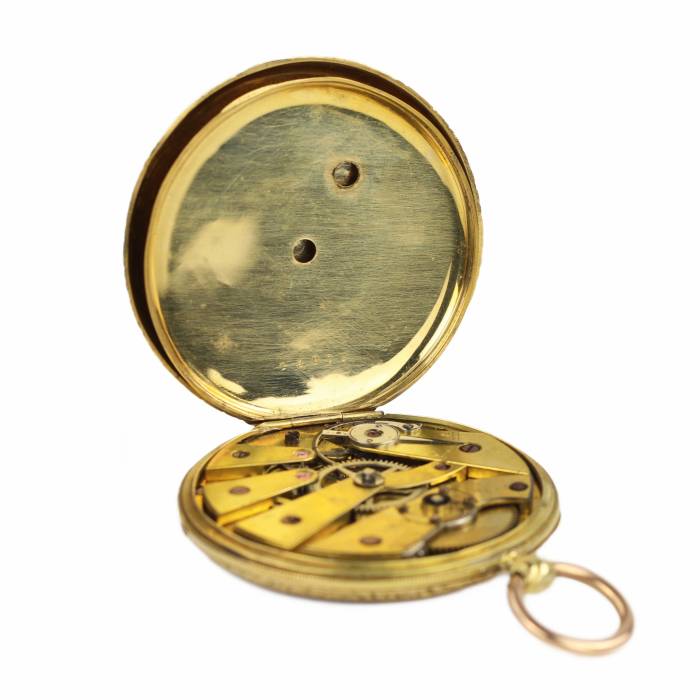
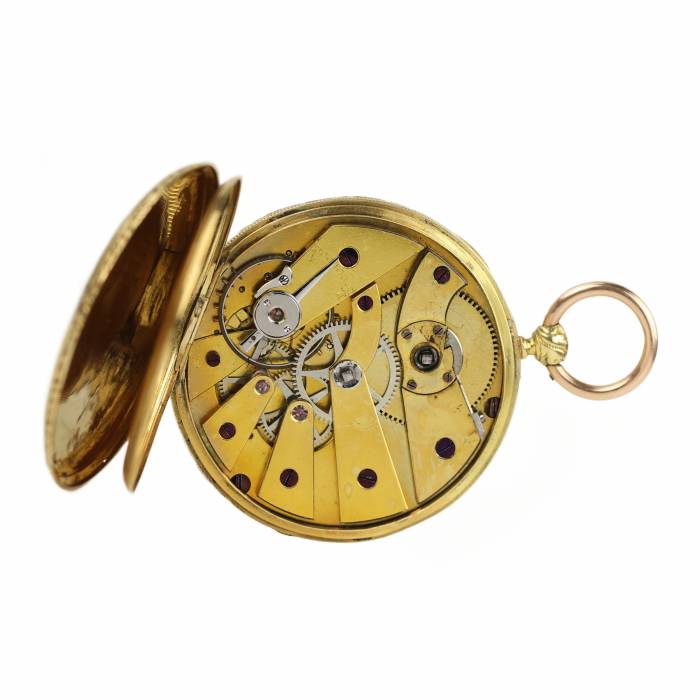
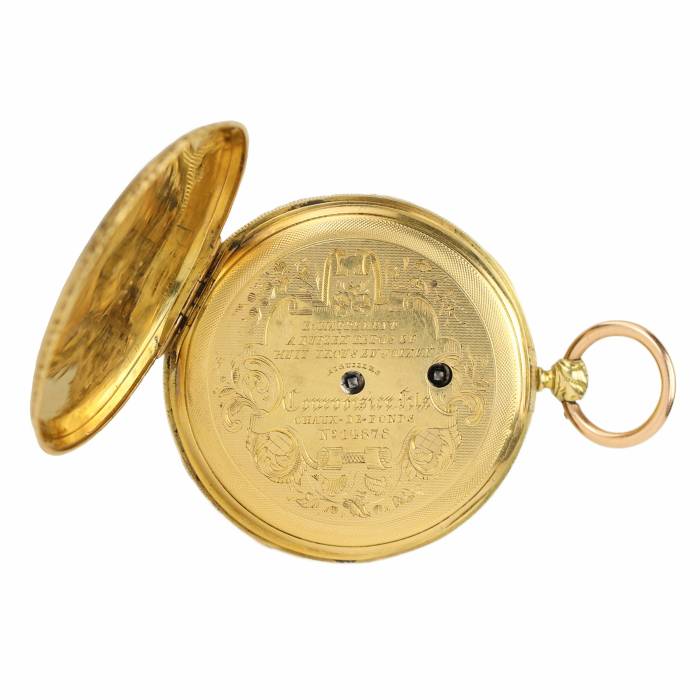
The high quality movement with bridge construction and ruby jewels bears the engraved inscription:
B. Courvoisier à Tunsberg et huit trous en rubis, Chaux-de-Fonds, No. 14878.
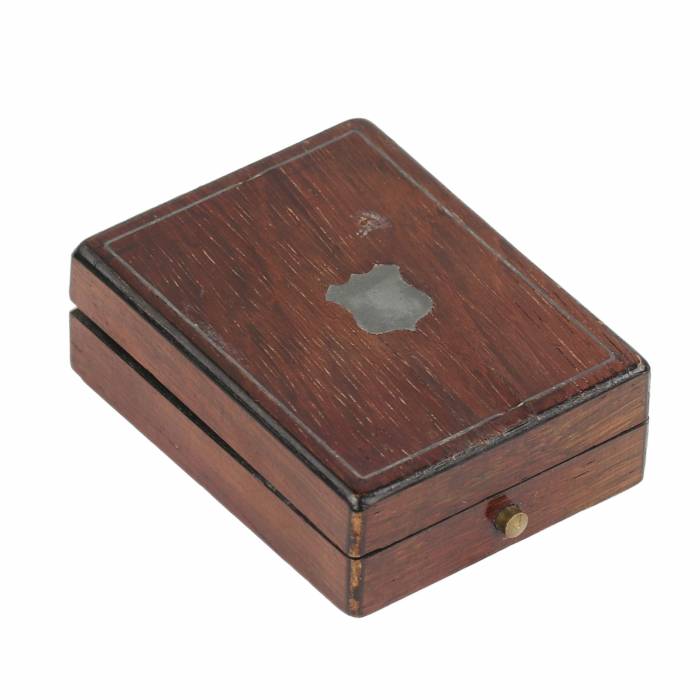
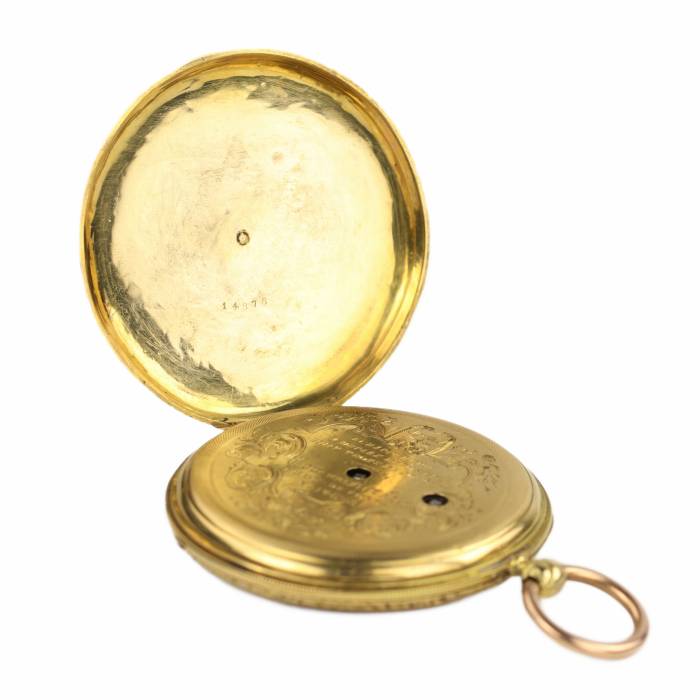
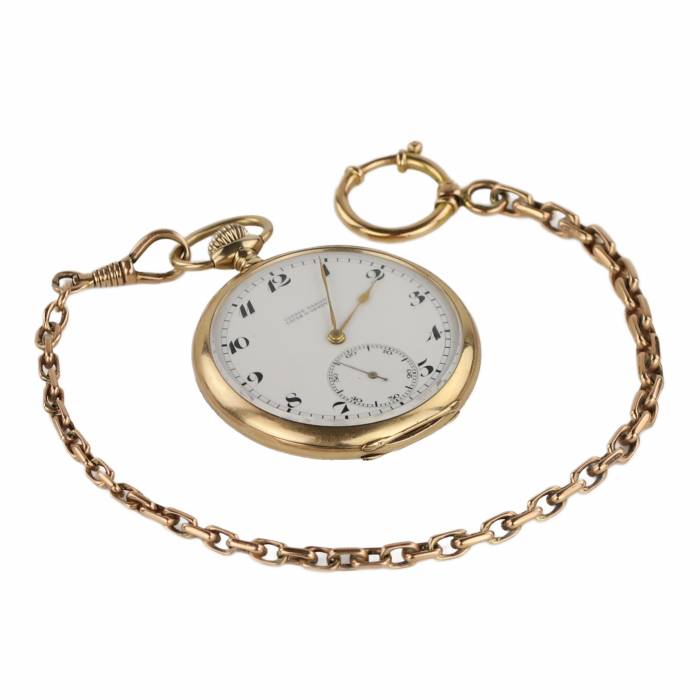
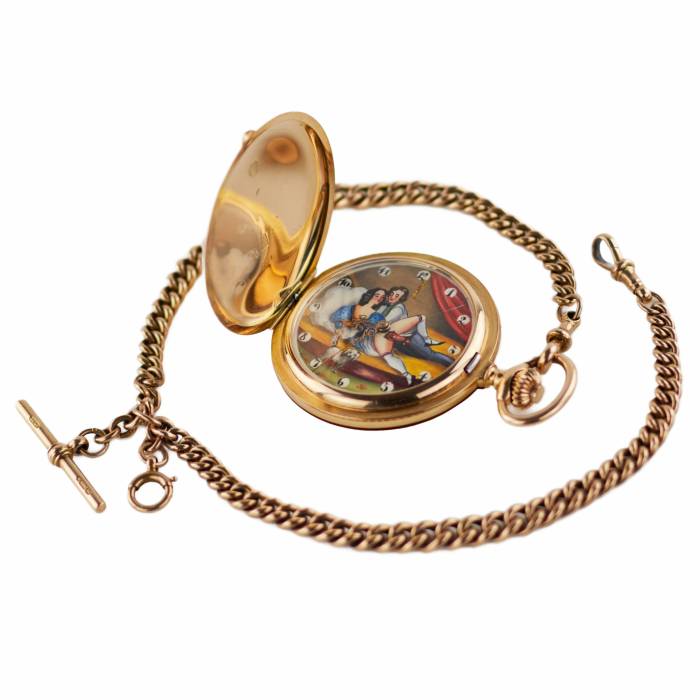
The watch is accompanied by its original Russian 56 standard gold dress chain and a hand finished winding key. The original fitted case with dark blue velvet lining has been preserved.
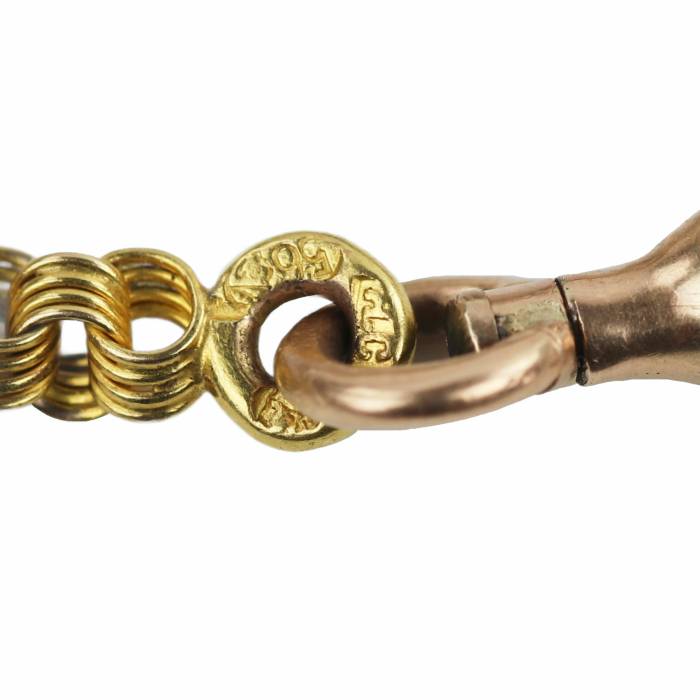
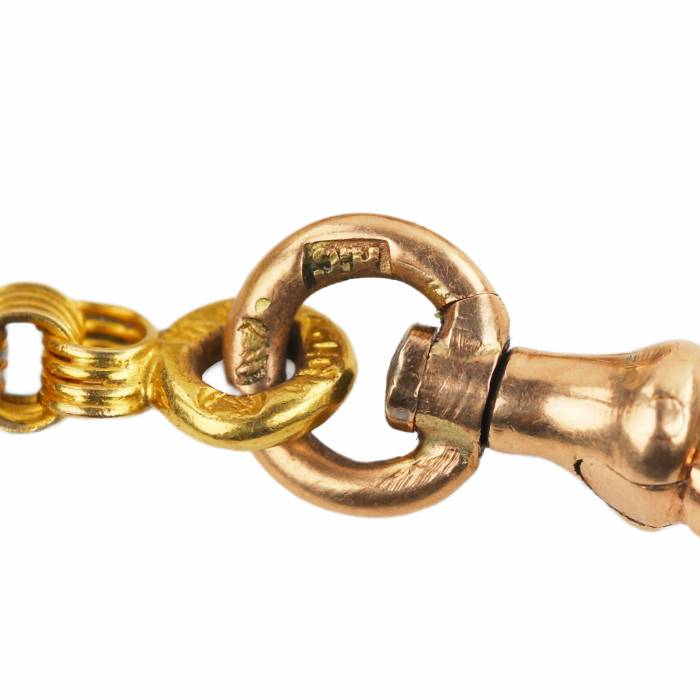
Hallmarks: Case: Swiss 585 standard (14K), assay marks. Chain: partially legible marks, maker’s mark HC, Saint Petersburg coat of arms, Russian 56 standard (18K), marks on clasp and link.
Dimensions: Watch: diameter 46 mm. Chain: length 154 cm.
Weight: Watch: 53.51 g. Chain: 38.45 g.
Condition: Excellent. The case, movement, enamel dial with miniature, chain and fitted case are preserved in authentic collector’s condition, without losses or later interventions.
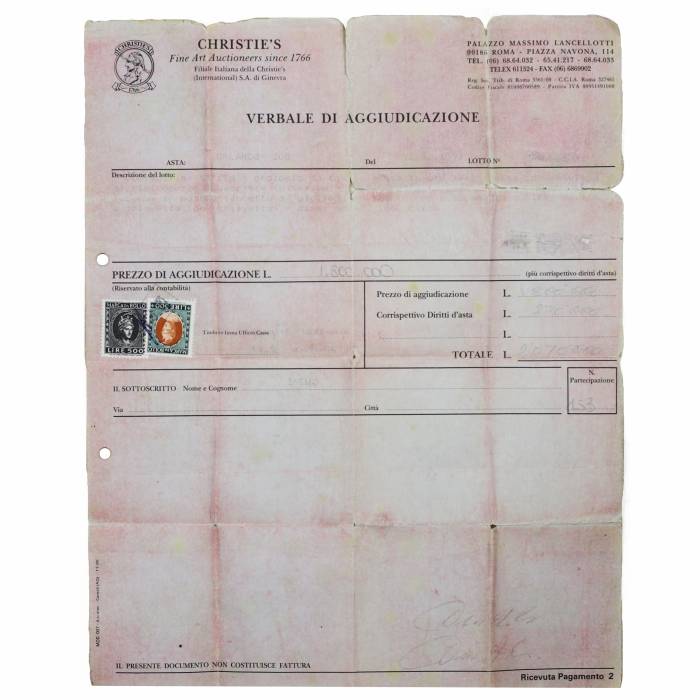
Provenance: Christie’s Auction, Rome, Palazzo Massimo Lancellotti branch.
Period:
Early 19th century
Portrait pocket watches of the early 19th century constitute a distinctive category of objects combining precise timekeeping with political symbolism. Following the defeat of Napoleon and the resolutions of the Congress of Vienna in 1815, the image of Emperor Alexander I assumed a central position in European visual culture. His likeness was widely disseminated through engravings, medals, miniatures and luxury objects, shaping the canonical image of the monarch as liberator of Europe and guarantor of the post-Napoleonic order.
Chaux-de-Fonds, one of the principal centers of Swiss watchmaking, was deeply integrated into international trade networks during the first quarter of the 19th century, including the Russian Empire and Scandinavia. Workshops such as Courvoisier Fils produced technically refined movements as well as richly decorated commemorative timepieces intended for diplomatic circles and affluent patrons. The inscription “à Tunsberg” reflects commercial ties with Northern Europe, characteristic of Swiss export activity of the period.
The iconography of Alexander I in ceremonial uniform with orders corresponds to official state portraits disseminated after 1812. The engraved panorama of Saint Petersburg reinforces the memorial character of the object, uniting sovereign and capital within a coherent symbolic program. The case demonstrates the aesthetic principles of the Empire style prevalent between 1810 and 1825, defined by classical symmetry, ornamental borders and radiant motifs inspired by Antiquity.
Today such watches are regarded as rare testimonies of transnational artistic exchange between Switzerland and the Russian Empire in the immediate post-Napoleonic era and are of particular interest to collectors of imperial memorabilia and historical horology.
Museum level preservation. Minor signs of age on the case. Enamel portrait without cracks or restoration. Movement functioning properly. Chain, key and fitted case original and period appropriate.
The condition report is provided for informational purposes only.
It is not comprehensive and may not reflect all defects, restorations, alterations, or adaptations, as Antiqon does not perform professional conservation-level assessments. The information is based on a qualified, yet subjective, evaluation by our specialists.Before purchasing, we recommend consultation with an independent expert.Please also consult our Terms and conditions and Glossary A-Z, which contain important information on lot characteristics and sale conditions.