Price:
15000 €
Add to cart

Courvoisier Frères was a Swiss watchmaking house based in La Chaux-de-Fonds, formed on the foundations of the eighteenth-century manufactory Josué Robert et Fils. The firm developed an extensive export trade in pocket watches and tourbillons, supplying Prussia and the Russian Empire and ranking among the notable manufacturers of the Swiss horological centre of the nineteenth century.
We will only share latest what our month on the COURVOISIER FRÈRES.
HISTORY AND DEVELOPMENT
The origins of the enterprise are linked to Josué Robert (1691-1771), who received the title of Royal Watchmaker from Frederick II of Prussia in 1725. His firm, Josué Robert et Fils, became one of the significant manufactures of the Neuchâtel region.
In 1781, Louis Courvoisier (1758-1832), son-in-law of the Robert family, entered the business. From 1787 the company operated under the name J. Robert & Fils, Courvoisier & Cie, and from 1795 as Robert & Courvoisier. In 1811 it became Courvoisier & Cie, with branches in La Chaux-de-Fonds, Geneva and Paris.
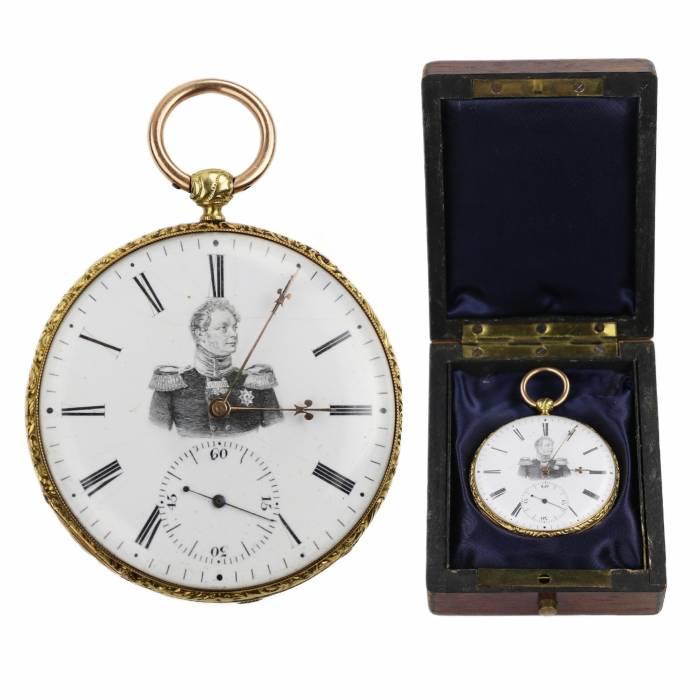
From 1815 the firm actively exported watches to the Russian Empire, including models inscribed PETERSBOURG and decorated with views of Saint Petersburg and imperial portraits. Deliveries also continued to the Prussian court.
In 1842 the sons of Louis Courvoisier established Courvoisier Frères. The company was commissioned to produce commemorative watches for Frederick William IV of Prussia, strengthening its international standing.
During the second half of the nineteenth century production expanded. In 1880 the name Courvoisier Frères was definitively adopted. A marriage alliance with the Gallet family briefly led to the brand Courvoisier-Gallet. Sub-brands included Mobilis, El Aguila and Madix. In 1904 the tourbillon patent CH30754 was registered under Mobilis. In 1915 the Madix model with reinforced case and radium markers was introduced.
In the twentieth century the firm concentrated on pocket watches and gradually lost ground amid the rise of wristwatches. In 1909 assets passed to L. Courvoisier & Cie, and in 1928 to L. Courvoisier & Co. Independent activity ceased by 1942.
TITLES, AWARDS AND COMMISSIONS
The firm held the status of supplier to the Prussian court and maintained strong export relations with the Russian Empire. Representative models were produced for private and court clients, including commemorative and complicated watches intended as diplomatic and official gifts.
ARTISTIC SPECIFICITY AND TECHNIQUES
Production followed the établissage system with final assembly and regulation carried out in-house. Anchor and cylinder escapements were employed, together with tourbillons, repeaters and calendar complications.
Cases in gold and silver were decorated with engraving, enamel, miniature painting and guilloché. Mobilis tourbillons featured open balance constructions aimed at improving chronometric precision. Madix models were designed for military use and featured reinforced cases.
LEGACY AND MASTERPIECES
Watches by Courvoisier Frères are preserved in the collections of:
▪ Musée International d’Horlogerie
▪ Patek Philippe Museum
▪ Topkapı Palace Museum
Notable examples include Robert & Courvoisier watches of the late eighteenth century, export gold models with Russian engraving from the 1820s, Mobilis tourbillons of the early twentieth century and the Madix military watch of 1915.