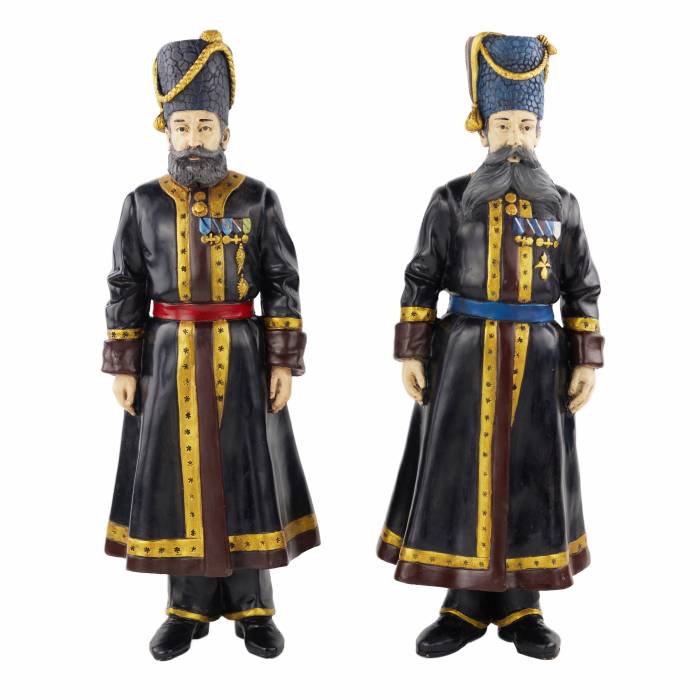
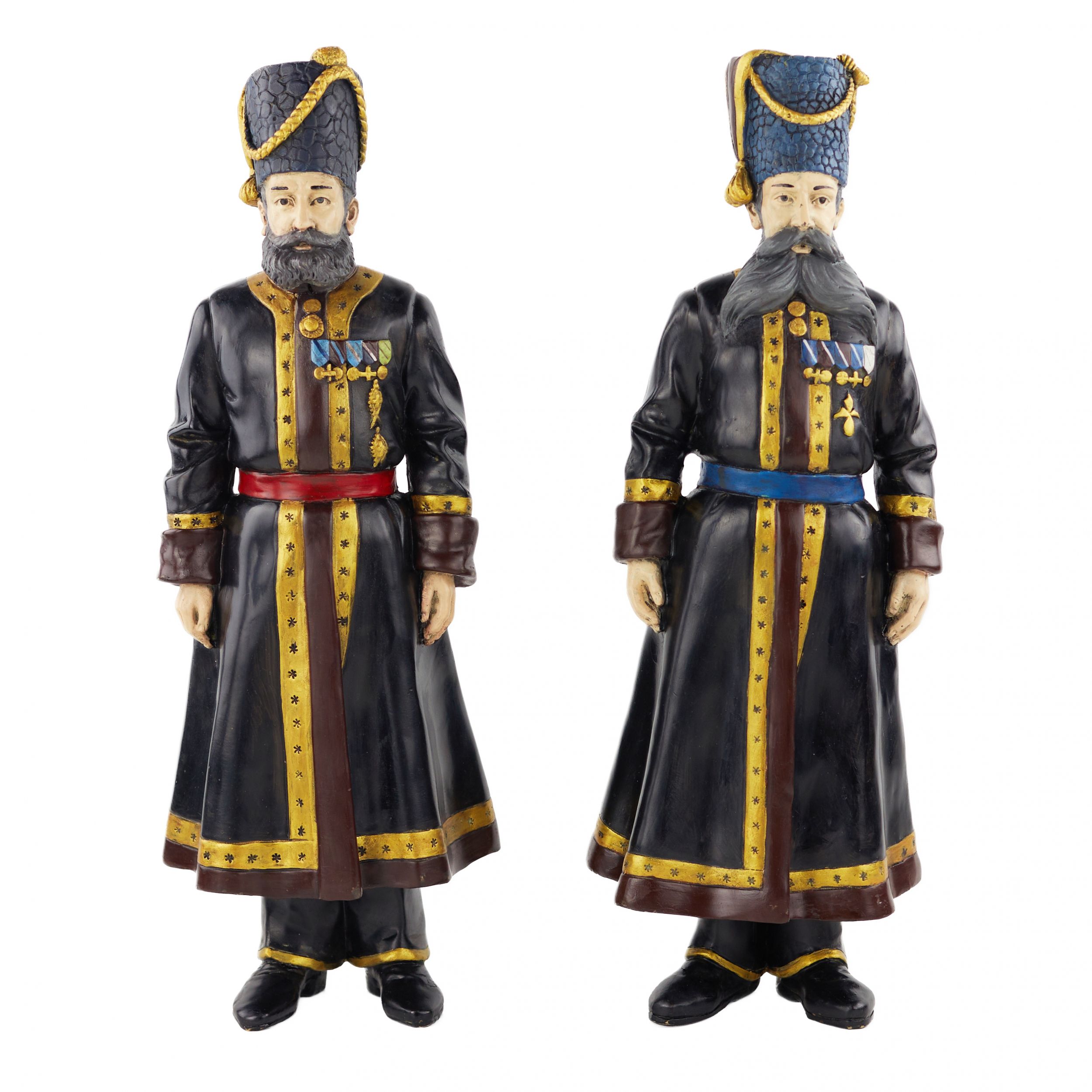
PAIRE DE FIGURES EN BRONZE DES COSAQUES DE LA GARDE IMPÉRIALE RUSSIE, SAINT-PÉTERSBOURG, 1912

PAIRE DE FIGURES EN BRONZE DES COSAQUES DE LA GARDE IMPÉRIALE RUSSIE, SAINT-PÉTERSBOURG, 1912

ID-ANTQ-15605
Live auction begins in:
| April 3, 2026 6:00 AM GMT+03:00
Estimé
1000 - 1500 EUR
Current Bid
EUR
 
0 Bids
Register for bidding
Request more info
Use our cost calculator

Discover how the value of similar works has evolved over the past 10 years. Art is not only beauty — it's an investment.

Price History

Discover how the value of similar works has evolved over the past 10 years. Art is not only beauty — it's an investment.

Request a Shipping Quote

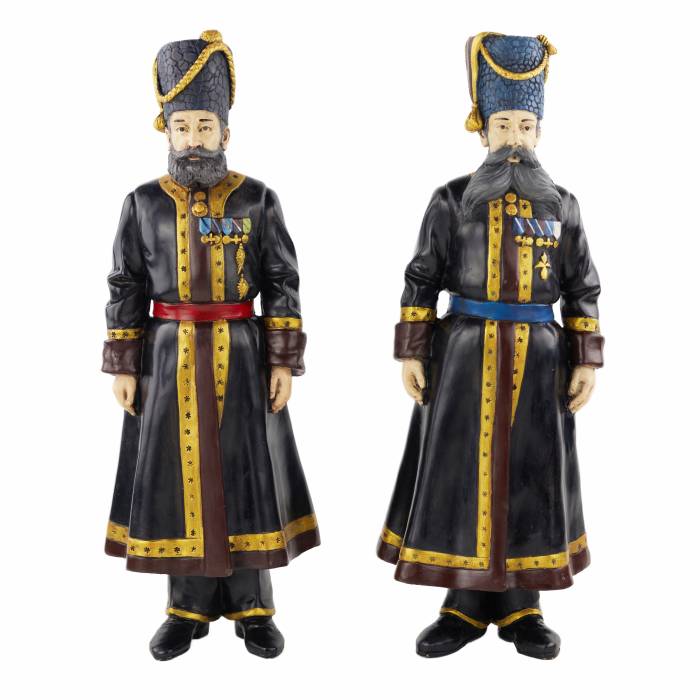
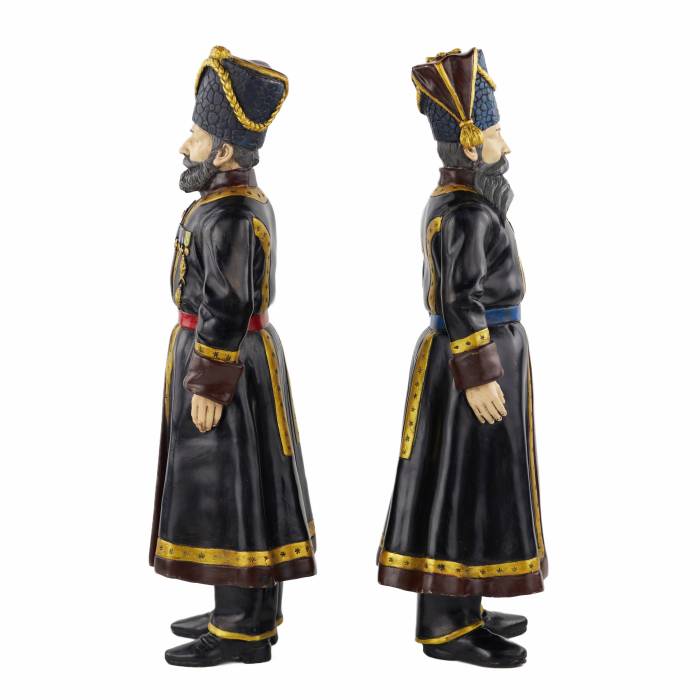
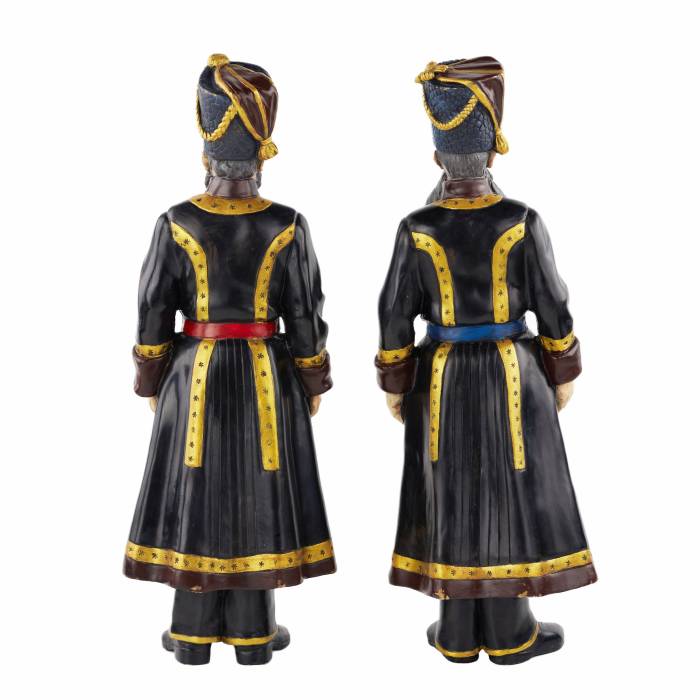
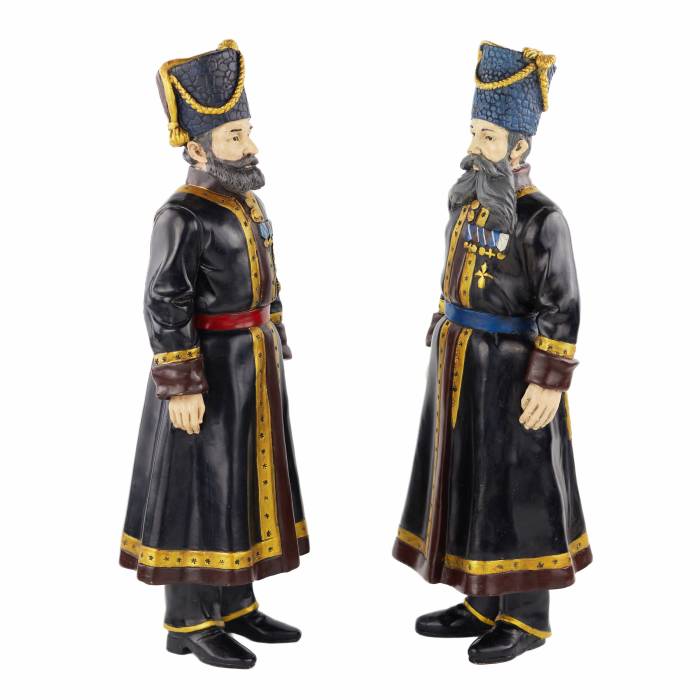
Rare paire de grandes figures en bronze, exécutées en polychromie à froid, représentant les Cosaques de la garde personnelle de la famille impériale russe A.A. Koudinov et N.N. Poustynnikov. Les figures portent l’uniforme de cérémonie avec décorations et médailles, coiffées de hautes papakhas et vêtues de caftans longs enrichis d’ornements dorés. La composition s’inspire de la commande de l’empereur Nicolas II en 1912, lorsque Henrik Wigström, maître joaillier de Fabergé, réalisa des miniatures en pierres dures des cosaques de chambre, offertes à l’impératrice douairière Maria Feodorovna et à l’impératrice régnante Alexandra Feodorovna.

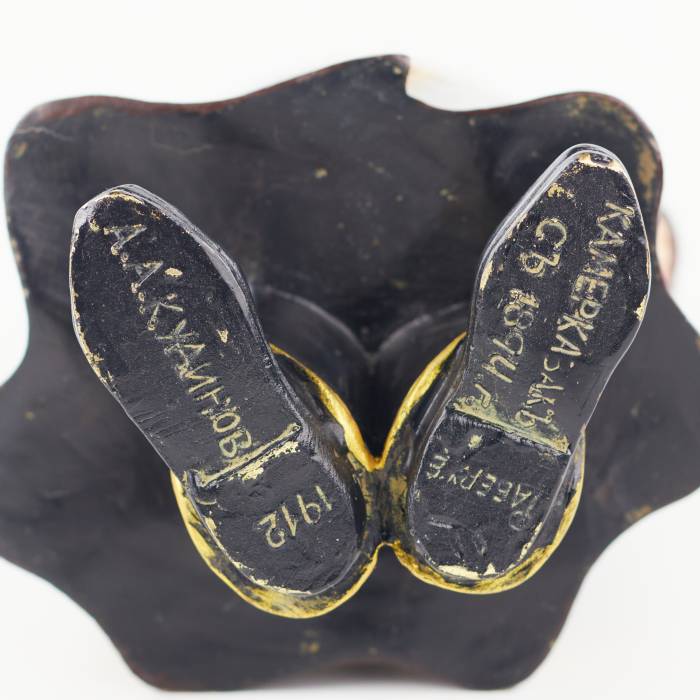
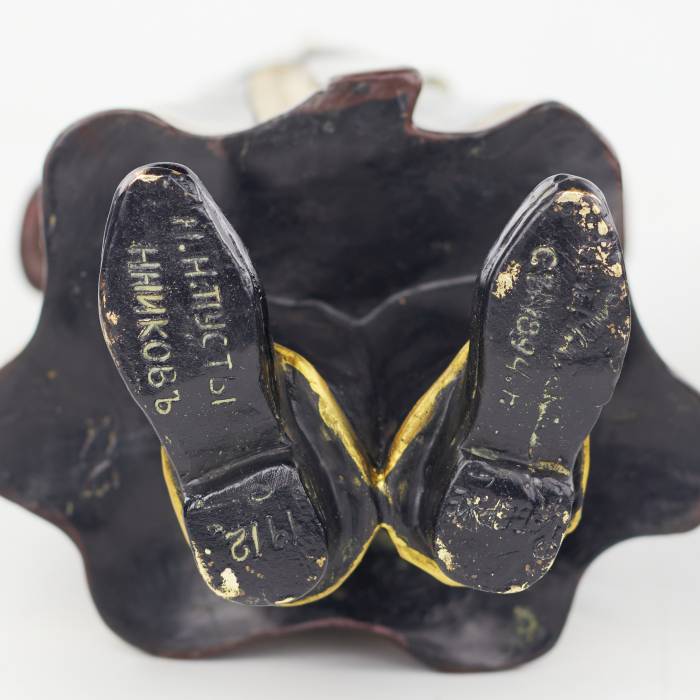
Les semelles portent les inscriptions : « Kamer-Kazak SV 1894 », « A.A. Koudinov », « N.N. Poustynnikov », « Fabergé 1912 ».

Poinçons: Inscriptions en relief sur les semelles : « KAMER-KAZAK SV 1894 », « A.A. Koudinov », « N.N. Poustynnikov », « FABERGÉ 1912 ».

Dimensions: Hauteur 40 cm.

État: Bon. Légères usures de la dorure et de la polychromie, sans pertes visibles. Les figures conservent la netteté des détails et leur qualité de collection.

Provenance: Collection privée européenne.

Art:
russia
Hauteur:
40 cm
Largeur:
30 cm
Épaisseur:
24 cm
Période:
Au Début Du 20Ème Siècle
Pays:
Russie
État:
Revive
Fair
Good
Very good
Like new

Les cosaques de chambre constituaient une partie de la garde personnelle des empereurs russes, assurant à la fois des fonctions cérémonielles et protectrices. Créé en 1827, ce corps réunissait des représentants cosaques vêtus d’uniformes richement ornés. À la charnière des XIXe et XXe siècles, ils faisaient partie intégrante de l’étiquette de cour, accompagnant le souverain lors des processions et cérémonies officielles.

A.A. Koudinov et N.N. Poustynnikov occupent une place particulière dans la mémoire culturelle de la dynastie Romanov. En 1912, pour le tricentenaire de la dynastie, Nicolas II commanda à Fabergé des miniatures en pierres dures de ces gardes, exécutées par Henrik Wigström. Ces œuvres furent offertes à Maria Feodorovna et à Alexandra Feodorovna, symbolisant le lien entre service militaire et art impérial.

Ces figures en bronze polychrome perpétuent la tradition de Fabergé des « portraits vivants », incarnant l’apogée de l’art décoratif russe du début du XXe siècle et son attachement aux traditions de la cour impériale. D’une rareté extrême, elles relèvent du patrimoine muséal.

Bon. Légères usures de la dorure et de la polychromie, sans pertes visibles. Les figures conservent la netteté des détails et leur qualité de collection.

The condition report is provided for informational purposes only.

It is not comprehensive and may not reflect all defects, restorations, alterations, or adaptations, as Antiqon does not perform professional conservation-level assessments. The information is based on a qualified, yet subjective, evaluation by our specialists.Before purchasing, we recommend consultation with an independent expert.Please also consult our Terms and conditions and Glossary A-Z, which contain important information on lot characteristics and sale conditions.

Faberge (1872–1917)
FabergeFrance is considered to be the birthplace of the Faberge family. In 1800, Pierre Faberges grandfather Carl Faberge moved to Pernau, in Livonia (the Russian province of the Baltic), where he received Russian citizenship. In the following years, the son of Pierre Faberge, Gustav Faberge, an ambitious young jeweler, decided to move to St. Petersburg where he continued to engage in jewelry On May 30, 1846, Carl Faberge was born into the Faberge family, at that moment his father was already heading a successful business in which several craftsmen from Northern Europe and Germany worked. At the age of 18, Carl Faberge travels to Europe to learn jewelry craft from the best professionals of that time. Throughout his stay, he explores the decorative arts created by his predecessors, imbued with new ideas that will fuel him for the rest of his career. In 1872, Carl Faberge returned to St. Petersburg and joined his fathers business. In 1882, after the death of Gustav Faberge, Karl took over the management of the company. In a short time, Karl surpasses the achievements of his own father: in the same year he receives the official title of master of jewelry, and the exhibition in Moscow leads to the fact that the Emperor Alexander III notices Faberges talent, who soon elevates to the rank of court jeweler. At this time, Faberge received his first order from the monarch: the emperor orders Easter gift for his wife, Maria Feodorovna, an original gift of a piece of jewelry and of art - an Easter egg, which became the beginning of a series of Faberge Easter eggs that imperial family ordered yearly. The Empress was so fascinated by the gift that Fabergé was turned into a court jeweler, he received an order to make an egg every Easter ; the product had to be unique and contain some kind of surprise, that was the only condition. The next emperor, Nicholas II, kept this tradition, each spring giving, two eggs as a gift - one to Maria Feodorovna, his widowed mother, and the second to Alexandra Feodorovna, the new empress. The production of each egg took almost a year. As soon as the sketch was approved, a whole team of the firms jewelers took over the work, the names of some of them survived. The contribution of the master Mikhail Perkhin is especially great. Also important jewelers were August Holstrom, Henryk Wigstrom, Eric Collin. The series of imperial eggs had such fame and success that the Fabergé company made several products for private customers (15 are known). Among them, a series of seven eggs, presented by the gold miner Alexander Ferdinandovich Kelkh to his wife, stands apart. The rest of the famous eight Fabergé eggs were custom-made for Felix Yusupov, Emmanuel Nobel, the Rothschilds, the Duchess of Marlborough and unidentified individuals. They are not as luxurious as the imperial ones, and they are not unique, they often repeated already invented for royal family. Having received the patronage of the royal family and the title of “jeweler of His Imperial Majesty and jeweler of the Imperial Hermitage”, the Faberge firm became famous in Europe. Many relatives of the imperial family in Great Britain, Denmark, Greece and Bulgaria received items as gifts. In 1900, in Paris, Faberge received the title of "Master of the Paris Guild of Jewelers", and he was also awarded the Order of the Legion of Honor. The war of 1914 significantly undermines the financial affairs of the Faberge company. In 1917, after the beginning of the soviet revolution, the Faberge family completely stopped production and went to immigration to the city of Riga, then moved to Switzerland.Carl Faberge died in 1920 in Swiss city of Lausanne.

Stay up to date with new arrivals
Save Sculpture en bronze and we let you know when new listings appears in this category
Sauvegarder

Related items