




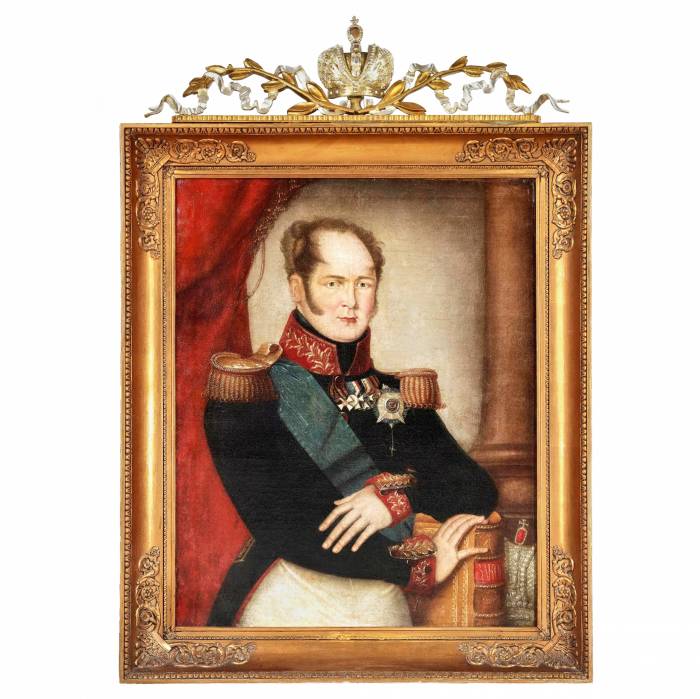
STATE PORTRAIT OF EMPEROR ALEXANDER I RUSSIA, FIRST HALF OF THE 19TH CENTURY
AntiqonART consultant will contact you within one business day after receiving your request.
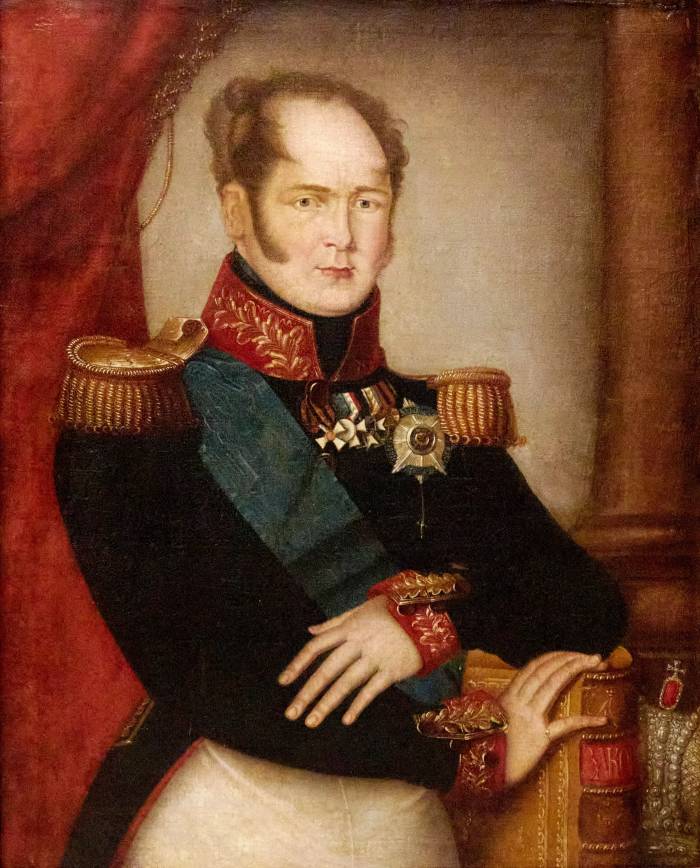
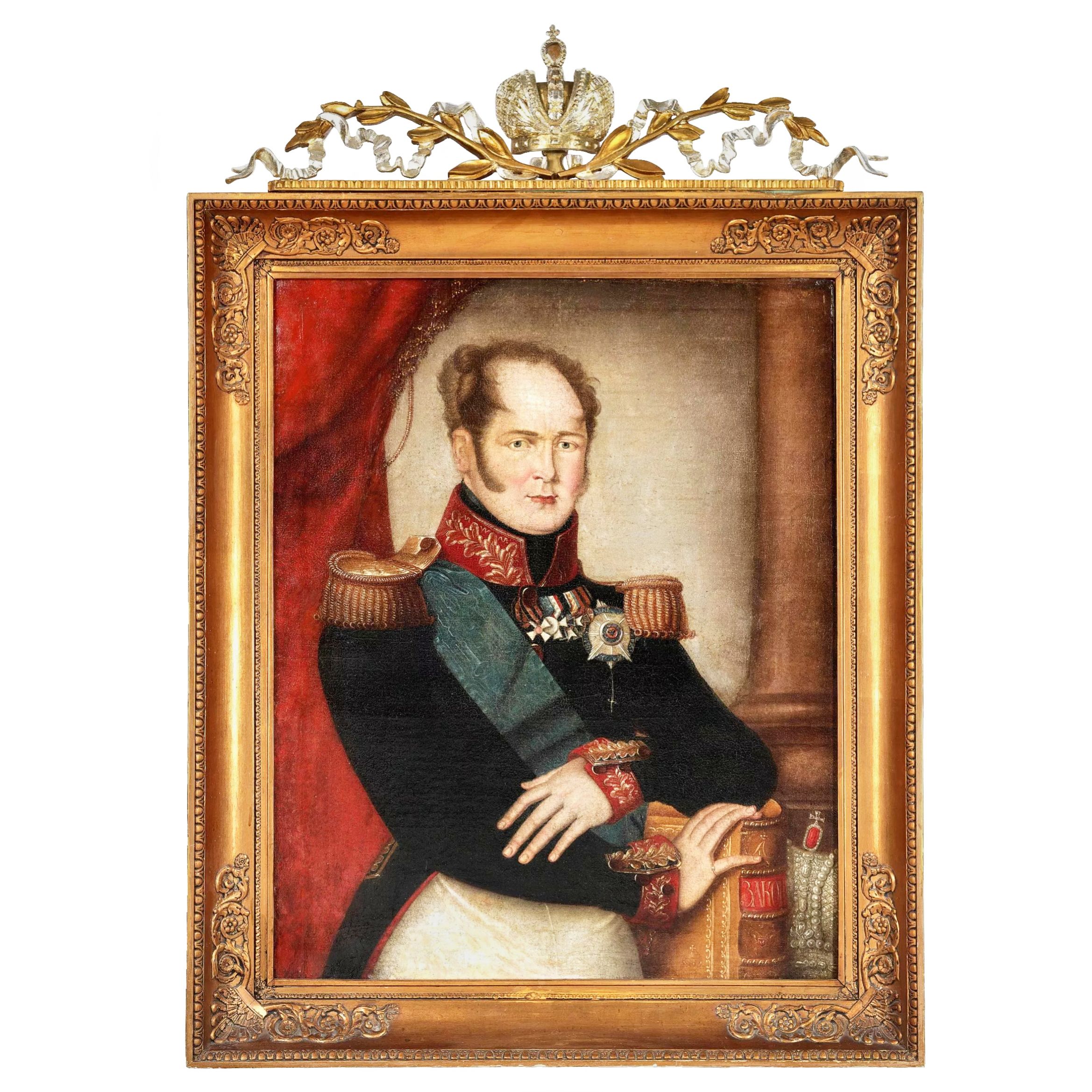
A waist-length state portrait of Emperor Alexander I of Russia (1777–1825), depicted en face. The monarch is shown in full military dress with richly decorated epaulettes and orders, including the star of the Order of St. Andrew the First-Called and other highest decorations of the Russian Empire. His right hand rests upon a book of laws, symbolising the supremacy of law over autocracy and echoing the Emperor’s image as a reformer. The composition features an architectural background with a column and heavy red drapery, enhancing the grandeur of the scene.
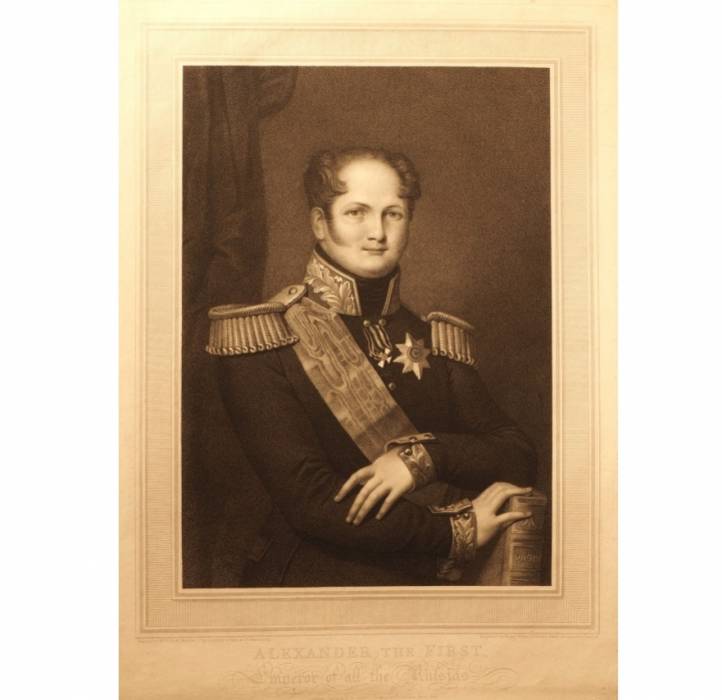
The pose and composition closely follow the famous lifetime portrait of Alexander I painted in 1814 by Russian artist Roman Maksimovich Volkov (1776–1831) during the Emperor’s visit to London, and engraved by British master Henry Hoppner Meyer (1782–1847). This iconography was widely disseminated in Europe and Russia through engravings and served as a model for official and state portraits such as this one. The presence of the book of laws directly reflects Volkov’s original concept as transmitted through Meyer’s engraving, underlining the reformist symbolism of the image.
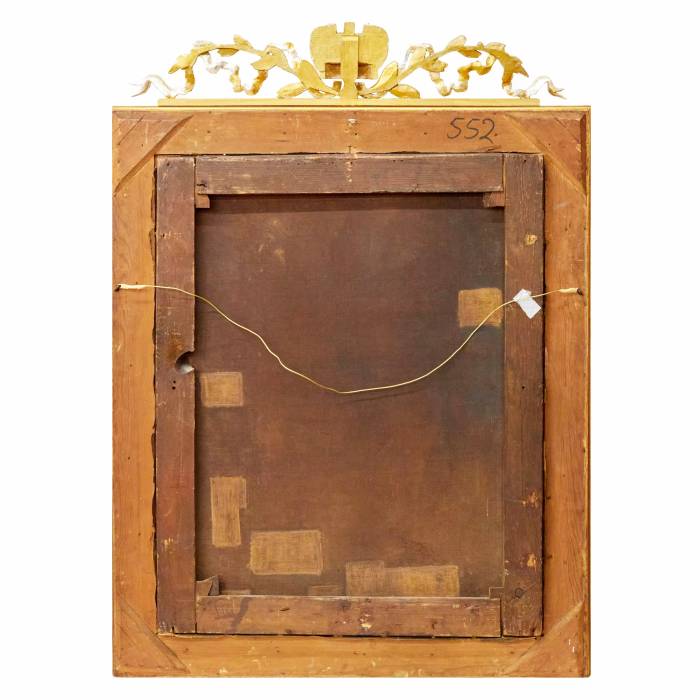
The lavish gilded frame is surmounted by a sculptural finial in the form of the Imperial Crown, suggesting an official or institutional origin. The crown finial shows traces of early restoration.
Dimensions: 90 × 72 cm (framed: height 130 cm, width 94 cm)
Material: Oil on canvas
Condition: Good preservation, with natural patina of age.
Provenance: Probably created for an official hall or administrative institution in the first half of the 19th century, based on the engraved portrait by Volkov/Meyer of 1814.
Alexander I Pavlovich (1777–1825), Emperor of All Russia from 1801, is remembered as a ruler combining liberal reforms with a commitment to monarchical order. The early years of his reign saw the activities of the “Unofficial Committee”, the drafting of constitutional projects, and educational reform. The symbolism of the book of laws in his portraits reflects his interest in legal reform and the idea of limiting administrative arbitrariness.
In 1814, after the defeat of Napoleon, Alexander I visited London as part of the anti-French coalition. During this visit, Roman Maksimovich Volkov, an academician of the Imperial Academy of Arts, created a lifetime drawing of the monarch, which became the basis for Henry Hoppner Meyer’s celebrated engraving. The engraving gained wide distribution across Europe, shaping the official iconography of the Emperor.
The composition with the hand resting on the book of laws and the gaze directed into the distance was perceived as expressing the monarch’s mission — to safeguard order, peace, and the rule of law. This painting, created in Russia after the Volkov–Meyer model, fits into the tradition of state portraiture, serving both as a state symbol and an artistic reflection of the era.
The painting is in good collector’s condition, with light craquelure and patina, no losses to the paint layer; the frame is overall well preserved, with minor losses to gilding and traces of early restoration to the crown finial.
The condition report is provided for informational purposes only.
It is not comprehensive and may not reflect all defects, restorations, alterations, or adaptations, as Antiqon does not perform professional conservation-level assessments. The information is based on a qualified, yet subjective, evaluation by our specialists.Before purchasing, we recommend consultation with an independent expert.Please also consult our Terms and conditions and Glossary A-Z, which contain important information on lot characteristics and sale conditions.