


DISH “BACCHUS”. NEO-RENAISSANCE, IN THE MANNER OF JOHANN MICHAEL MAUCHER (1645–1701) GERMANY, 19TH CENTURY
AntiqonART consultant will contact you within one business day after receiving your request.
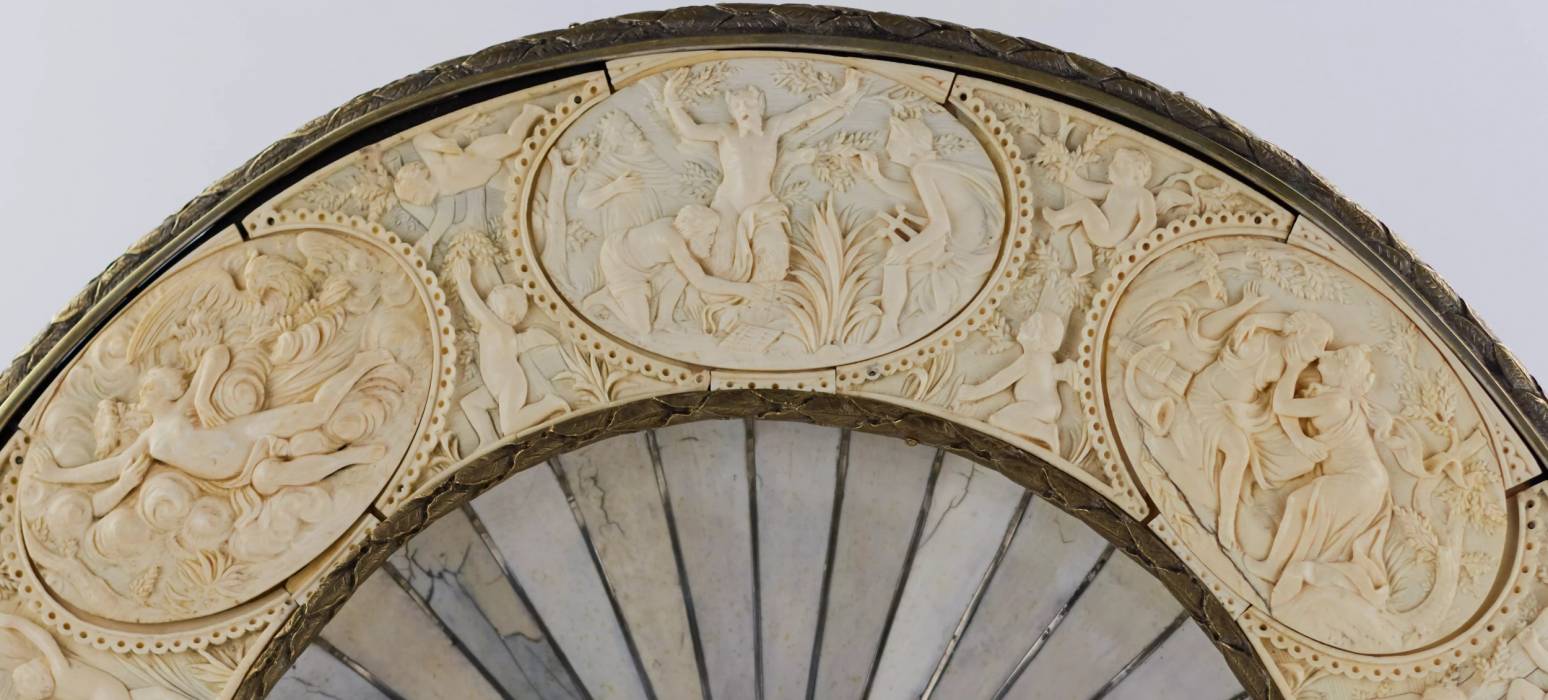
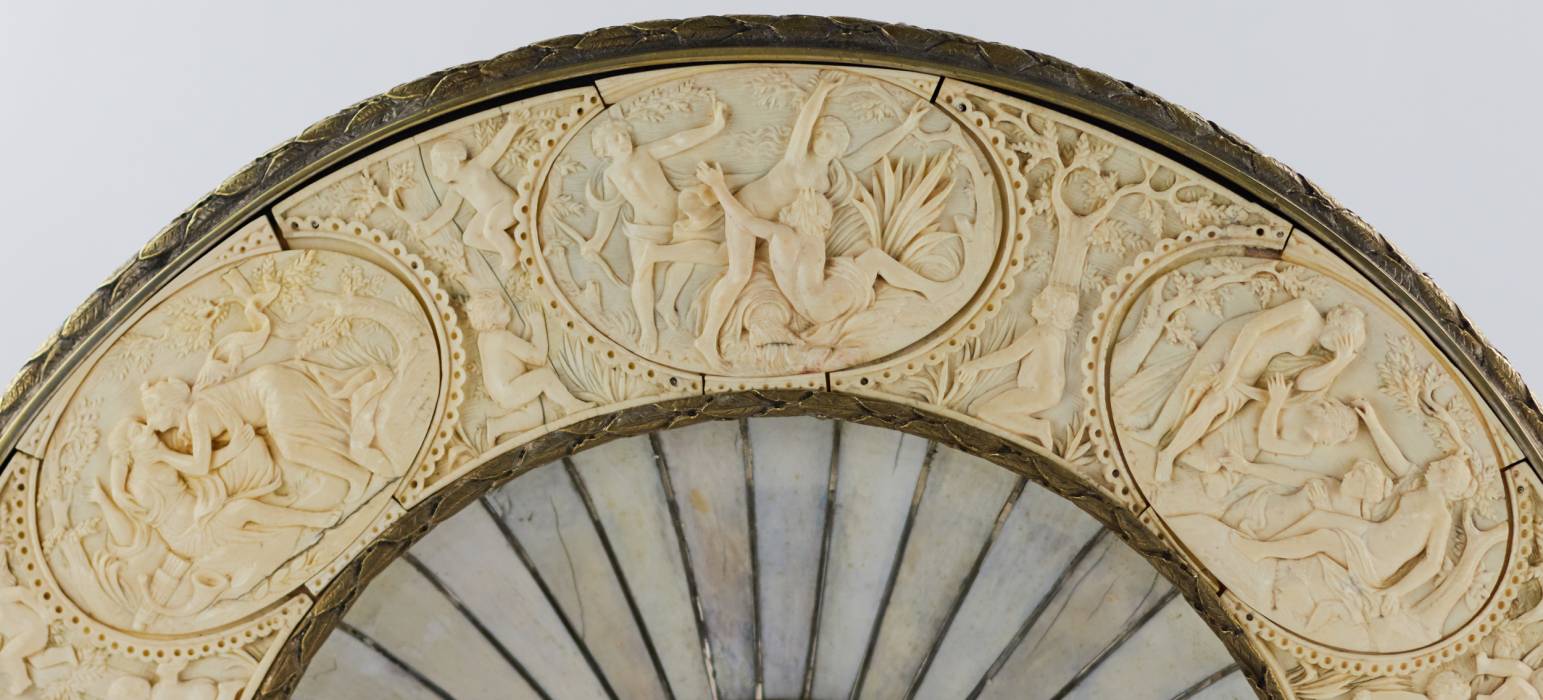
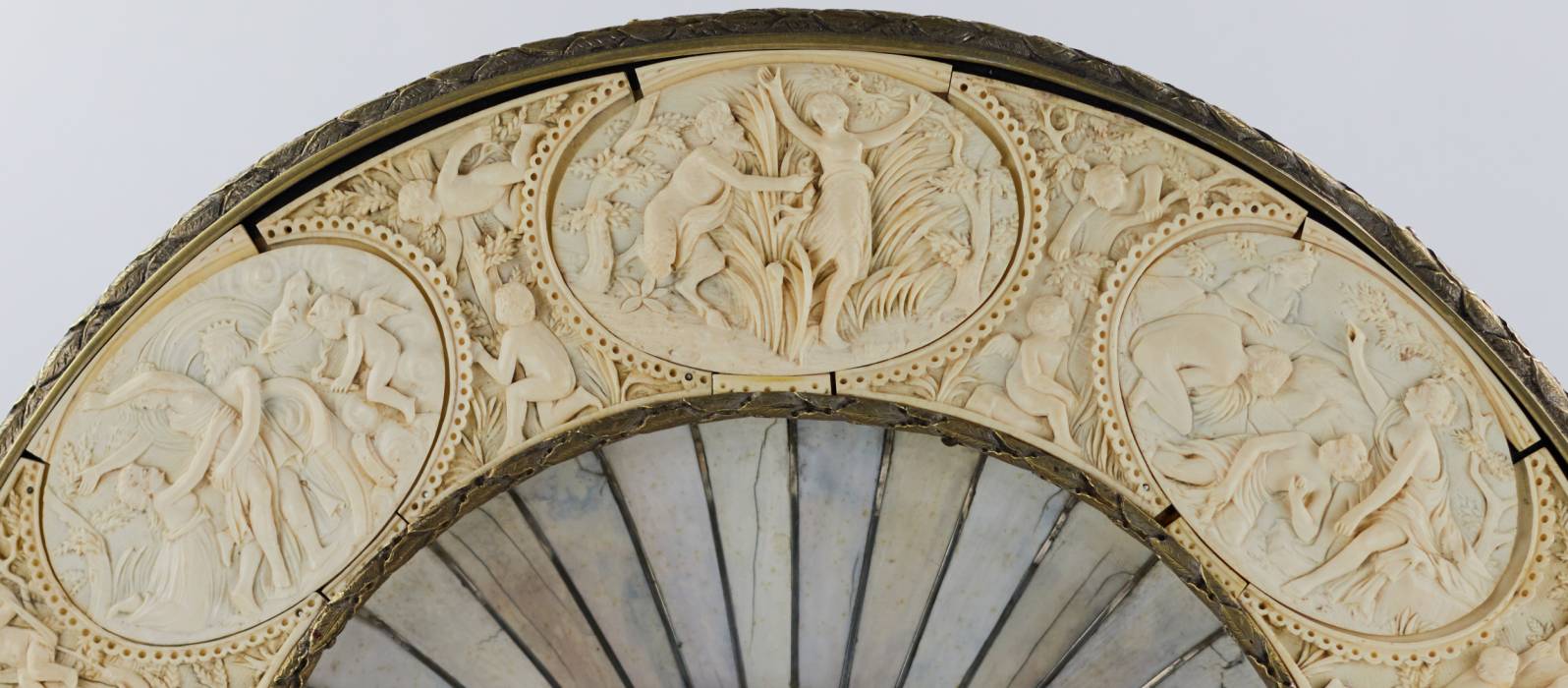
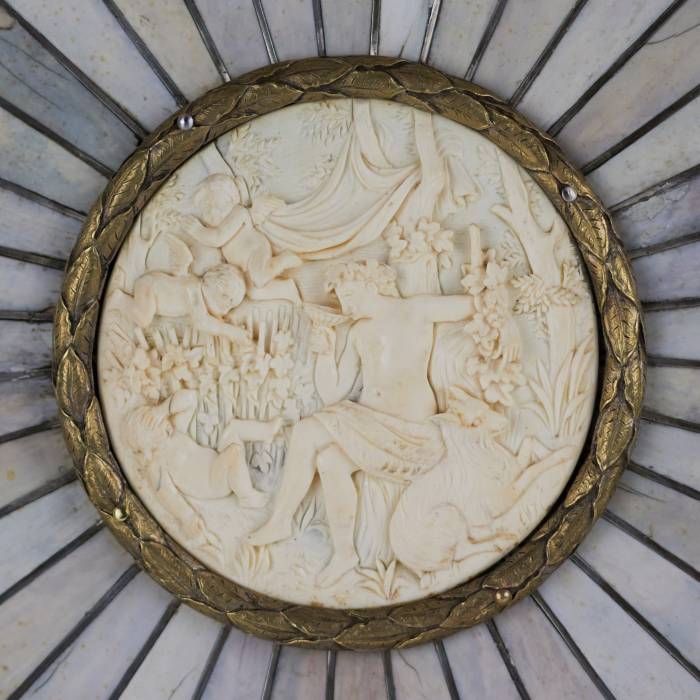
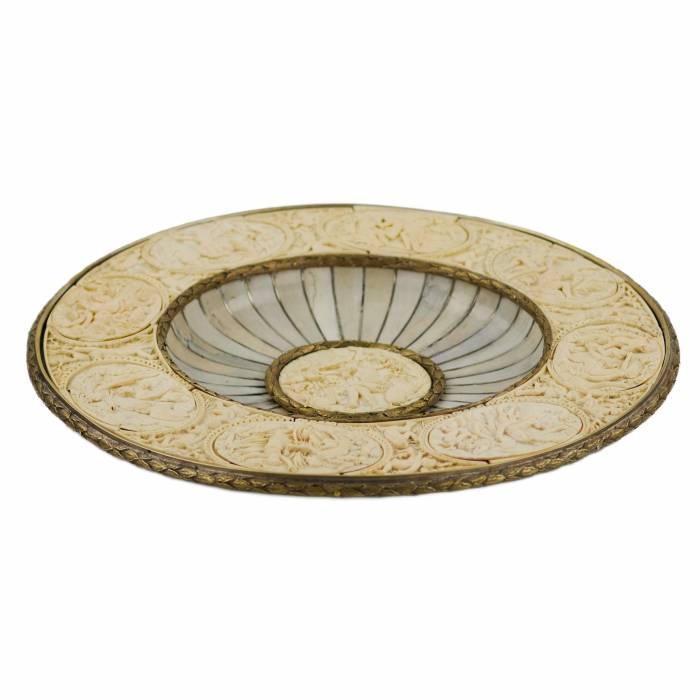
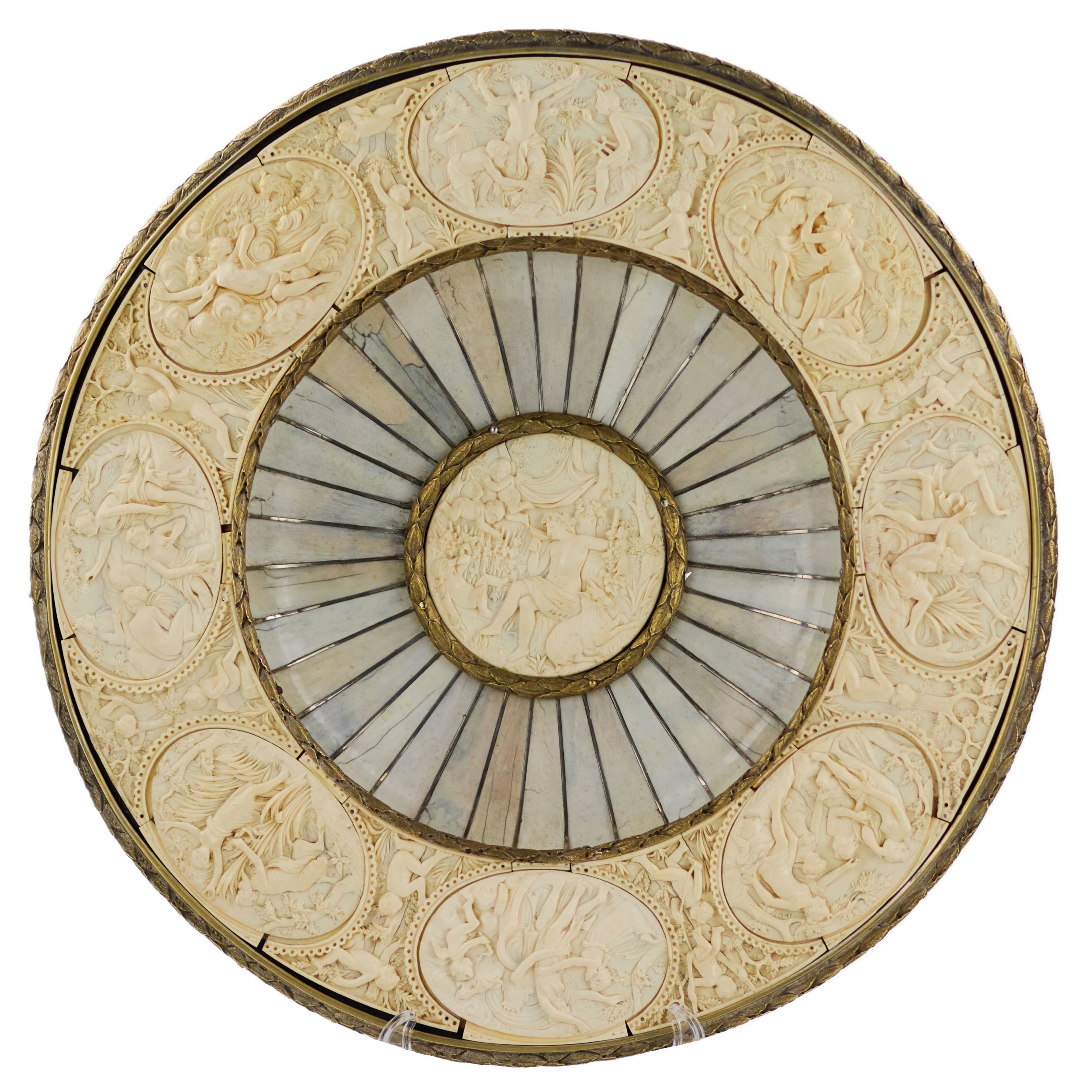
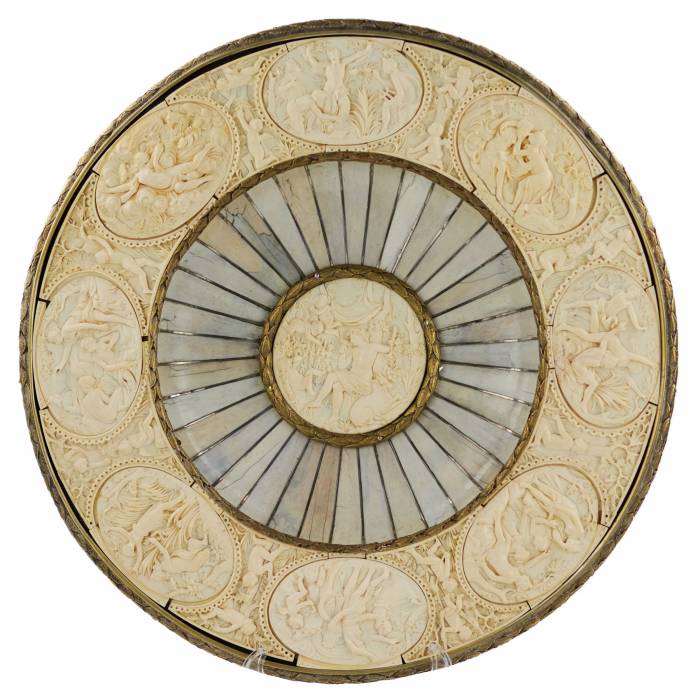
A magnificent Neo-Renaissance decorative dish executed in carved ivory inlaid on a wooden support, created in the manner of the works of the eminent German master Johann Michael Maucher (1645–1701). The composition forms a complex and carefully conceived ensemble with a rich mythological programme, drawing upon themes of Classical antiquity characteristic of Renaissance decorative arts and reinterpreted in the 19th century.
The central medallion is adorned with a relief depiction of Dionysus (Bacchus) drinking from a cup, accompanied by his followers and a goat as a traditional attribute of wine worship, set against a forest landscape with vine tendrils. Radiating from the centre are eight oval cartouches forming a continuous narrative cycle. These depict the contest between Marsyas and Apollo judged by King Midas; Zeus seducing Callisto; Callisto exposed and punished by Diana; Zeus rescuing Callisto and placing her among the stars as Ursa Major; the abduction of Proserpina by Pluto; the advances of a satyr towards a nymph; Actaeon punished by Diana for voyeurism; and the abduction of the nymph Io by Zeus concealed in a cloud.
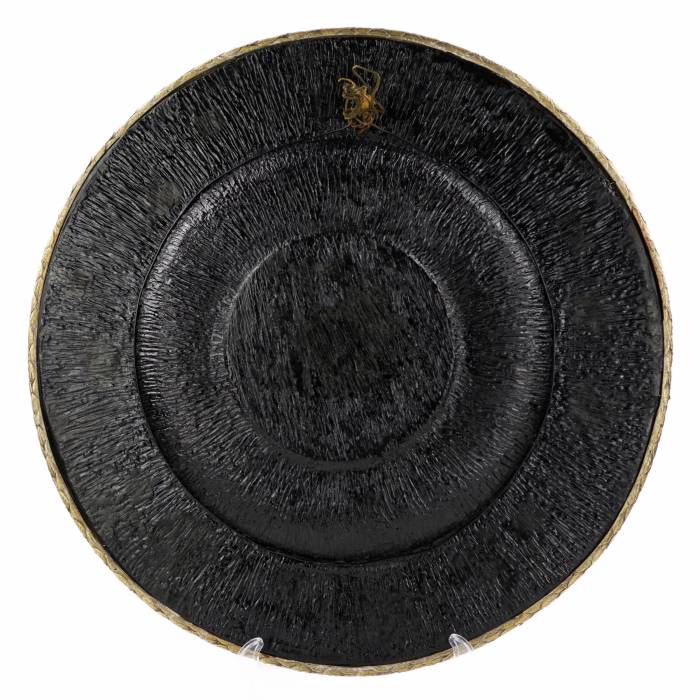
The carved relief displays a high level of artistic refinement. Finely modelled figures, fluid drapery and a wealth of subsidiary motifs lend the composition depth and rhythmic harmony. The brass binding hoops serve both structural and decorative functions, enhancing the architectural coherence of the form. The reverse is executed in dark-stained wood, revealing the traces of hand craftsmanship.
Material: Carved ivory, wood, brass, deer antler.
Dimensions: Diameter 46.5 cm.
Weight: 2700 g.
Condition: Good. Minor age-related surface changes consistent with the period. No losses, cracks or later interventions observed.
Provenance: Probably Germany, 19th century.
Decorative dishes with multi-figure carved compositions occupy a significant place in the history of European decorative arts, rooted in the traditions of the late Renaissance and Mannerism. In the 17th century such works were produced primarily in southern German centres of ivory carving, where a strong tradition developed around ivory and deer antler as materials of the highest artistic and social value. A central figure of this tradition was Johann Michael Maucher (1645–1701), whose oeuvre established the canon of carved dishes and vessels with elaborate mythological programmes.
Maucher and his circle were distinguished by their virtuoso handling of relief carving, complex iconography and architecturally balanced compositions. The central image typically functioned as a semantic and visual nucleus, around which a narrative cycle of cartouches unfolded. Classical mythology was interpreted not merely as ornament, but as a philosophical allegory of passion, punishment, transformation and ecstatic freedom, resonating with the intellectual culture of the Baroque period.
In the 19th century, amid the revival of historical styles, Neo-Renaissance became a leading trend in German decorative arts. Artists and workshops turned to acknowledged masterpieces of the “golden age” of German ivory carving, reinterpreting them for a new generation of collectors and museums. Such dishes were conceived as cabinet works rather than utilitarian objects, intended to demonstrate erudition, taste and status.
Important points of reference for the present dish include authentic works by Johann Michael Maucher preserved in major museum collections. Notably, the basin with the “Triumph of Galatea and marine scenes” dated 1672, executed in ivory, deer antler and metal, is held in the Museo Civico Medievale, Bologna. A comparable oval dish depicting hunting scenes, Diana and Actaeon is published in The Golden Age of Flemish Art from the collection of the State Hermitage Museum (inv. no. Э-7267).
Thus, the present dish demonstrates a profound connection to the classical tradition of 17th-century German ivory carving while reflecting the aesthetic and collecting ideals of the 19th century. It combines high decorative quality, a complex mythological programme and technical mastery, qualifying it as a museum-level example of European Neo-Renaissance decorative art.
Overall condition is good. The carving is crisp and well preserved. The ivory shows a natural, even patina. The construction is stable, with all brass elements intact. Age-related wear only.
The condition report is provided for informational purposes only.
It is not comprehensive and may not reflect all defects, restorations, alterations, or adaptations, as Antiqon does not perform professional conservation-level assessments. The information is based on a qualified, yet subjective, evaluation by our specialists.Before purchasing, we recommend consultation with an independent expert.Please also consult our Terms and conditions and Glossary A-Z, which contain important information on lot characteristics and sale conditions.