
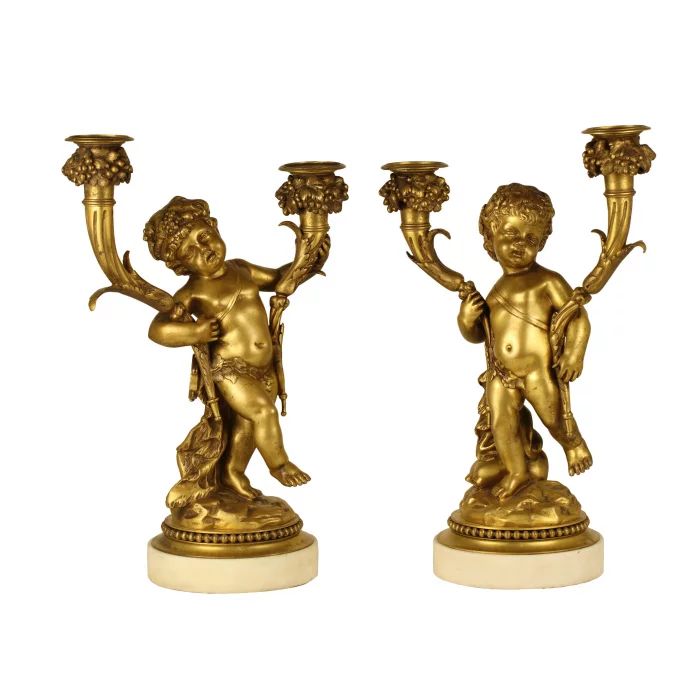
PAIR OF CANDELABRA WITH FIGURES OF CUPIDS FRANCE, SECOND HALF OF THE 19TH CENTURY

PAIR OF CANDELABRA WITH FIGURES OF CUPIDS FRANCE, SECOND HALF OF THE 19TH CENTURY

ID-ANTQ-3274
2200 EUR
Add to cart
Request more info
Guarantee of Authenticity

At Antiqon ART, we build trust and value your choice. Every purchase of art and antiques with us is an investment backed by our expertise, reputation, and a 100% authenticity guarantee.

Price History

Discover how the value of similar works has evolved over the past 10 years. Art is not only beauty — it's an investment.

Complimentary Shipping & Returns

Antiqon ART offers free packaging, insurance, and delivery for most items purchased through the company. Exceptions include large and oversized items that require specialized packing and shipping.

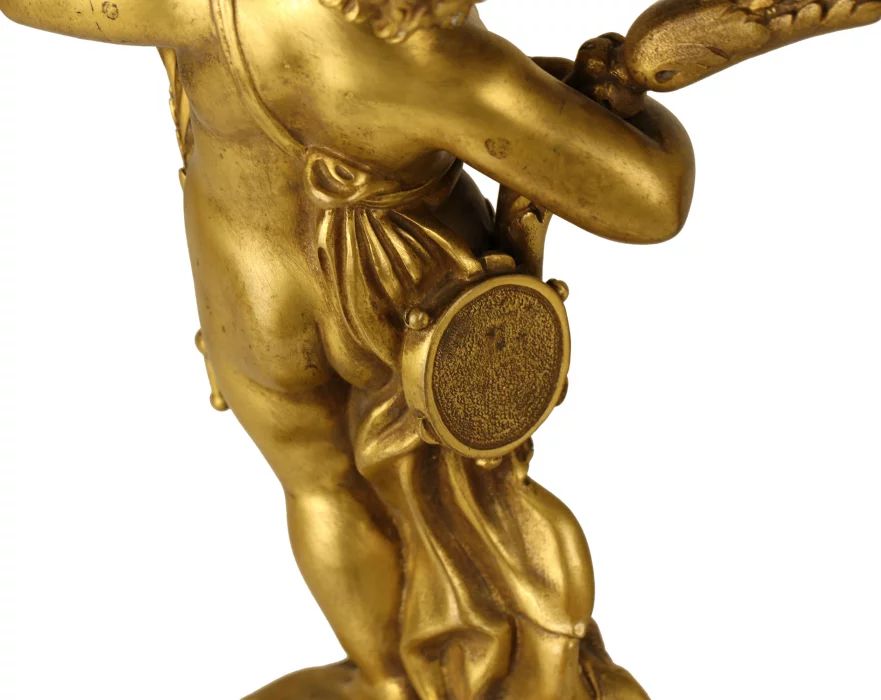
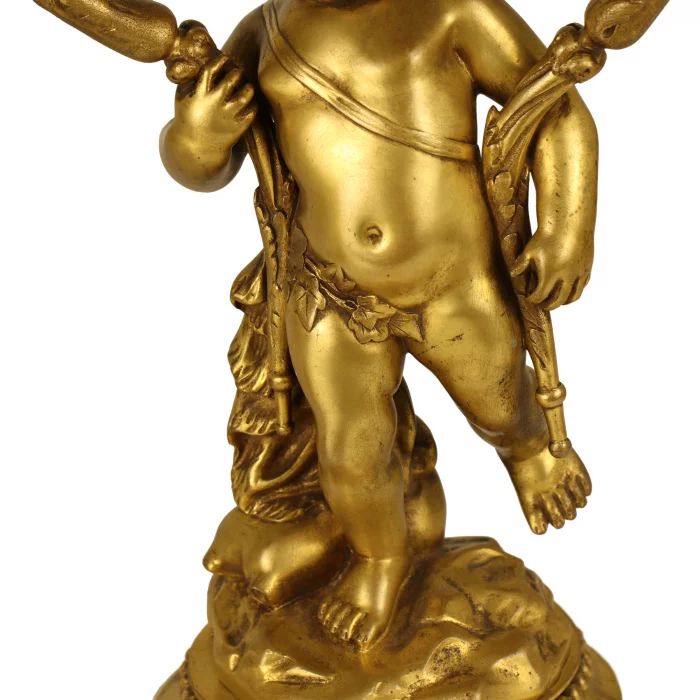
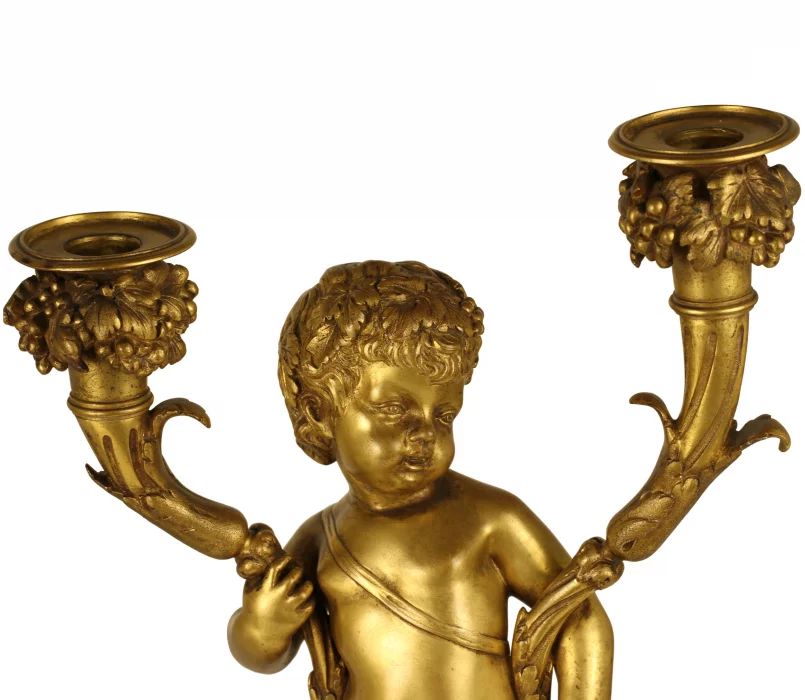
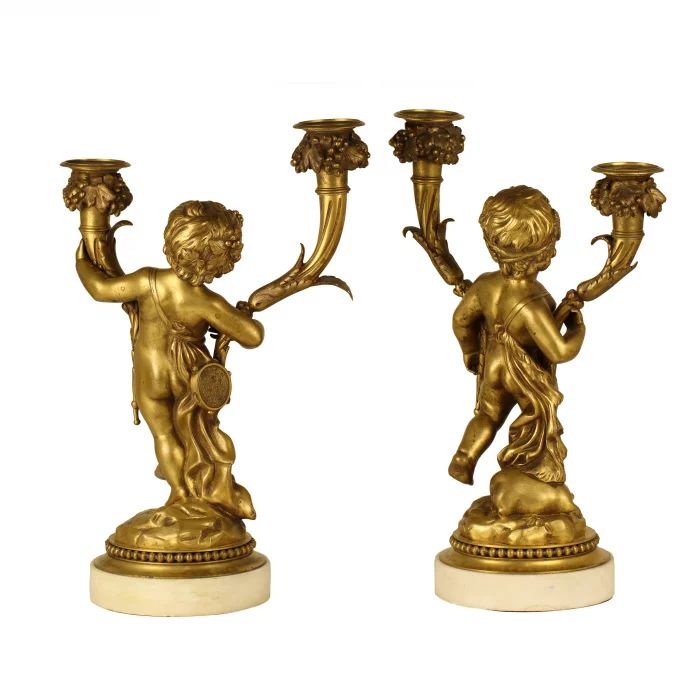
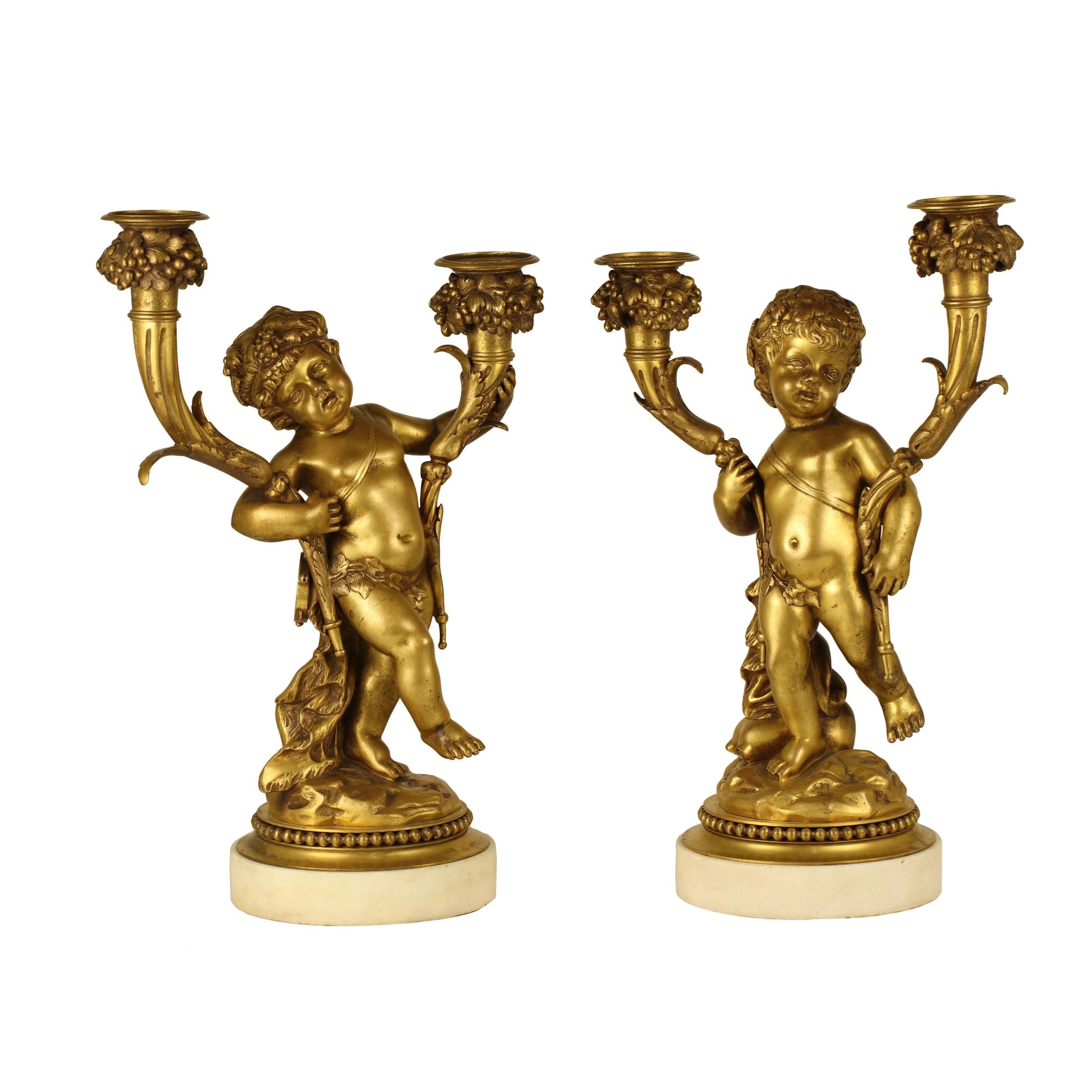
A decorative pair of candelabra executed in the form of cupids represents a refined example of French bronze casting from the Historicism period, strongly influenced by the Neorococo aesthetic. Each figure is cast in bronze and finished with a rich gilt surface, emphasizing the sculptural modeling, soft anatomical treatment, and high level of craftsmanship. The cupids are depicted in lively, dynamic poses with gently twisted bodies, creating a sense of movement and visual rhythm.

The figures hold candle branches shaped as cornucopia, adorned with garlands of grapevines and bunches of grapes, traditional symbols of abundance, prosperity, and joy. The details are finely executed, with carefully modeled vine leaves, grapes, and textured surfaces. The candelabra are mounted on circular white marble bases, providing an elegant contrast to the warm golden tone of the gilt bronze and enhancing the ceremonial character of the ensemble.

The composition is well suited to interiors inspired by the Louis XV Revival, Belle Époque, and late 19th-century eclectic taste, designed for placement on mantelpieces, consoles, or as decorative focal points in formal salon interiors.

Dimensions: Height – 37.5 cm; Width – 15 cm; Depth – 5.5 cm.

Material: Gilt bronze; base – white marble.

Condition: Good. Gilding well preserved with minor signs of age on protruding elements. Marble bases intact, without chips or cracks.

Provenance: Private European collection.

Art:
europe
Height:
37.5 cm
Width:
15 cm
Depth:
55 cm
Period:
Late 19th century
Style:
Neorococo
Country:
France
Material:
Gilded bronze and marble
Condition:
Revive
Fair
Good
Very good
Like new

In the second half of the 19th century, France experienced a renewed fascination with historical styles, particularly the artistic legacy of 18th-century Rococo, which found expression in the widespread production of decorative objects in the Neorococo manner. The period of Historicism was characterized by a conscious reinterpretation of past forms and iconography, adapted to the tastes of bourgeois and aristocratic interiors during the Belle Époque.

Figures of cupids and putti held a prominent place in French decorative arts, continuing traditions established during the reign of Louis XV. In 19th-century interpretations, these motifs were rendered with increased academic precision, emphasizing anatomical realism and decorative clarity. The use of the cornucopia and grapevine imagery refers to classical symbolism associated with fertility, abundance, and vitality, making such objects particularly desirable for refined domestic interiors.

Candelabra of this type were produced by specialized Parisian bronze foundries and were intended to adorn mantelpieces, sideboards, and consoles, combining functional lighting with sculptural elegance. The inclusion of white marble bases reinforced associations with classical heritage and elevated the status of these objects as distinguished interior accents. Today, such works are preserved in museum and private collections and are regarded as characteristic examples of French decorative art of the 19th century.

Overall good condition. Gilt bronze with consistent surface, showing light wear consistent with age. Marble bases stable, with no evidence of restoration or loss.

The condition report is provided for informational purposes only.

It is not comprehensive and may not reflect all defects, restorations, alterations, or adaptations, as Antiqon does not perform professional conservation-level assessments. The information is based on a qualified, yet subjective, evaluation by our specialists.Before purchasing, we recommend consultation with an independent expert.Please also consult our Terms and conditions and Glossary A-Z, which contain important information on lot characteristics and sale conditions.

Neo-rococo
Neo-rococo, or the second rococo, is one of the stylistic trends that manifested itself in the period of historicism in the 19th century. Neo-Rococo is a rethinking of the characteristic features of the Rococo style that prevailed in the middle of the 18th century. The neo-rococo style found itself in architecture, interior design, furniture and household items design. The emergence of the neo-rococo style is associated with the restoration of the royal dynasty of the Bourbons and the completion of the Empire style in the first third of the 19th century. The chronology of the style is described by the reign of Louis XVIII and King Charles X (1824-1830). Sometimes the period of the reign of Louis Philippe (1830-1848) is also added to it. This time is called the style of Louis Philippe, or "the third rococo". After a tumultuous period of revolutions and wars, nostalgia for the "good old days" and the return of "royal styles" arose. Light, graceful and sophisticated forms of rococo perfectly embodied such moods. Neorocacious motives were also present in the products of the St. Petersburg cabinetmakers of the Gambs brothers in the 1850s and 1860s. In the Winter Palace in St. Petersburg, a boudoir designed by G.E. Boss in the "Pompadour style" (1853). The abundance of gilding, mirrors, red silk makes a spectacular but heavy impression. The same architect designed the dance hall in the mansion of Prince M.V. Kochubei on Konnogvardeisky Boulevard in the style of the second rococo (1853-1855). The dance halls in many mansions were designed primarily in rocaille style. A.I. Stackenschneider in 1847-1856 created a number of interiors of the Winter Palace in the neo-rococo style: the "pink drawing room" (not preserved), the "green dining room" (1850). In 1847-1851, the architect R.I. Kuzmin created several of the same interiors in the Arsenal square of the Grand Palace in Gatchina. It is significant that these interiors were adjacent to the "Gothic" and "Chinese" galleries. During the Art Nouveau period, along with other styles, the fourth Rococo emerged. The Small (White) dining room in the Winter Palace was designed in this style, designed by architect A.F. Krasovsky (1894).
... Read More

Stay up to date with new arrivals
Save Candlesticks and candelabra and we let you know when new listings appears in this category
Save

Related items