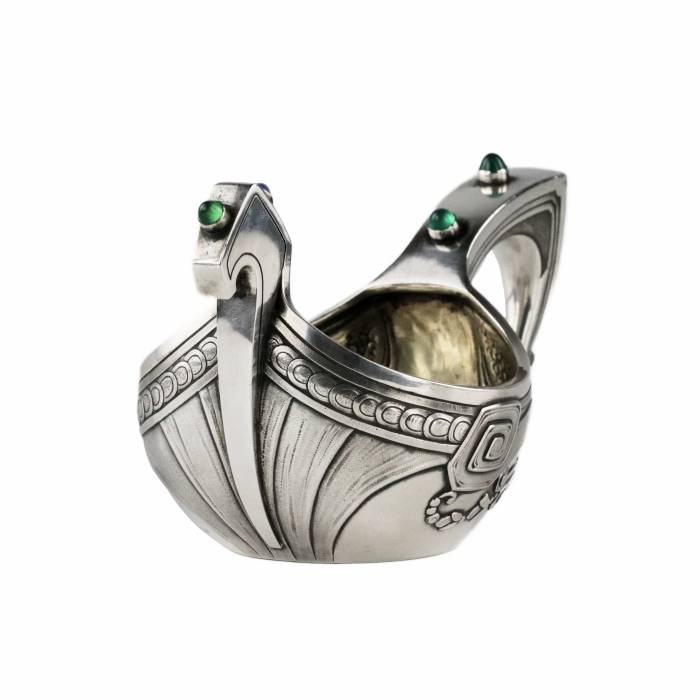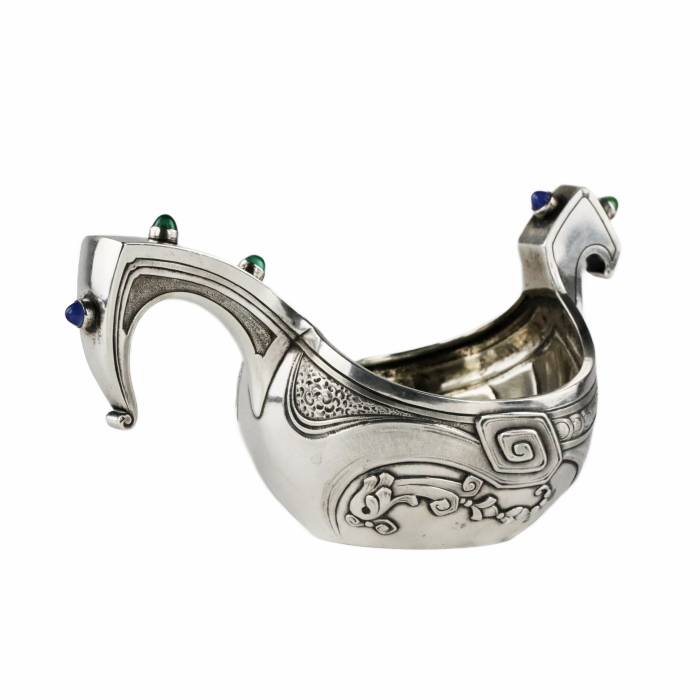
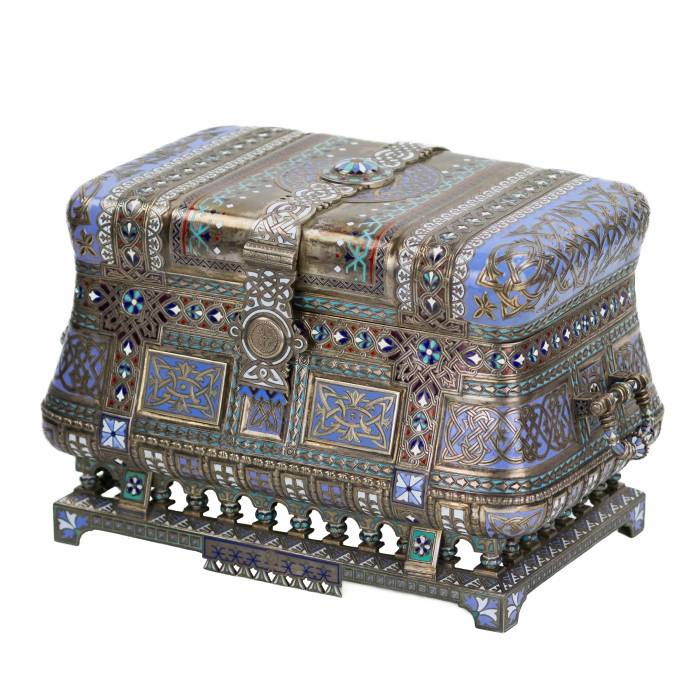
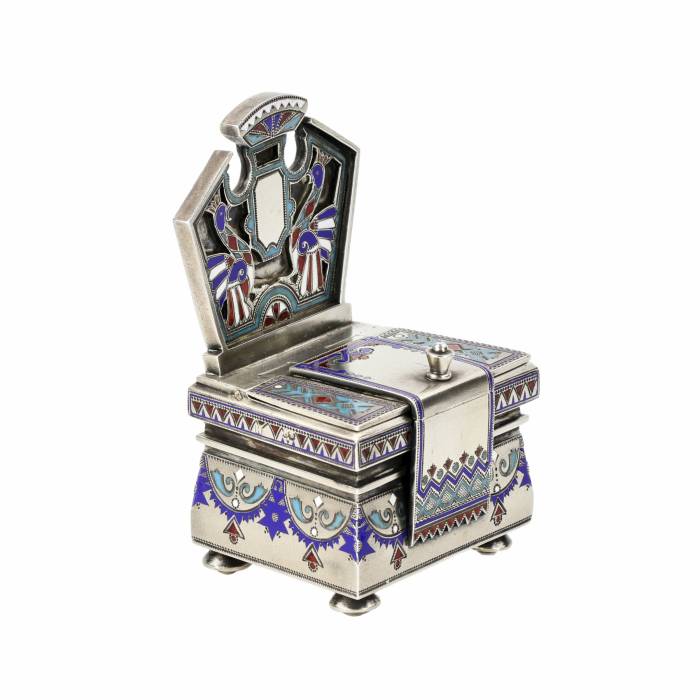
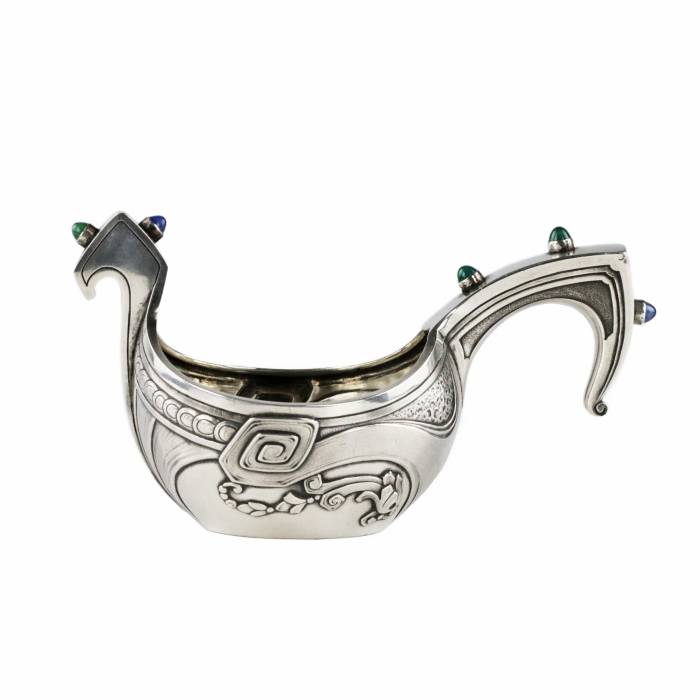
Russian, silver ladle, decorated with precious stones.

Russian, silver ladle, decorated with precious stones.

ID-ANTQ-3574
5800 EUR
Sold
Guarantee of Authenticity

At Antiqon ART, we build trust and value your choice. Every purchase of art and antiques with us is an investment backed by our expertise, reputation, and a 100% authenticity guarantee.

Price History

Discover how the value of similar works has evolved over the past 10 years. Art is not only beauty — it's an investment.

Complimentary Shipping & Returns

Antiqon ART offers free packaging, insurance, and delivery for most items purchased through the company. Exceptions include large and oversized items that require specialized packing and shipping.

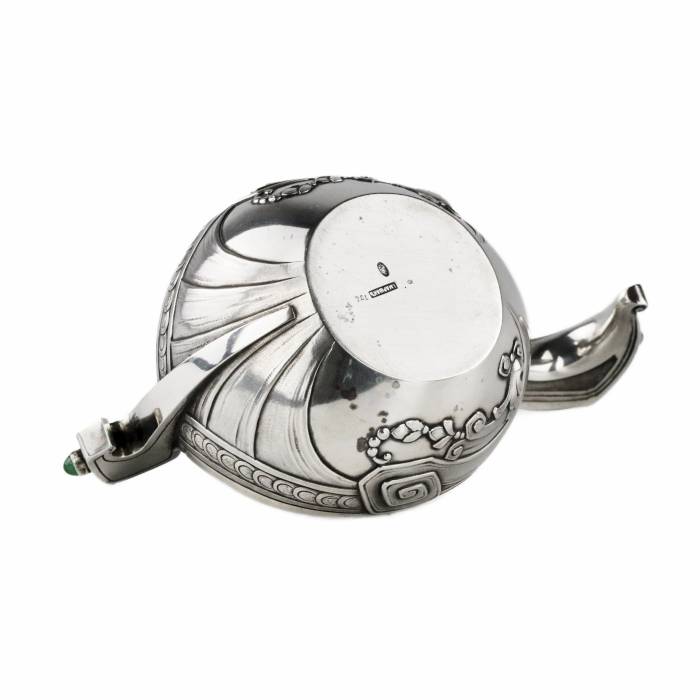
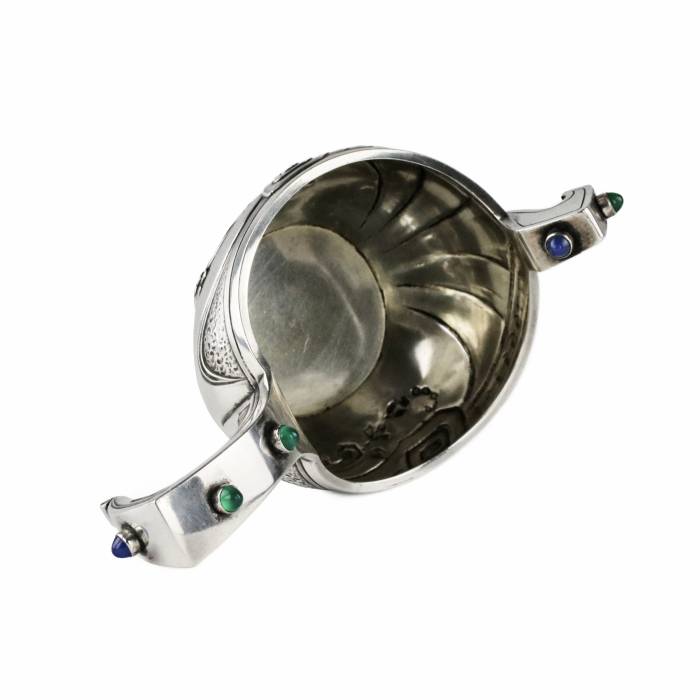
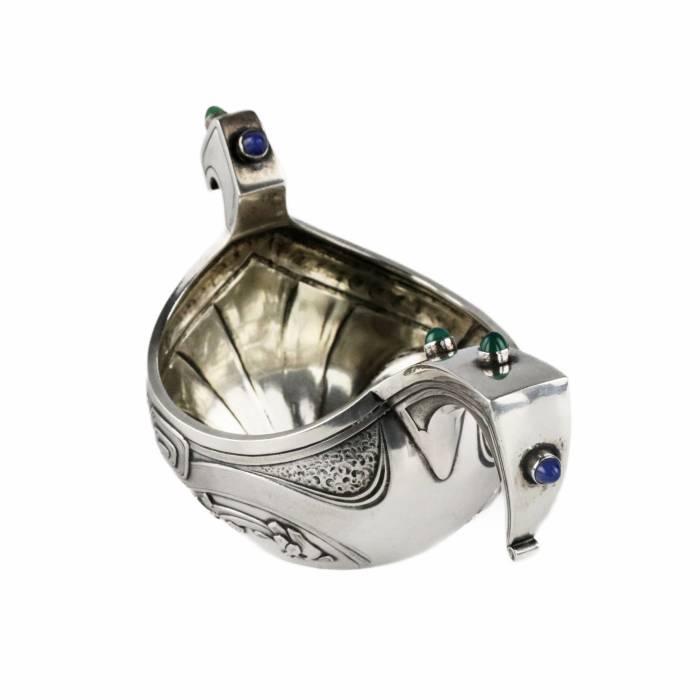
Russian, silver ladle, decorated with emerald and sapphire cabochons.

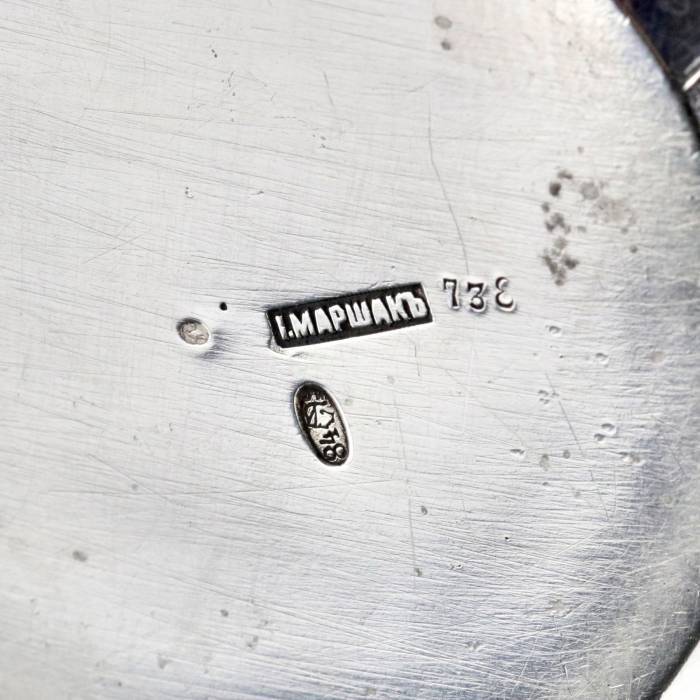
Hallmarks: silver 84, hallmark of the city of Moscow, hallmark of the assay master IL Ivan Lubedkin (1898-1914). The name of the master I. Marshak (Marshak Joseph Abramovich (1878, Kyiv)). Considered one of the great competitors of Faberge at the beginning of the last century, sometimes called the Cartier of Kiev, at the beginning of the Russian Revolution of 1917, the company employed 150 people, inventory number 738, French import stamp (swan)

SIZE: Height: 8 cm. Width: 14 x 7.5 cm. Weight: 140 g.

Art:
russia
Height:
8 cm
Width:
14 cm
Depth:
7.5 cm
Period:
At the turn of 19th -20th century
Country:
Royal Russia
Material:
Silver 84, Gilding, Emerald
Condition:
Revive
Fair
Good
Very good
Like new

The condition report is provided for informational purposes only.

It is not comprehensive and may not reflect all defects, restorations, alterations, or adaptations, as Antiqon does not perform professional conservation-level assessments. The information is based on a qualified, yet subjective, evaluation by our specialists.Before purchasing, we recommend consultation with an independent expert.Please also consult our Terms and conditions and Glossary A-Z, which contain important information on lot characteristics and sale conditions.

Marshak, Joseph Abramovich. Master goldsmith.
Joseph Abramovich Marshak (1854; the village of Gnatovka, Kiev province - August 9, 1918; Kiev) - merchant, jeweler, philanthropist. One of the biggest competitors of Faberge. Founder of the Marshak Jewelry House, which had 92 buildings and produced more than half of the gold products in the Southwest Territory of the Russian Empire. Kiev merchant of the 1st guild. Multiple prize-winner of various exhibitions. He was the first in all of Russia to entrust women to work in jewelry. Joseph was born into a poor family and was the oldest child. At the age of 14 he moved to Kiev and went as an apprentice to a jewelry workshop, eventually became an assistant to the master.On May 2, 1878, he opened his own workshop in Kiev on Podil. The first time he worked alone, a year later he moved to Khreshchatyk and was able to expand the business, taking on an apprentice and students. At first, Marshak only produced jewelry and sold them through the shops of other craftsmen and merchants.Over the next 10 years, he significantly expanded his business: he recruited new masters, earned prestige in his circle, visited jewelry exhibitions in Germany and France, and introduced new approaches to production. In particular, he was the first to instruct female craftsmen to perform engraving operations, which required the utmost accuracy and concentration.Gradually, Marshaks workshop grew into a large factory, which soon began to develop new markets - at first, jewelry was sold in Kiev, Poltava, Kharkov and Tbilisi, and over time also in Moscow, St. Petersburg and Warsaw, large stores of which were the main customers of the Kiev jewelry house. Marshaks products were highly appreciated at specialized exhibitions - in 1893 in Chicago and in 1894 in Antwerp, his works were awarded a diploma and a medal.Over time, Marshak added watchmaking to the jewelry business. He also opened a craft school, which trained highly qualified jewelers and cutters. Joseph Marshak was one of the main competitors of Carl Faberge, he was even called the "Kiev Cartier". His products - jewelry, sets, watches and other pieces of jewelry art - were presented as a gift to wealthy people, representatives of the nobility and merchants, as well as the imperial family. After the revolution, the factory was expropriated by the Soviet government. Josephs son Alexander opened a salon in Paris, where he successfully continued his fathers business, and after the Second World War, jeweler Jacques Verger opened the markets of North America and Morocco for the Marchak jewelry house. Having survived many difficulties and even bankruptcy, in April 2005 the Marchak jewelry salon reopened in Paris.

Stay up to date with new arrivals
Save Russian silver and we let you know when new listings appears in this category
Save

Related items