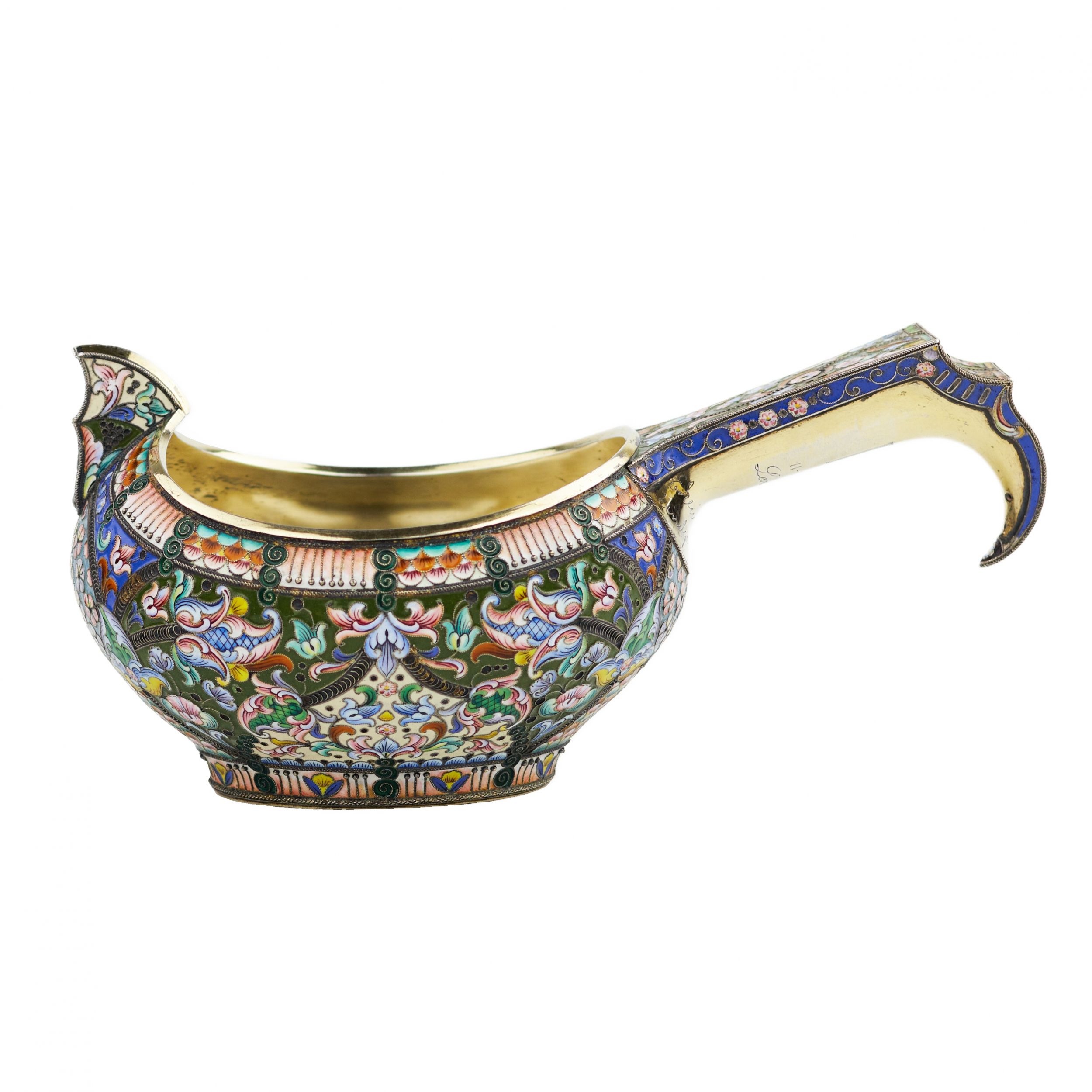



LARGE RUSSIAN SILVER KOVSH WITH CLOISONNÉ ENAMEL BY KONSTANTIN SKVORTSOV RUSSIA, MOSCOW, 1908–1917
AntiqonART consultant will contact you within one business day after receiving your request.
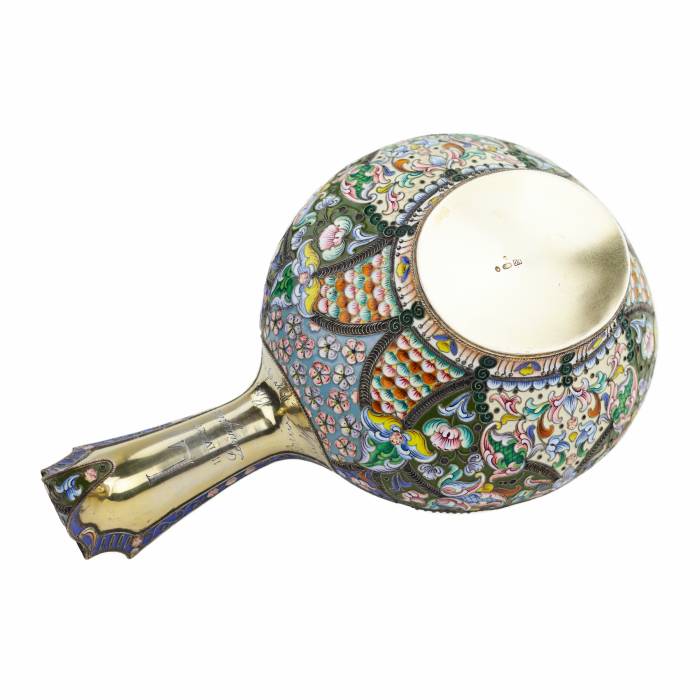
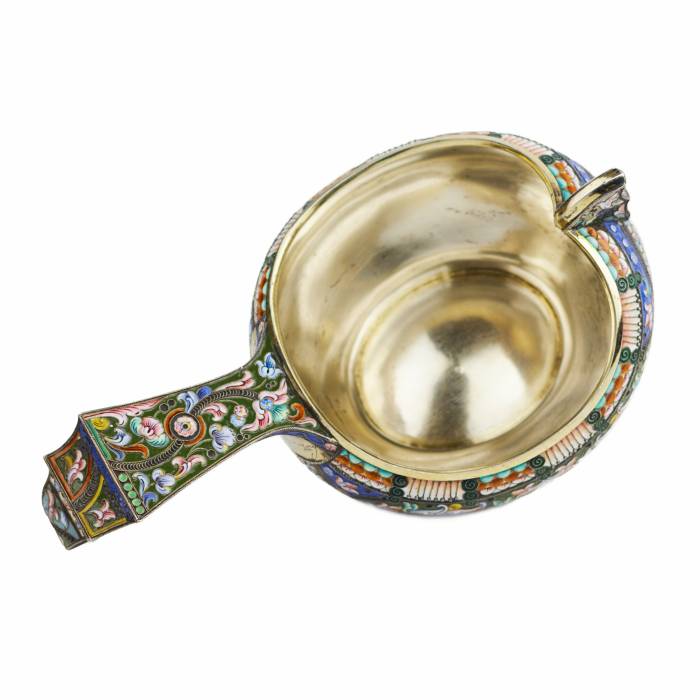
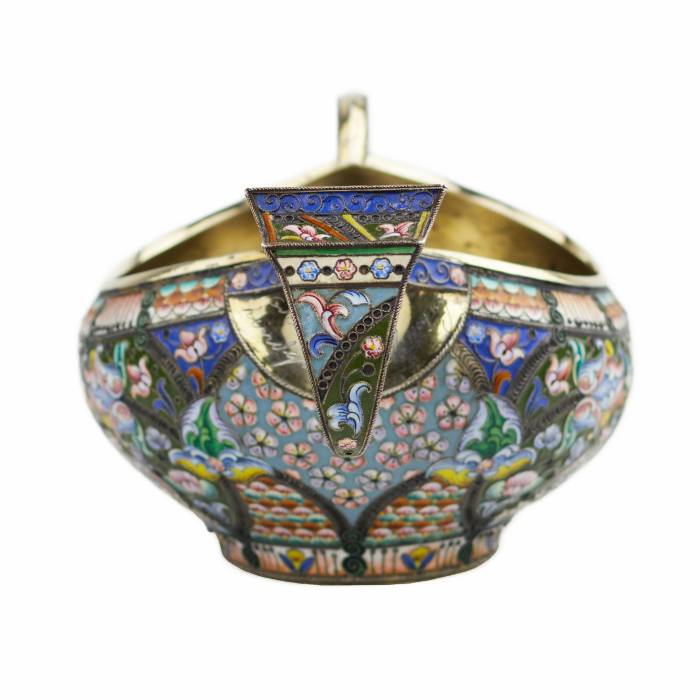
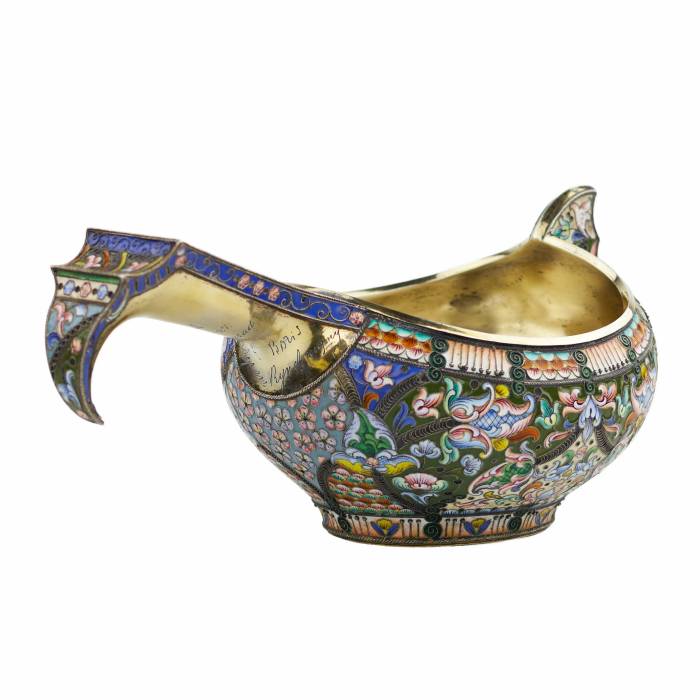
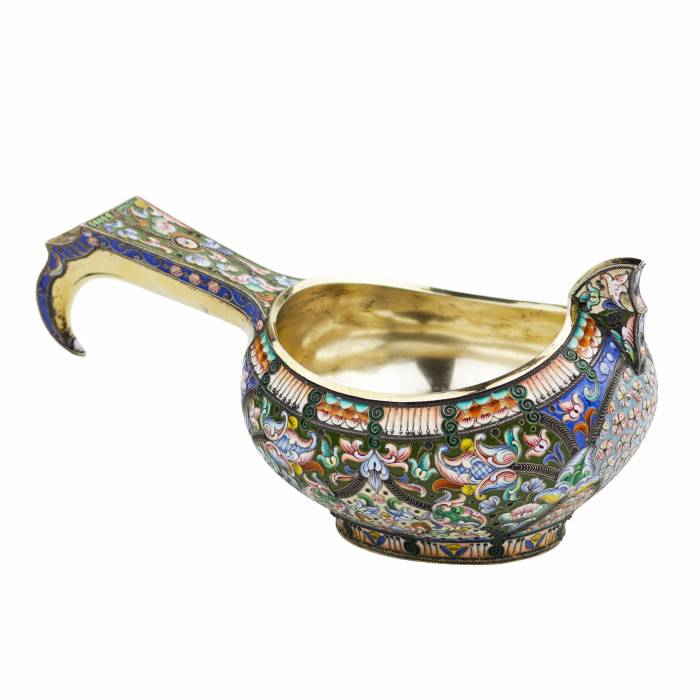
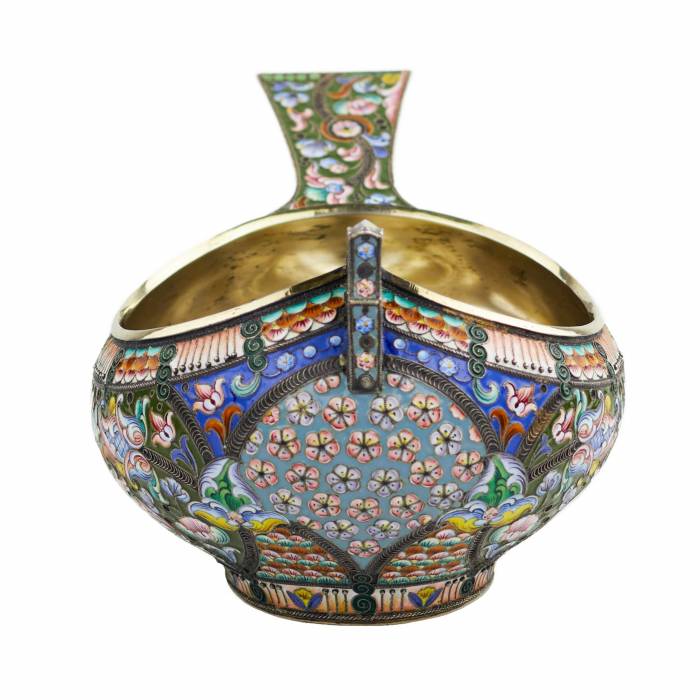
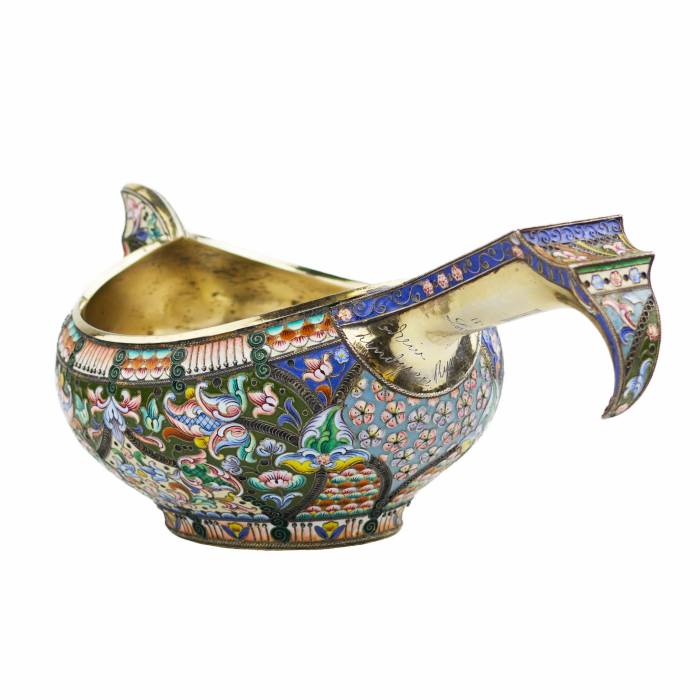
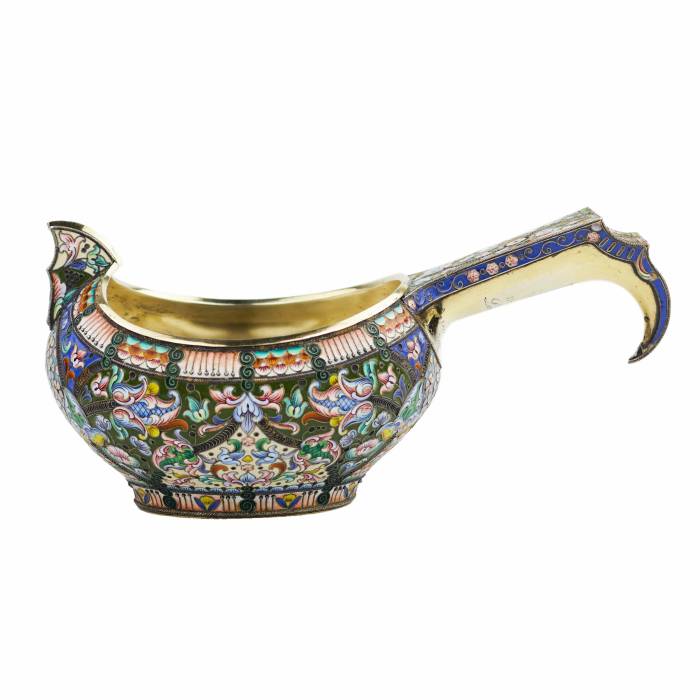
A large ceremonial Russian silver kovsh executed in Moscow by the silversmith Konstantin Illarionovich Skvortsov in the early 20th century. The vessel is conceived in the traditional form of a stylized boat, a shape rooted in ancient Russian ceremonial drinking vessels and widely revived in Moscow silver of the late Imperial period. The monumental silhouette provides a framework for an elaborate and richly articulated decorative program.
The surface is adorned with high-quality polychrome cloisonné enamel applied to large panels featuring vegetal ornament and stylized floral clusters. Extremely fine silver wire partitions create a precise rhythmic structure, reflecting a high level of technical mastery. The color palette ranges from emerald green and deep cobalt blue to sky blue, coral and white tones, producing a harmonious and vibrant chromatic composition. The interior is finished with fire gilding, enhancing the visual richness of the piece and reinforcing its ceremonial character. The handle is decorated in the same ornamental language and seamlessly continues the overall decorative scheme.
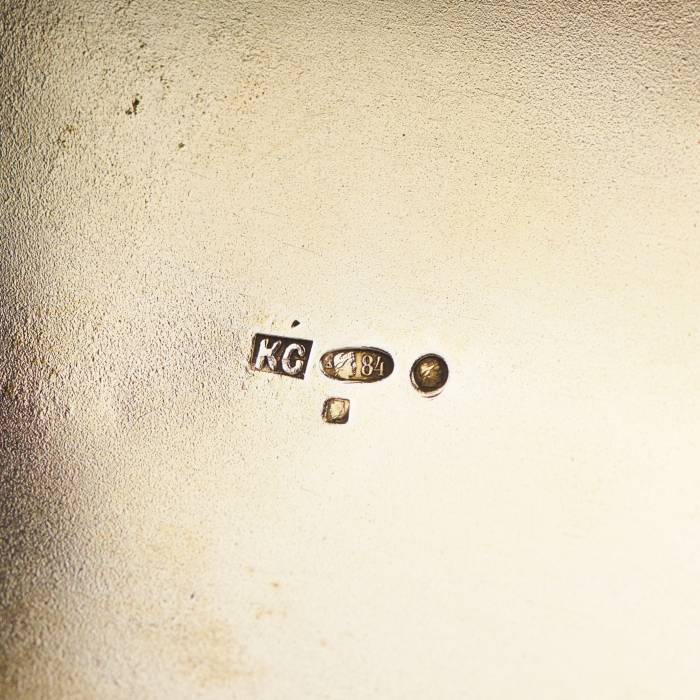
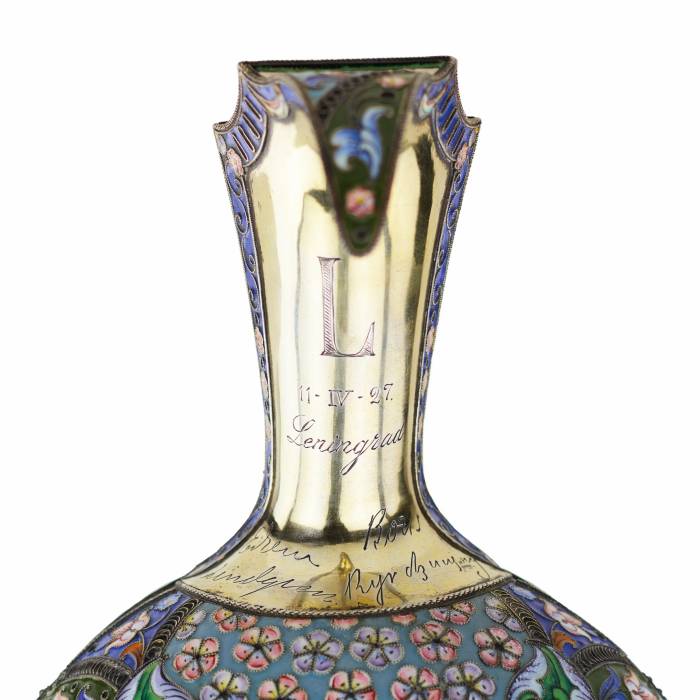
Hallmarks: Cyrillic initials “KS” in a rectangular cartouche, corresponding to the silversmith Konstantin Illarionovich Skvortsov; Moscow Assay Office hallmark with a woman’s head in a kokoshnik and silver standard “84”, dated 1908–1917; Additional assay marks; Presentation engraving on the inner side of the handle: letter “L” and date “1927”.
Dimensions: Length 23 cm. Height 10 cm. Width 23 cm. Thickness 13 cm.
Weight: 510 g.
Condition: Good.
Provenance: Private collection.
Cloisonné enamel kovshi occupy a distinguished position in the history of Russian decorative arts of the late 19th and early 20th centuries. During this period, Moscow silversmiths actively revived national forms inspired by medieval Russian art, integrating them with contemporary artistic language and refined technical execution. The boat-shaped kovsh became one of the emblematic forms of this movement, combining archaic symbolism with monumental decorative presence.
Cloisonné enamel was regarded as one of the most demanding and prestigious techniques in Moscow silver of the early 20th century. It required exceptional precision in wirework, carefully balanced color schemes, and multiple kiln firings, making such objects costly and highly valued. Kovshi of this type were created not for everyday use but for ceremonial occasions, presentation gifts, and representative interiors, often serving as symbols of status and cultural identity.
Konstantin Illarionovich Skvortsov belonged to a circle of Moscow masters who continued the traditions of major firms and independent workshops at the turn of the century. His works are characterized by confident command of enameling techniques, attention to scale, and a strong sense of compositional unity. Between 1908 and 1917, such kovshi were perceived as expressions of national style, uniting decorative splendor with historical references to pre-Petrine Russia. Today, these works are recognized as significant examples of Russian silver of the Late Art Nouveau and Neo-Russian period, sought after by both museum and private collections.
Good condition. Silver with an even natural patina. Enamels well preserved, without losses or restoration, showing minor age-related wear. Interior gilding stable. Hallmarks clear and legible.
The condition report is provided for informational purposes only.
It is not comprehensive and may not reflect all defects, restorations, alterations, or adaptations, as Antiqon does not perform professional conservation-level assessments. The information is based on a qualified, yet subjective, evaluation by our specialists.Before purchasing, we recommend consultation with an independent expert.Please also consult our Terms and conditions and Glossary A-Z, which contain important information on lot characteristics and sale conditions.