




GIUSEPPE MAZZOLINI (1806–1876). VIRGINIA. ITALY, ROME, 1874
AntiqonART consultant will contact you within one business day after receiving your request.
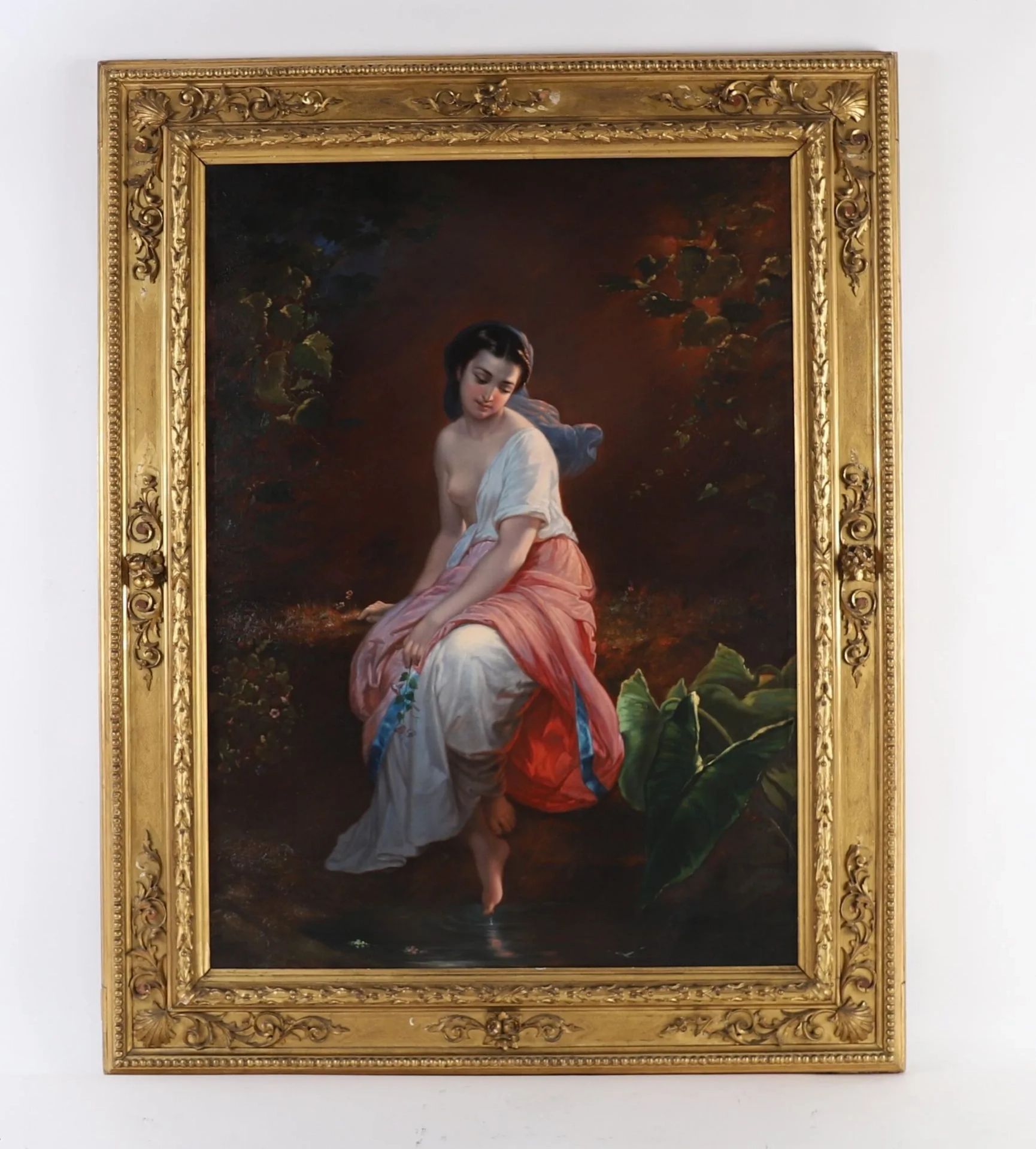
The present work represents a refined and high-quality example of Academic painting of the second half of the 19th century, focused on the idealized female figure and the poetic language of salon contemplation. The young woman is placed within an intimate coastal landscape at twilight. The composition is structured around a calm diagonal of the body and a gentle inclination of the head, creating an atmosphere of inner silence and concentration. Moonlight acts as the principal compositional element, softly illuminating the shoulder, neckline, and facial profile before dissolving into the half-tones of the background and reflections on the water.
The painterly technique is grounded in strict academic draftsmanship and subtle glazing. The modeling of the body reveals careful anatomical precision combined with an idealizing smoothness of form. Drapery plays a significant decorative role: the warm red and pink textiles establish the chromatic focus of the composition, set against the subdued brown and green tones of the landscape. The balanced interplay of light and shadow reinforces the nocturnal, humid atmosphere and enhances the refined salon character of the image.
Overall, the painting may be regarded as an authorial variation on an Academic motif closely aligned with the French tradition, in which harmony of silhouette, nobility of pose, and emotional restraint prevail over narrative drama.
Marks: Signed “MAZZOLINI” in the lower part of the painting; inscriptions on the reverse of the canvas; old collection label on the reverse of the frame.
Dimensions: 95 × 66.4 cm.
Material: Oil on canvas.
Condition: Good collectible condition.
Provenance: According to the old label on the reverse of the frame: “Virginia / Bought at Rome / 1874”.
Rome in the 1870s remained one of the principal centers of European Academic culture, where the traditions of rigorous draftsmanship, idealized plasticity, and refined painterly modeling continued to flourish. It was within this artistic environment that the work of Giuseppe Mazzolini (1806–1876) took shape. Belonging to a circle of Italian painters strongly oriented toward French Salon art, Mazzolini worked primarily in Rome, adhering to strict Academic principles of anatomical accuracy, compositional clarity, and idealized figural representation inherited from the classical Academic tradition of the first half of the century.
During the second half of the 19th century, Salon compositions featuring the female figure set within a poeticized natural setting enjoyed sustained popularity. Such subjects allowed artists to demonstrate a high level of professional mastery in the rendering of nuanced chiaroscuro, the quality of flesh, the texture of fabrics, and the complex effects of evening or nocturnal light. Mazzolini specialized in figurative compositions with female subjects, distinguished by emotional restraint, refined plasticity, and a pronounced orientation toward contemplative viewing, in keeping with the tastes of the international audience and private collectors visiting Rome at the time.
In Virginia, this artistic approach is expressed through the calm, balanced pose of the figure and the decisive role of moonlight, which creates a meditative, almost non-narrative space. The artist’s visual language is characterized by compositional clarity, soft glazing, and a noble harmony of color. The female figure is conceived as a timeless and aesthetically complete ideal, free from genre specificity and narrative drama, aligning the work with the broader European Academic tradition.
Stylistically, the painting reveals a close affinity with the aesthetic of Thomas Couture, evident in the idealized facial type, measured emotional expression, and compositional equilibrium. The figure functions not as a character within a specific narrative, but as an autonomous plastic ideal, oriented toward harmony of form and visual balance.
Parallels may also be drawn with the Academic tradition of the bather in Russian painting, particularly in the works of Karl Timoleon von Neff and Andrei Frantsevich Belloli, where the female figure is treated as an independent aesthetic object, and priority is given to plastic perfection of form, clarity of silhouette, and noble restraint of expression.
Thus, Virginia stands as a mature and convincing example of 19th-century European Academic painting, uniting the Roman Italian milieu with French and Russian artistic references. The work retains significant art-historical and collectible value as a refined Salon composition founded on the ideals of form, tonal harmony, and poetic light.
The canvas is in good collectible condition. Traces of early restoration are present. The support is stable, with no active losses observed.
The condition report is provided for informational purposes only.
It is not comprehensive and may not reflect all defects, restorations, alterations, or adaptations, as Antiqon does not perform professional conservation-level assessments. The information is based on a qualified, yet subjective, evaluation by our specialists.Before purchasing, we recommend consultation with an independent expert.Please also consult our Terms and conditions and Glossary A-Z, which contain important information on lot characteristics and sale conditions.