CIMON AND IFIGENIA. IVORY MINIATURE. JOSEF STADLER GERMANY / AUSTRIA, FIRST HALF OF THE 19TH CENTURY
AntiqonART consultant will contact you within one business day after receiving your request.
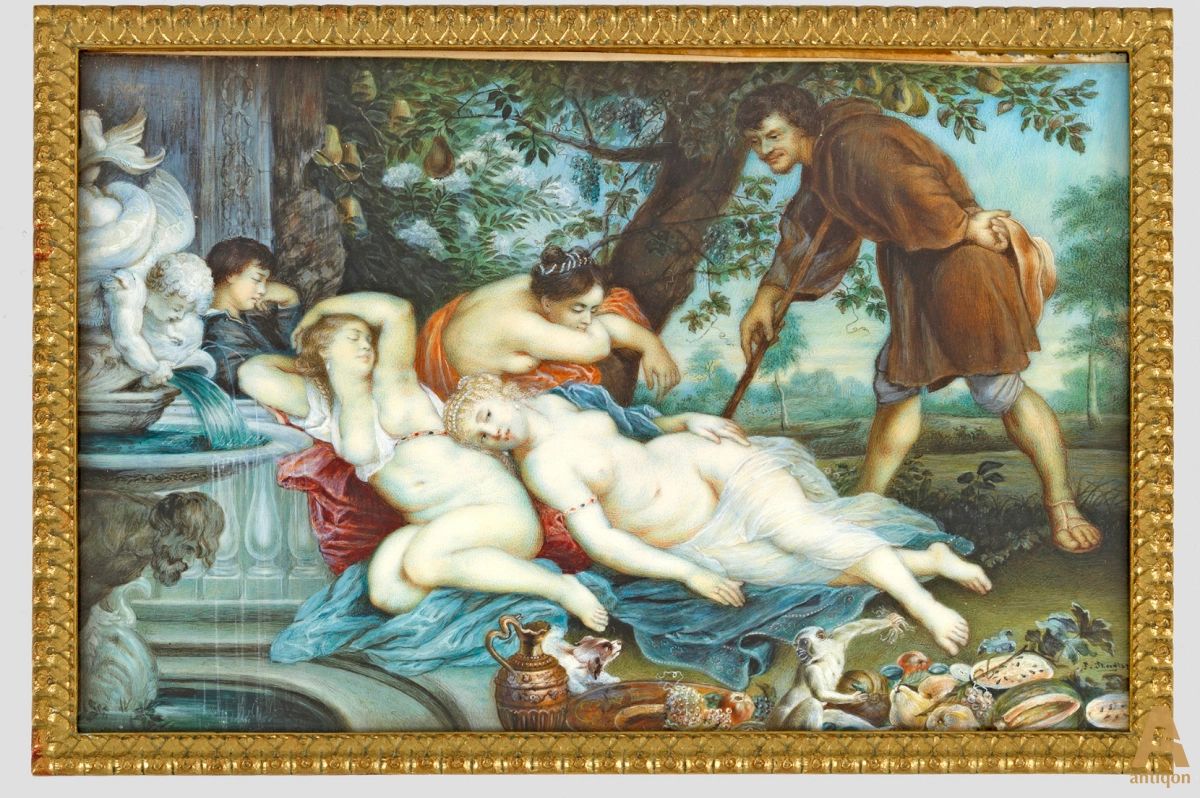
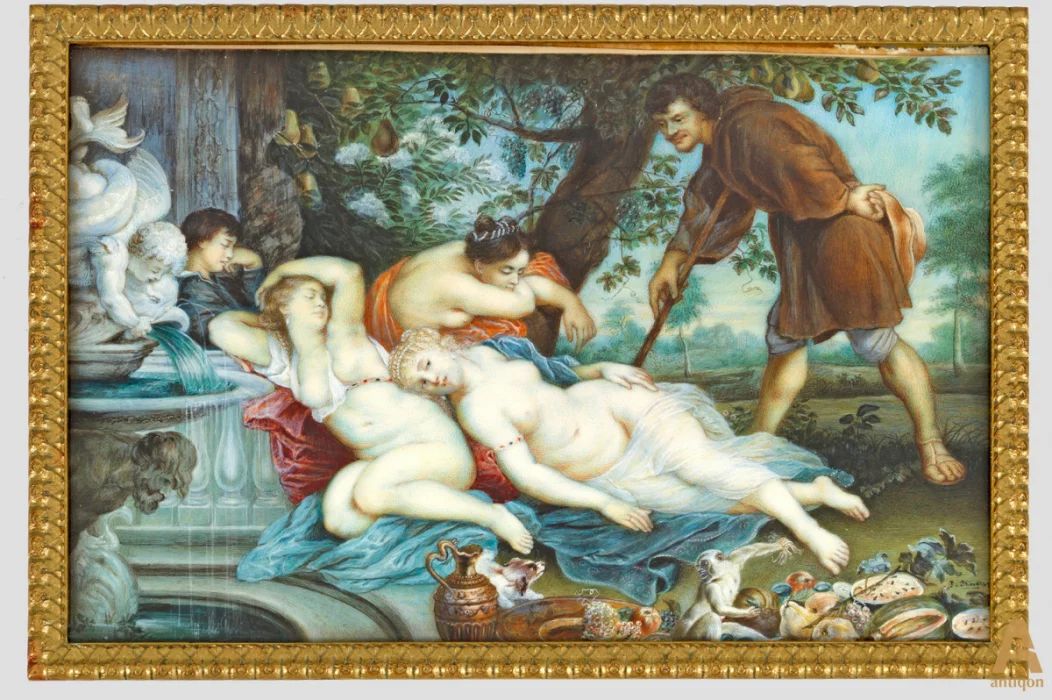
An outstanding ivory miniature created by Josef Stadler (c. 1800–after 1835) in the first quarter of the 19th century, executed in tempera and set in an elegant gilt frame. The work is a late, highly detailed reproduction of the famous composition Cimon and Ifigenia, painted around 1617 by the eminent Flemish master Peter Paul Rubens (1577–1640) in collaboration with Frans Snyders (1579–1657). The original is held in the Kunsthistorisches Museum, Vienna.
At the centre is the mythological scene in which the shepherd Cimon, once coarse and ignorant, awakens to beauty and refinement as he gazes upon the sleeping nude Ifigenia and her companions at a fountain. The composition is rich in allegorical details: finely rendered still lifes with fruits and animals in the lower section, sculptural elements of the fountain, and a delicately painted landscape background.
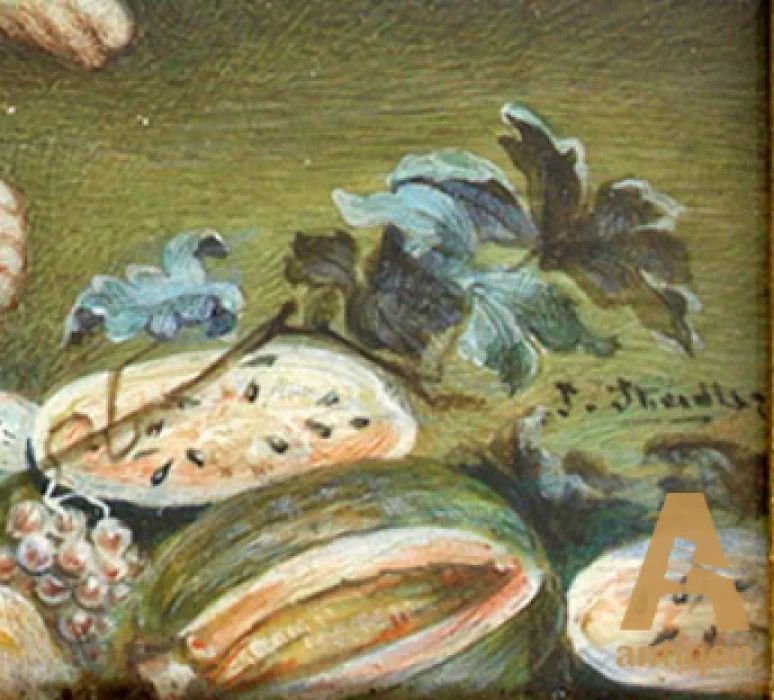
Stadler’s mastery is evident in the subtle modelling of forms, the filigree rendering of fabric textures, the gentle radiance of skin, and the jewelled precision in the depiction of minute details — from drops of water to fruit seeds. The artist’s signature “J. Stadler” is placed in the lower right corner.
Dimensions: 16 × 22 cm (framed).
Material: Tempera on ivory; gilt frame.
Provenance: Private European collection; Schloss Ahlden auction.
Bibliography: Schildlof, La Miniature en Europe, vol. II, p. 779.
The theme of Cimon and Ifigenia originates from Day X, Novel IX of Giovanni Boccaccio’s Decameron, and was especially popular in Baroque art, combining sensual, moralising, and allegorical elements. In Peter Paul Rubens’s (1577–1640) interpretation, created around 1617 in Antwerp, the work depicts the moment of inner transformation of the rough shepherd Cimon, who, upon seeing the sleeping beauty Ifigenia, awakens to love, culture, and virtue. The scene’s symbolism emphasises the triumph of civilisation and refinement over savagery and ignorance.
Frans Snyders (1579–1657), master of animal and still life painting, enriched the composition with exquisitely rendered fruits, birds, and animals, imparting an atmosphere of abundance and vitality. This collaboration became iconic in Flemish art of the 17th century, inspiring numerous later copies and interpretations, including 19th-century miniatures.
Josef Stadler (c. 1800–after 1835) — a German-Austrian miniaturist and painter of the first quarter of the 19th century — was renowned for his detailed reproductions of the masterpieces of the Old Masters. Working in tempera and watercolour on ivory, he preferred small-scale formats that allowed collectors to own “portable museums” within their private collections. His works are distinguished by filigree precision, attention to the original’s details, and the ability to adapt monumental compositions to miniature scale without losing expressiveness. Stadler frequently produced reproductions for aristocratic and private collections, where they were valued both for their artistic and cultural-historical significance.
Such miniatures occupy a special place in the Biedermeier art of Germany and Austria, demonstrating a high level of craftsmanship and the enduring 19th-century passion for collecting Renaissance and Baroque subjects in refined decorative form.
Excellent condition; no paint loss; colours are vivid, surface clean. Frame in good condition with a light patina of age.
The condition report is provided for informational purposes only.
It is not comprehensive and may not reflect all defects, restorations, alterations, or adaptations, as Antiqon does not perform professional conservation-level assessments. The information is based on a qualified, yet subjective, evaluation by our specialists.Before purchasing, we recommend consultation with an independent expert.Please also consult our Terms and conditions and Glossary A-Z, which contain important information on lot characteristics and sale conditions.