

THE GIFT OF CLEOPATRA TO CAESAR ITALIAN SCHOOL, BOLOGNA, LATE 17TH CENTURY
AntiqonART consultant will contact you within one business day after receiving your request.
Discover your personalized shipping cost — based on where you are and how you prefer to receive your piece..
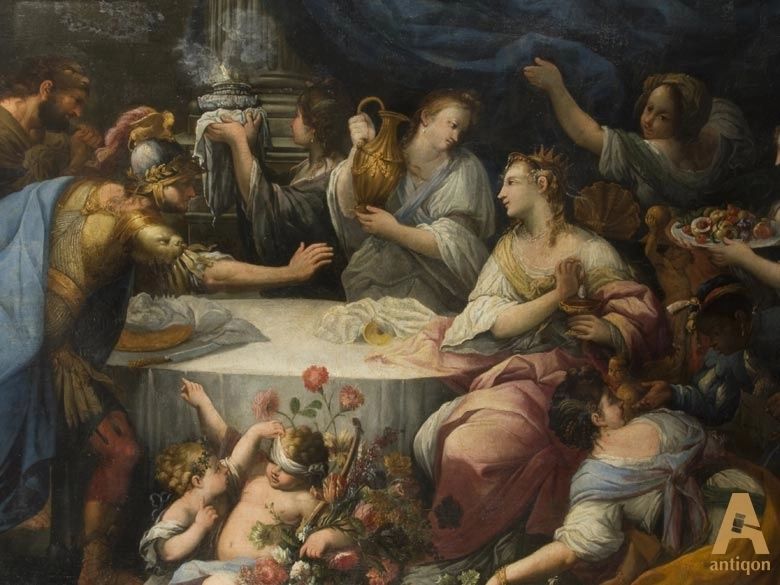
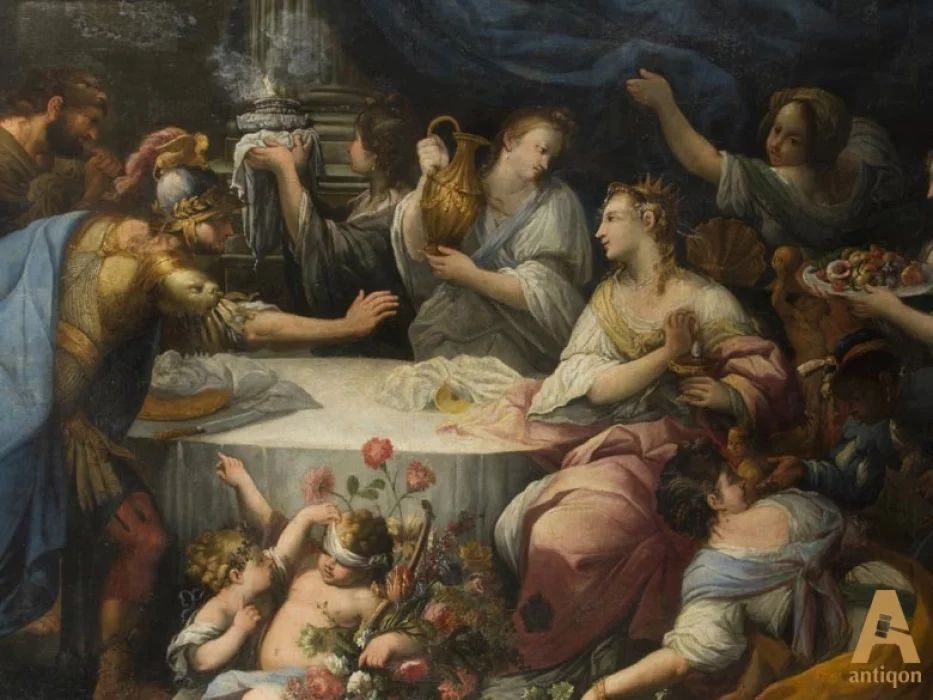
The monumental painting The Gift of Cleopatra to Caesar is an outstanding example of historical and allegorical painting in the Italian academic tradition of the late 17th century, created within the Bolognese school. The subject is inspired by Pliny the Elder’s Natural History—a rare and meaningful episode of the Egyptian queen Cleopatra’s banquet, during which she, wishing to demonstrate her superiority in wealth and wit, dissolves an invaluable pearl in vinegar and drinks it in the presence of an astonished Julius Caesar.
The composition is staged in a grand theatrical manner: at the centre—a large oval banquet table, surrounded by figures, architectural settings, and draperies that evoke an ancient hall. Cleopatra, draped in gold-threaded fabrics and crowned with a diadem, towers over the scene with unshaken dignity. Her pose—tense yet restrained—expresses strength, control, and calculation. Opposite her stands Caesar—in armour and cloak—captured at the very moment of astonishment, forming a counterpoint to the feminine dominance of the scene.
Dramatic details abound: putti with pearls, vases and ewers; a table laden with gifts, fruits, and golden vessels; attendants observing the action, mirroring the viewer’s own emotional reaction. Architectural elements—columns, frieze, vaults—enhance the monumentality and historical depth of the scene, while delicate veils of light create an immersive effect and emphasize the sculptural quality of the figures.
The painting is executed with exceptional mastery. The manner characteristic of Marcantonio Franceschini (1648–1729) is evident in the idealized female faces, peach-golden palette, attention to drapery, and compositional dynamism. The influence of Carlo Cignani (1628–1719), Franceschini’s teacher, appears in the clarity of structure and classical modelling of the bodies. The absence of a signature suggests the work of a major Bolognese workshop, commissioned for a grand reception room.
The work is a rare example of the synthesis between an ancient subject and the aesthetics of the High Baroque, combining monumentality, symbolism, and technical perfection, making it a valuable artistic and collectible object.
Medium: Oil on canvas
Dimensions: 198 × 298 cm
Condition: Good; professionally restored by a restorer of the State Tretyakov Gallery
Provenance: Private European collection, formerly—Hampel Auction, Munich
The legend behind the scene is recounted by Pliny the Elder in Natural History (Book IX, 119). Cleopatra, seeking to win a wager for the most expensive banquet in history, removes a pearl earring, dissolves it in vinegar, and drinks it—astonishing Julius Caesar and forcing him to acknowledge her superiority. This gesture became a symbol of the intellectual and cultural pre-eminence of the East over the West, of feminine diplomacy over military power.
In Renaissance and Baroque art, Cleopatra emerged as the image of a ruler combining beauty, intellect, and strategic thinking. In the residences of the elite, such scenes served as allegories of power and diplomacy, as well as political parables.
The Bolognese school, founded by the Carracci Academy in 1582, sought to unite the ideals of antiquity with emotional expressiveness. In the 17th century, its leading masters were Carlo Cignani (1628–1719) and his pupil Marcantonio Franceschini (1648–1729), who defined the academic style of the region for the next century.
Cignani, a pupil of Francesco Albani, was renowned for the refined harmony of his forms, soft modulation of light, and classical balance of composition. He was not only an outstanding painter but also a pedagogue, heading the Academy in Bologna and later working in Forlì, creating monumental frescoes and altarpieces.
Franceschini, having absorbed the aesthetics of his master, developed a more decorative and refined style, combining elegance of line, a light colour palette, and pronounced idealization of figures. His works are distinguished by the purity of drawing and delicate chiaroscuro modelling, often carrying allegorical or moral undertones. He received commissions from the courts of Savoy and the Habsburgs, worked for Papal Rome, and was one of the most sought-after painters of his time.
In the creative dialogue between Cignani and Franceschini, the visual formula of late Baroque Bolognese academic painting was formed—harmoniously merging the heritage of antiquity with emotional expressiveness, refined colour, and compositional clarity. The Gift of Cleopatra to Caesar continues this tradition, blending historical narrative, allegorical subtext, and ceremonial monumentality.
The canvas is in good condition, lined and relined, with a stabilized paint layer. Museum-type frame. Professionally restored by a restorer of the State Tretyakov Gallery.
The condition report is provided for informational purposes only.
It is not comprehensive and may not reflect all defects, restorations, alterations, or adaptations, as Antiqon does not perform professional conservation-level assessments. The information is based on a qualified, yet subjective, evaluation by our specialists.Before purchasing, we recommend consultation with an independent expert.Please also consult our Terms and conditions and Glossary A-Z, which contain important information on lot characteristics and sale conditions.