


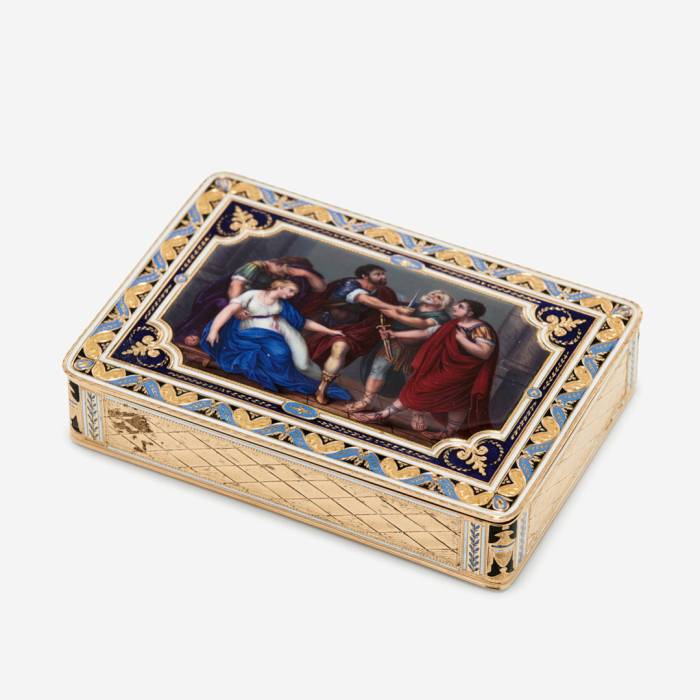
GOLD SNUFF BOX WITH ENAMEL MINIATURE “THE DEATH OF LUCRETIA” SWITZERLAND, GENEVA, 1801–1805
AntiqonART consultant will contact you within one business day after receiving your request.
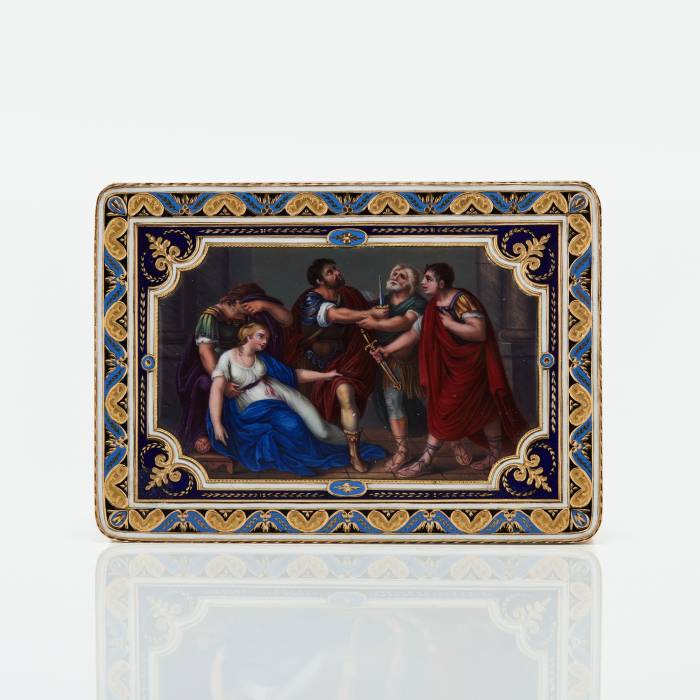
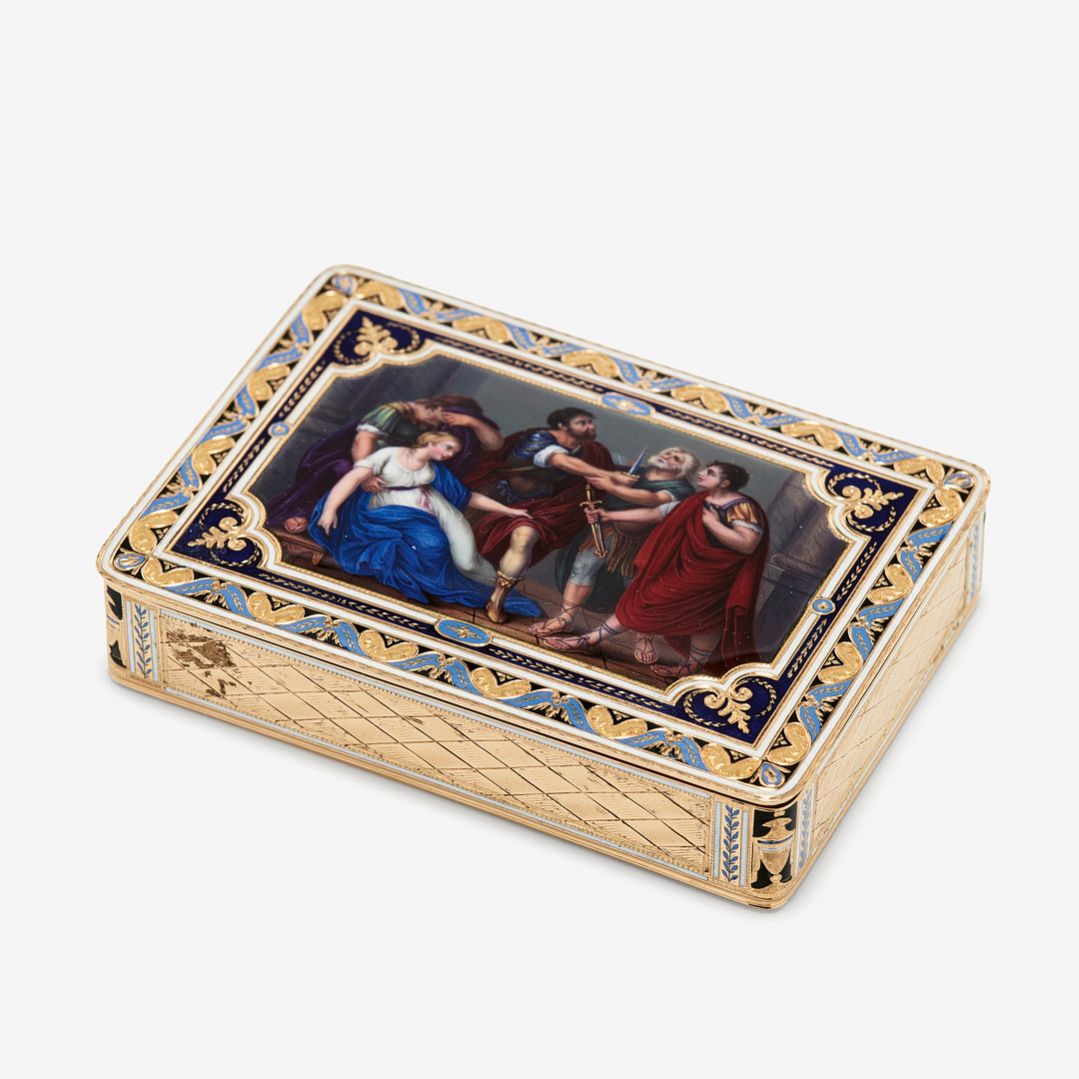
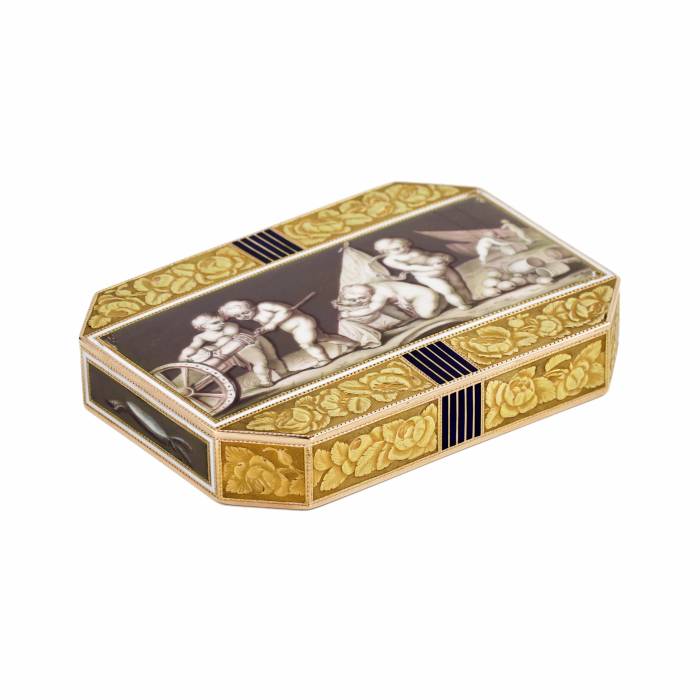
A rare gold snuff box created in Geneva between 1801 and 1805 in the workshop of Georg Rémond & Lamy et Cie, one of the leading Swiss jewellery houses of the early nineteenth century. The lid is decorated with a virtuoso painted enamel miniature depicting the dramatic classical theme “The Death of Lucretia”. The scene is framed by an elegant border of chased gold and contour enamel in deep cobalt and black tones characteristic of the Geneva school of the Consulate period.
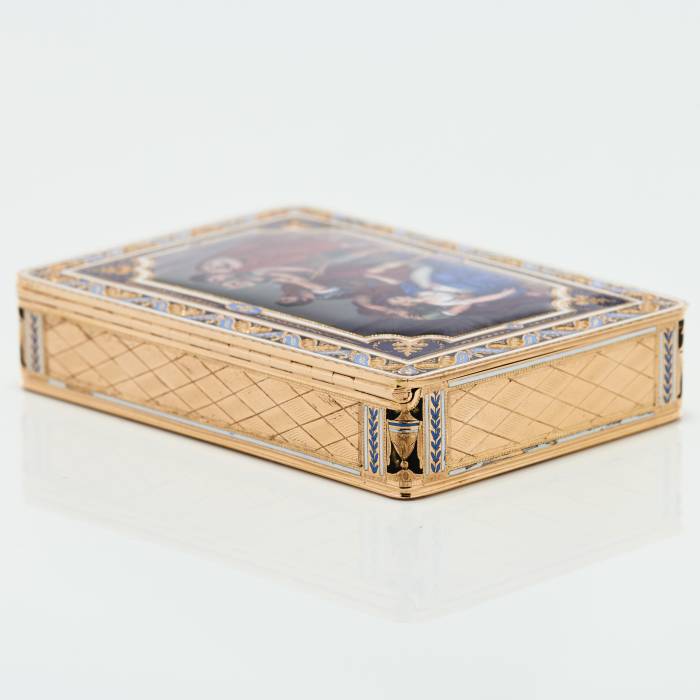
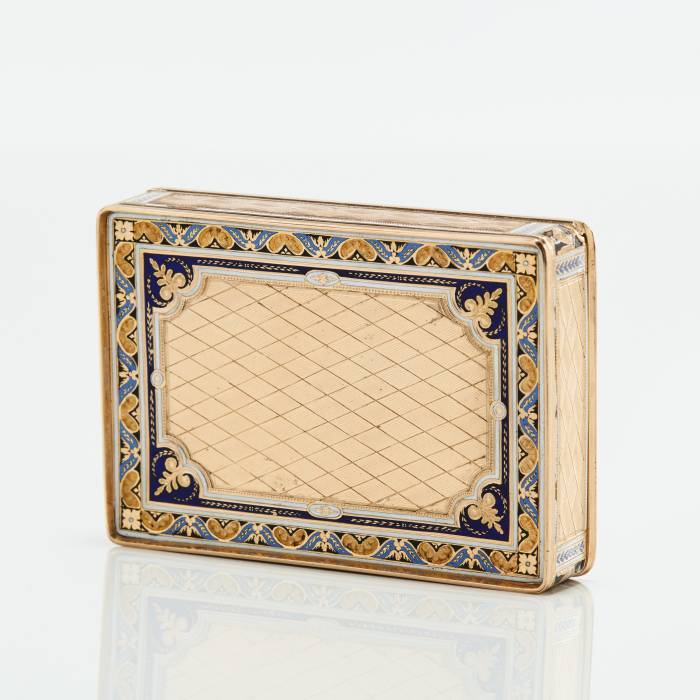
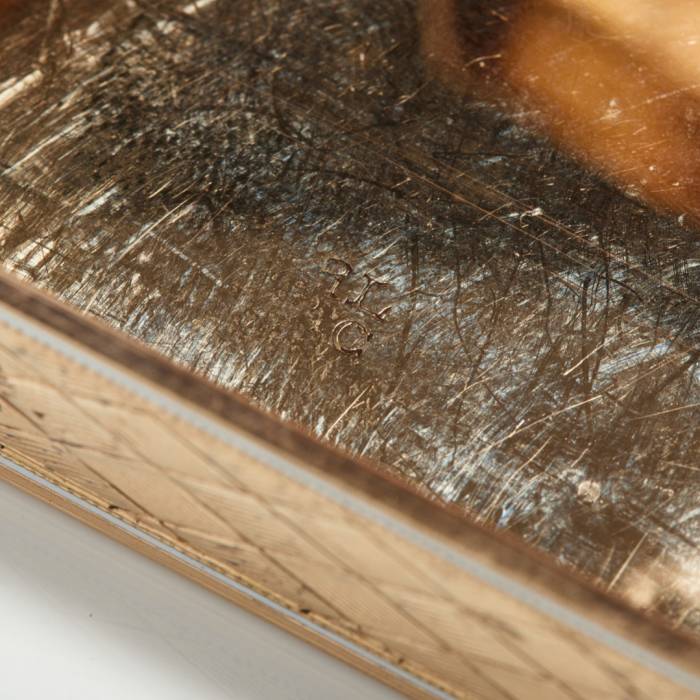
The body is crafted from 18K gold and adorned with exceptionally fine diagonal guilloché engraving. The perimeter is highlighted with ornamental borders combining stylised ribbon motifs, leaf patterns and light blue enamel inserts. The corners are articulated with vertical panels featuring classical decorative elements. The interior of the lid and walls are polished to a mirror finish, emphasising the exceptional quality of workmanship.
Marks: Letters G R L C for the workshop of Georg Rémond & Lamy et Cie, Geneva, 1801–1805.
Dimensions: Length 8.3 cm.
Weight: 104 g.
Condition: Good. Minor signs of use. Enamel without losses.
Provenance: Private collection of Jan Ribbhagen.
In the early nineteenth century, Geneva emerged as one of the most significant European centres of decorative arts, distinguished by its mastery in jewellery and painted enamel. The workshop of Georg Rémond & Lamy et Cie, built upon the earlier enterprise of Georg Rémond active since the late eighteenth century, became one of the city’s most prestigious ateliers. Its works are characterised by technical precision, high purity gold, sophisticated guilloché engraving and enamel painting executed at the level of the finest European miniaturists.
Objects by Rémond & Lamy were widely exported to France, Britain and Russia, where they enjoyed great popularity among the aristocracy. Comparable snuff boxes are preserved in the Victoria and Albert Museum, the Metropolitan Museum of Art and the Louvre, identifiable by their distinctive marks G R or G R L C and by the stylistic combination of classical compositions, painted enamel and complex guilloché surfaces. Geneva boxes of this period, particularly those produced by Rémond & Lamy, are considered benchmark examples of early nineteenth century neoclassical goldsmithing.
The miniature “The Death of Lucretia” is rooted in the Roman legend of Lucretia, whose tragic fate became a symbol of virtue and political transformation. During the Consulate and early Empire, the subject gained renewed relevance as an allegory of civic virtue and moral integrity. Geneva enamel painters, including those at Rémond & Lamy, adopted such themes to elevate their objects beyond decorative luxury to intellectual artefacts.
Characteristic features of the workshop include the use of high purity gold, intricate guilloché patterns, multicoloured enamel borders andminiatures based on Western European paintings and engravings. Such elements firmly associate these works with the Geneva artistic tradition, which helped define the international standard of luxury in the early nineteenth century. Comparable examples in major museums and historic private collections reaffirm the significance of snuff boxes produced by Georg Rémond & Lamy et Cie.
In good collectible condition. Minor surface wear to the gold consistent with age. Enamel miniature intact and without cracks. Box without deformation. Lid mechanism closes securely.
The condition report is provided for informational purposes only.
It is not comprehensive and may not reflect all defects, restorations, alterations, or adaptations, as Antiqon does not perform professional conservation-level assessments. The information is based on a qualified, yet subjective, evaluation by our specialists.Before purchasing, we recommend consultation with an independent expert.Please also consult our Terms and conditions and Glossary A-Z, which contain important information on lot characteristics and sale conditions.