EASTER EGG CASKET BY THE HOUSE OF CARL FABERGÉ. MASTER HENRIK WIGSTRÖM RUSSIA, ST PETERSBURG, 1904–1908
AntiqonART consultant will contact you within one business day after receiving your request.
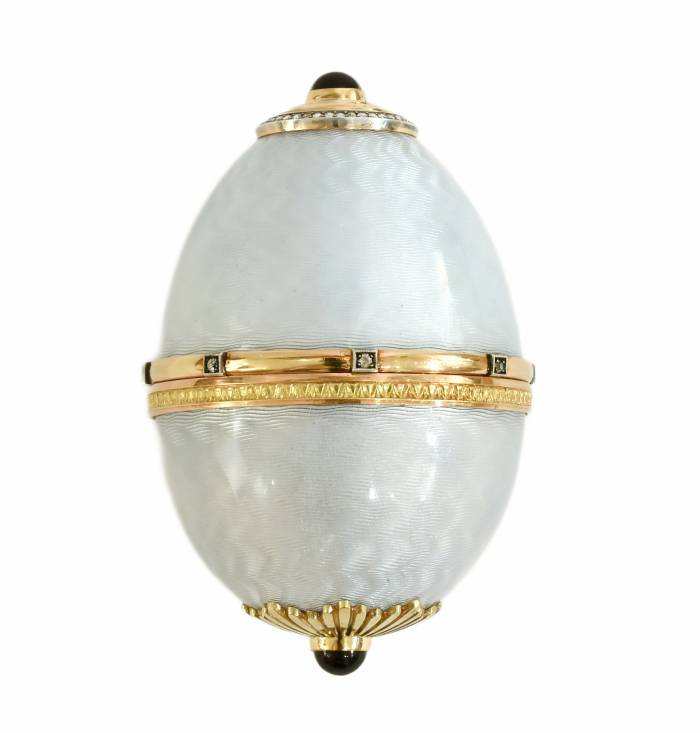
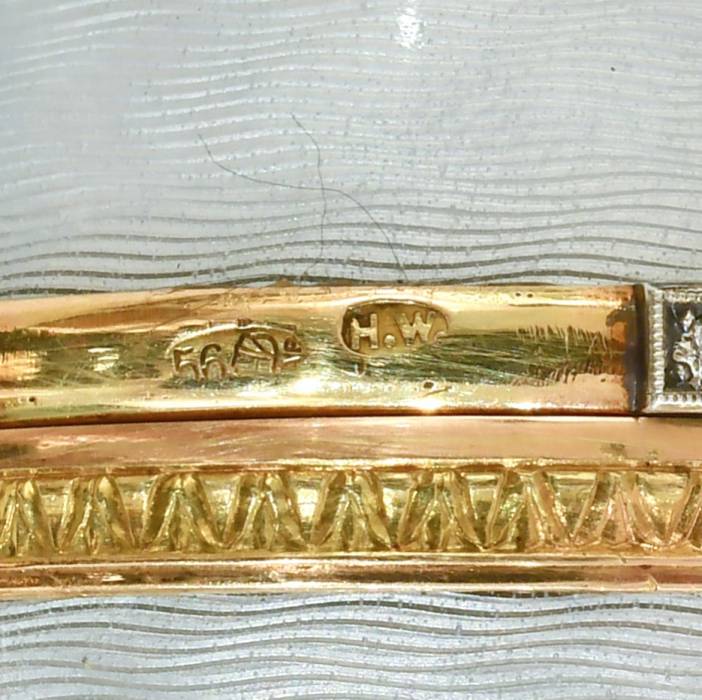
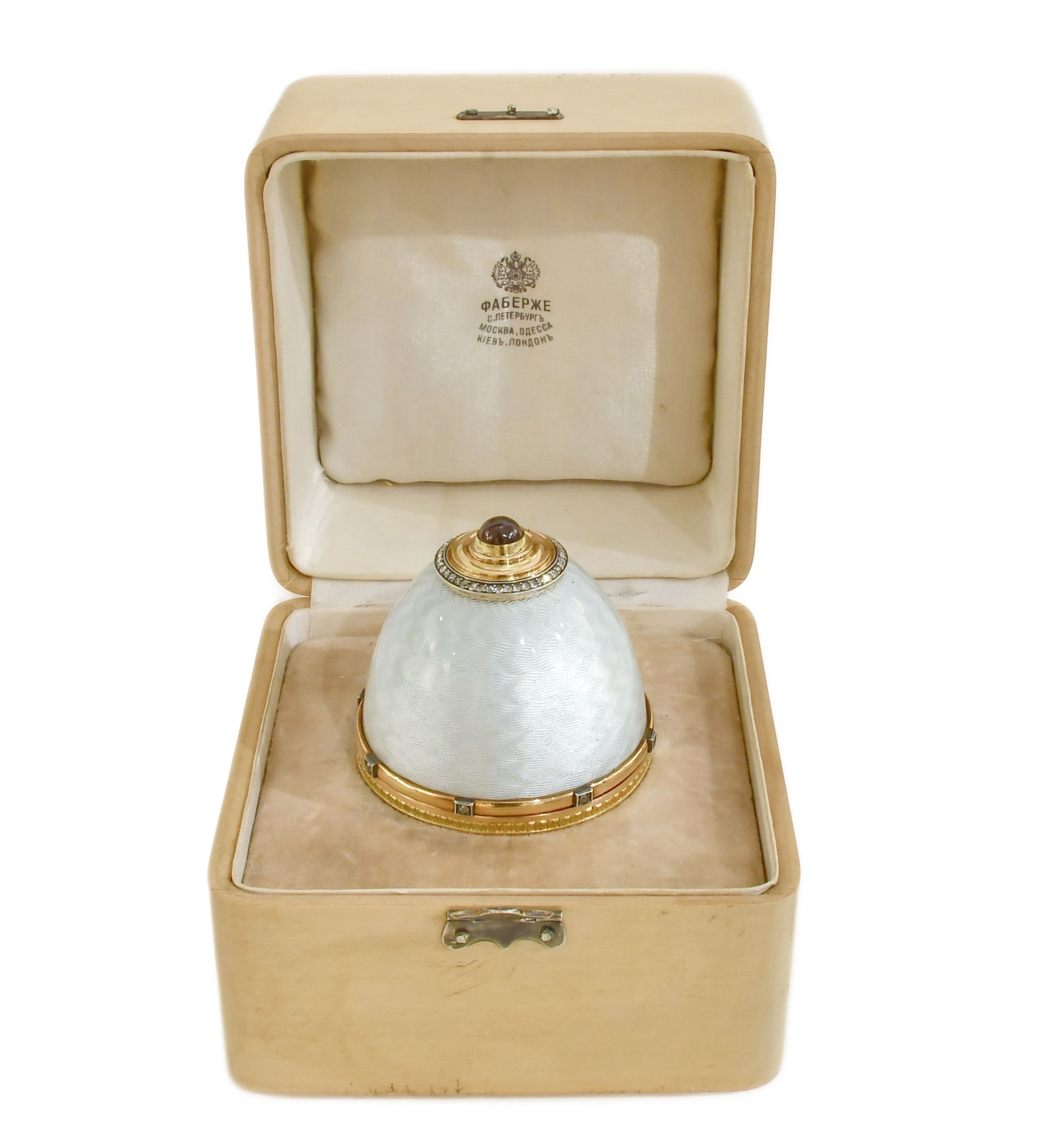
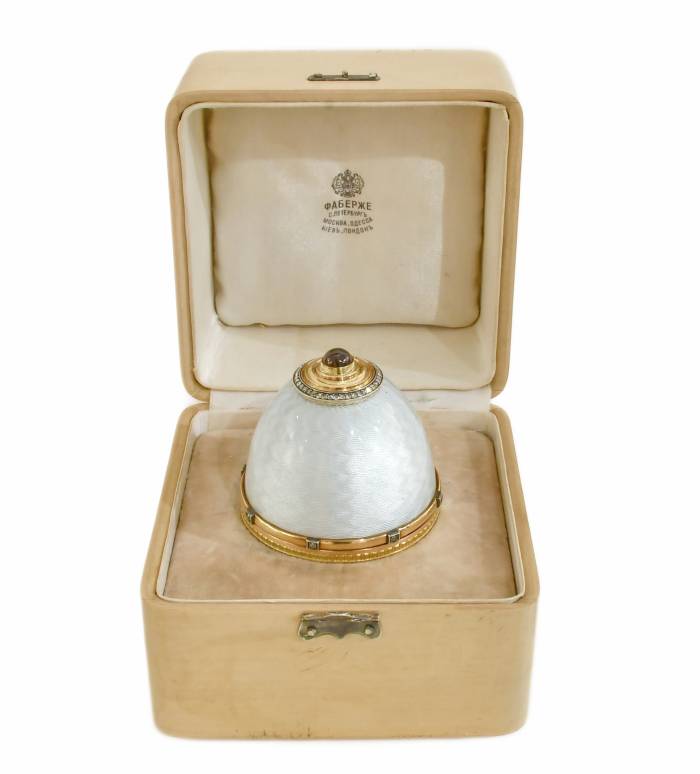
An elegant jewelled Easter egg casket created in the St Petersburg workshop of the House of Carl Fabergé under the direction of the leading master Henrik Wigström (Henrik Wigström, 1862–1923). The object represents a small decorative egg-shaped casket composed of two joined halves.
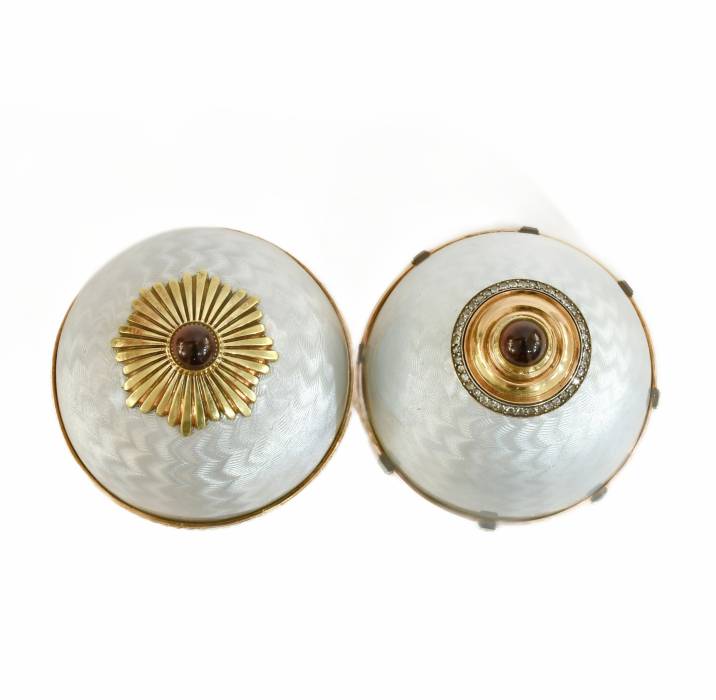
The surface of the body is covered with translucent white enamel over a guilloché ground. The delicate radial and wave-like structure of the guilloché produces a characteristic play of light beneath the translucent enamel layer and represents one of the most recognisable artistic features of Fabergé’s production of the early twentieth century.
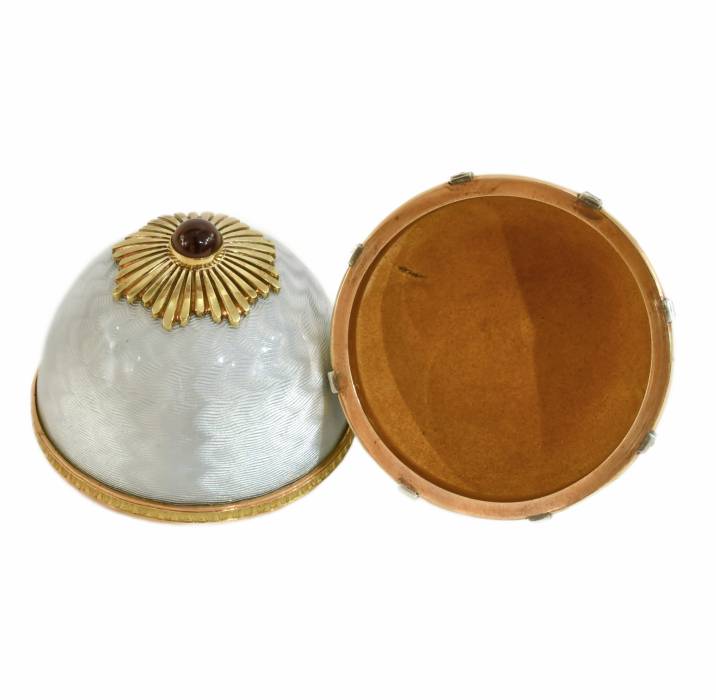
The body is divided by a decorative gold band with a geometric ornament and set with small rose-cut diamonds. The upper section is crowned with a decorative rosette centred by a red cabochon stone, most likely an almandine garnet. A corresponding cabochon element is placed in the lower part of the egg. The upper medallion is additionally framed by a ring of rose-cut diamonds, enhancing the jewelled refinement of the composition.
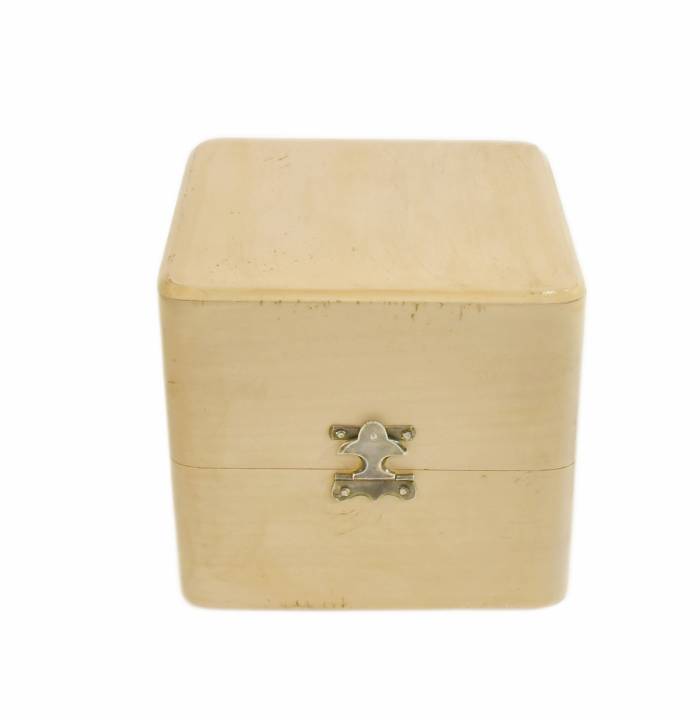
The interior is formed as a small casket with a smooth gold lining. The egg is preserved in its original Fabergé fitted wooden presentation case with silk lining. On the inside of the lid appears the firm’s mark with the Imperial double-headed eagle and the inscription: “Fabergé. St Petersburg. Moscow. Odessa. Kiev. London.”
The artistic language of the object combines the strict geometry characteristic of later Fabergé works with refined jewelled plasticity and the tradition of Imperial Easter gifts.
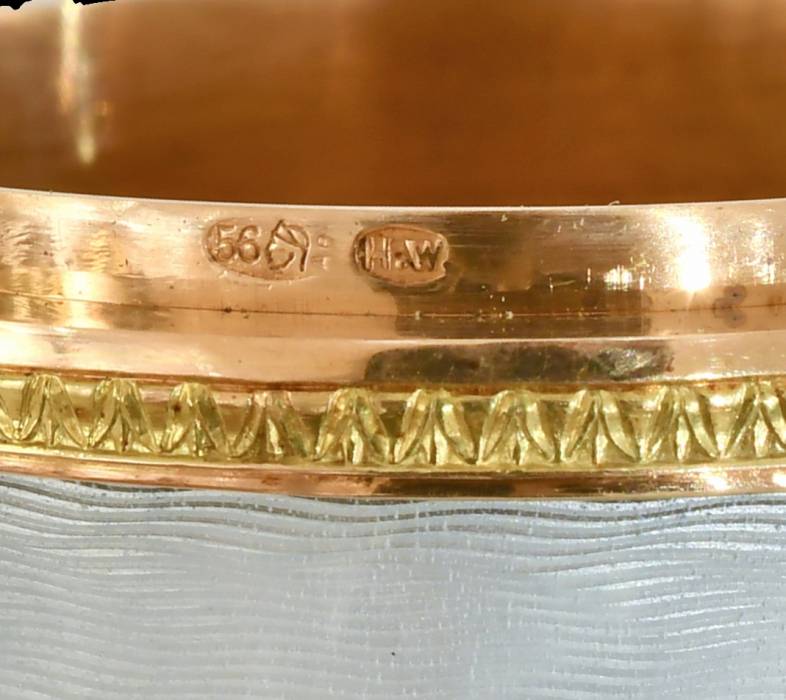
Marks: Maker’s mark “H.W.” - Henrik Wigström; assay mark “56” with the female head in kokoshnik facing left; initials of the assay inspector “A.P.” (Alexander Vasilyevich Romanov), St Petersburg Assay Office, 1904–1908.
Dimensions: Height 7.5 cm.
Weight: Not specified.
Condition: Very good. The enamel and mounts are well preserved with minor traces of age.
Provenance: Private collection.
Expert Opinion: Valentin Vladimirovich Skurlov, Candidate of Art History, Honorary Academician of the Russian Academy of Arts, expert of the Ministry of Culture of the Russian Federation for cultural property, scientific consultant on Fabergé for Christie’s auction house.
Jewelled Easter eggs occupy a special place in the artistic heritage of the House of Carl Fabergé, one of the most distinguished jewellers of the Russian Empire at the end of the nineteenth and beginning of the twentieth century. The tradition of presenting decorative Easter eggs originates in the Orthodox custom of exchanging symbolic gifts during the celebration of the Resurrection of Christ. However, it was the Fabergé workshops that transformed this traditional symbol into a highly refined object of jewelled art. In 1885 Emperor Alexander the Third commissioned the first Imperial Easter egg for Empress Maria Feodorovna. From that moment such creations became an annual tradition at the Romanov court and soon gained international recognition.
Alongside the famous Imperial Easter eggs produced for members of the Imperial family, the firm of Fabergé also created smaller jewelled eggs of a more intimate scale. These objects were intended for private clients among the highest aristocracy and the wealthy bourgeoisie of the Russian Empire. They retained the essential artistic principles of the Imperial works - exceptional craftsmanship, translucent enamels over guilloché grounds and refined diamond setting - yet were conceived in a more intimate scale suitable for personal gifts and collecting.
A particularly important role in the creation of such works was played by the master Henrik Wigström (Henrik Wigström, 1862–1923), one of the principal craftsmen of the later period of Fabergé’s activity. Born in the Grand Duchy of Finland, then part of the Russian Empire, Wigström began working in Saint Petersburg in the eighteen-eighties and became a pupil and close collaborator of Mikhail Evlampievich Perkhin, the chief workmaster of Fabergé. After Perkhin’s death in 1903 Wigström assumed the leadership of one of the principal workshops of the firm and became the chief executor of a significant number of Fabergé’s jewelled works until the closure of the enterprise in 1918.
During the period when Wigström directed the workshop, several of the most famous Imperial Easter eggs of the later Fabergé period were produced. Among the works executed in his workshop are the celebrated Imperial eggs “Trans-Siberian Railway” (1900), “Cockerel” (1900), “Lilies of the Valley” (1898), “Gatchina Palace” (1901), “Fifteenth Anniversary of the Reign” (1911), “Alexander Palace” (1908) and one of the most renowned creations of the late Imperial series, the egg “Tercentenary of the House of Romanov” (1913). These works demonstrate the highest level of technical mastery and artistic refinement achieved by the Fabergé workshops at the turn of the twentieth century.
Works from the Wigström workshop are distinguished by their balanced proportions, clarity of composition and exceptionally refined guilloché engraving used as the ground for translucent enamels. It was during this period that the technique of translucent enamel over engine-turned gold reached its highest artistic perfection. The surface of the metal was first engraved with intricate mechanical patterns produced on specialised guilloché machines, after which it was covered with a layer of translucent enamel. Light passing through the enamel intensified the depth and rhythm of the engraved pattern, creating the luminous shimmering effect that became one of the artistic hallmarks of Fabergé’s production.
Small Easter egg caskets produced in Wigström’s workshop were highly appreciated by clients of the early twentieth century. They were frequently acquired as refined Easter gifts and were often intended to contain miniature jewels or small commemorative objects. Unlike the unique Imperial eggs, such pieces could be produced in limited series and were sold through Fabergé’s boutiques in Saint Petersburg and Moscow, as well as through the firm’s international branches, including the London establishment.
Following the events of 1917 a significant number of Fabergé works were confiscated, dispersed abroad or melted down. For this reason small jewelled Easter eggs of the early twentieth century executed by Henrik Wigström today represent a considerable rarity. Particularly valuable are examples preserved in good condition and accompanied by their original Fabergé presentation cases, which constitute an important testimony to their origin within the workshops of the celebrated jeweller.
The object is in very good condition. The enamel shows no visible chips or cracks and the guilloché ground remains clearly visible. The stones are securely set and the mounts show no noticeable deformation. The original Fabergé presentation case is preserved with minor signs of age and use.
The condition report is provided for informational purposes only.
It is not comprehensive and may not reflect all defects, restorations, alterations, or adaptations, as Antiqon does not perform professional conservation-level assessments. The information is based on a qualified, yet subjective, evaluation by our specialists.Before purchasing, we recommend consultation with an independent expert.Please also consult our Terms and conditions and Glossary A-Z, which contain important information on lot characteristics and sale conditions.