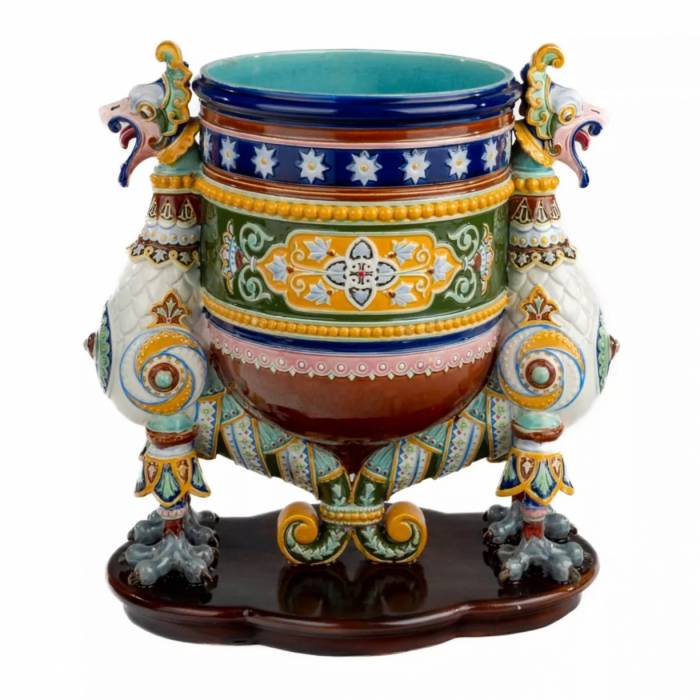
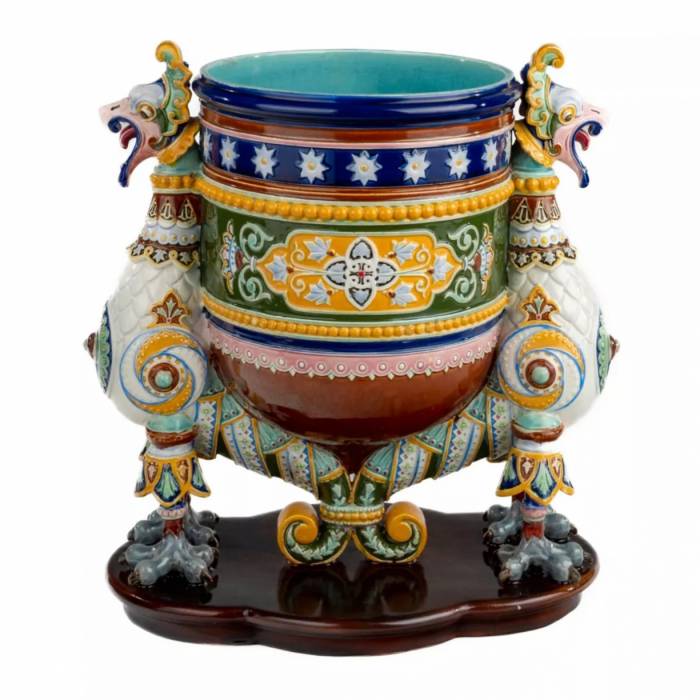
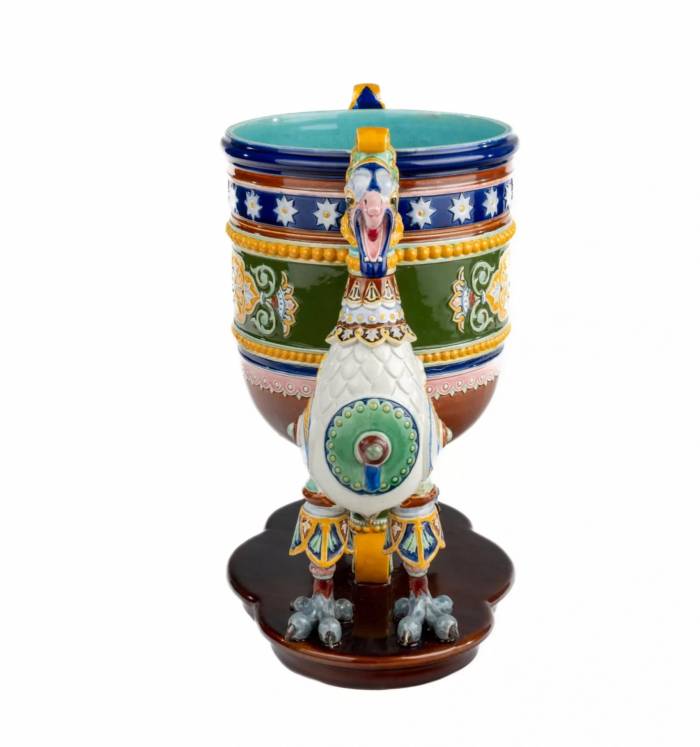
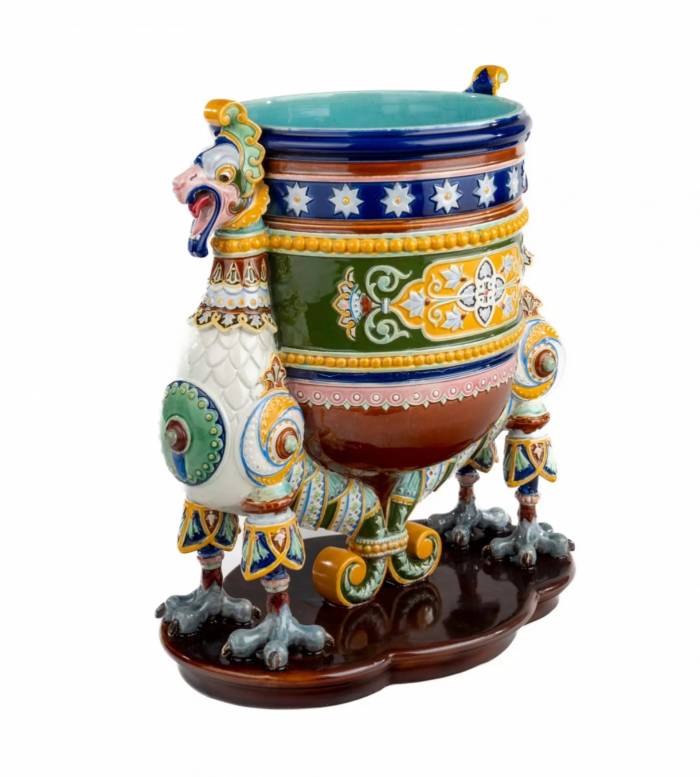
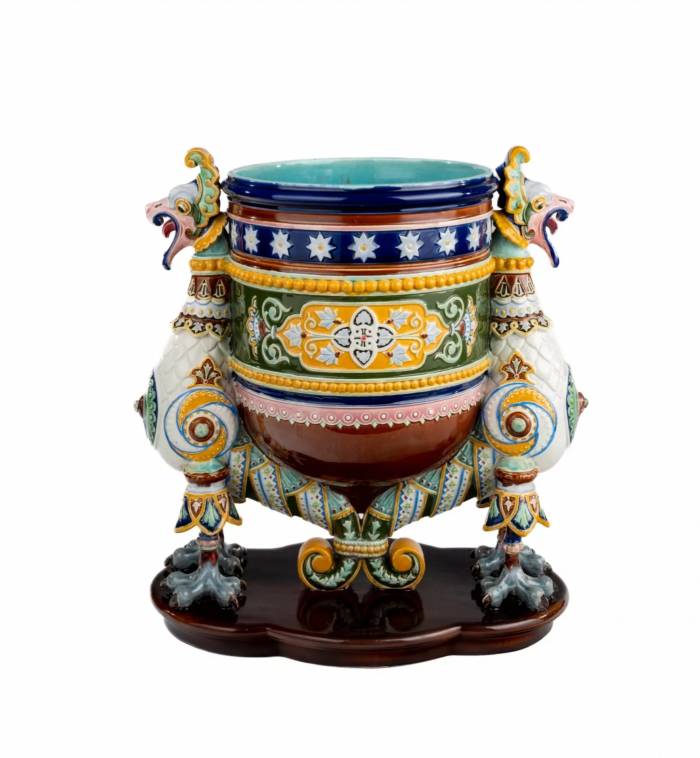
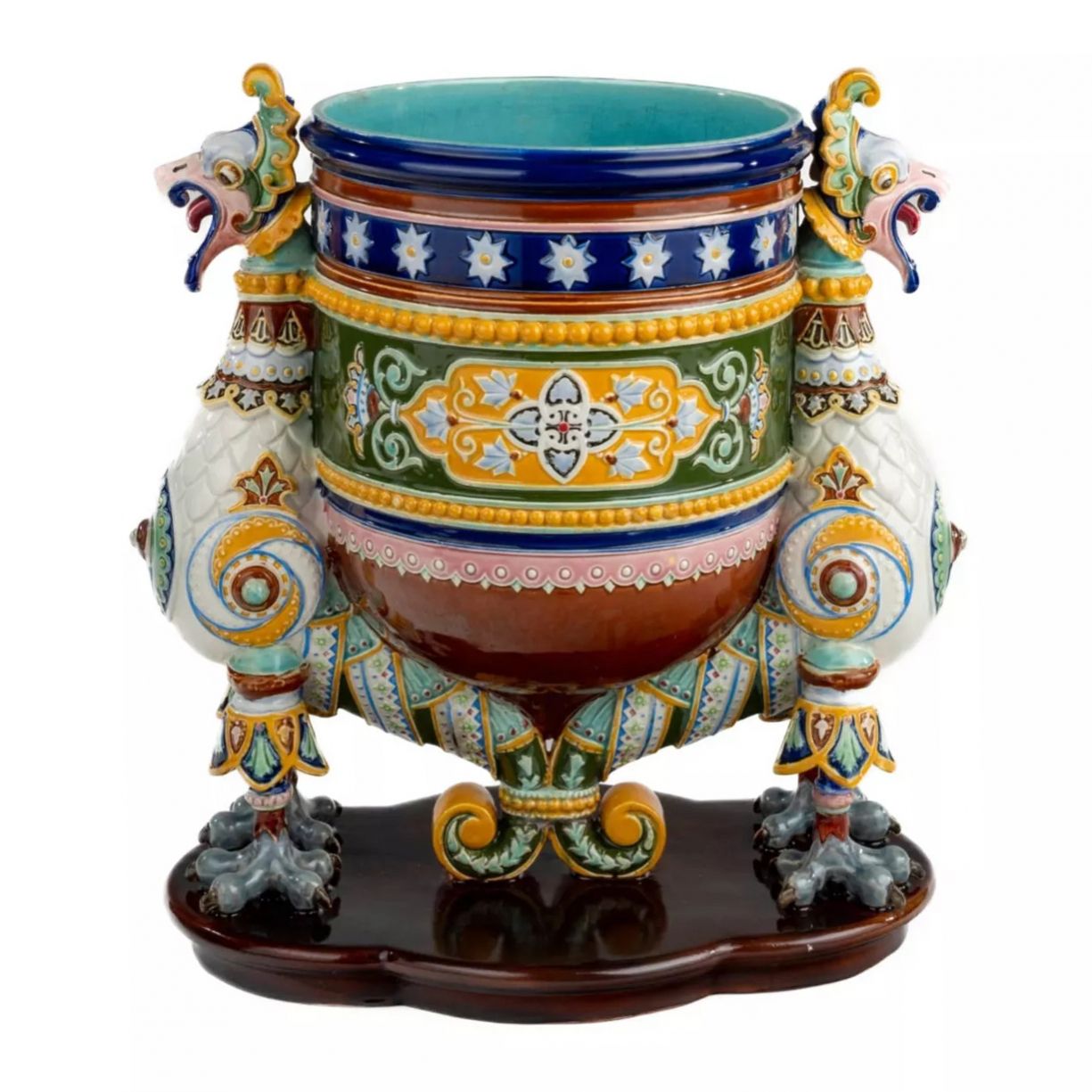
Vase in neo-Russian style. Kuznetsovs factory in Dulevo, 1890

Vase in neo-Russian style. Kuznetsovs factory in Dulevo, 1890

ID-ANTQ-8026
May 18, 2024 12:00 PM GMT+03:00
Live auction is finished
Estimate
5000 - 10000 EUR
Lot Sold
 
Lot sold
Use our cost calculator

Discover how the value of similar works has evolved over the past 10 years. Art is not only beauty — it's an investment.

Price History

Discover how the value of similar works has evolved over the past 10 years. Art is not only beauty — it's an investment.

Request a Shipping Quote
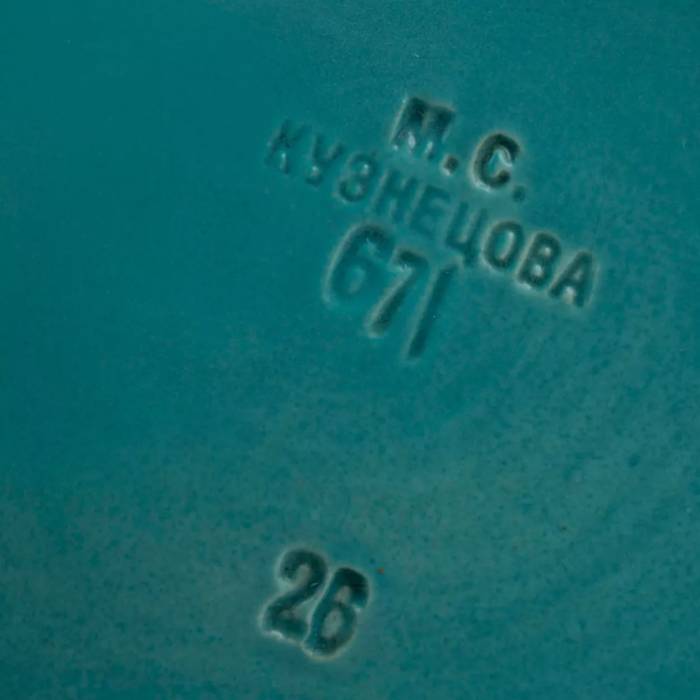
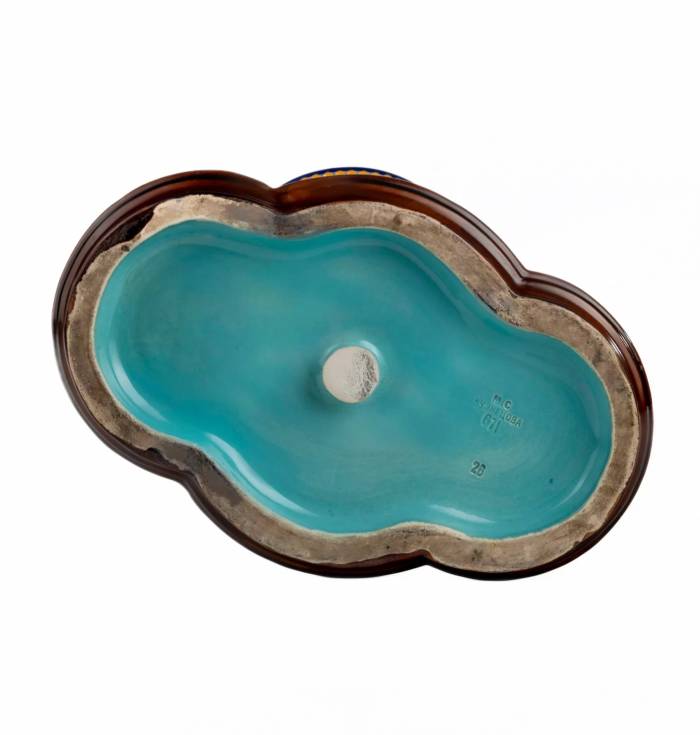
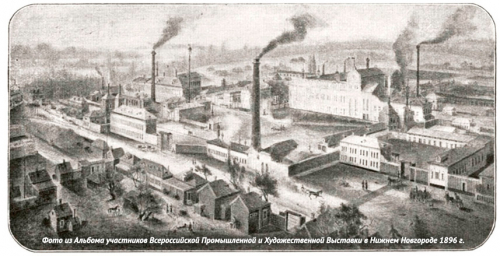
A large flowerpot with a sculptural image made in an oriental motif is a large bowl with a high cylindrical body, resting on a flat pedestal (four-bladed) and supported by two fairy-tale animals with the head of a dragon and the legs of a bird. Fancy polychrome coloring with geometric and other patterns is made in bright and contrasting colors. The surface of the pot is decorated with multi-colored friezes in relief with stylized cartouches, inlaid with ivy leaf motifs, edged with pearl friezes, the upper edge of the pot is decorated with 8-pointed stars. In general, the ornamental pattern is formed by decorative elements characteristic of similar porcelain paintings of this era. The glaze coating gives the item shine. The author of the sketch of the flowerpot model is A.S. Kaminsky (1829-1897), Moscow architect and artist, professor at the Moscow School of Painting, Sculpture and Architecture, husband of P. M. Tretyakov’s sister (founder and owner of the art gallery of the same name). For the first time such a flower pot was made at a factory in the Tver province, which belonged to S.I. Maslennikov in the 1880s (the factory was founded by Auerbach). Maslennikovs factory was famous in Russia for its majolica products used to decorate chapels, as well as mugs made for the coronation of Emperor Alexander III. After a fire occurred at the factory in 1889, it was acquired by M.S. Kuznetsov, and its owner went to work for the new owner, where he worked until 1896. As M.S. Kuznetsov practiced, along with the purchase of the factory he stipulated the right to use and repeat the factory’s old models. Sometimes, with such a purchase, he also stipulated the use of an old production mark (for example, the Gardner plant - the use of the last trademark of the enterprise with a double-headed eagle, the use of surviving models of products for the manufacture of repetitions; the Auerbach plant - the image of a double-headed eagle in the trademark). Under the leadership of Kuznetsov, the company began producing majolica products in 1885. Presumably, in the early 1890s, M.S. Kuznetsov’s enterprise produced a small batch of S.M. Maslennikov’s flowerpots intended for public sale. An identical vase is kept in the collection of the State Historical Museum in Moscow (GIM No. 112833). - A vase of a similar style was presented at the Russian Art” auction at Sothebys on November 30, 2016, lot 126A Majolica, textured processing, painting with enamel paints. Mark of the M.S. Kuznetsov factory in the Tver province, Vyshnevolotsk district, Chernyatka village (former S.I. Maslennikov factory). The production mark is embossed and made in dough. The model number indicated in the price list of the factorys products is 671 (in the test) and the foundrys index (?) is 26 (in the test). The condition of the item is very good. Slight abrasion of paint along the upper edge of the flowerpot. Height - 33.0 cm. Flowerpot: diameter - 21.0 cm, height - 23.0 cm. Pedestal (flat, four-blade): length - 29.0; width -18.0 cm.
Art:
russia
Height:
33 cm
Width:
18 cm
Depth:
18 cm
Period:
Late 19th century
Style:
Neo-Russian
Country:
Russia
Material:
Majolica, Polychrome painting
Condition:
Revive
Fair
Good
Very good
Like new

The condition report is provided for informational purposes only.

It is not comprehensive and may not reflect all defects, restorations, alterations, or adaptations, as Antiqon does not perform professional conservation-level assessments. The information is based on a qualified, yet subjective, evaluation by our specialists.Before purchasing, we recommend consultation with an independent expert.Please also consult our Terms and conditions and Glossary A-Z, which contain important information on lot characteristics and sale conditions.

Kuznetsov Porcelain Factory in Dulyovo
Kuznetsov porcelain factory in Dulevo The Dulevo porcelain factory was founded in 1832 by a native of Gzhel, Terenty Kuznetsov, who planned to establish mass production of porcelain. And after 20 years, he made the plant the leading enterprise in Russia. The factory′s porcelain was distinguished by noble simplicity - dazzling whiteness was combined with magnificent gilding and a uniform, rich shine of the glaze. But to successfully sell the dishes, a different painting was required - brighter, more catchy. Therefore, the emphasis was placed on originality, folk art, national characteristics and traditions, as a result of which the unique Dulevo style was born - “agashki”. From these ingenuous agashkas and rosans, from folk writing on ceramics, all the Dulevo drawings came, in them is the soul of the Dulevo porcelain factory. The plant received its greatest development under the management of Matvey Kuznetsov, who created the Partnership for the Production of Porcelain and Earthenware. The plant′s workshops were equipped with new equipment from France.In 1902 M.S. Kuznetsov was included in the honorary list of suppliers of the imperial court. To realize his plans, he invited famous artists to work, including the famous Russian artist M.A. Vrubel.In 1918 the plant was nationalized. Hallmarks of the Dulevo plant (1832-1917): The hallmarks of the largest Kuznetsov production are quite varied in design and reflect the longest stage of work. Stamp No. 12 (pressed in the dough) was attributed by A. B. Saltykov to the years 1853-1863, that is, to the period of activity of Sidor Terentyevich Kuznetsov, however, the teapot we discovered with such a stamp gravitates stylistically to the 30-40s of the 19th century. Stamps Nos. 13, 14 are cobalt, also from the period of activity of Sidor Terentyevich (1853-1863). Seals Nos. 15-21 belong to the early period of activity of Matvey Sidorovich Kuznetsov (1864-1889). The most common are overglaze blue ones (the color of overglaze factory marks - red, blue, green - indicates the grade of products); No. 19 - made with gold paint. Stamps No. 19-22 are reproduced for the first time. The inscriptions on stamps No. 21-22 are typical for eastern goods. Seal No. 22 is from the period of the Partnership (1889-1917).
... Read More

Stay up to date with new arrivals
Save Russian porcelain and we let you know when new listings appears in this category
Save

Related items