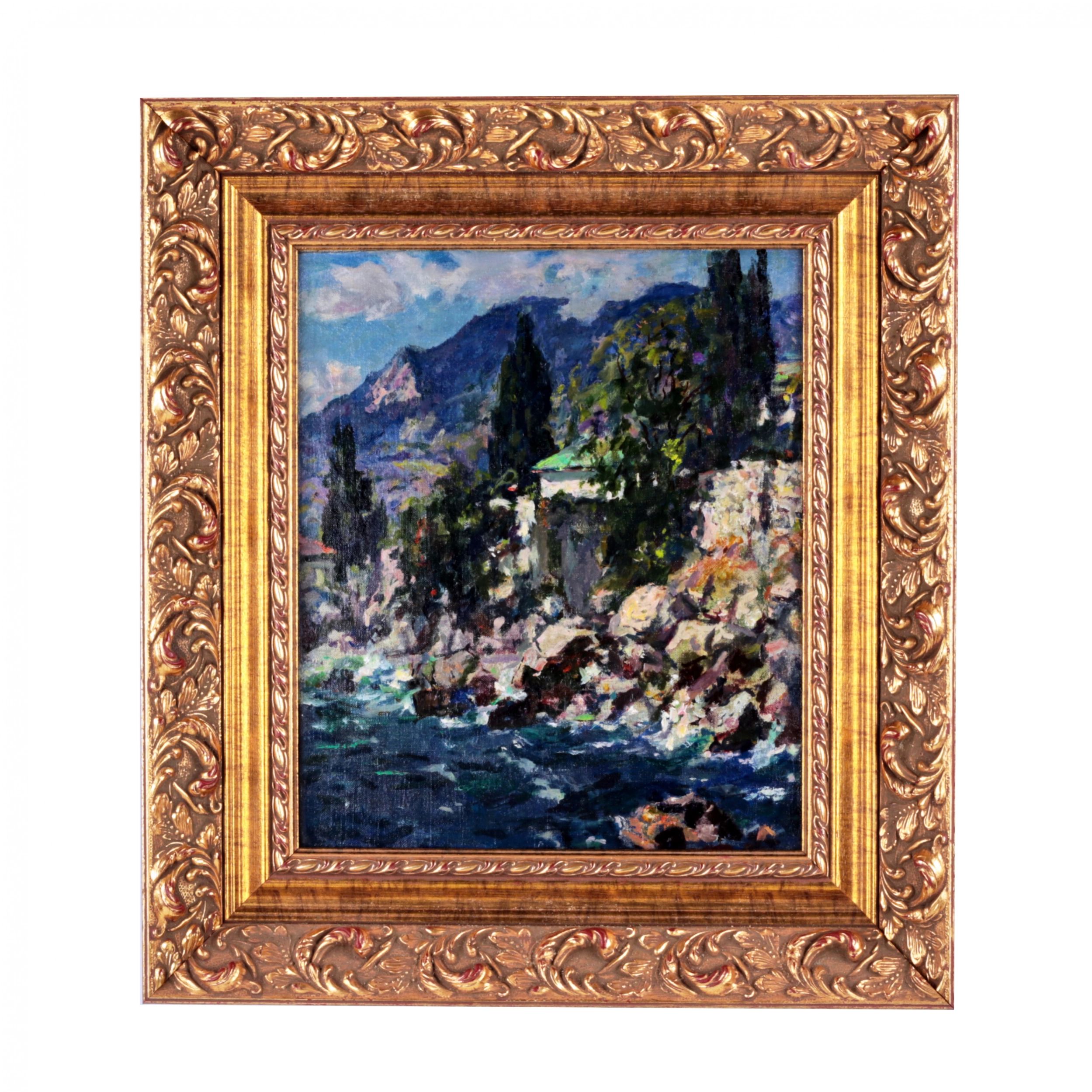




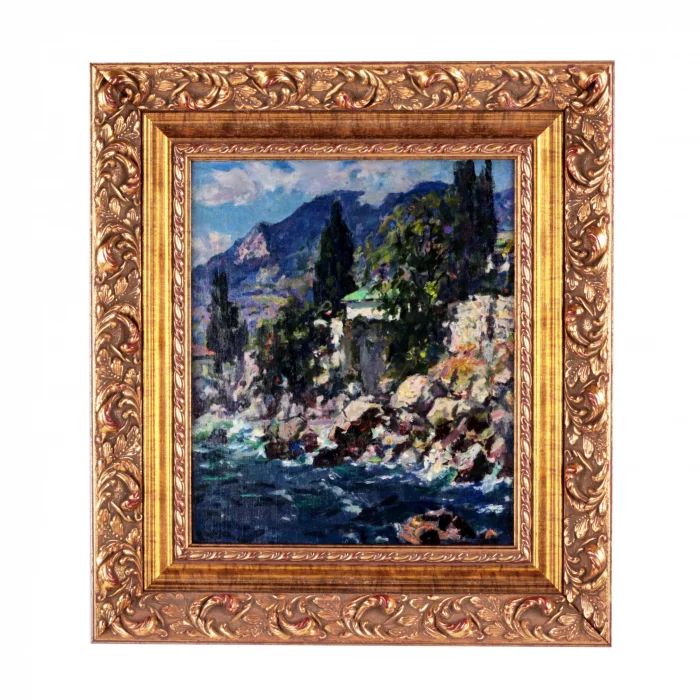
CRIMEAN LANDSCAPE WITH A SEASHORE AND CYPRESSES RUSSIA, 1920s–1930s
AntiqonART consultant will contact you within one business day after receiving your request.
Discover how the value of similar works has evolved over the past 10 years. Art is not only beauty — it's an investment.
Discover how the value of similar works has evolved over the past 10 years. Art is not only beauty — it's an investment.
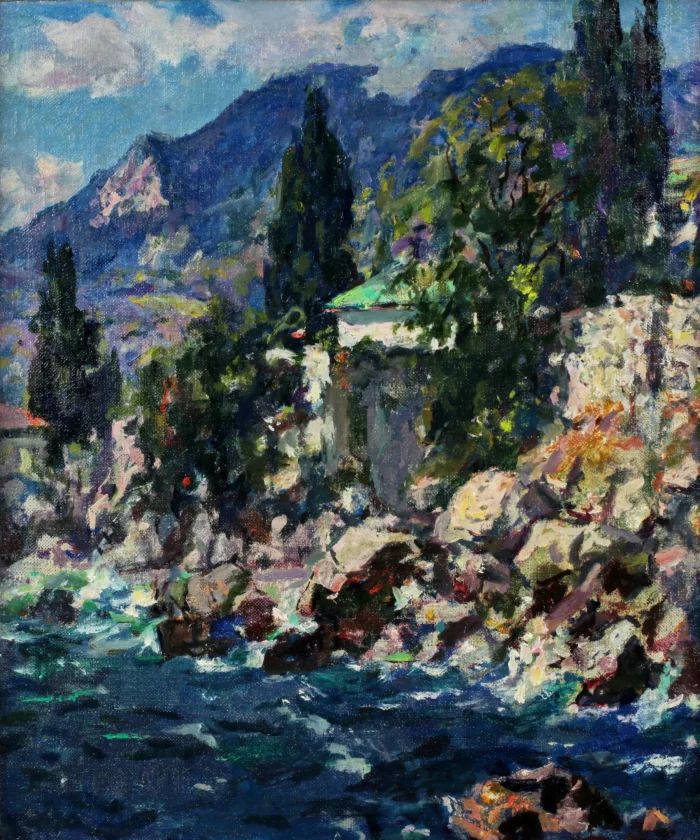
A refined Crimean landscape capturing the atmosphere of the southern coast on a clear summer day. The composition is structured around a gentle diagonal movement of the rocky shoreline, harmoniously balanced by the vertical accents of slender cypresses and the calm horizontal expanse of the sea. In the middle ground, a small house with a green roof is organically integrated into the natural setting, serving as both a compositional and chromatic focal point. In the distance, a panorama of mountain ranges unfolds in cool bluish-violet tones, dissolved within a luminous atmospheric perspective.
Executed in a plein-air manner characteristic of Russian painting of the first third of the twentieth century, the work employs a free and confident brushstroke that avoids detailed delineation in favor of conveying the overall state of nature and the interplay of light, air, and space. The color scheme is built upon a subtle balance between the cool tones of the sea and mountains and the sun-bleached yellow-white and ochre hues of the coastal rocks, evoking the sensation of intense southern sunlight. The painting is marked by restrained harmony and a lyrical mood, free from decorative artifice or excessive expressiveness.
By its painterly language, chromatic sensitivity, and overall atmosphere, the work relates to the tradition of Russian Impressionism and to the circle of professional artists active in Crimea during the 1920s–1930s, who continued the development of plein-air painting beyond academic and ideologically driven frameworks.
Dimensions: 34 × 28 cm (visible); 48 × 43 cm (framed).
Medium: Oil on canvas.
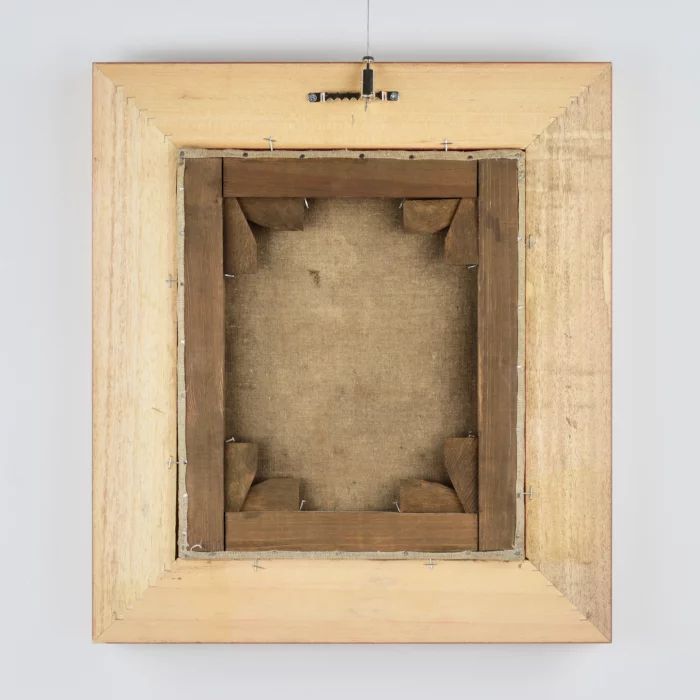
Condition: Good. The canvas has been relined; the paint layer is stable, with minor signs of age.
Provenance: Private collection.
Crimean landscape painting of the first third of the twentieth century occupies a distinctive place in the development of the Russian school of painting. Following the 1917 Revolution, the peninsula became one of the major centers of artistic life, where artists such as Konstantin Bogaevsky, Pyotr Konchalovsky, Vasily Polenov (in his later years), Alexander Kuprin, Sergei Vinogradov, Nikolai Samokish, Konstantin Korovin, and others worked in pursuit of capturing the emotional richness and luminous intensity of the southern environment. During this period, Crimea was perceived not merely as a geographical location but as a cultural space that allowed the continuity of the plein-air tradition within a rapidly changing artistic landscape.
Motifs of Crimea—mountains, cypresses, rugged cliffs, and bays with tiled-roof houses—became symbols of a vanishing paradise and artistic freedom. For many Russian artists of the 1920s who found themselves in the South, Crimea offered an alternative to the lost cultural centers of Moscow and St Petersburg, a place where the search for light and color in the spirit of Impressionism could continue in a more intimate and personal mode.
Such studies were often executed rapidly, directly from nature, in immediate contact with the surrounding environment. Their aim was to capture the fleeting state of the atmosphere—the sun, the wind, and the play of reflections on water and stone. In contrast to the academic landscapes of the nineteenth century, artists of this generation sought emotional synthesis and the transmission of a momentary impression, where composition followed the rhythm of nature and color became the principal expressive element.
The present work belongs to this context and may be associated with the Crimean cycles produced by artists working in Gurzuf, Alupka, and Yalta during the 1920s–1930s. The combination of rich yet restrained color, painterly texture, and a well-considered architectural rhythm of the landscape makes this painting an expressive example of the neoclassical strand of Russian Impressionism, uniting academic draftsmanship with the sensual immediacy of plein-air vision. Such works not only convey the unique atmosphere of Crimea but also serve as valuable documents of artistic life in the post-revolutionary era, when painting remained a sphere of personal freedom and inner harmony.
Overall condition is good. The canvas has been professionally relined; the paint surface remains stable. Minor signs of natural aging are present but do not affect the visual integrity of the work.
The condition report is provided for informational purposes only.
It is not comprehensive and may not reflect all defects, restorations, alterations, or adaptations, as Antiqon does not perform professional conservation-level assessments. The information is based on a qualified, yet subjective, evaluation by our specialists.Before purchasing, we recommend consultation with an independent expert.Please also consult our Terms and conditions and Glossary A-Z, which contain important information on lot characteristics and sale conditions.