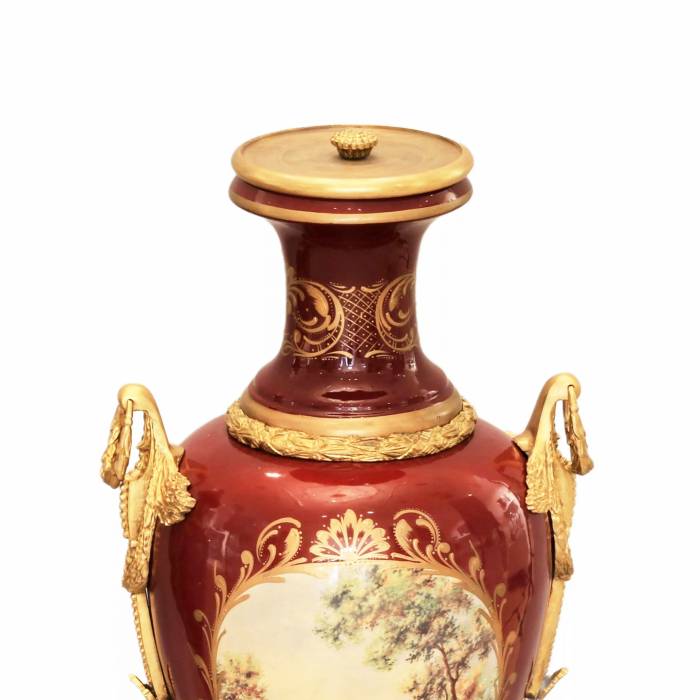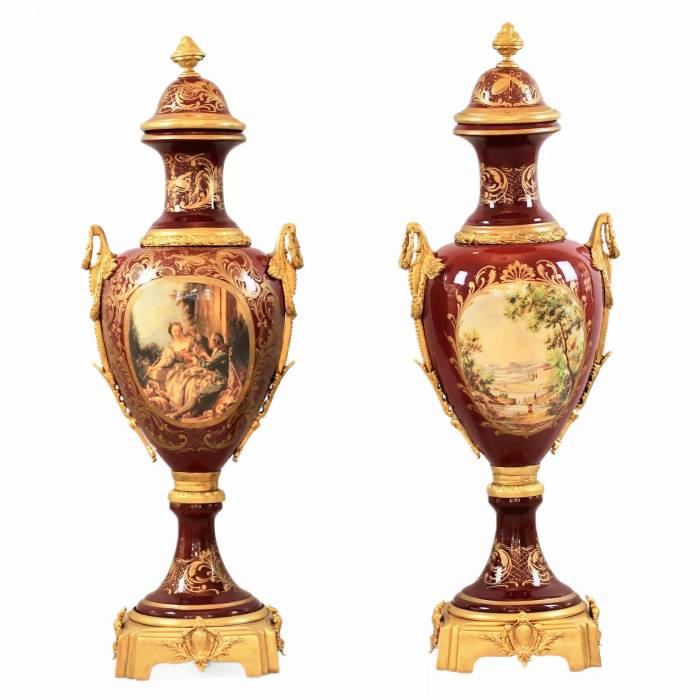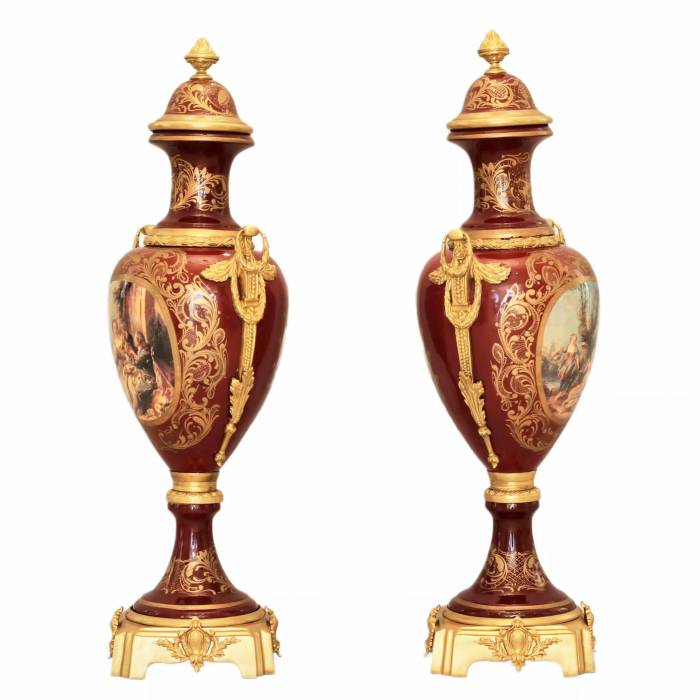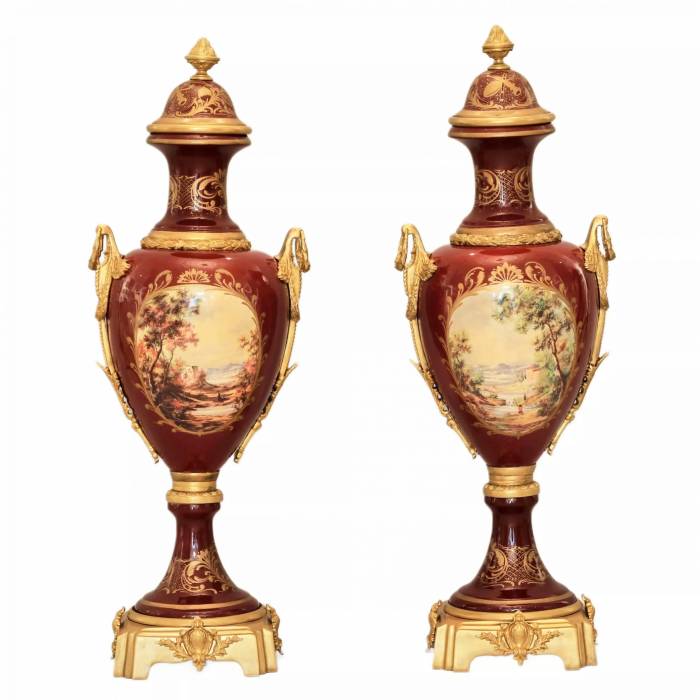
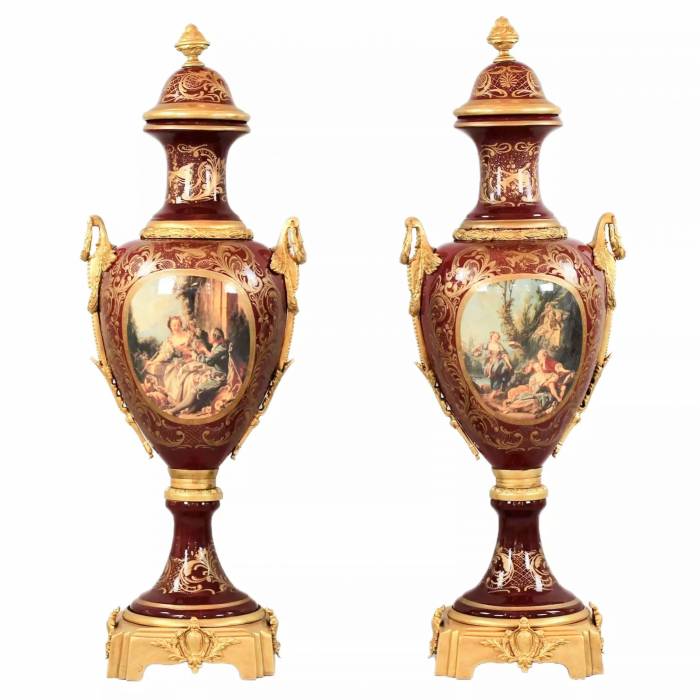
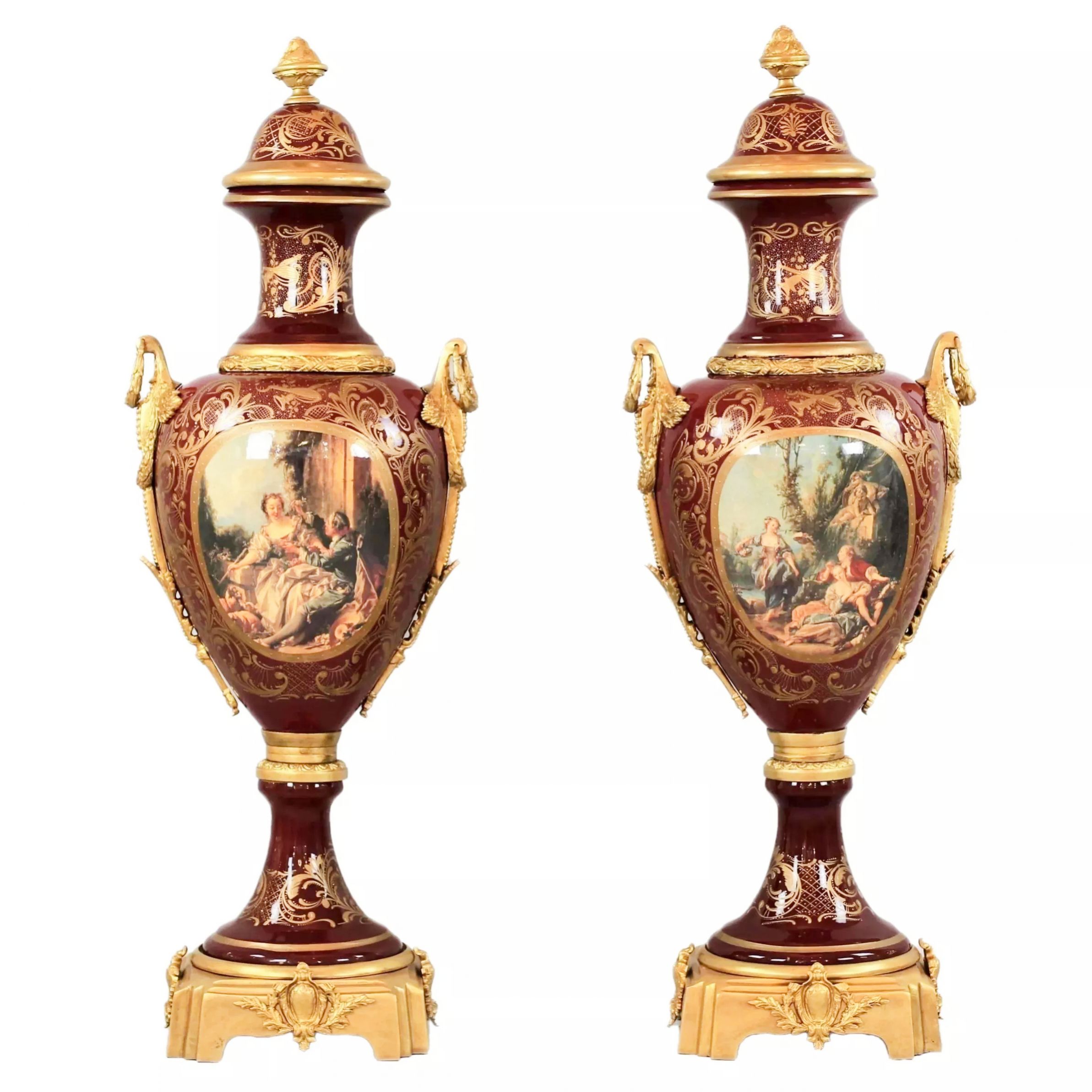
Pair of porcelain floor vases with gilt bronze in the Louis XVI style. France. 1920 th century.

Pair of porcelain floor vases with gilt bronze in the Louis XVI style. France. 1920 th century.

ID-ANTQ-8541
Live auction begins in:
| April 10, 2026 2:37 AM GMT+03:00
Estimate
1000 - 1500 EUR
Current Bid
EUR
 
0 bids
Register for bidding
Request more info
Use our cost calculator

Discover how the value of similar works has evolved over the past 10 years. Art is not only beauty — it's an investment.

Price History

Discover how the value of similar works has evolved over the past 10 years. Art is not only beauty — it's an investment.

Request a Shipping Quote
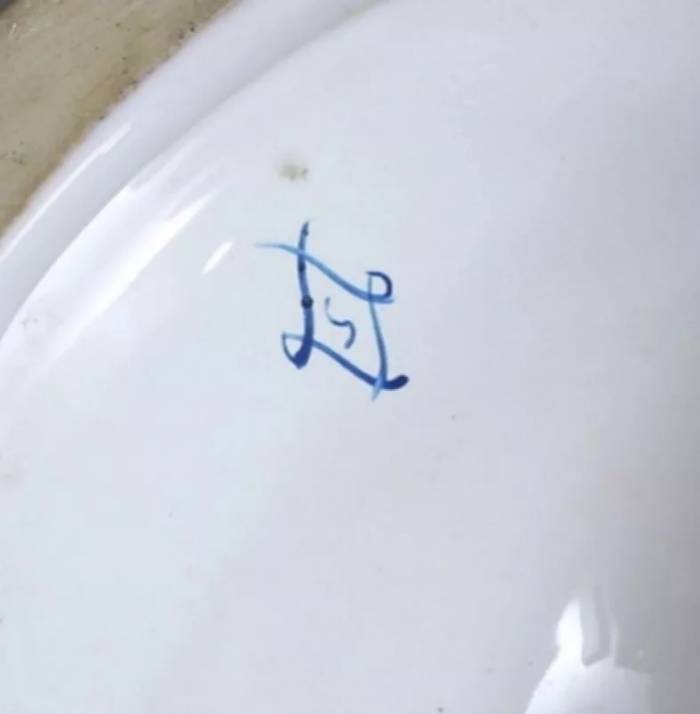
Pair of large amphora-shaped porcelain floor vases with pedestals and gilded bronze fittings. The porcelain parts are decorated with gilded roccaille and floral patterns with grotesques of musical instruments on a carmine background. The central decoration is decal lampshades of gallant scenes and landscape pastorals on the body of the vases. France. Second half of the 1920th century. S stamp in a woven diamond shape. Sevres manufactory of the 18th century.

Each height: 125 cm.

Art:
europe
Height:
125 cm
Width:
40 cm
Depth:
130 cm
Period:
19th century
Style:
Louis XVI
Country:
France
Material:
Bronze and porcelain
Condition:
Revive
Fair
Good
Very good
Like new

The condition report is provided for informational purposes only.

It is not comprehensive and may not reflect all defects, restorations, alterations, or adaptations, as Antiqon does not perform professional conservation-level assessments. The information is based on a qualified, yet subjective, evaluation by our specialists.Before purchasing, we recommend consultation with an independent expert.Please also consult our Terms and conditions and Glossary A-Z, which contain important information on lot characteristics and sale conditions.
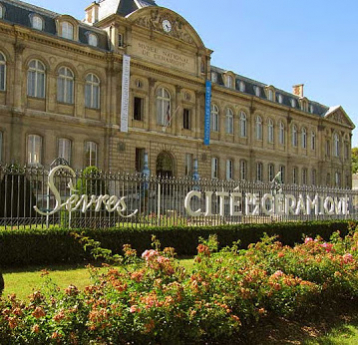
Sevres porcelain manufactory (FR. Manufacture nationale de Sevres)
Sevres porcelain manufactory (FR. Manufacture nationale de Sevres)In 1738, almost 30 years after the production of the first European porcelain in Meissen, a successful attempt was made in French Vincennes to create porcelain from soft paste. This year, the Marquis Orri de Fulvy received a license from King Louis XV to manufacture porcelain. From the very beginning, the factory operated as the "Manufactory Royal". In 1751 the Marquis Orri de Fulvi died and the king received 25 percent of the factory. Early French porcelain imitated Meissen works.In 1740, porcelain production began in Vincennes with the support of Louis XV and Madame de Pompadour. In 1756, the factory was transferred to Sevres, not far from the Bellevue Palace, where Madame de Pompadour lived. It became a royal manufactory since 1759.In 1772, the production of hard paster china began. The company had serious problems after the French Revolution (1789). The porcelain made in Sèvres was destined for the aristocracy and royal families. Unfortunately for production, the revolution ended the monarchy in France. Finally, in 1798, the company was overtaken by the French government. The government appointed Alexander Brongniart to run the business. Under his leadership, the company managed to serve a new group of wealthy clients.Until 1780, the factory was granted a monopoly on multi-color porcelain painting.The company continued to thrive during the Napoleonic era and the rest of the 19th century.Porcelain made in Sèvres is most often marked with two intertwined letters "Ls" in blue paint. The national manufactory Sevres is still one of the leading European porcelain manufactories.

Stay up to date with new arrivals
Save European porcelain and we let you know when new listings appears in this category
Save

Related items