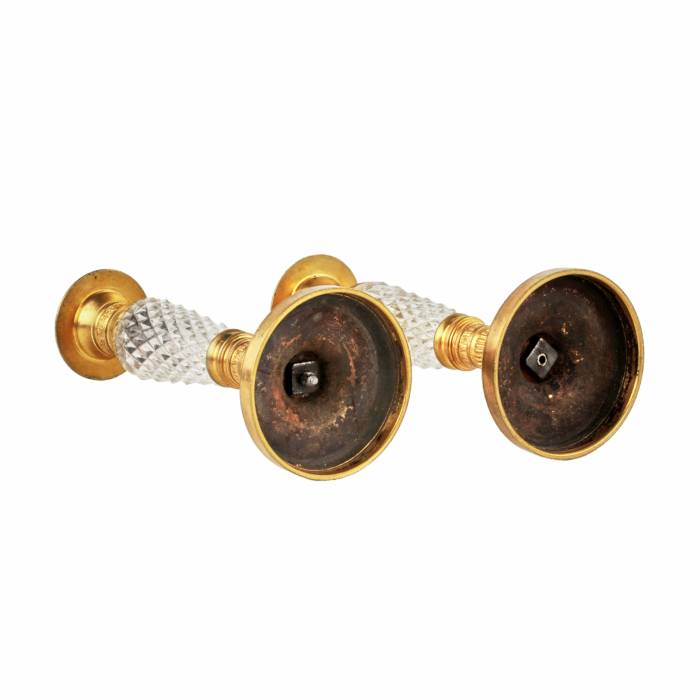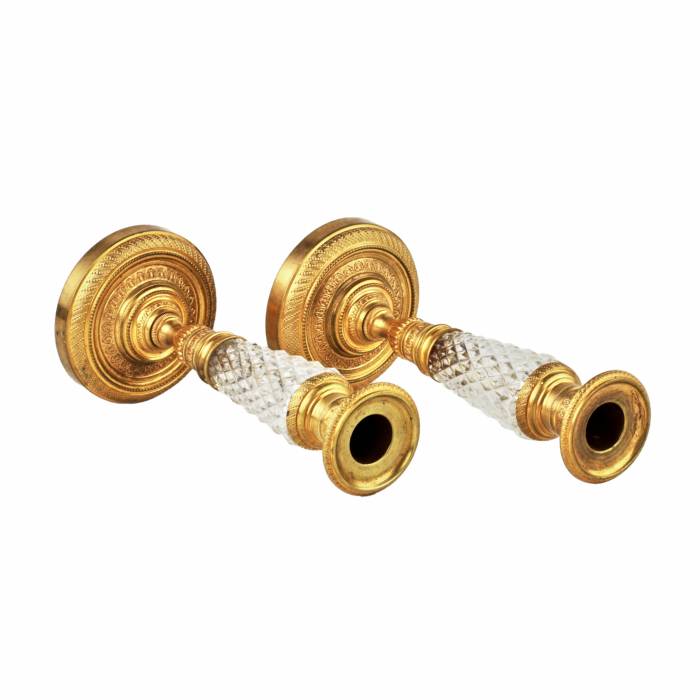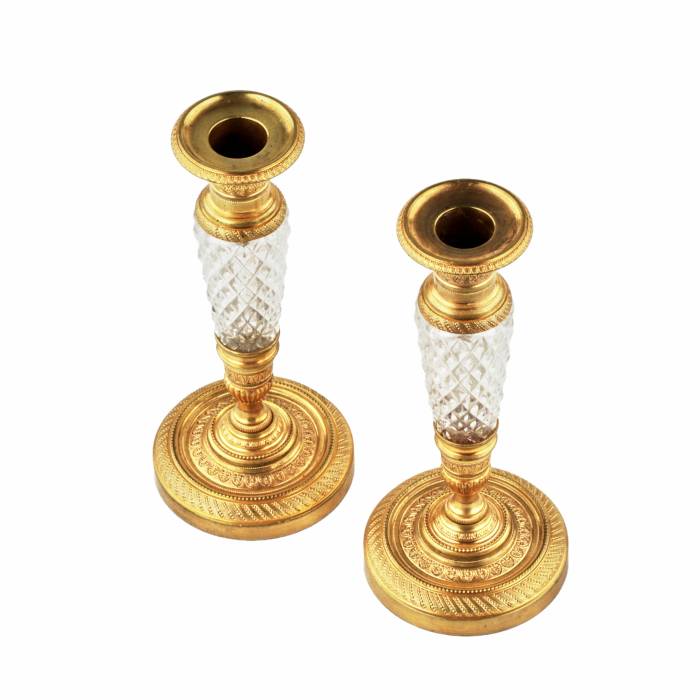
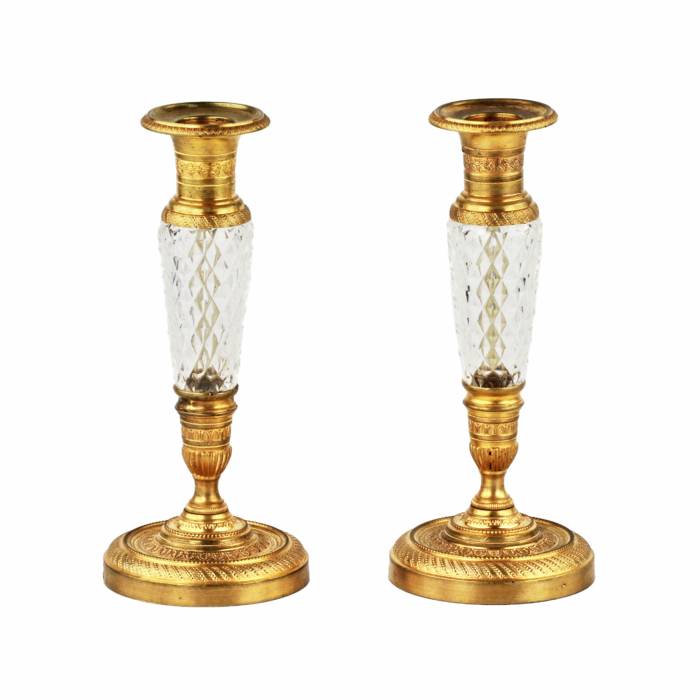
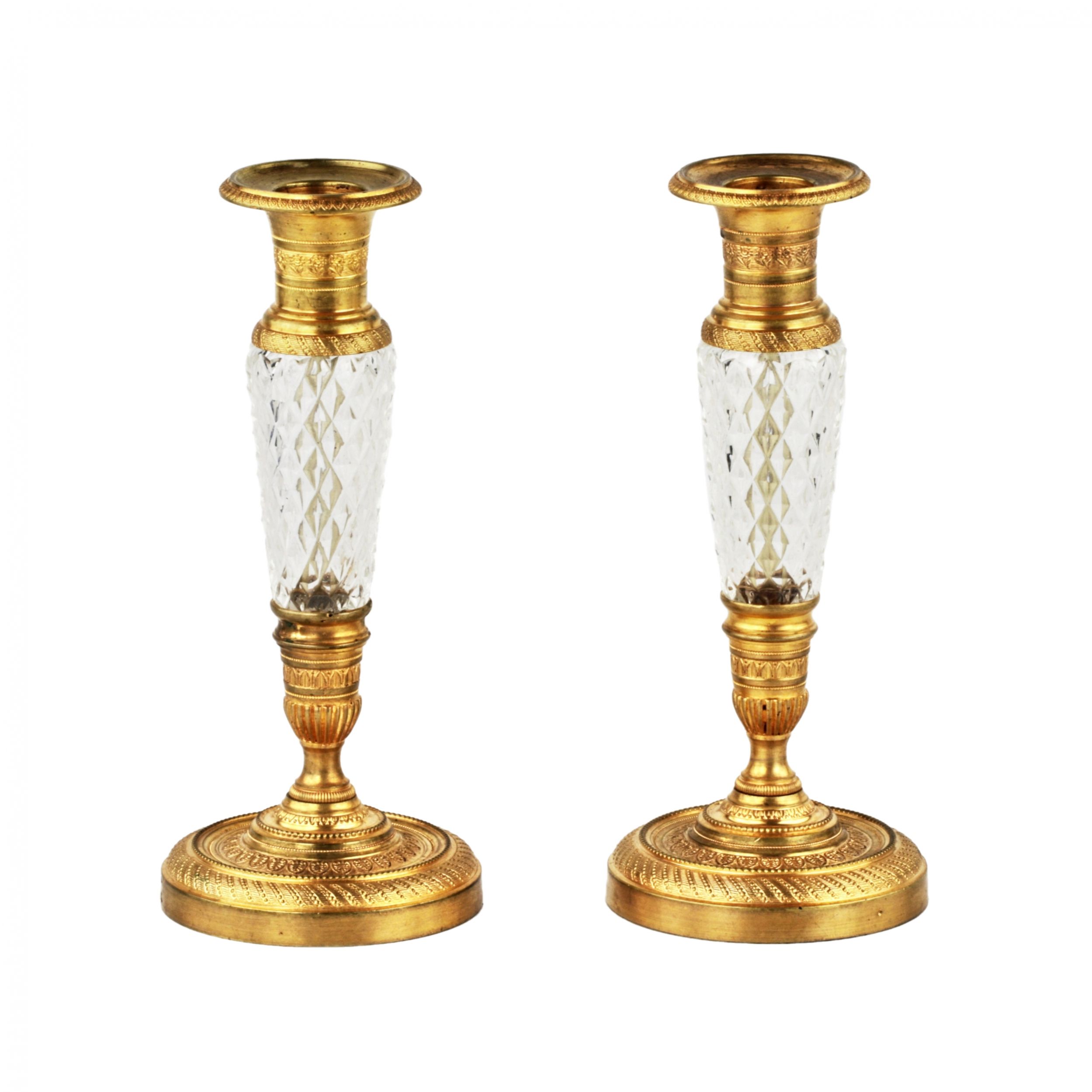
Pair of Empire candlesticks from the 1900s.

Pair of Empire candlesticks from the 1900s.

ID-ANTQ-5018
Live auction begins in:
| April 10, 2026 2:42 AM GMT+03:00
Estimate
200 - 300 EUR
Current Bid
EUR
 
0 bids
Register for bidding
Request more info
Use our cost calculator

Discover how the value of similar works has evolved over the past 10 years. Art is not only beauty — it's an investment.

Price History

Discover how the value of similar works has evolved over the past 10 years. Art is not only beauty — it's an investment.

Request a Shipping Quote
A pair of interior candlesticks in gilded bronze and pressed glass, in the French Empire style. 1900. Height 19 cm.
Art:
europe
Height:
19 cm
Width:
8.3 cm
Depth:
20 cm
Period:
Early 20th century
Style:
Empire
Country:
Europe
Material:
Bronze, glass
Condition:
Revive
Fair
Good
Very good
Like new

The condition report is provided for informational purposes only.

It is not comprehensive and may not reflect all defects, restorations, alterations, or adaptations, as Antiqon does not perform professional conservation-level assessments. The information is based on a qualified, yet subjective, evaluation by our specialists.Before purchasing, we recommend consultation with an independent expert.Please also consult our Terms and conditions and Glossary A-Z, which contain important information on lot characteristics and sale conditions.
Empire
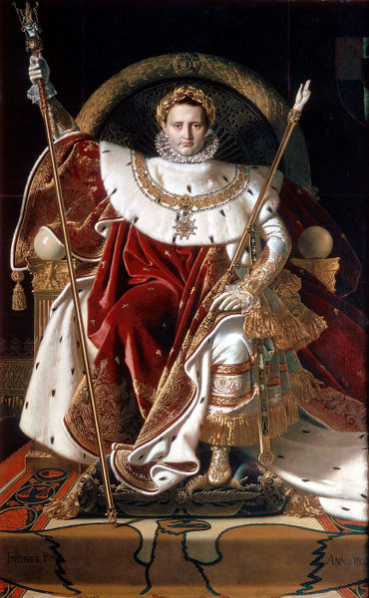
Empire - a style in architecture, arts and crafts and fine arts of the first third of the XIX century. in European countries, which completed the development of classicism. The Empire style developed in France during the era of Napoleon Bonaparte, and then spread to many other countries. The distinctive features of this style are solemnity, splendor, massiveness of large volumes, richness of decor. Artists who create works in the Empire style drew their inspiration from the elements of antique ornament, but they (unlike classicism) were guided mainly by Greek, not Roman antiquity. The motives of decor and architecture in the art of the Empire style repeated in many respects not only Roman samples, but also ancient Egyptian art, in connection with the Egyptian campaign of Bonaparte. Empire architecture is characterized by monumentality, geometric correctness of volumes and integrity (triumphal arches, columns, palaces). The ceremonial palace interiors were richly decorated with picturesque panels inspired by Pompeian paintings, reliefs reminiscent of Egyptian sphinxes, vases, furniture and antique bronze. The decor was often overloaded with arabesques, palmettes, fantastic motives from Etruscan art and military paraphernalia of Roman origin (armor, shields, swords, wreaths, heraldic eagles, etc.). Empire through numerous attributes and symbols asserted the idea of imperial greatness.In Russia, the Empire style was most widespread in the city-planning ensembles of the center of St. Petersburg, designed by K. Rossi. In Moscow, many buildings and mansions were built in this style according to the designs of D. Battista and G. Gilardi and A. Grigoriev. In Russian sculpture, the Empire style was reflected in a number of monuments, for example, in the creation of I. Martos - the monument to K. Minin and Dm. Pozharsky on Red Square in MoscowThe founder of the Empire style is the painter Louis David, and the exponents of this style are the architects Charles Persier (1764–1838) and Pierre Fontaine (1762–1853). 

Stay up to date with new arrivals
Save Candlesticks and candelabra and we let you know when new listings appears in this category
Save

Related items