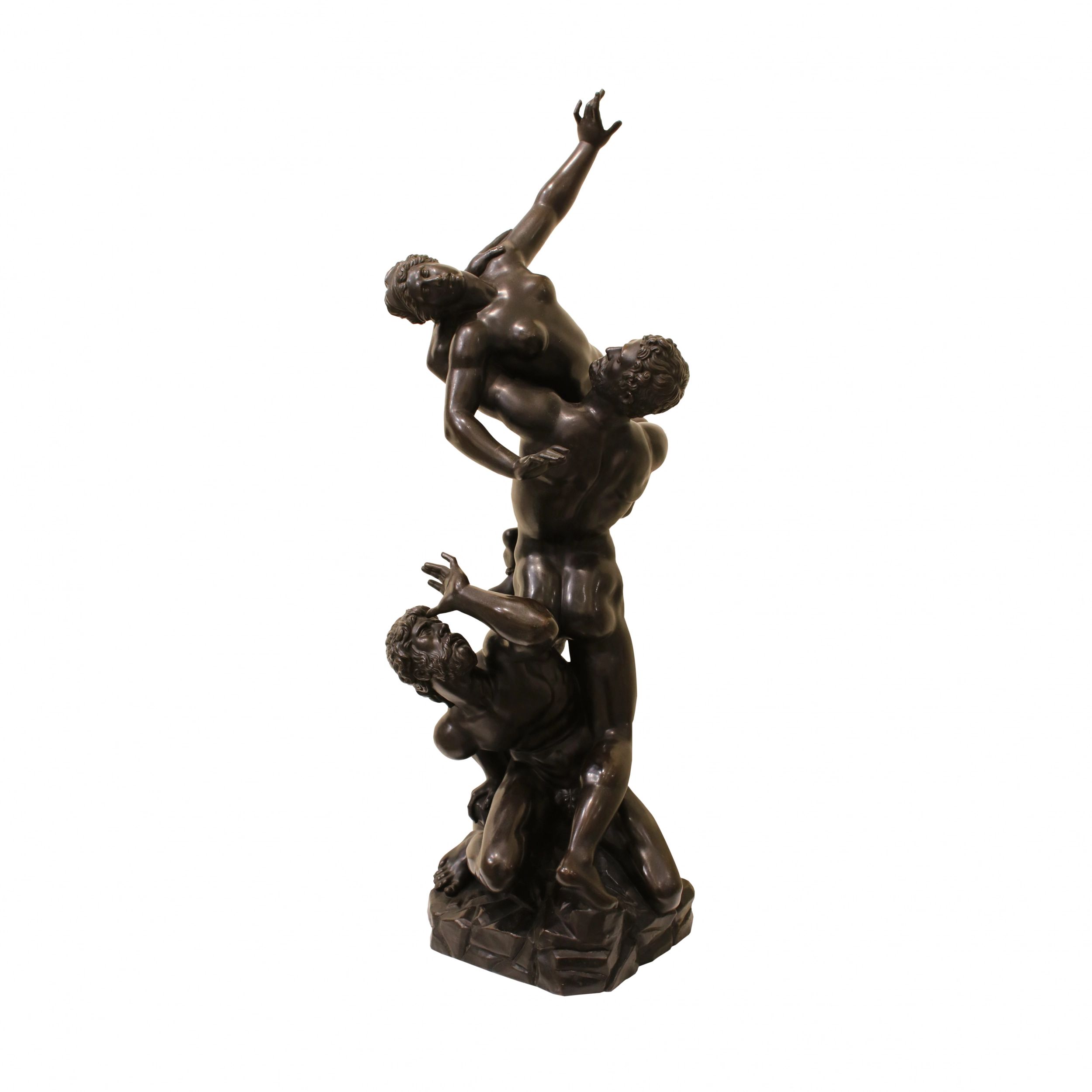
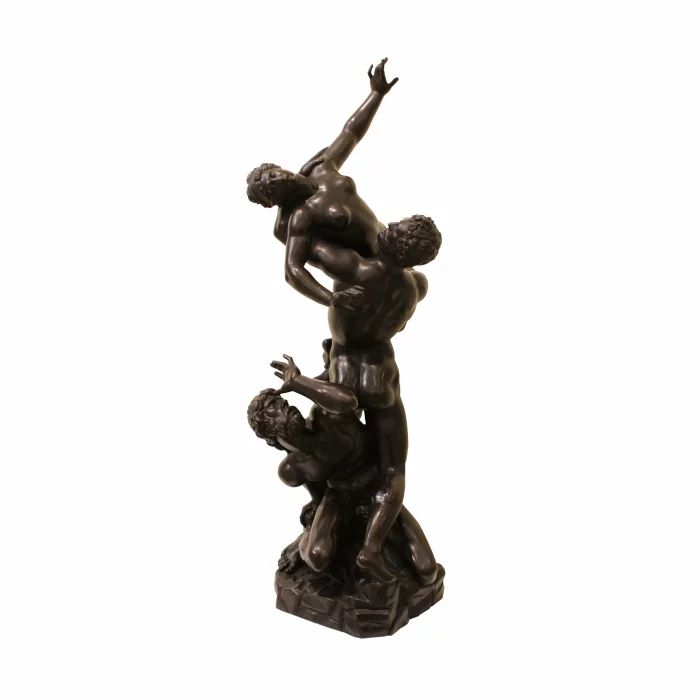
SCULPTURAL GROUP “THE RAPE OF THE SABINE WOMEN” AFTER GIOVANNI DA BOLOGNA (1529-1608) ITALY, 20TH CENTURY
AntiqonART consultant will contact you within one business day after receiving your request.
Discover how the value of similar works has evolved over the past 10 years. Art is not only beauty — it's an investment.
Discover how the value of similar works has evolved over the past 10 years. Art is not only beauty — it's an investment.
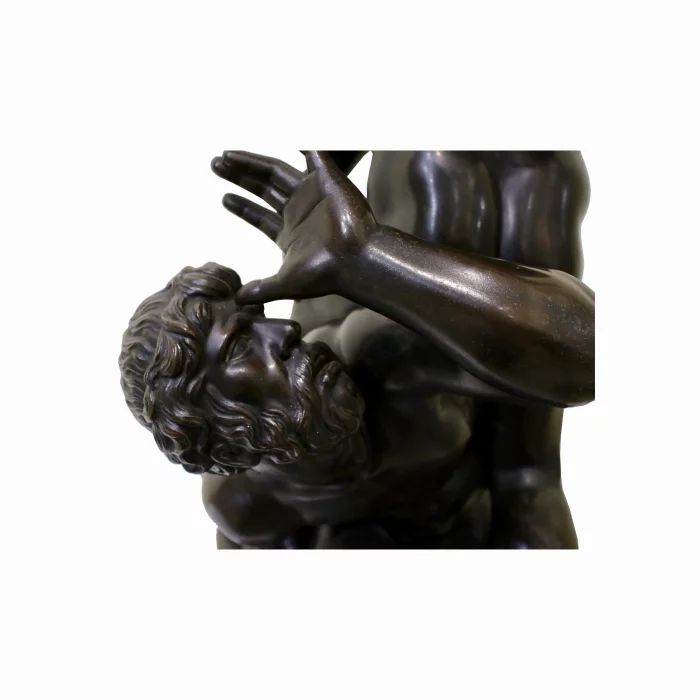
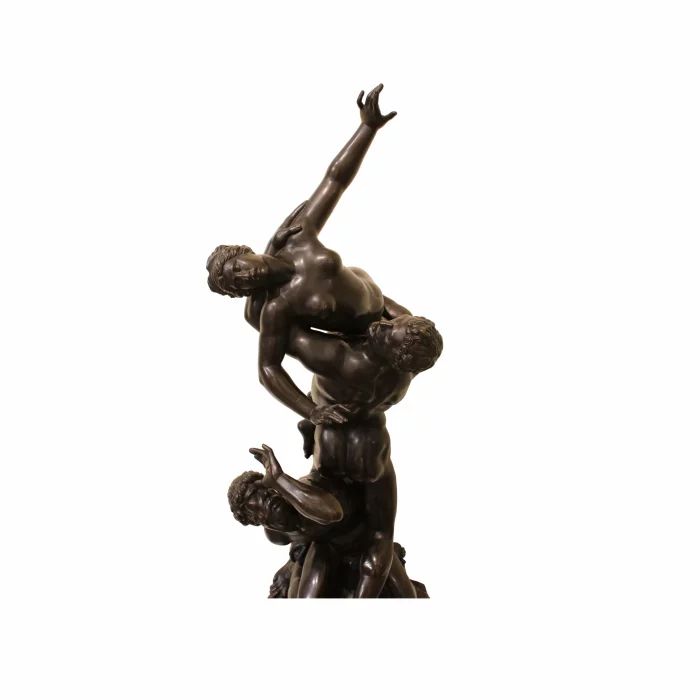
The sculptural group The Rape of the Sabine Women was created after the celebrated model by the Florentine master Giovanni da Bologna, one of the leading figures of Late Mannerism and early Baroque. The composition refers to one of the most dramatic episodes of Roman legendary history, associated with the founding of Rome and the beginning of the so-called Sabine War.
The multi-figure group is conceived according to the principle of figura serpentinata, characteristic of Giambologna’s sculptural language. The viewer’s eye moves upward in a spiraling motion: from the defeated, pleading figure at the base to the central male protagonist asserting possession, and further to the ascending female figure, whose gesture intensifies the dramatic tension. The contrast of poses, the opposition of gestures, and the complex spatial arrangement create a powerful sense of continuous movement and inner conflict.
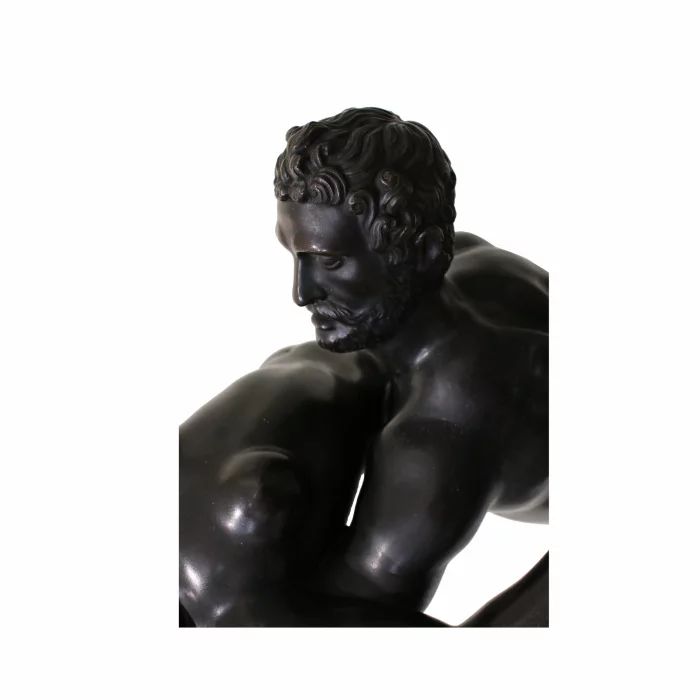
The modeling of the nude bodies recalls classical antiquity, while the expressive poses and dynamic composition reflect the aesthetics of Mannerism. The surface treatment visually imitates bronze with a noble patina, a feature typical of high-quality interior and collector’s replicas produced during the 20th century.
Material: Composite material, coating, bronze patina.
Dimensions: Height 110 cm; Width 40 cm; Depth 40 cm.
Condition: Good.
Provenance: Private European collection.
The original sculptural group The Rape of the Sabine Women, created by Giambologna between 1579 and 1583 for the Loggia dei Lanzi in Florence, stands as one of the most significant masterpieces of European Mannerism and a manifesto of a new approach to sculptural space. Conceived for viewing in the round rather than from a single frontal viewpoint, the work demonstrates a radical departure from earlier compositional conventions. Only later did the group receive its definitive interpretation connected with the Roman legend of the abduction of the Sabine women.
The subject derives from ancient sources, notably Livy and Plutarch. According to legend, Romulus, seeking to secure the future of the young city of Rome, organized a festival and invited neighboring tribes. At a predetermined signal, the Romans seized the Sabine women, triggering a conflict that ultimately ended in reconciliation and the unification of the communities. For Renaissance humanists and later generations, the episode symbolized the birth of a state through conflict and the overcoming of chaos.
Giambologna’s creative process is well documented. Preparatory models are preserved in major European museum collections, including the Museo di Capodimonte in Naples and the Victoria and Albert Museum in London, while the full-scale plaster model is housed in the Galleria dell’Accademia in Florence.
During the 20th century, amid renewed interest in the great masterpieces of Mannerism and Baroque art, such compositions were widely produced as high-quality interior and collector’s replicas. These works were intended for representative settings and private collections, maintaining a visual and cultural link to canonical examples of European sculpture.
Overall condition is good. The surface is even, with a uniform bronze patina. Minor signs of wear and age-related surface abrasions consistent with the period. No structural damage or evidence of restoration observed.
The condition report is provided for informational purposes only.
It is not comprehensive and may not reflect all defects, restorations, alterations, or adaptations, as Antiqon does not perform professional conservation-level assessments. The information is based on a qualified, yet subjective, evaluation by our specialists.Before purchasing, we recommend consultation with an independent expert.Please also consult our Terms and conditions and Glossary A-Z, which contain important information on lot characteristics and sale conditions.