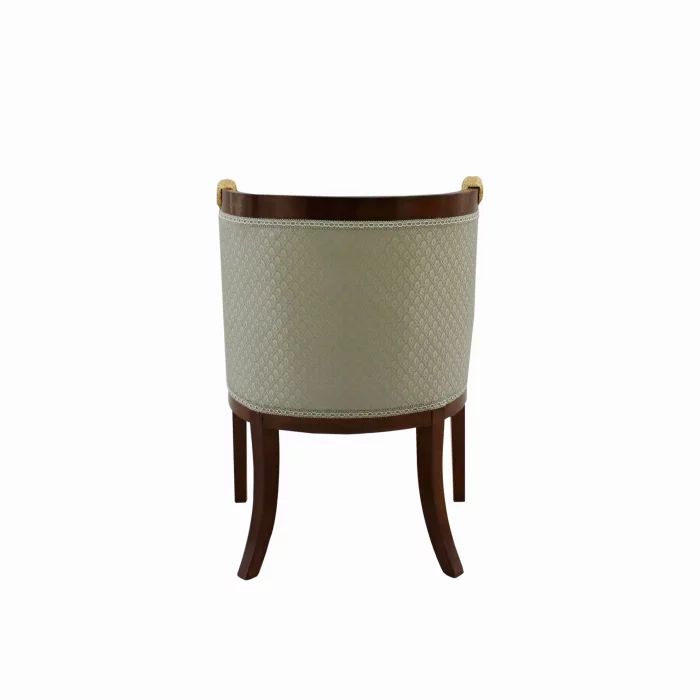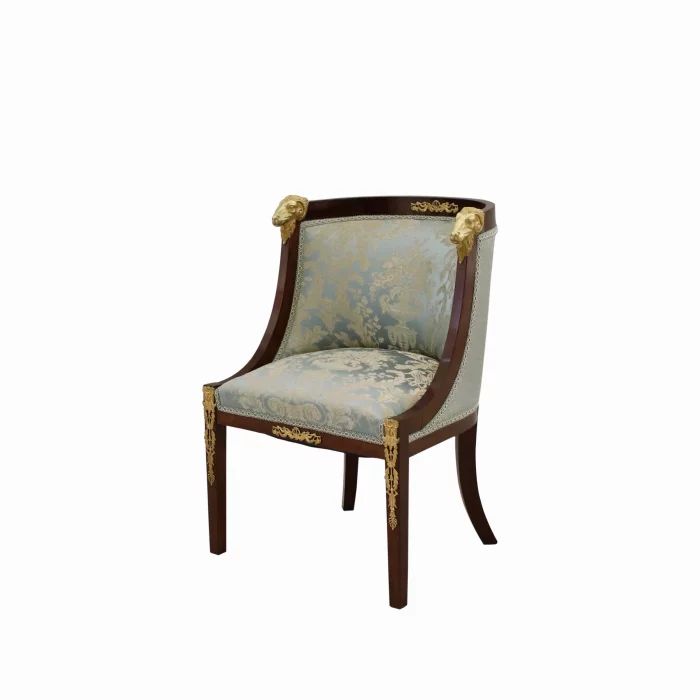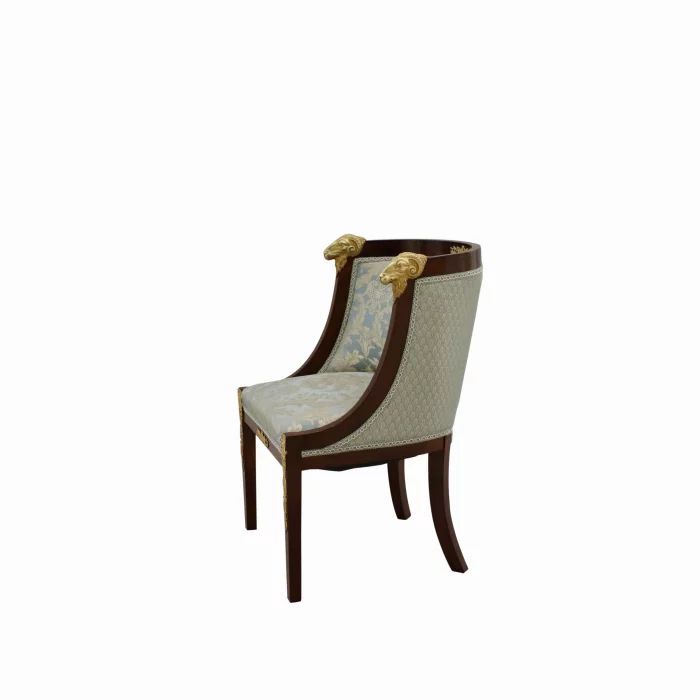
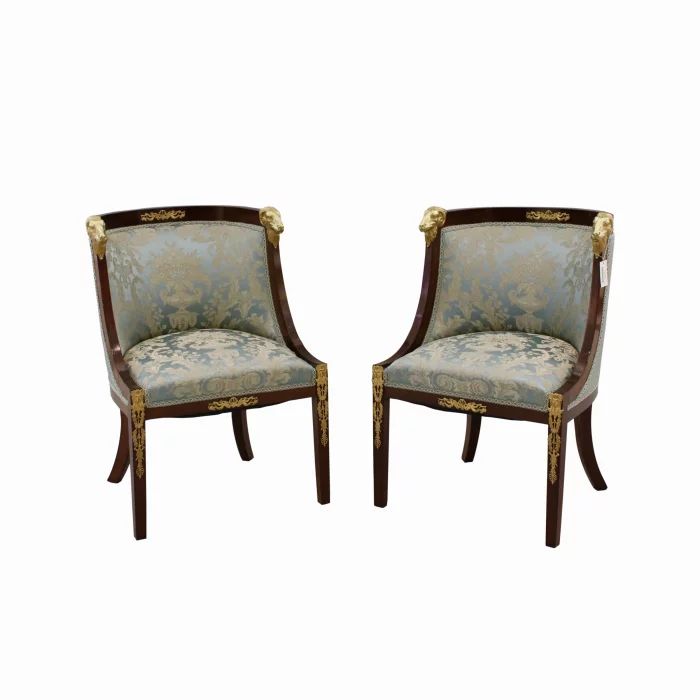
PAIR OF EMPIRE STYLE ARMCHAIRS FRANCE, FIRST QUARTER OF THE 19TH CENTURY

PAIR OF EMPIRE STYLE ARMCHAIRS FRANCE, FIRST QUARTER OF THE 19TH CENTURY

ID-ANTQ-2707
Live auction begins in:
| April 10, 2026 2:42 AM GMT+03:00
Estimate
800 - 1200 EUR
Current Bid
EUR
 
0 bids
Register for bidding
Request more info
Use our cost calculator

Discover how the value of similar works has evolved over the past 10 years. Art is not only beauty — it's an investment.

Price History

Discover how the value of similar works has evolved over the past 10 years. Art is not only beauty — it's an investment.

Request a Shipping Quote

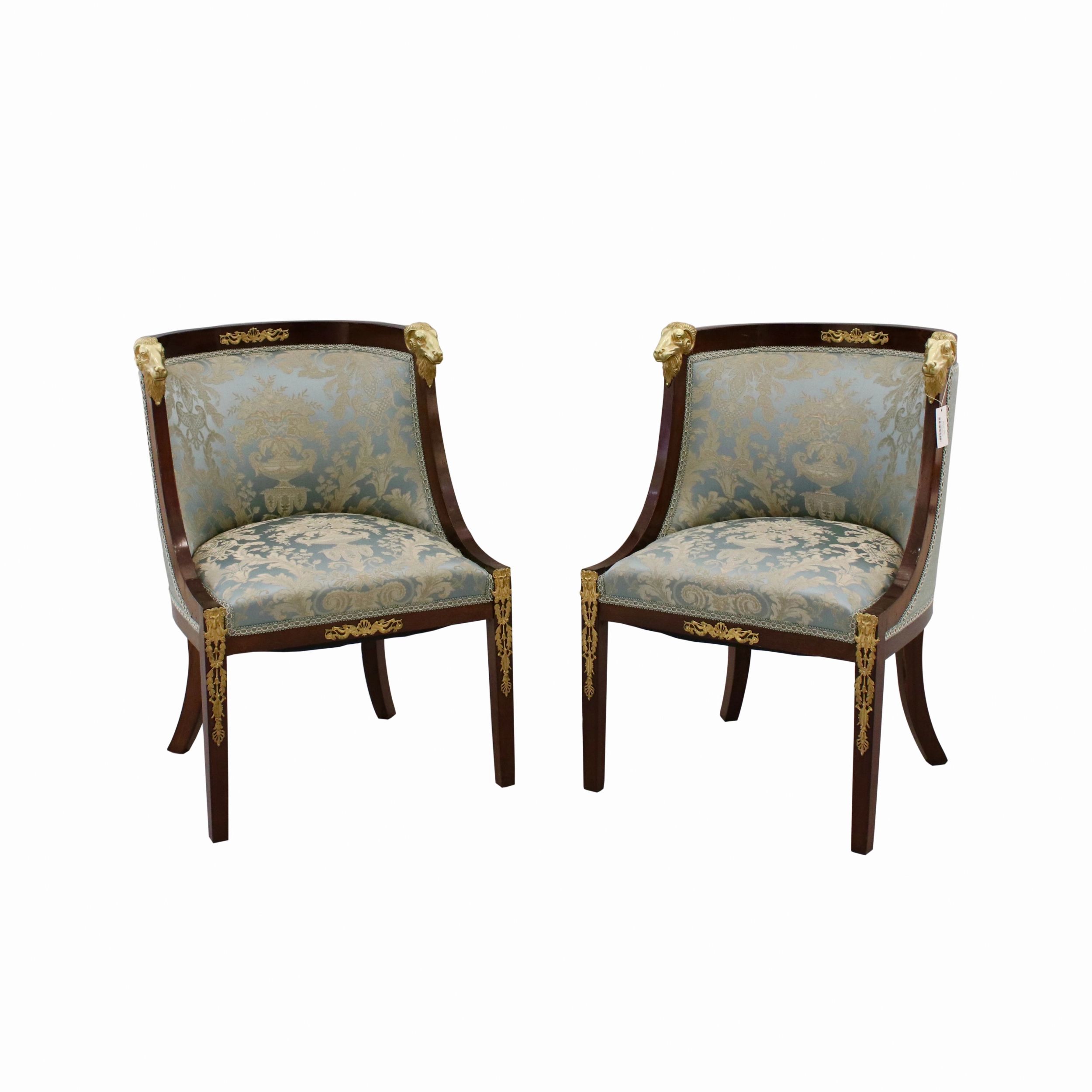
A distinguished pair of Empire period armchairs crafted from mahogany and adorned with gilt bronze mounts. The chairs form an elegant semi-cylindrical volume with straight, architecturally emphatic front legs and dynamically curved rear supports. The high sweeping arms merge seamlessly into the backrests and terminate in finely cast gilt bronze ram’s heads, serving as the principal symbolic and decorative accents. The primary ornamentation is concentrated on the façade: the legs and horizontal stretchers are enriched with delicately executed grotesques echoing the ram motif, as well as arabesques with trumpeting trophies, pearls, and shells. The warm, deep tone of the polished mahogany provides a refined contrast to the brilliance of the gilt bronze. The upholstery is executed in classical patterned textile with vegetal motifs, harmoniously complementing the строгая architectural clarity of the form.

Dimensions: Height: 78 cm. Width: 53 cm.

Condition: After professional full restoration. The structure has been stabilised, the mahogany carefully conserved, the gilt bronze mounts cleaned and secured, and the upholstery renewed with respect for the historical character of the pieces.

Provenance: Private European collection.

Art:
europe
Height:
78 cm
Width:
53 cm
Depth:
120 cm
Period:
19th century
Style:
Empire
Country:
France
Material:
Gilded bronze, Wood, Fabrics
Condition:
Revive
Fair
Good
Very good
Like new
The Empire style emerged in France during the Consulate and the First Empire as the official artistic language of the Napoleonic era. Its aesthetic was grounded in a reinterpretation of classical antiquity, infused with symbols of power, military virtue, and imperial authority. Empire furniture is characterised by architectural clarity, monumental silhouettes, and the extensive use of gilt bronze decoration derived from Greco-Roman and Egyptian sources. The ram motif employed in these armchairs originates from ancient cult symbolism, signifying strength, sacrifice, and divine protection, making it particularly appropriate for ceremonial interiors. Mahogany, imported from overseas colonies, was among the most prestigious materials of the period and was widely used in furniture destined for palaces and aristocratic residences. Armchairs of this type were intended for grand salons and reception rooms, functioning not only as utilitarian furnishings but also as markers of social rank and affiliation with the imperial culture of the early 19th century.

Excellent condition following restoration. Structural integrity fully restored, minimal signs of age consistent with period, and decorative elements preserved in full.

The condition report is provided for informational purposes only.

It is not comprehensive and may not reflect all defects, restorations, alterations, or adaptations, as Antiqon does not perform professional conservation-level assessments. The information is based on a qualified, yet subjective, evaluation by our specialists.Before purchasing, we recommend consultation with an independent expert.Please also consult our Terms and conditions and Glossary A-Z, which contain important information on lot characteristics and sale conditions.
Empire
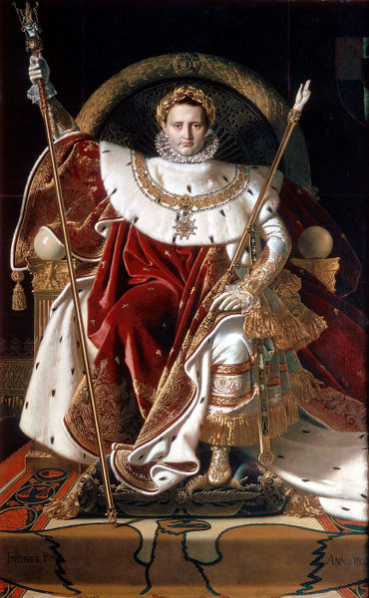
Empire - a style in architecture, arts and crafts and fine arts of the first third of the XIX century. in European countries, which completed the development of classicism. The Empire style developed in France during the era of Napoleon Bonaparte, and then spread to many other countries. The distinctive features of this style are solemnity, splendor, massiveness of large volumes, richness of decor. Artists who create works in the Empire style drew their inspiration from the elements of antique ornament, but they (unlike classicism) were guided mainly by Greek, not Roman antiquity. The motives of decor and architecture in the art of the Empire style repeated in many respects not only Roman samples, but also ancient Egyptian art, in connection with the Egyptian campaign of Bonaparte. Empire architecture is characterized by monumentality, geometric correctness of volumes and integrity (triumphal arches, columns, palaces). The ceremonial palace interiors were richly decorated with picturesque panels inspired by Pompeian paintings, reliefs reminiscent of Egyptian sphinxes, vases, furniture and antique bronze. The decor was often overloaded with arabesques, palmettes, fantastic motives from Etruscan art and military paraphernalia of Roman origin (armor, shields, swords, wreaths, heraldic eagles, etc.). Empire through numerous attributes and symbols asserted the idea of imperial greatness.In Russia, the Empire style was most widespread in the city-planning ensembles of the center of St. Petersburg, designed by K. Rossi. In Moscow, many buildings and mansions were built in this style according to the designs of D. Battista and G. Gilardi and A. Grigoriev. In Russian sculpture, the Empire style was reflected in a number of monuments, for example, in the creation of I. Martos - the monument to K. Minin and Dm. Pozharsky on Red Square in MoscowThe founder of the Empire style is the painter Louis David, and the exponents of this style are the architects Charles Persier (1764–1838) and Pierre Fontaine (1762–1853). 

Stay up to date with new arrivals
Save Armchairs and chairs and we let you know when new listings appears in this category
Save

Related items