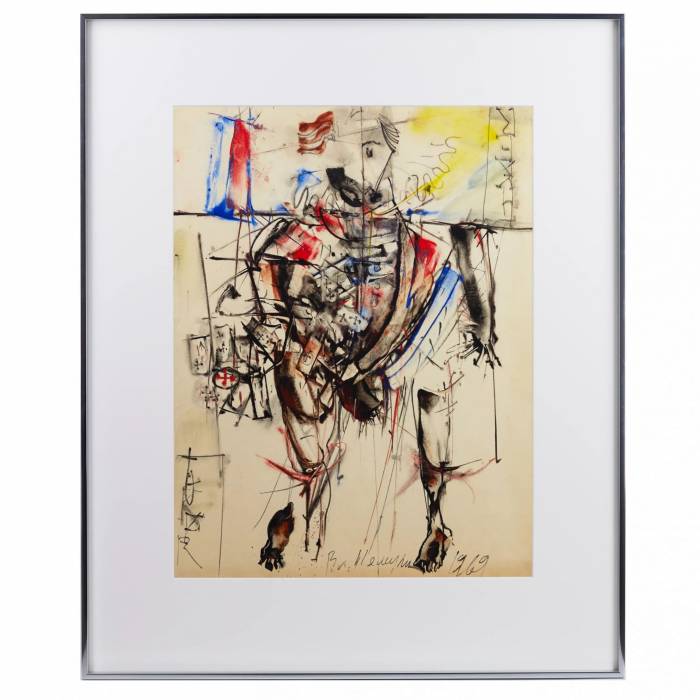
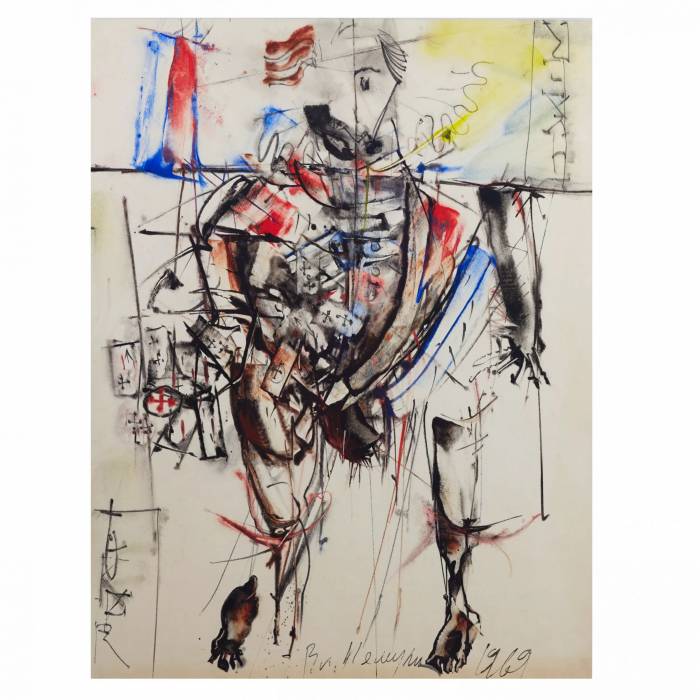
VLADIMIR NIKOLAEVICH NEMUKHIN (1925 - 2016). “JACK”, 1969 USSR, 1969
AntiqonART consultant will contact you within one business day after receiving your request.
Discover how the value of similar works has evolved over the past 10 years. Art is not only beauty — it's an investment.
Discover how the value of similar works has evolved over the past 10 years. Art is not only beauty — it's an investment.
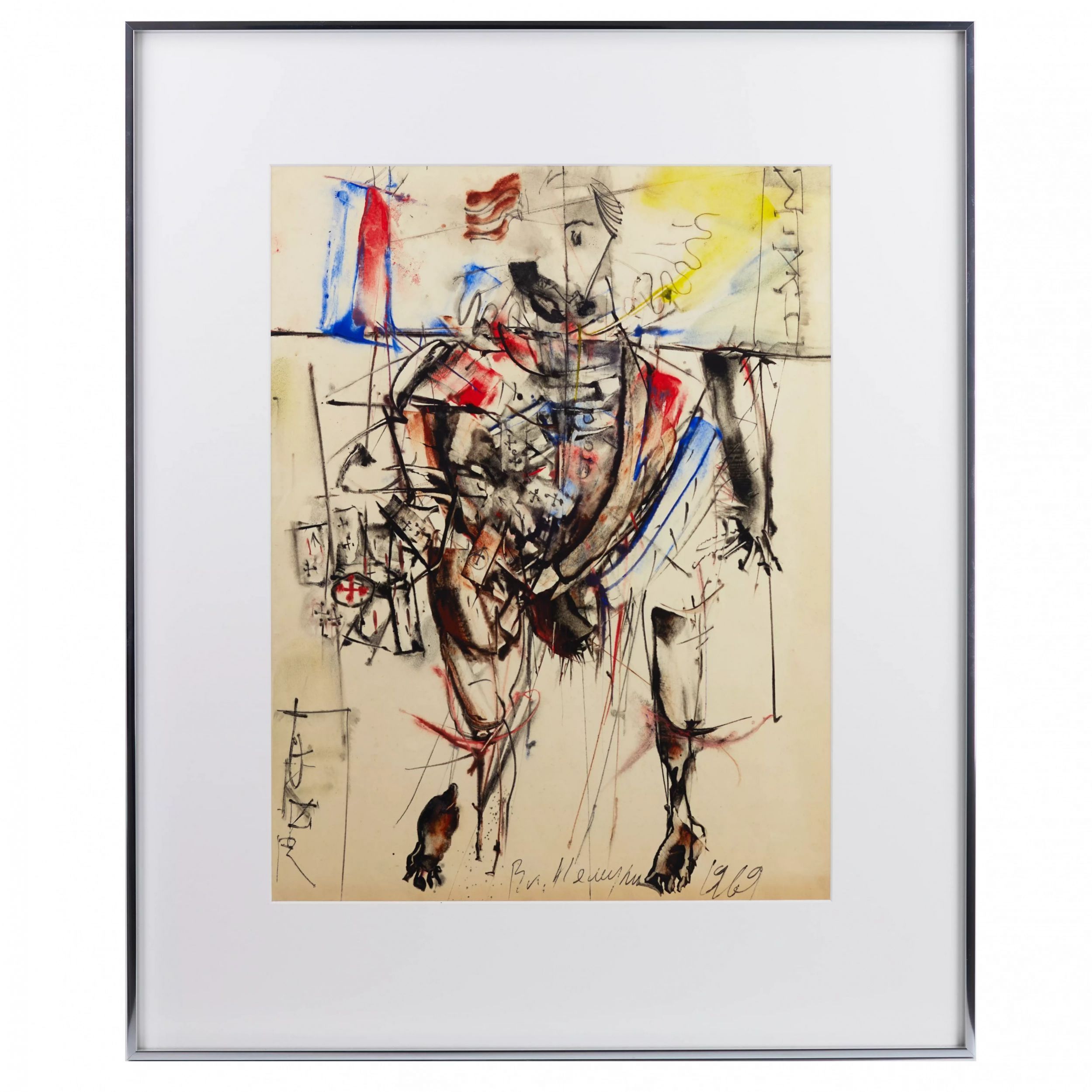
A striking abstract composition “Jack”, executed in 1969 in mixed media on paper, belongs to the mature period of Vladimir Nemukhin’s творчество and represents a characteristic example of his iconic card series of the late 1960s. The work demonstrates the fully сформировавшийся artistic language of the master, in which the motif of a playing card transforms from a figurative sign into a complex metaphorical construct. The composition is structured through the intersection of diagonals and vertical axes, forming a fragmented and internally tense image of the jack. The face is treated in a mirrored manner and divided into symmetrical planes, reinforcing a sense of duality, inner conflict and the instability of identity.
The expressive ink line is combined with насыщенные colour accents in gouache, creating a rhythmically organised plastic structure of the sheet. Card symbols and abstract signs are integrated into the pictorial space as elements of a coherent visual system developed by the artist in the 1960s. In Nemukhin’s interpretation, the jack is not a figure of a card game but a metaphor for fate, risk, choice and historical uncertainty. The work is distinguished by a rare balance between gestural freedom, intellectual depth and strict compositional discipline, characteristic of the artist’s finest works of this period. The piece is presented in a steel frame with passe-partout under museum glass.
Dimensions: 55.2 x 42.4 cm; framed 77 x 63 cm.
Material: Mixed media on paper.
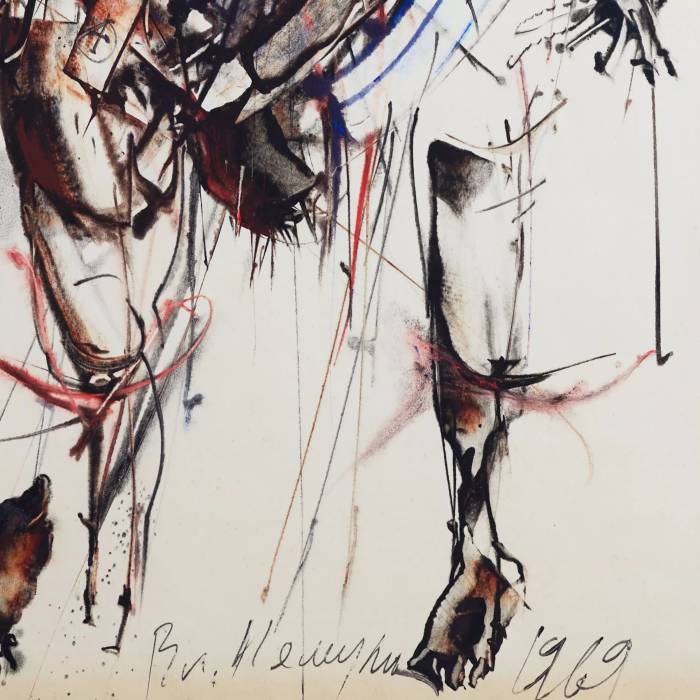
Signature: Lower right: “Vl. Nemukhin 1969”.
Condition: Good condition. Minor crease in the lower left corner. Otherwise well preserved, paint layer stable.
Provenance: Private collection of Anne-Marie Dey.
The year 1969 marks a pivotal stage in the development of Moscow’s unofficial art. Vladimir Nemukhin was one of the central figures of the Lianozovo group, an artistic circle formed outside the official doctrine of Socialist Realism. Under conditions of ideological control and institutional pressure, artists of this milieu developed an autonomous visual language grounded in symbol, sign and philosophical metaphor, consciously distancing themselves from prescribed aesthetic norms of Soviet cultural policy.
The theme of playing cards occupies a central place in Nemukhin’s artistic thinking. The figure of the jack, embedded within the hierarchical structure of the game, becomes a philosophical model of fate, chance and the duality of human nature. Unlike the joker, which exists outside the system, the jack belongs to its internal order, making it a more precise metaphor for human existence within historical and ideological constraints.
In works of the late 1960s, the expressive tension of the line intensifies. Compositions acquire a more complex architectural organisation, constructed through intersecting axes and diagonals that simultaneously fragment and reassemble the figure. This visual dynamism reflects the existential concerns of the nonconformist generation – a striving for inner freedom within external limitations.
Works from this period are represented in major museum collections in Russia and are regarded by art historians as significant examples of Soviet Modernism and artistic nonconformism of the second half of the 20th century.
The present work gains additional historical and cultural significance through its provenance. It originates from the private collection of Anne-Marie Dey. Her mother, Claude Dey, a journalist for France-Soir in Moscow, maintained contacts with representatives of Soviet unofficial art. She is known to have met Oscar Rabin in Paris and collaborated with him on his autobiography published in 1981. In scholarly literature on Soviet nonconformism, Claude Dey is mentioned in the context of Western coverage and cultural mediation, highlighting the importance of transnational artistic exchanges during the Cold War.
The sheet is in good collectible condition. A minor crease is visible in the lower left corner. The surface remains stable, with no significant paint loss. The frame and museum glass ensure proper presentation and preservation.
The condition report is provided for informational purposes only.
It is not comprehensive and may not reflect all defects, restorations, alterations, or adaptations, as Antiqon does not perform professional conservation-level assessments. The information is based on a qualified, yet subjective, evaluation by our specialists.Before purchasing, we recommend consultation with an independent expert.Please also consult our Terms and conditions and Glossary A-Z, which contain important information on lot characteristics and sale conditions.