IMPRESSIVE EMPIRE STYLE CHANDELIER RUSSIA, FIRST QUARTER OF THE 19TH CENTURY
AntiqonART consultant will contact you within one business day after receiving your request.
Discover how the value of similar works has evolved over the past 10 years. Art is not only beauty — it's an investment.
Discover how the value of similar works has evolved over the past 10 years. Art is not only beauty — it's an investment.
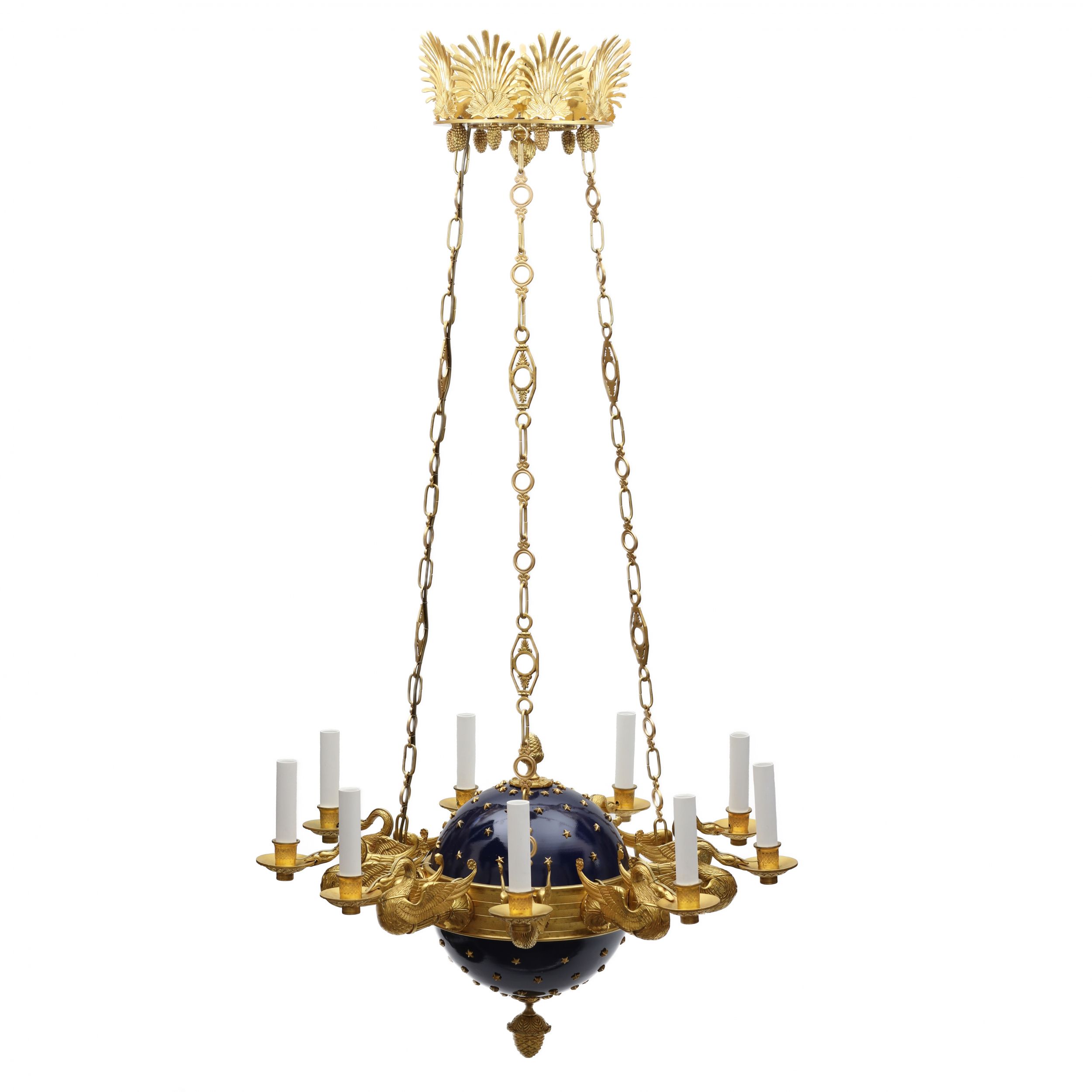
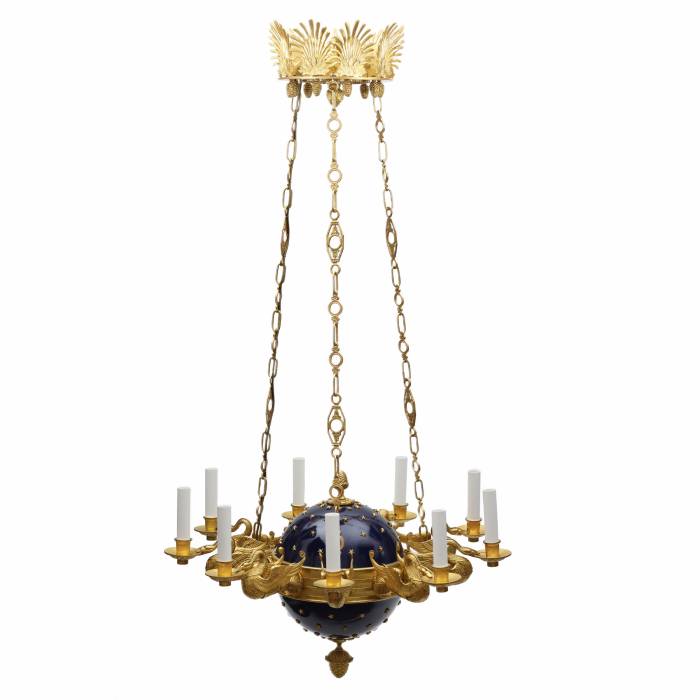
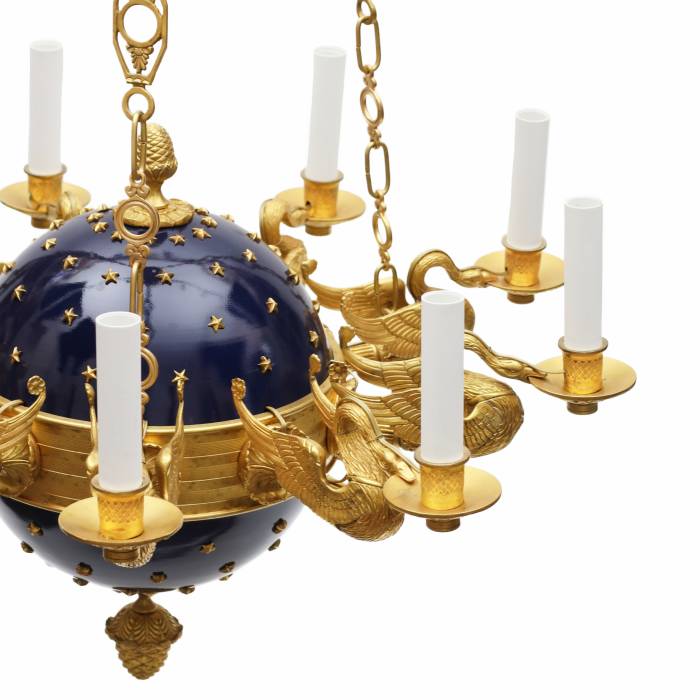
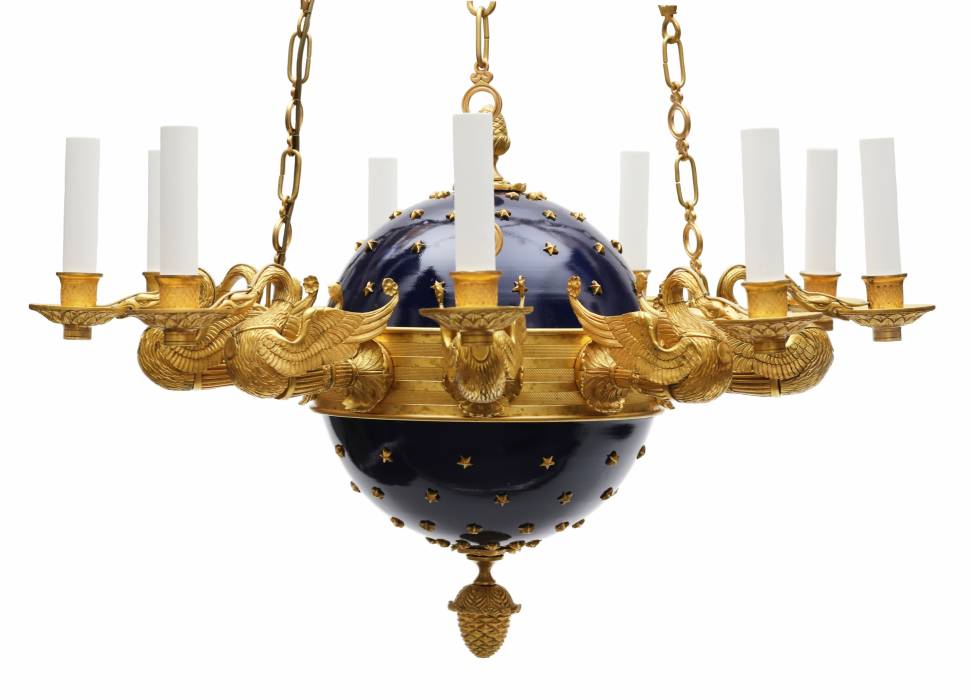
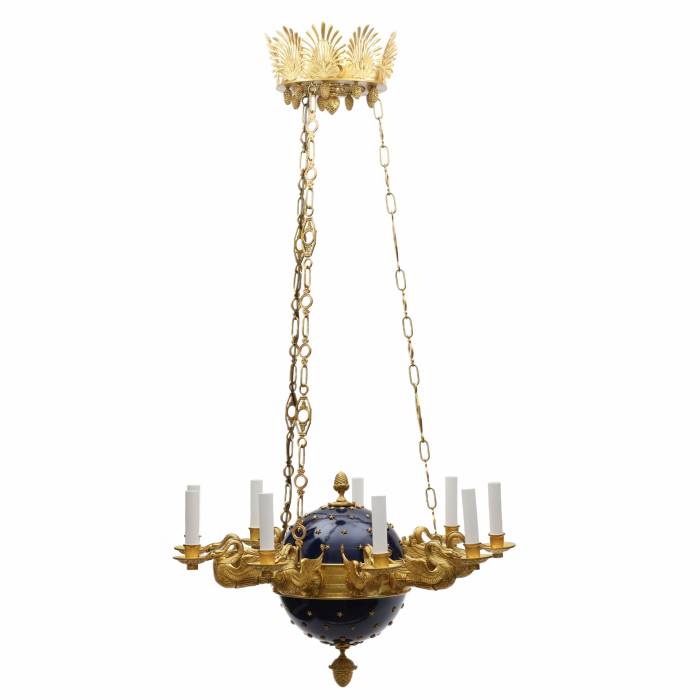
An impressive Empire style chandelier, characteristic of grand ceremonial interiors from the reign of Emperor Alexander I. The composition is constructed according to a rare spherical principle, reflecting the architectural rigor and symbolic program of the Russian Imperial style. The central body takes the form of a deep blue sphere adorned with sculptural gilt stars, creating the impression of a celestial vault.
The sphere is encircled by a broad gilt bronze band with refined relief ornament. Around the circumference are nine arms executed in the form of majestic swans with outstretched wings. The sculptural modeling of the birds demonstrates crisp feather detailing and expressive symmetry typical of high Russian Empire craftsmanship. Each swan supports a circular candle plate, forming a harmonious crown around the central body.
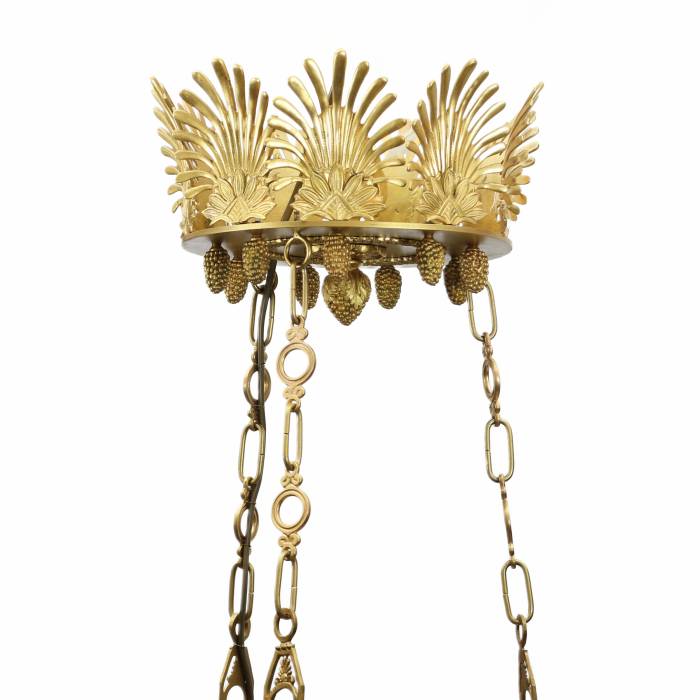
The chandelier is suspended by massive chains attached to a richly ornamented ceiling rose decorated with palmettes and pendant pine-cone clusters. The lower section terminates in a stylized pine-cone finial, a traditional symbol of abundance in early 19th-century decorative art. Electrified while preserving its historical silhouette and proportions.
Literature: Hans Ottomeyer and Peter Pröschel, Vergoldete Bronzen, Klinkhardt & Biermann, Munich, 1986, p. 359, pl. 5.11.4.
Dimensions: Height 130 cm; diameter 66 cm.
Condition: Good. Gilding evenly preserved. Minor traces of age. Wiring updated.
Provenance: Private collection.
Lighting fixtures in the Empire style held a central position within the ceremonial interiors of the Russian Empire during the first quarter of the 19th century. Under Alexander I, decorative arts acquired a monumental and symbolically charged character, reflecting the ideals of state power and the revival of Antique tradition.
The spherical form of this chandelier represents a rare and expressive compositional device interpreted as an allegory of the celestial sphere and cosmic harmony. The gilt stars reinforce imperial symbolism and the idea of divine authority. Such iconography was actively employed in the architectural and decorative programs of St Petersburg palaces.
The swan motif became especially prominent in Russian Empire design, associated with Antique mythology, purity, and ideal beauty. In early 19th-century bronze work, swans frequently served as sculptural supports for chandeliers, candelabra, and wall lights, emphasizing symmetry and architectural clarity.
Hans Ottomeyer and Peter Pröschel’s authoritative study Vergoldete Bronzen documents comparable spherical lighting forms as characteristic examples of monumental gilt bronze production of the period. Works of this type were produced in St Petersburg workshops for imperial and aristocratic residences.
Today, chandeliers of this category are highly sought after by collectors of Russian Empire decorative arts and museums of historic interiors due to their rarity of design, exceptional bronze casting quality, and strong symbolic program.
Overall condition good. Minor age-related wear to the gilding and surface of the sphere. Structure stable. Modern wiring in working order.
The condition report is provided for informational purposes only.
It is not comprehensive and may not reflect all defects, restorations, alterations, or adaptations, as Antiqon does not perform professional conservation-level assessments. The information is based on a qualified, yet subjective, evaluation by our specialists.Before purchasing, we recommend consultation with an independent expert.Please also consult our Terms and conditions and Glossary A-Z, which contain important information on lot characteristics and sale conditions.