


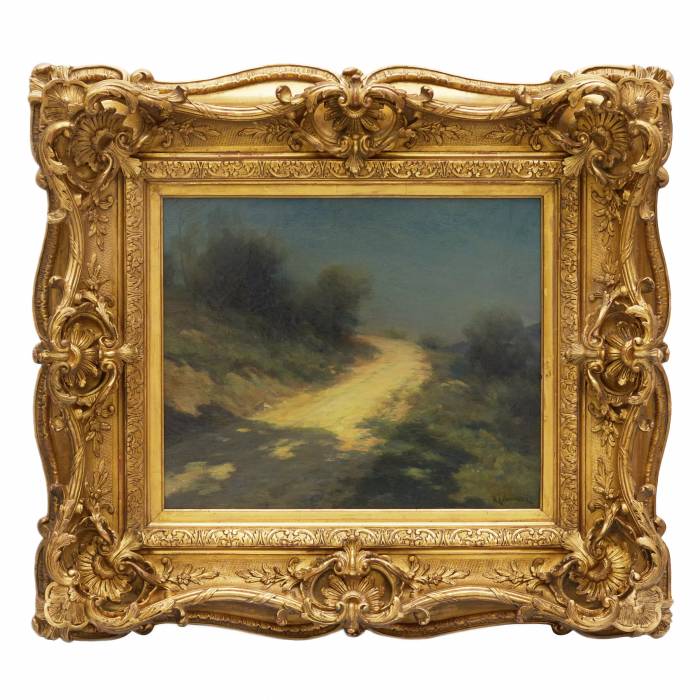
ISAAC ILYICH LEVITAN (1860–1900) COUNTRY ROAD LATE 19TH CENTURY
AntiqonART consultant will contact you within one business day after receiving your request.
Discover how the value of similar works has evolved over the past 10 years. Art is not only beauty — it's an investment.
Discover how the value of similar works has evolved over the past 10 years. Art is not only beauty — it's an investment.
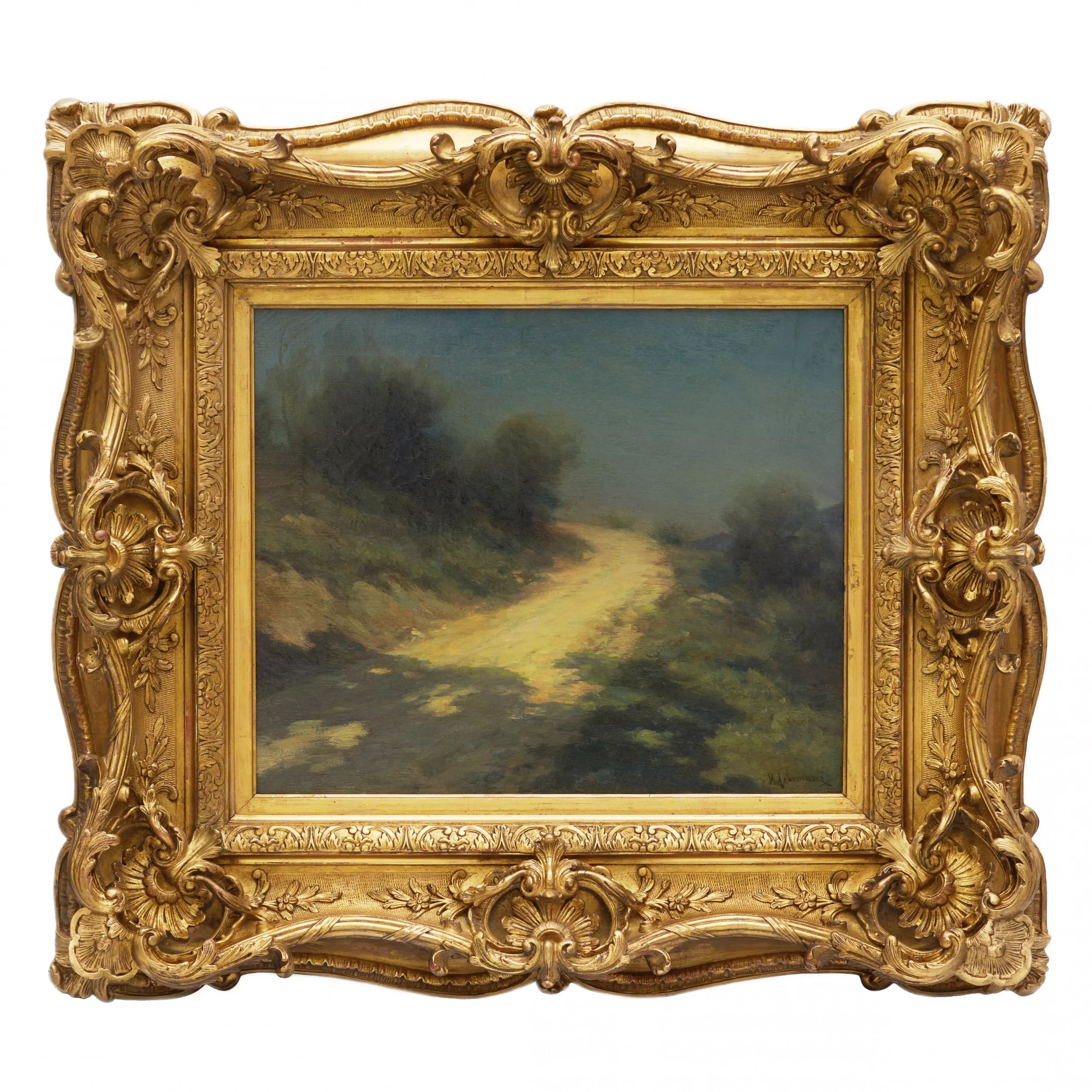
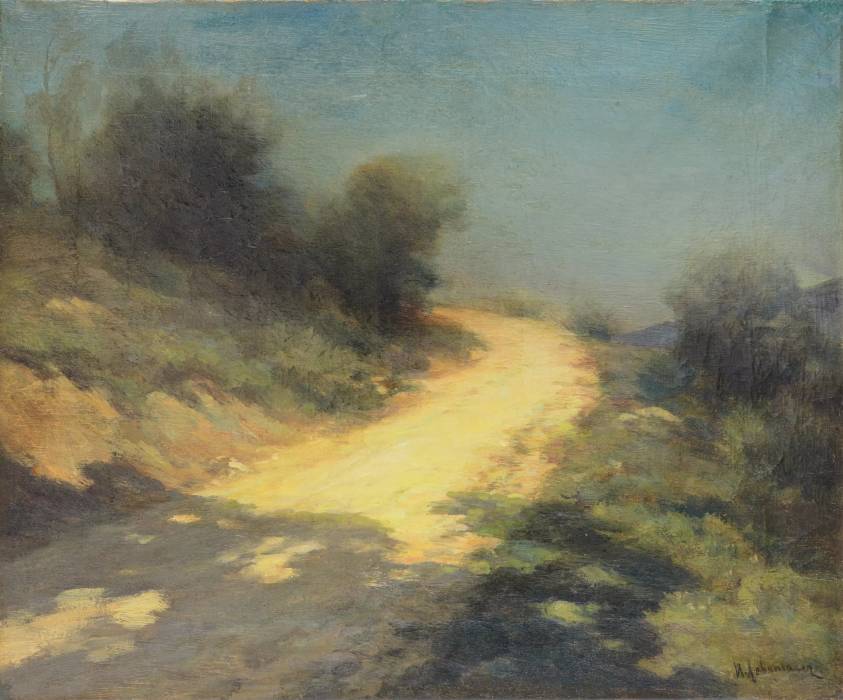
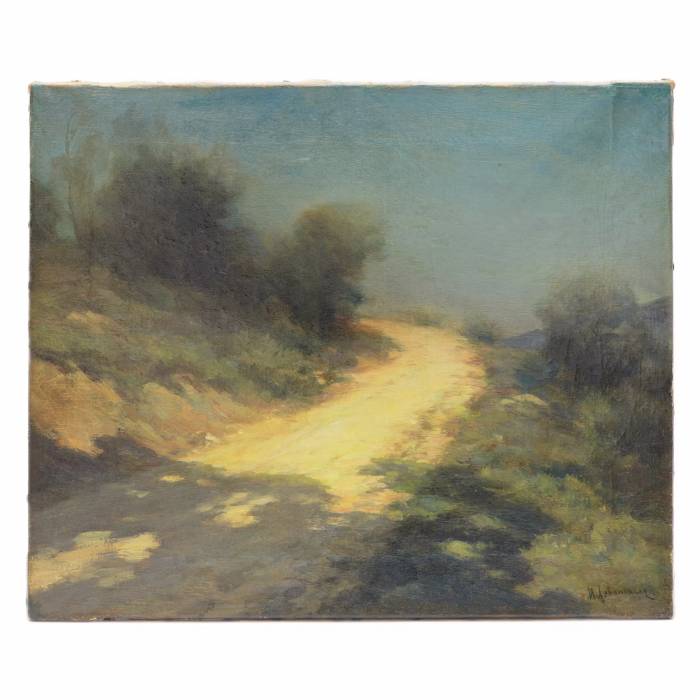
A lyrical landscape depicting a winding country road receding into the depth of a mist-filled space is attributed as a work by the outstanding master of Russian landscape painting, Isaac Ilyich Levitan, dating to the late nineteenth century. The artistic character of the painting corresponds to the tradition of the Russian landscape school of that period and reflects the principles of lyrical realism, within which the motif of nature acquires emotional and conceptual expressiveness.
The composition is structured around the diagonal movement of the country road, which crosses the darkened foreground and gradually recedes into the depth of space. The perspective is achieved through a gentle softening of tonal contrasts and the gradual dissolution of forms within the atmospheric environment, creating a sense of spatial depth and extension.
The organization of light and shadow plays a significant role in shaping the image. The illuminated strip of the road stands out against the denser shadowed masses of vegetation, forming a rhythm of light and dark passages. Light is treated not as a localized source but as a unifying atmospheric medium, evenly distributed across the surface of the canvas, without sharp boundaries or pronounced contrasts, thereby enhancing the impression of a natural state of landscape and humid air.
The color palette is maintained in olive greens, warm ochres, and muted gray-blue tones. The painterly manner is free, with a certain degree of generalization of forms, corresponding to the character of the late Russian landscape tradition.
The work is presented in a decorative frame dating to the late nineteenth century, corresponding to the period of the painting’s creation.
Dimensions: 36 × 48 cm
Medium: Oil on canvas
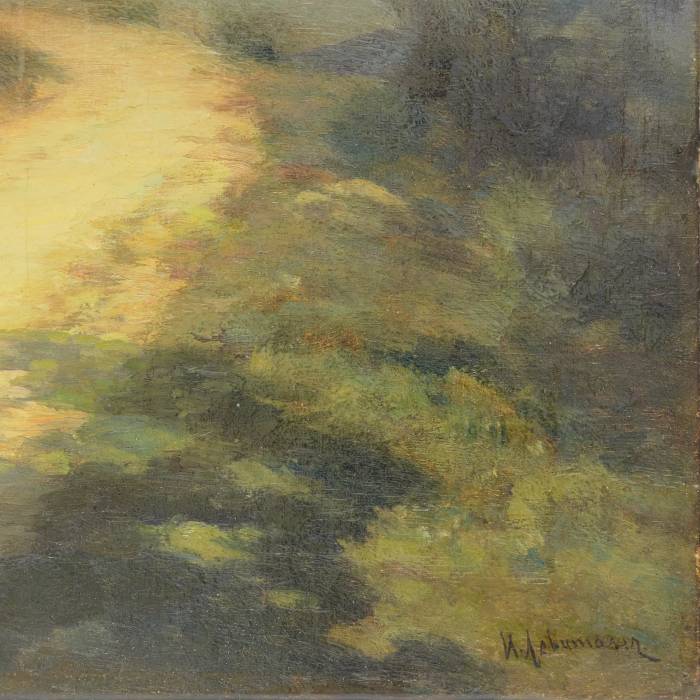
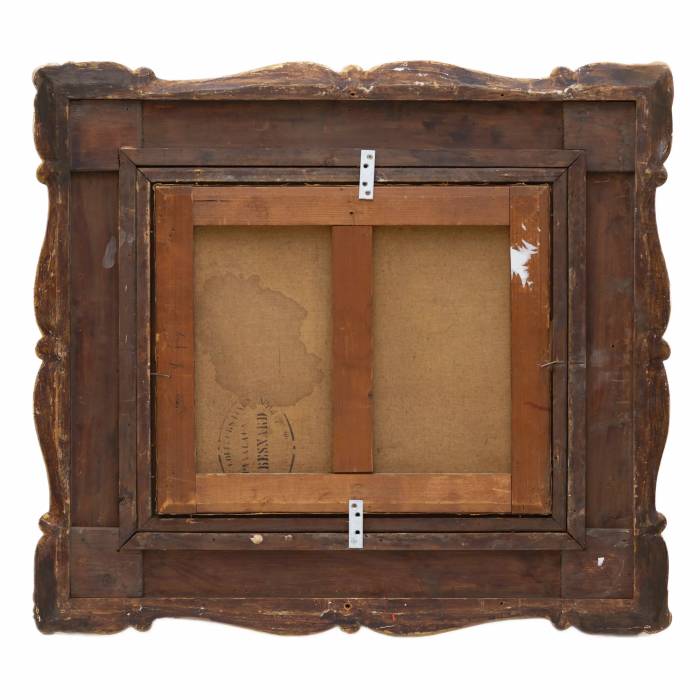
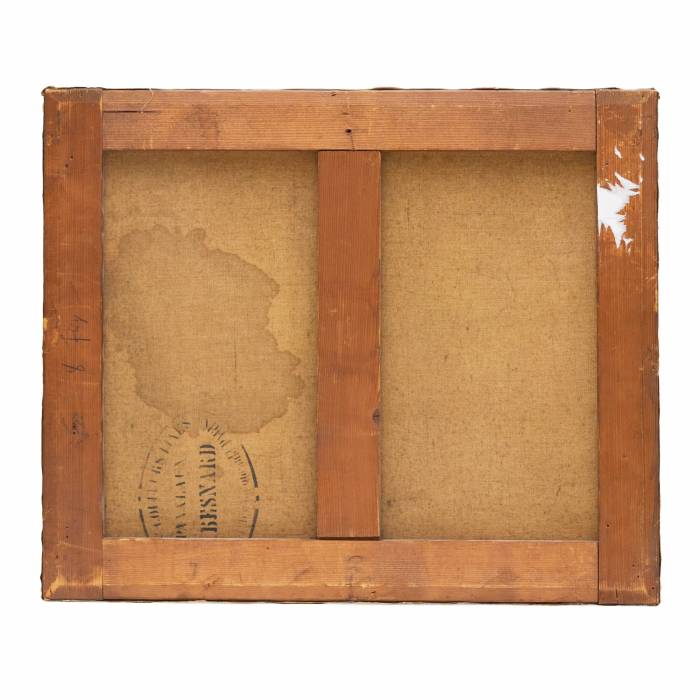
Signature: Signed lower right “I. Levitan.” The reverse of the canvas bears the factory stamp “BASSANO.”
Provenance: The painting originates from a private collection. It belonged to a collector born in Riga in 1914 who emigrated to France in the 1930s–1940s; subsequently it was passed down by descent within the family.
Isaac Ilyich Levitan occupies a central place in the history of Russian landscape painting of the late nineteenth century as one of the founders of the movement defined in art historical scholarship as the “landscape of mood.” His mature works are characterized by tonal unity, a soft model of light and shadow, and particular attention to the condition of the atmospheric environment. In Levitan’s paintings, light does not appear as a sharply defined local source but is perceived as diffused atmosphere, unifying the pictorial space and creating a sense of depth and inner stillness.
The attribution of the present work is based on a number of stylistic features. Above all, it concerns the treatment of light: the gentle juxtaposition of the illuminated road and the darkened masses of vegetation corresponds to compositional devices encountered in Levitan’s landscapes of the 1880s and 1890s. A similar spatial organization can be observed in a number of his intimate studies and works featuring the motif of a road, where diagonal construction serves as a means of conveying movement and spatial extension.
Parallels are also evident in the chromatic structure: the combination of olive greens, ochres, and muted gray-blues corresponds to the palette of the artist’s later period, during which he sought subtle nuance and tonal unity. The motif of the country road as a symbol of journey and the passage of time appears repeatedly in his oeuvre, allowing the present work to be considered within the context of the artist’s late nineteenth-century practice.
Surface dirt, darkened varnish, and localized losses of the paint layer are present. Signs of natural aging of the pictorial surface are observed.
The condition report is provided for informational purposes only.
It is not comprehensive and may not reflect all defects, restorations, alterations, or adaptations, as Antiqon does not perform professional conservation-level assessments. The information is based on a qualified, yet subjective, evaluation by our specialists.Before purchasing, we recommend consultation with an independent expert.Please also consult our Terms and conditions and Glossary A-Z, which contain important information on lot characteristics and sale conditions.