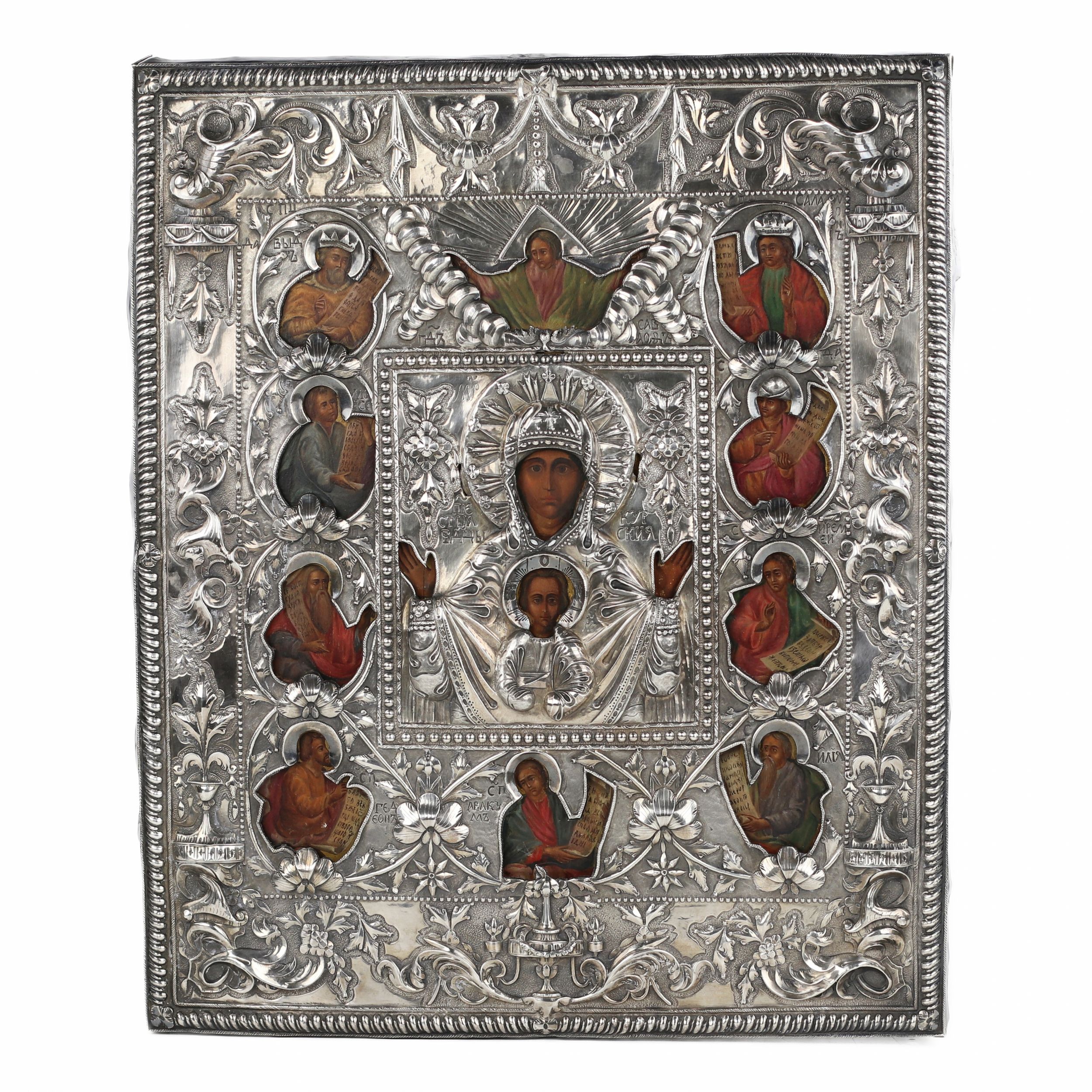
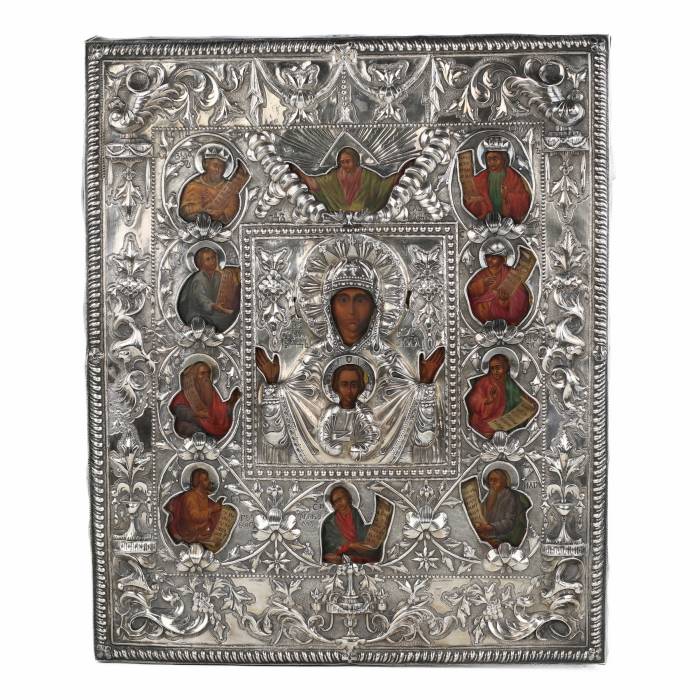
ICON “KURSK-KORENNAYA MOTHER OF GOD OF THE SIGN” RUSSIA, VOLOGDA, 1802
AntiqonART consultant will contact you within one business day after receiving your request.
Discover how the value of similar works has evolved over the past 10 years. Art is not only beauty — it's an investment.
Discover how the value of similar works has evolved over the past 10 years. Art is not only beauty — it's an investment.
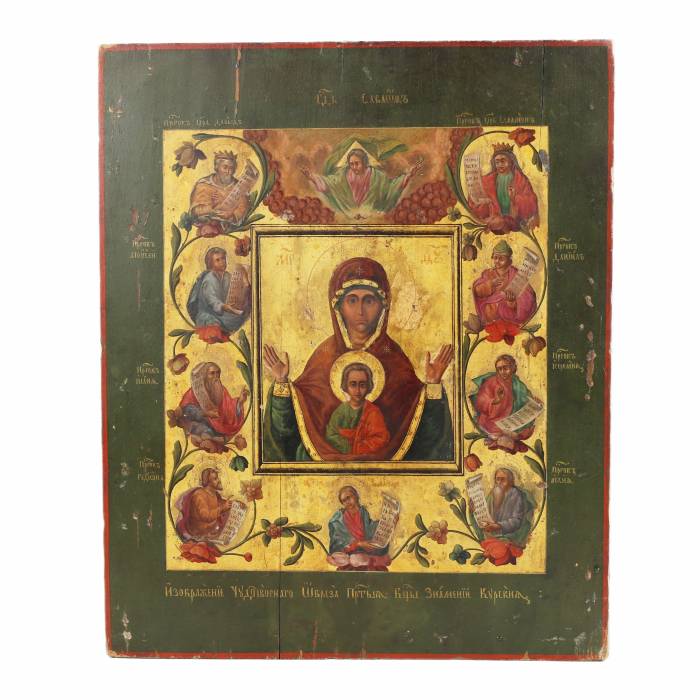
An outstanding monument of Russian Northern icon painting at the turn of the 18th and 19th centuries, uniting the traditions of the Vologda school with a high level of silver craftsmanship. The icon represents the Most Holy Mother of God of the Orans type – “The Sign”, with the Christ Child depicted in a medallion upon Her breast. The central image is framed within a painted border and surrounded by figures of the Lord Sabaoth and Old Testament prophets holding unfolded scrolls foretelling the Incarnation.
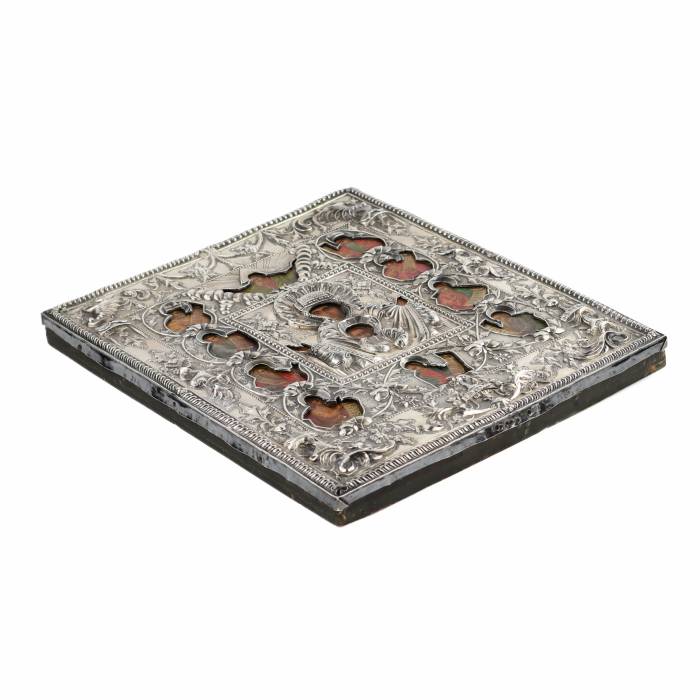
Of particular artistic significance is the repoussé silver oklad executed by the silversmith Andrian Ioakimov Klishin in 1802. The composition of the oklad is constructed in strict symmetry characteristic of early Classicism, while preserving the ornamental richness of the Baroque tradition. The vegetal ornament, garlands, cartouches and the radiant halo of the Mother of God are rendered in deep repoussé with refined detailing. Gilded elements emphasize the sacred center of the composition.
The icon combines spiritual expressiveness in painting with the virtuosity of Northern Russian silver artistry, demonstrating the high artistic culture of Vologda in the early 19th century.
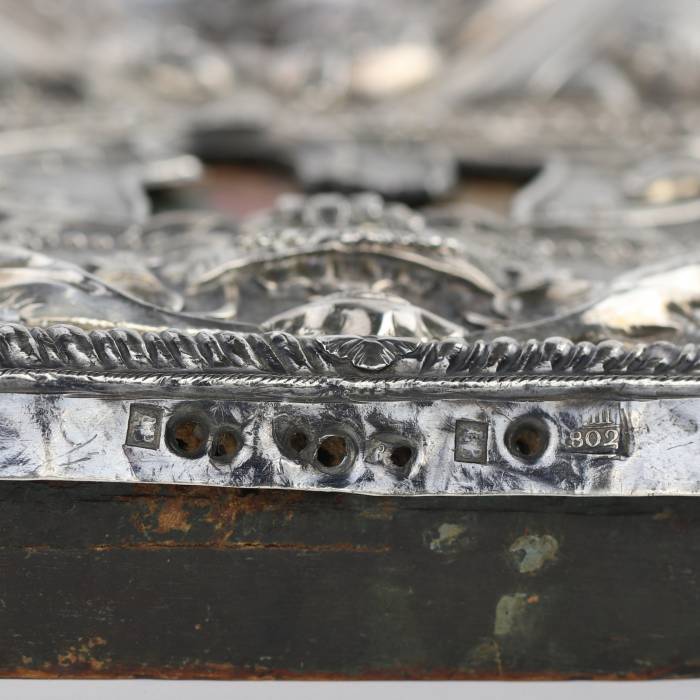
Hallmarks: Maker’s mark “АК” in Cyrillic within a square cartouche – Andrian Ioakimov Klishin; Assay mark of the city of Vologda with the initials “ГШ” – assay master Grigory Shishkin, beneath the date “1802”; Corresponding to Postnikova-Loseva hallmark catalogue No. 310 and No. 324.
Dimensions: Height – 41.5 cm; Width – 35 cm.
Condition: Good. Minor traces of age on the painted surface and silver oklad. The composition is fully preserved without loss of principal elements.
Provenance: Private collection.
The Kursk-Korennaya Icon of the Mother of God “The Sign” is among the most venerated sacred images in the history of Russian Orthodoxy and occupies a distinguished place within the evolution of Orthodox iconography. The iconographic type “The Sign” derives from the Byzantine Orans – the praying Mother of God with uplifted hands and the medallion of the Christ Child upon Her breast, symbolizing the mystery of the Incarnation. In the artistic environment of medieval Rus, this type gained prominence as early as the pre-Mongol period and became one of the principal theological visual expressions of the Advent of the Savior.
According to ecclesiastical tradition, the miracle-working Kursk image was discovered in the 13th century near the city of Kursk and subsequently acquired the status of a national shrine. Numerous copies were produced throughout Russia, establishing a strong regional tradition while preserving the canonical composition. Museum research and scholarly studies emphasize that such copies often reflect the stylistic characteristics of local schools while maintaining strict adherence to iconographic canons.
At the turn of the 18th and 19th centuries, the Vologda icon-painting school was distinguished by compositional clarity, a restrained yet luminous color palette, and a synthesis of ancient Russian tradition with emerging elements of early Classicism. Northern artistic centers, including Vologda, maintained close ties with monastic commissions, where silver oklads played a crucial role. The oklad functioned not merely as decoration but as a theological and liturgical element, accentuating the sacred center of the icon and symbolizing divine light.
Vologda silver craftsmanship of the late 18th and early 19th centuries is well documented in archival materials and represented in Russian museum collections. Regional masters were known for refined repoussé technique, sculptural modeling of ornament, and the use of gilding to emphasize principal figures. The activity of Andrian Ioakimov Klishin belongs within this tradition. His works reveal a transitional artistic language combining the decorative richness of late Baroque with the ordered symmetry of Classicism.
The oklad of this icon represents a synthesis of theological meaning and artistic mastery: the radiant halo of the Mother of God, the prophetic medallions, and the ornamental garlands form a unified liturgical structure in which silver serves as a metaphor for uncreated divine light. Such works constitute rare testimony to the spiritual culture of the Russian North in the early 19th century and hold considerable historical and artistic significance within the broader development of Russian ecclesiastical art.
The painted surface shows minor wear along the borders. The silver oklad displays natural patina and traces of devotional use. Structurally stable, with no evidence of later restoration interventions.
The condition report is provided for informational purposes only.
It is not comprehensive and may not reflect all defects, restorations, alterations, or adaptations, as Antiqon does not perform professional conservation-level assessments. The information is based on a qualified, yet subjective, evaluation by our specialists.Before purchasing, we recommend consultation with an independent expert.Please also consult our Terms and conditions and Glossary A-Z, which contain important information on lot characteristics and sale conditions.