


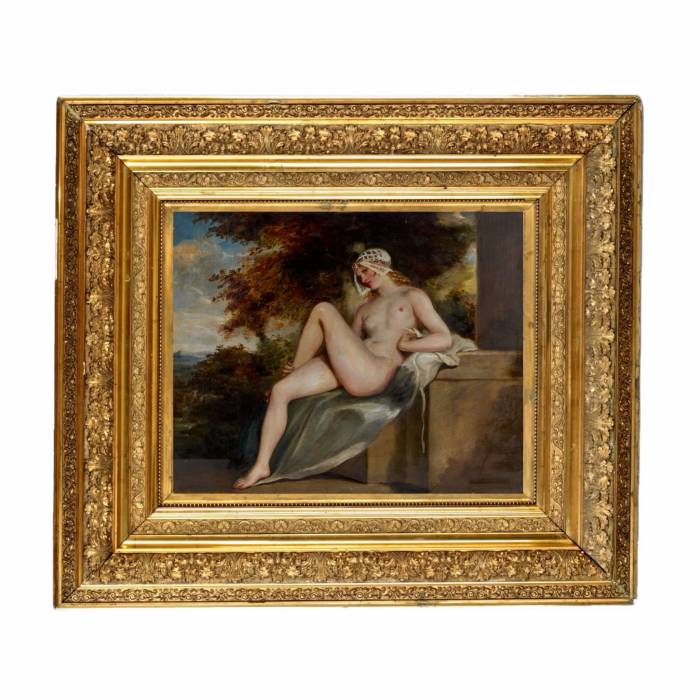
NUDE. WILLIAM ETTY (1787 - 1849) ENGLAND, EARLY 19TH CENTURY
AntiqonART consultant will contact you within one business day after receiving your request.
Discover how the value of similar works has evolved over the past 10 years. Art is not only beauty — it's an investment.
Discover how the value of similar works has evolved over the past 10 years. Art is not only beauty — it's an investment.
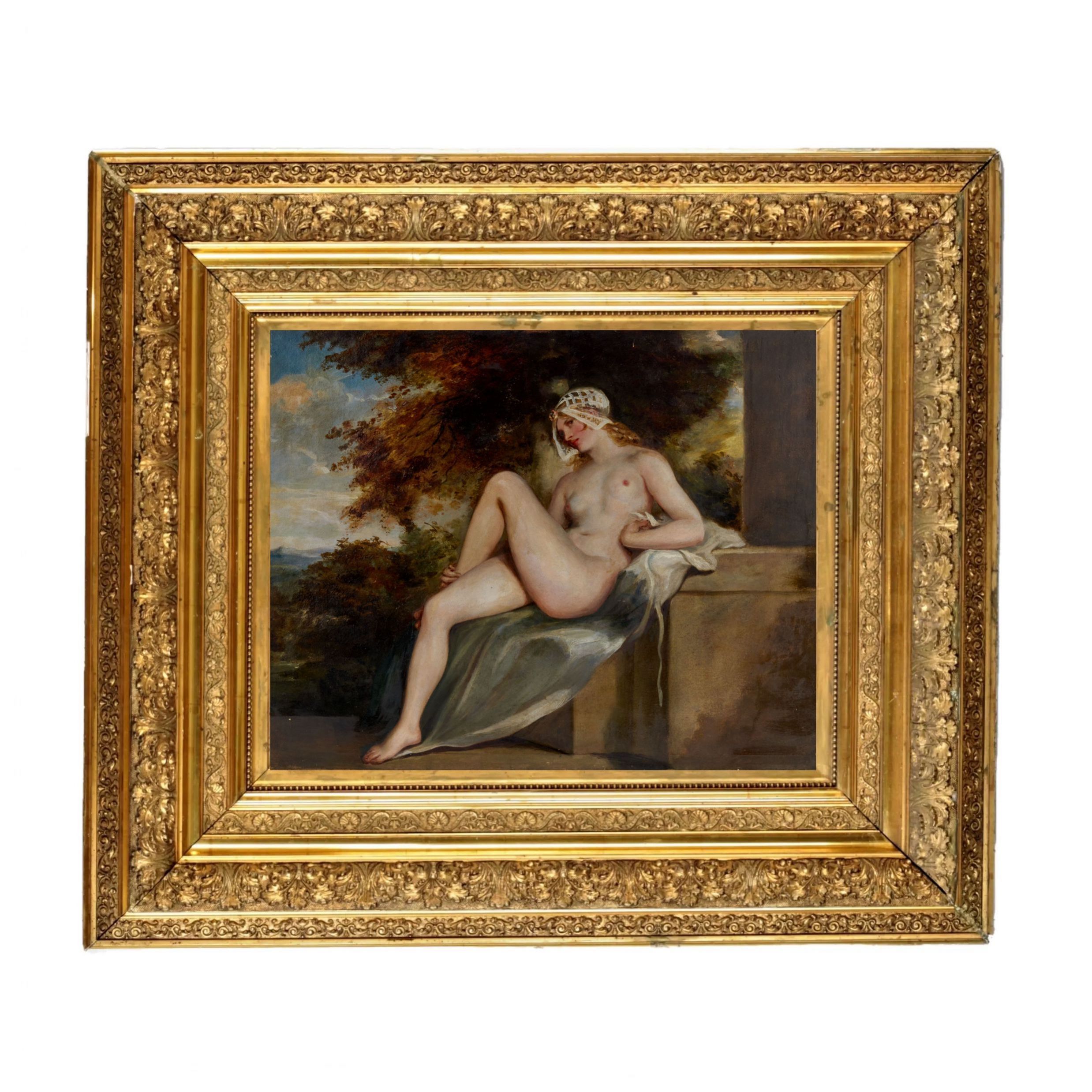
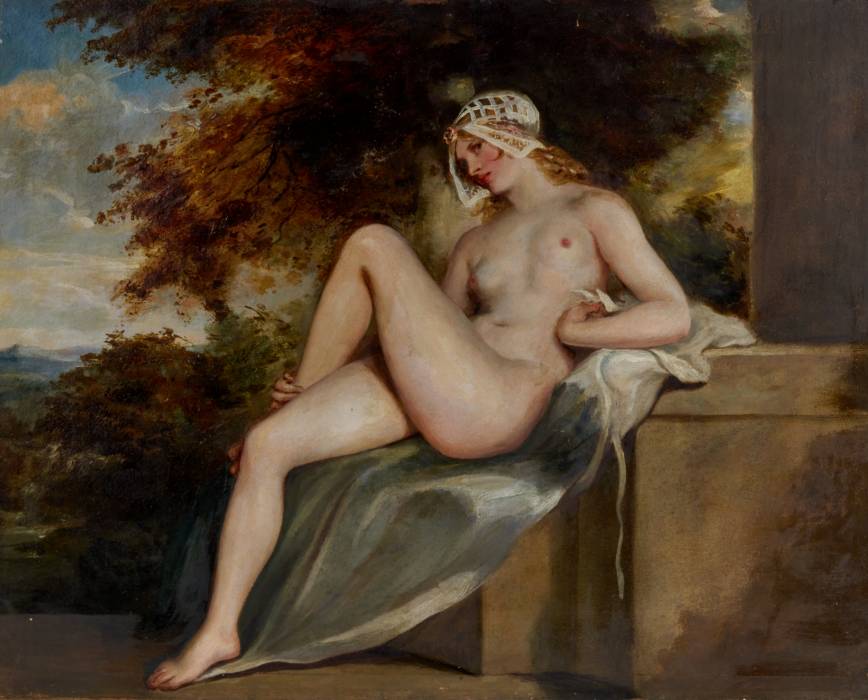
A refined example of early 19th-century English academic painting, embodying one of the central themes in the oeuvre of William Etty - the study of the human form through the lens of Classical tradition. The composition is constructed along a diagonal axis: the reclining nude figure is placed freely upon a stone ledge partially covered with drapery, creating an atmosphere of natural ease and painterly spontaneity.
The heroine is gently illuminated, her skin rendered in delicate pearlescent tones characteristic of Etty’s technique, in which sensuality is balanced by academic discipline. The surrounding landscape, suggestive of an English park with dense foliage and an opening vista, enhances the Romantic atmosphere of secluded idyll. Nature and beauty are united in a harmonious visual dialogue, echoing the poetic sensibility that marked the transition from late Neoclassicism to early Romanticism.
For Etty, the nude was never a provocation but the highest embodiment of artistic ideal, rooted in the Venetian tradition of the sixteenth century. His admiration for Titian and Veronese informed his mastery of colour and layered glazing, producing a luminous surface and a palpable richness of paint.
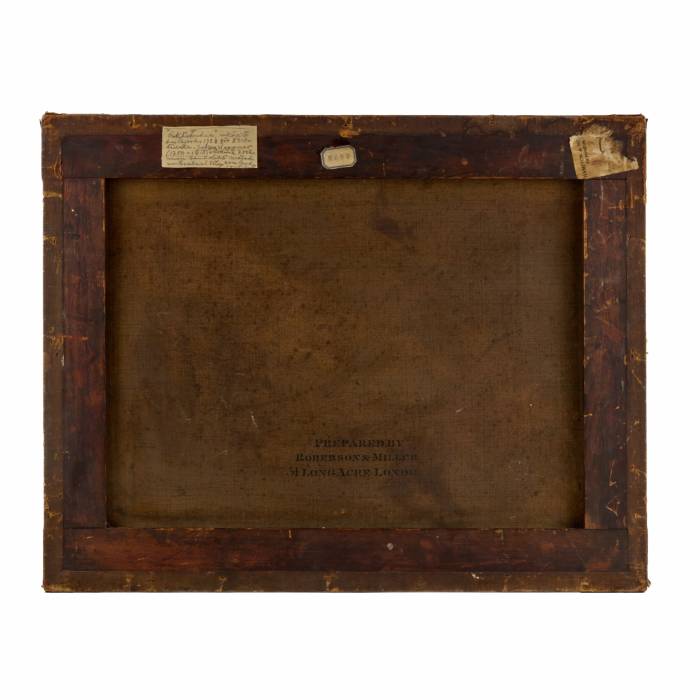
On the reverse of the canvas appears the supplier’s stamp of Roberson & Miller, 51 Long Acre, London, a distinguished 19th-century London colorman whose materials were widely used by leading British artists. Additional collector and auction labels further attest to the painting’s presence within the art market.
Dimensions: 45.5 x 57.5 cm (without frame).
Material: Oil on canvas.
Condition: Good collector’s condition. The paint layer is stable, with natural age-related craquelure consistent with the period. No evidence of intrusive restoration is visible.
Provenance: Private European collection. Owner’s stamps and auction numbers on the reverse.
William Etty occupies a singular position in the history of British art as the first major English painter to systematically devote himself to the large-scale representation of the nude. At a time when the English school remained comparatively restrained, his works marked a decisive step toward establishing a national tradition of historical and figure painting rooted in Classical precedent.
Educated at the Royal Academy in London, Etty absorbed the academic emphasis on life drawing and the study of Antique sculpture. His travels to Italy proved formative, exposing him to the colouristic brilliance and sensuous surface of the Venetian masters. From Titian and Veronese he derived not only a devotion to colour but also a painterly approach based on layered glazes and luminous tonal transitions.
During the early nineteenth century, the renewed interest in the idealized human body emerged within the broader context of late Neoclassicism and the rise of Romantic sensibility. Etty’s art synthesizes these currents: classical clarity of form is infused with emotional warmth and poetic intimacy. His female nudes, often set within pastoral or allegorical settings, were perceived by contemporaries as meditations on beauty, harmony and moral reflection rather than mere displays of sensuality.
Today, Etty’s works are held in major museum collections, including Tate Britain and York Art Gallery, where his contribution is recognised as pivotal to the development of British figurative painting. Paintings featuring a solitary female nude remain among the most sought-after examples of his production, representing the most characteristic and enduring aspect of his artistic identity - the union of academic tradition, Venetian colourism and refined sensuality.
The painting is in well-preserved condition. The canvas has not been relined. Even age-related craquelure is present and does not affect the overall visual integrity. The reverse retains historical stamps and labels; the stretcher is likely original or early. Standard museum conservation conditions are recommended.
The condition report is provided for informational purposes only.
It is not comprehensive and may not reflect all defects, restorations, alterations, or adaptations, as Antiqon does not perform professional conservation-level assessments. The information is based on a qualified, yet subjective, evaluation by our specialists.Before purchasing, we recommend consultation with an independent expert.Please also consult our Terms and conditions and Glossary A-Z, which contain important information on lot characteristics and sale conditions.