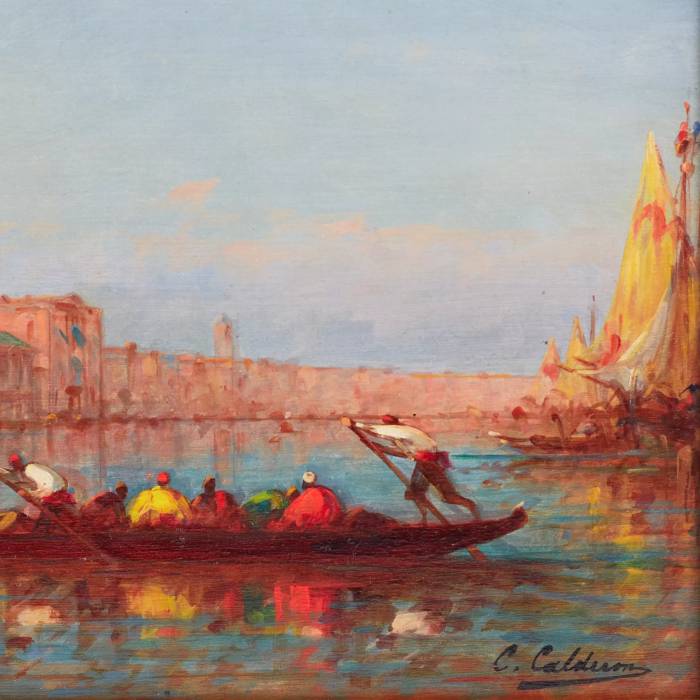
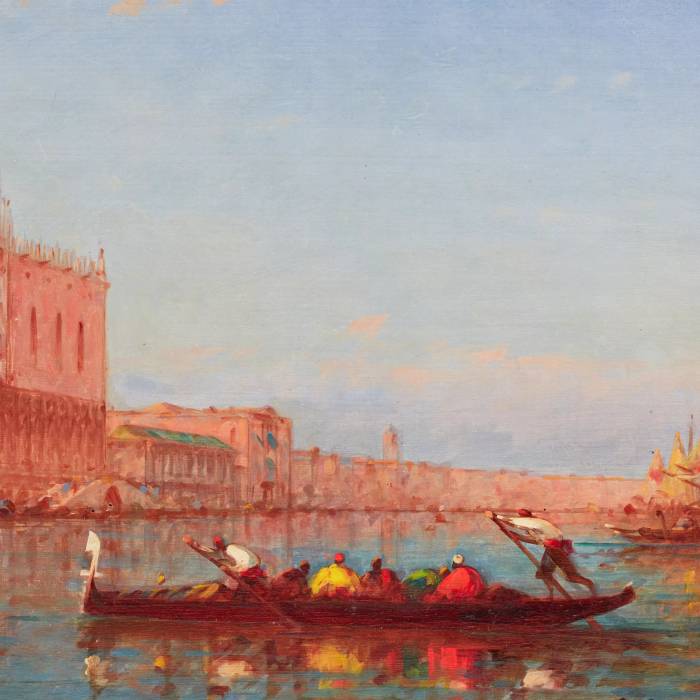
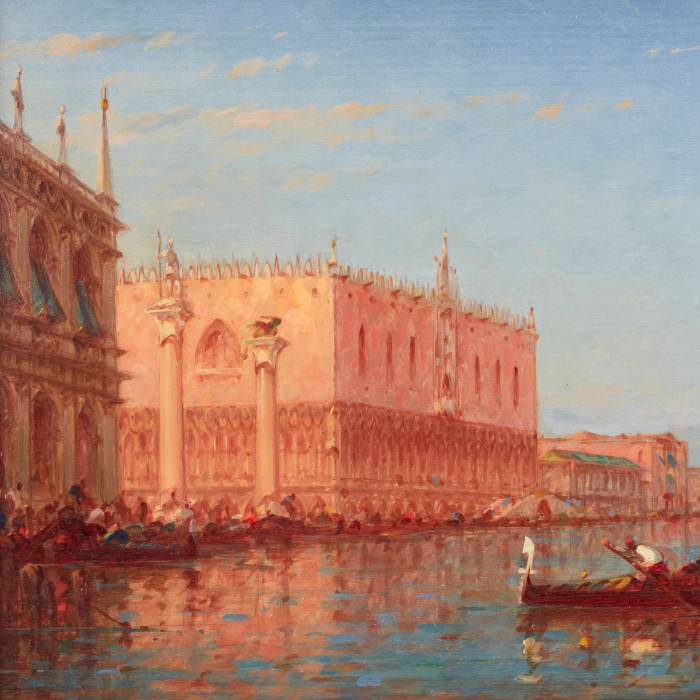
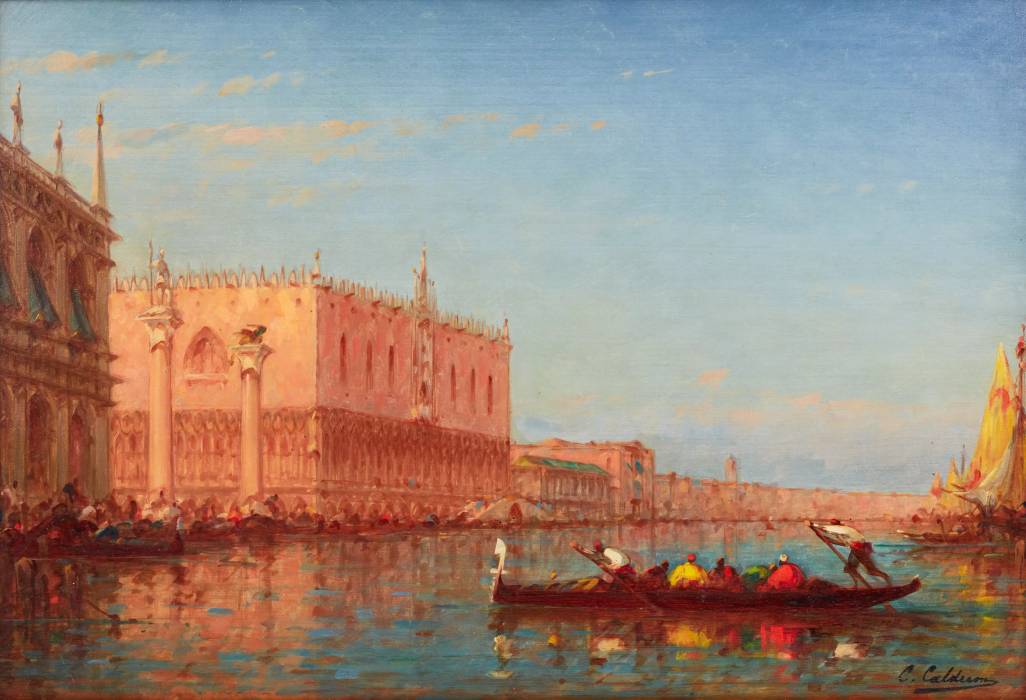
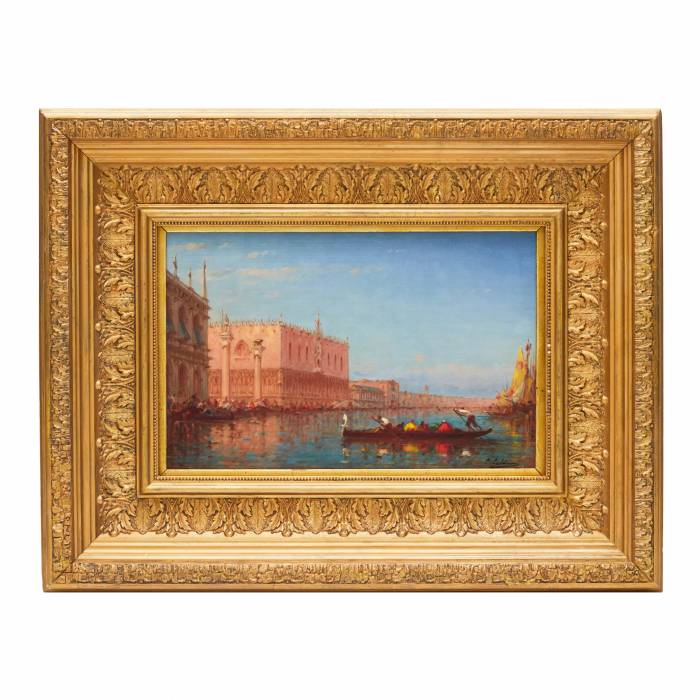
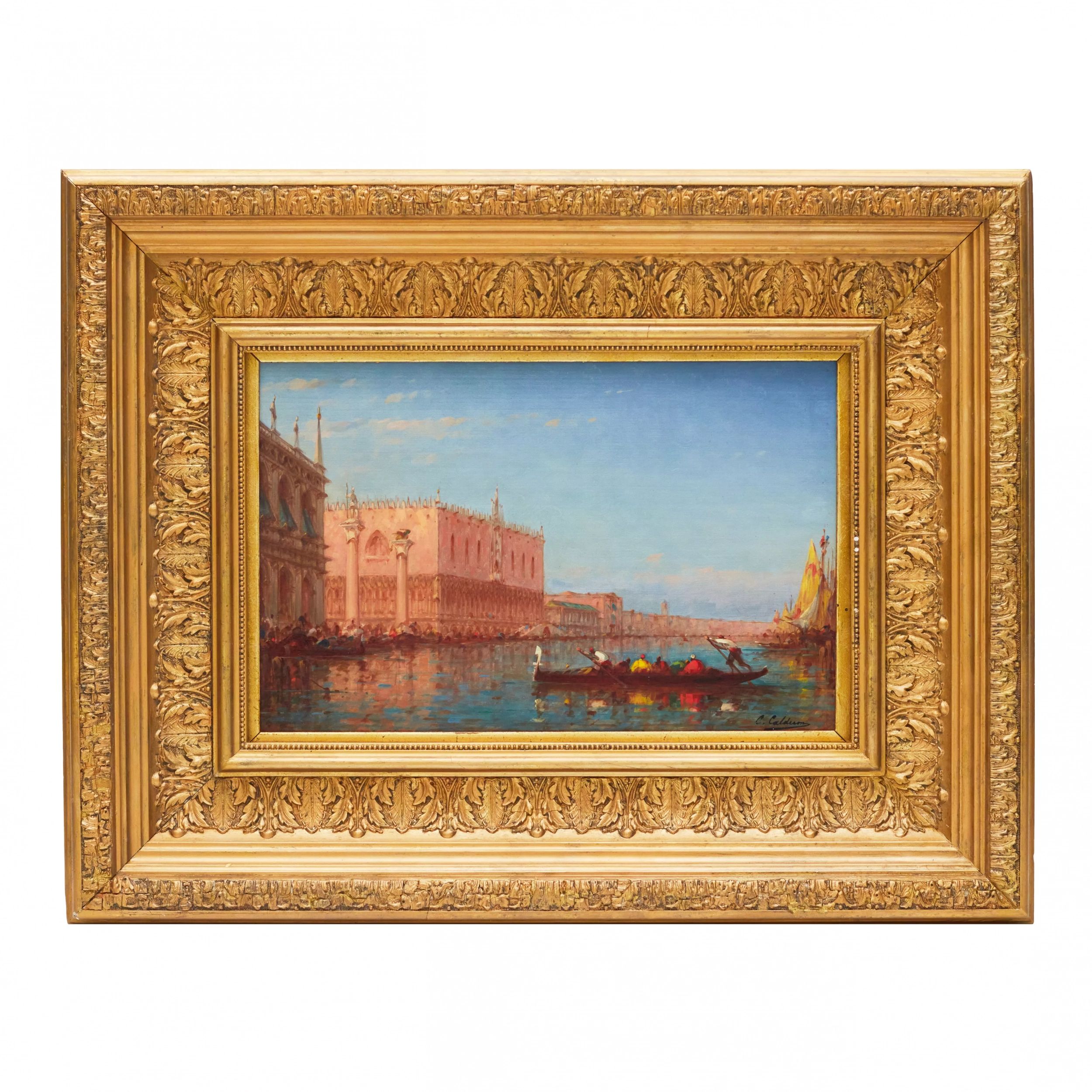
This refined composition by Charles-Clément Calderon (1870–1906) captures the Doge’s Palace and St Mark’s Square bathed in the soft light of Venice. The artist merges academic precision with a delicate painterly touch, conveying both architectural grandeur and the city’s vitality. Two Piazzetta columns dominate the foreground — one topped with the winged lion of St Mark, the other with St Theodore. A gondola with vividly dressed passengers enlivens the tranquil waters, adding rhythm and reflection to the luminous Venetian scene.
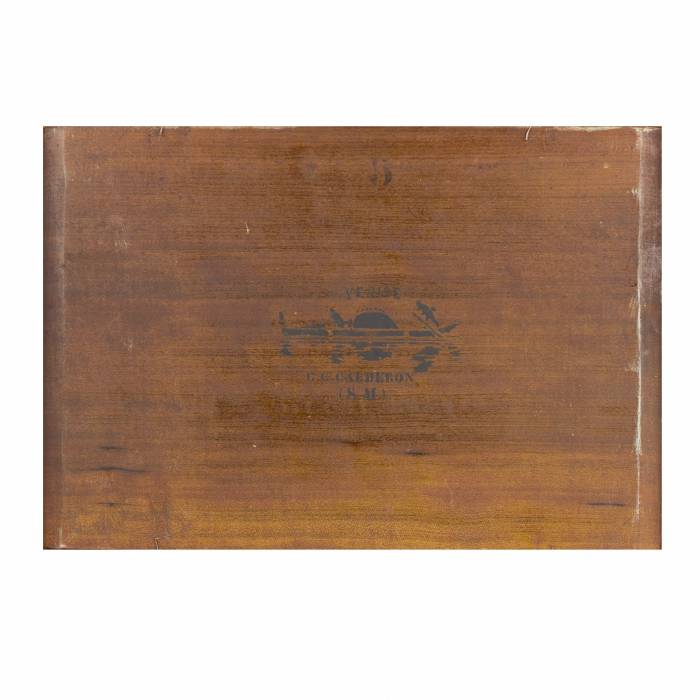
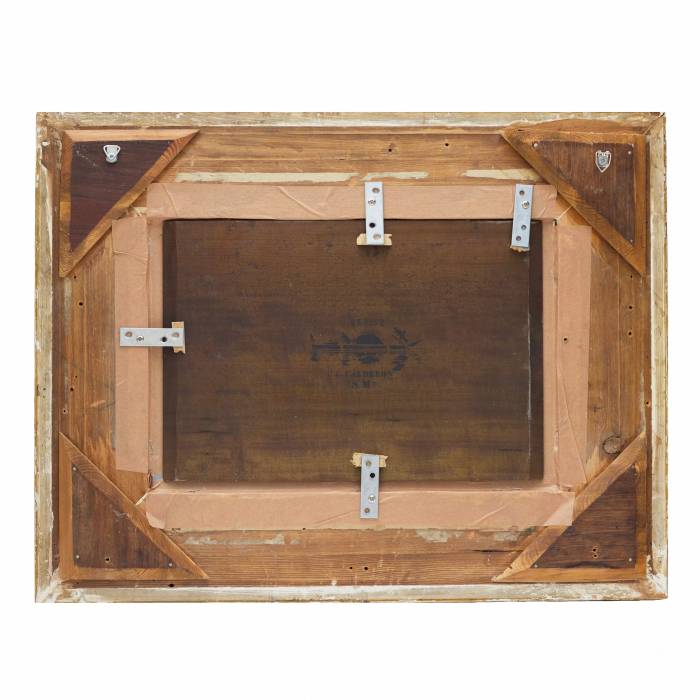
Marks: Signed “C. Calderon” lower right; on the reverse stamped “VENISE – C.C. CALDERON (S.M.)”.
Dimensions: 24 × 35 cm.
Material: Oil on mahogany panel.
Frame size: 45 × 57 cm.
Condition: Good condition with natural age patina; original gilded frame with minor wear.
Provenance: Private European collection.
Charles-Clément Calderon (1870–1906) was a French painter active at the turn of the 19th–20th century, trained in the academic school and closely connected with the studio of Alexandre Cabanel (1823–1889). From Cabanel he inherited clarity of drawing, color harmony, and a refined approach to light and shadow.
Venice played a central role in Calderon’s work, symbolizing both cultural heritage and artistic inspiration. Unlike earlier romantic depictions of the city, Calderon sought to convey Venice as a living organism — dynamic, luminous, and inhabited. His canvases merge the grandeur of monuments with the immediacy of everyday life.
The Doge’s Palace and St. Mark’s Square, the focus of this painting, embodied the political and cultural heart of Venice. The symbolism of the two Piazzetta columns, dedicated to St. Mark and St. Theodore, reflects the city’s spiritual and civic identity. At the same time, the gondola in the foreground anchors the scene in daily Venetian life at the turn of the century.
Such works were highly appreciated by European collectors of the late 19th and early 20th centuries, who saw Venice as both a cultural ideal and a living city — a metaphor of the unity between history, faith, and art.
In good overall condition; paint layer stable; original frame with light wear and natural patina.
The condition report is provided for informational purposes only.
It is not comprehensive and may not reflect all defects, restorations, alterations, or adaptations, as Antiqon does not perform professional conservation-level assessments. The information is based on a qualified, yet subjective, evaluation by our specialists.Before purchasing, we recommend consultation with an independent expert.Please also consult our Terms and conditions and Glossary A-Z, which contain important information on lot characteristics and sale conditions.