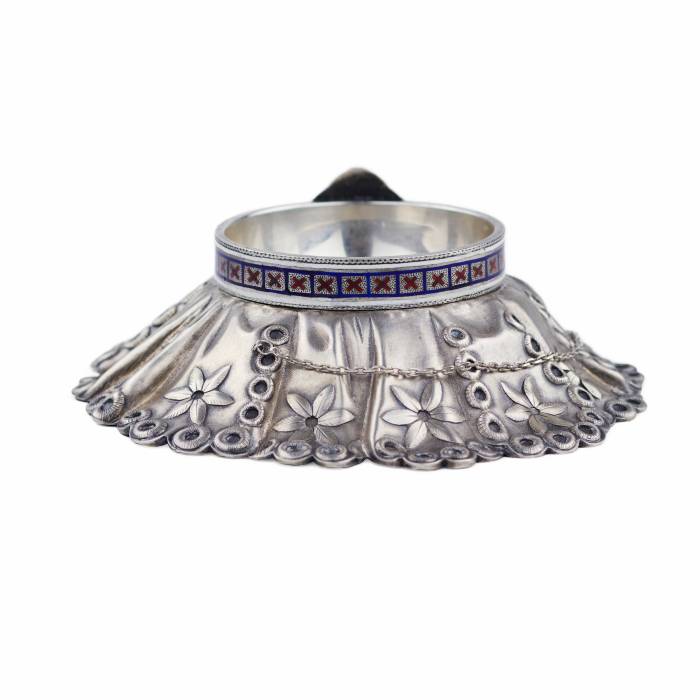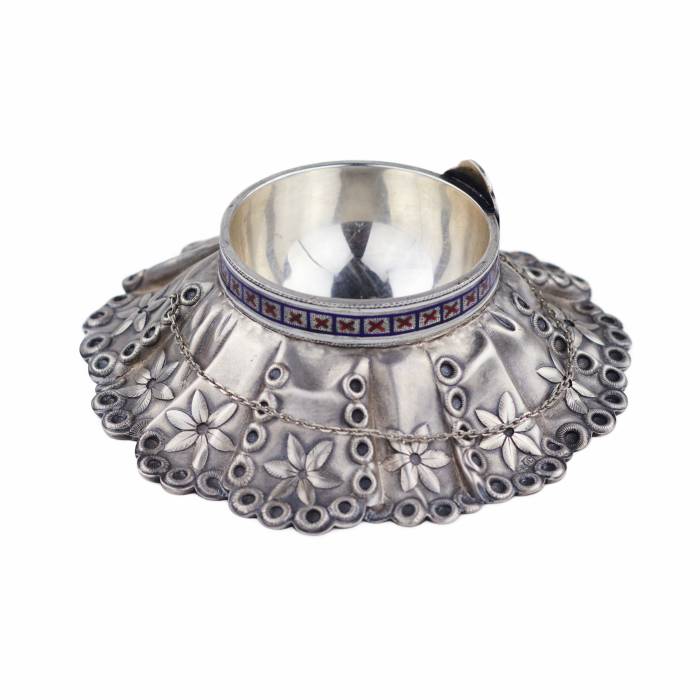

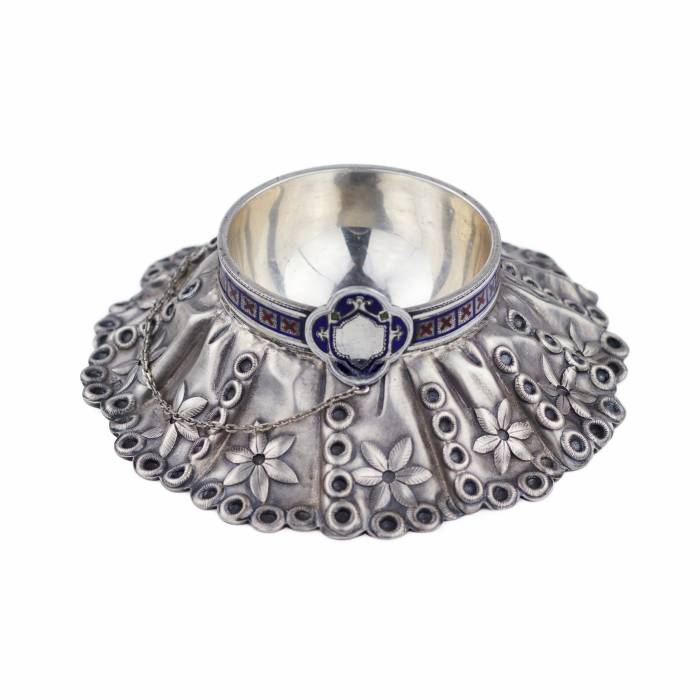
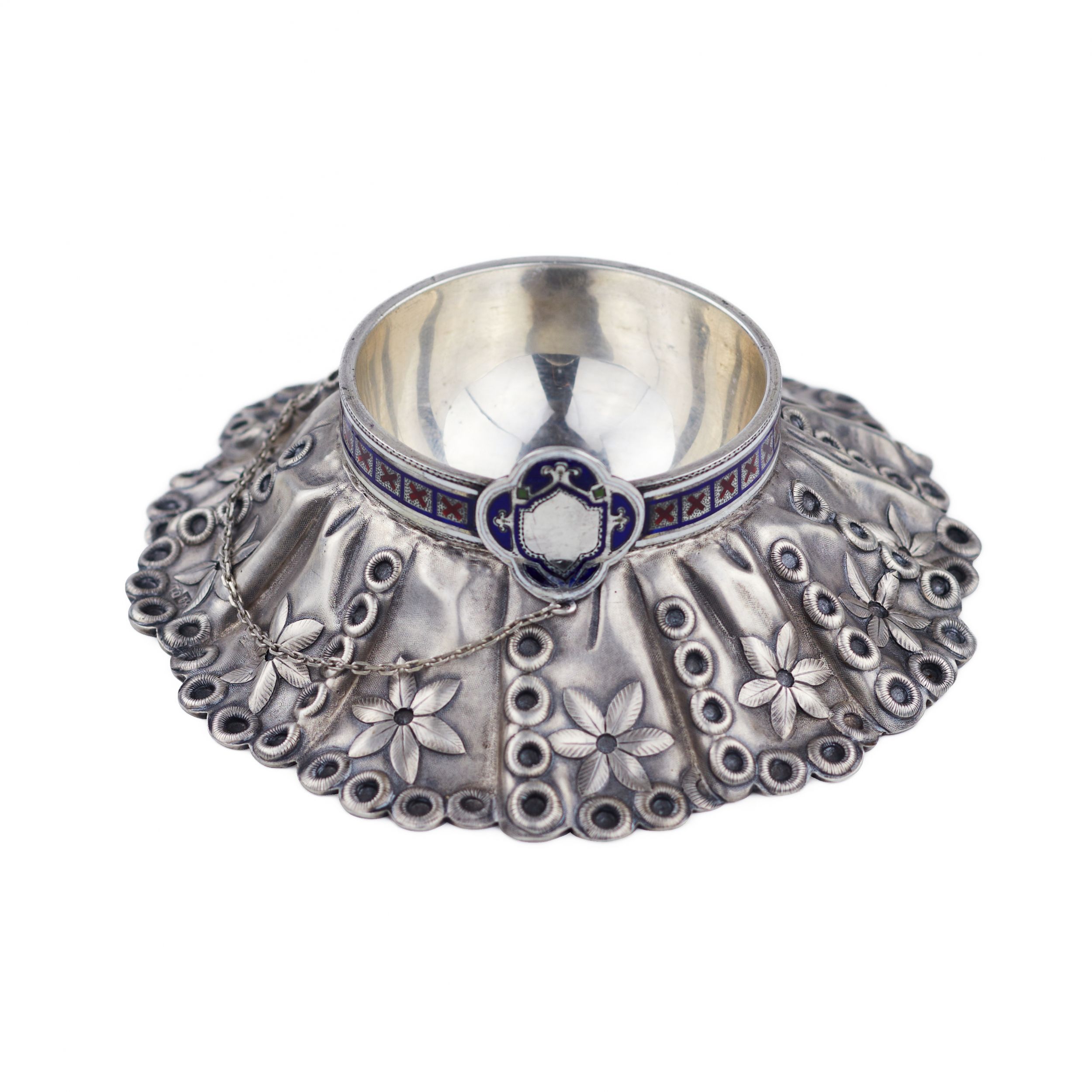
Wedding salt cellar for karavay with enamel in the form of a tablecloth Pavel Ovchinnikov firm, Moscow, 1875

Wedding salt cellar for karavay with enamel in the form of a tablecloth Pavel Ovchinnikov firm, Moscow, 1875

ID-ANTQ-15344
November 29, 2025 12:00 PM GMT+02:00
Live auction is finished
Estimate
1000 - 1500 EUR
Lot Sold
 
Lot sold
Use our cost calculator

Discover how the value of similar works has evolved over the past 10 years. Art is not only beauty — it's an investment.

Price History

Discover how the value of similar works has evolved over the past 10 years. Art is not only beauty — it's an investment.

Request a Shipping Quote

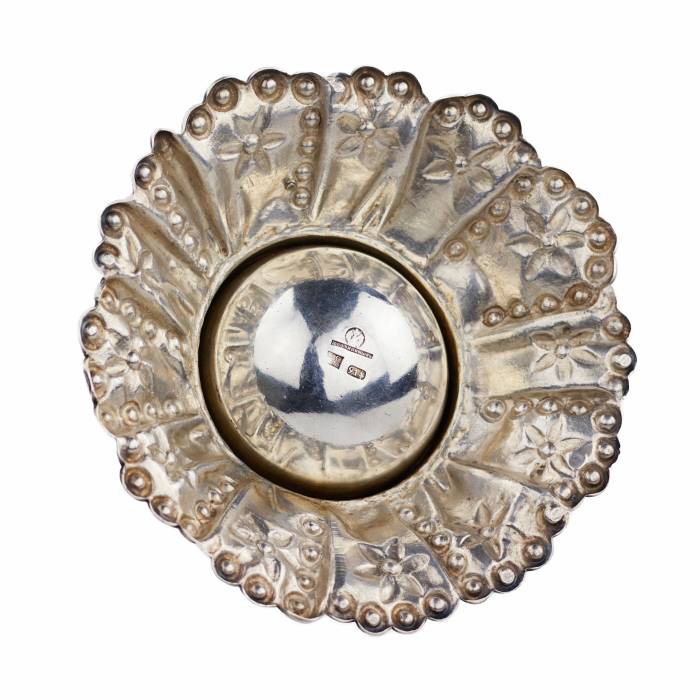
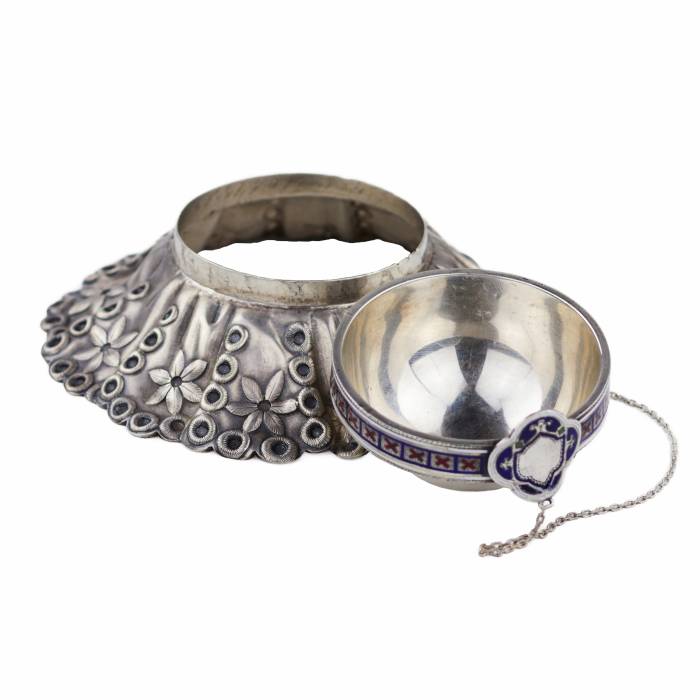
A rare collectible salt cellar in the shape of a stylised tablecloth, crafted from silver with niello and decorated with polychrome enamel. Produced by the renowned firm of Pavel Ovchinnikov, purveyor to the Imperial Court. The upper section is shaped as a smooth circular bowl with a colorful frieze of alternating geometric patterns in blue and red. The base mimics a draped cloth with embossed floral and lace-like ornaments. On the front, a heraldic enamel medallion. The piece likely served as a wedding salt cellar for the traditional karavay bread ceremony, a symbol of hospitality, abundance and family unity in Russian custom.

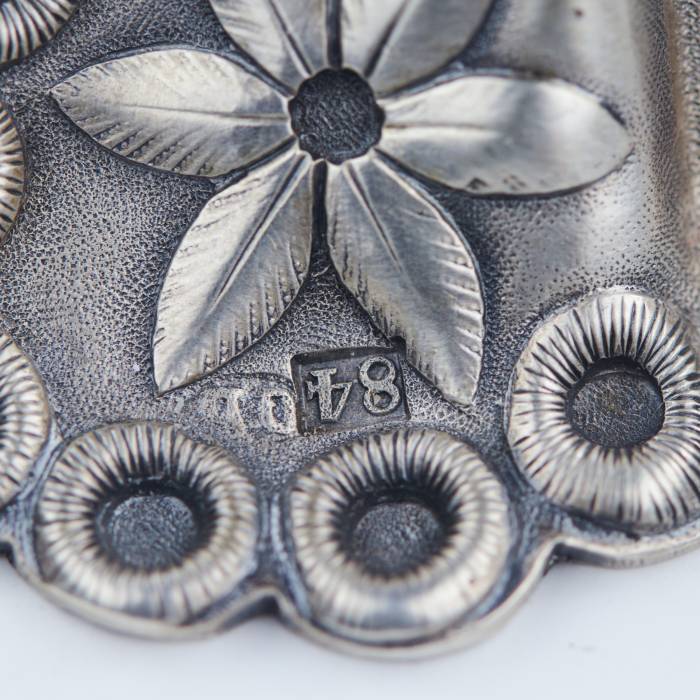
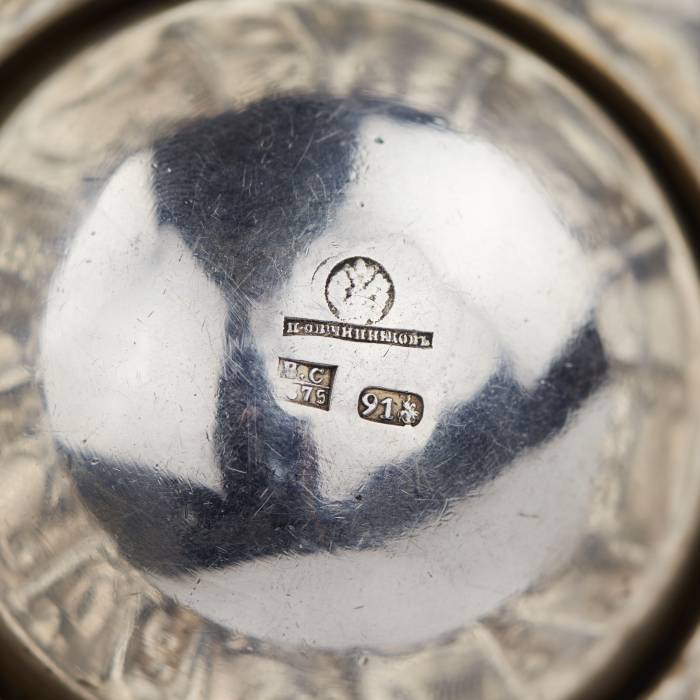
Hallmarks: Maker’s mark beneath the double-headed eagle: P. Ovchinnikov (in a rectangular cartouche). Moscow assay mark dated 1875 with initials V.S (Viktor Savinsky, assay inspector). State mark with silver standard 91 and Moscow city emblem (Saint George).

Dimensions: Height: 5.1 cm. Width: 12.7 cm

Weight: 171 g. Silver, 91 standard (.925)

Condition: Generally good. Wear consistent with age, minor enamel losses.

Provenance: Moscow, Pavel Ovchinnikov workshop, 1875

Art:
russia
Height:
5.1 cm
Width:
12.7 cm
Depth:
12.7 cm
Period:
19th century
Style:
Neo-Russian
Country:
Royal Russia
Material:
Silver 91, Champlevé enamel
Gifts:
Other
Condition:
Revive
Fair
Good
Very good
Like new

Founded in 1851 in Moscow, the Ovchinnikov firm rose to prominence as one of Imperial Russia’s finest silversmiths. Known for combining innovation with traditional ornamentation, the firm became an official supplier to the Imperial Court and gained international acclaim.

In Russian wedding tradition, salt presented with bread (karavay) symbolises prosperity and peace. Such salt cellars were often family heirlooms, crafted with care and rich symbolism. This example showcases cloisonné enamel, niello and repoussé work, reflecting both technical mastery and cultural heritage.

The hallmark of Viktor Savinsky certifies the silver as 91 zolotniks, the highest Russian standard. Comparable pieces are held in the collections of the State Historical Museum and the All-Russian Museum of Decorative Arts.

Overall good condition. Light surface wear and enamel losses consistent with age. No significant deformations, with minor traces of restoration.

The condition report is provided for informational purposes only.

It is not comprehensive and may not reflect all defects, restorations, alterations, or adaptations, as Antiqon does not perform professional conservation-level assessments. The information is based on a qualified, yet subjective, evaluation by our specialists.Before purchasing, we recommend consultation with an independent expert.Please also consult our Terms and conditions and Glossary A-Z, which contain important information on lot characteristics and sale conditions.
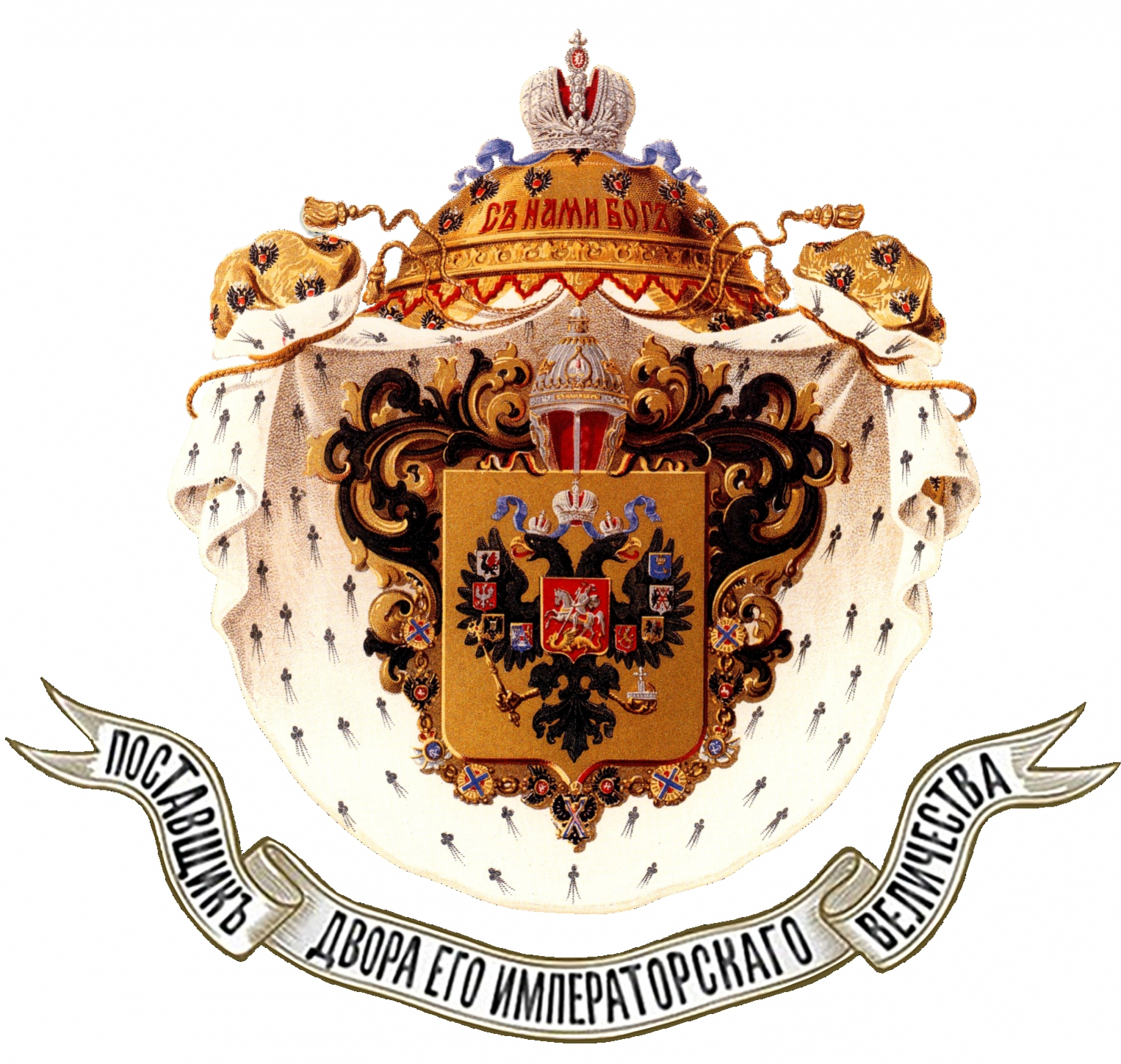
Firm P.A.Ovchinnikov (1851 -1917)
The firm of Pavel Akimovich Ovchinnikov was one of the largest jewelry companies in Imperial Russia during the second half of the 19th and the early 20th century. Official Purveyor to the Court of His Imperial Majesty. Founded in 1851, the enterprise quickly became a flagship of Russian jewelry art, earning international acclaim for its exceptional gold and silver pieces adorned with enamel, niello, and engraving in the spirit of historicism and neo-Russian style. The Master’s Path: From Apprentice to Factory FounderPavel Akimovich Ovchinnikov was born into the family of a serf owned by Prince Volkonsky. As a boy, he demonstrated remarkable drawing skills and was sent to Moscow to apprentice for eight years in the gold and silversmith workshop of his brother Andrey Akimovich. After gaining his freedom and marrying in 1850, he invested his wife′s dowry of 1,000 rubles into starting his own business. In 1851, he opened a workshop that grew into a full-fledged factory by 1853.By 1854, the company’s annual turnover exceeded 1.5 million rubles. The factory’s output began reaching the Moscow elite and clergy. In 1865, the firm participated in national and international exhibitions, earning prestigious awards—gold and silver medals, the Legion of Honour (Paris, 1867), and the Iron Cross (Vienna, 1873). Purveyor to the Imperial Court In 1865, the firm was officially recognized as a purveyor to the Imperial Court, a title reaffirmed in 1881 and 1896. In 1873, a branch was opened in St. Petersburg, and in 1878, the company began supplying the household of Grand Duke Mikhail Nikolaevich. Ovchinnikov’s products were present in the major palaces of the empire and were exported across Europe and the East. Revolution in Enamel ArtOne of the firm’s greatest contributions was the development of artistic enamel. Ovchinnikov’s craftsmen were the first in Russia to use plique-à-jour enamel—a translucent technique requiring extreme skill. Enamel became not just decorative but a central artistic element. It was often combined with niello, engraving, carving, and gilding. At the 1872 Polytechnic Exhibition in Moscow, Ovchinnikov presented a service decorated with niello medallions depicting Moscow cityscapes and bright enamel ornamentation—a highlight of the event. Oriental Style and the ChinoiserieTrendOvchinnikov was among the first in Moscow to master Eastern stylistics, which became popular in late 19th-century Europe and Russia. In the spirit of chinoiserie, his workshop produced caskets, snuffboxes, and trays adorned with enamel lacquer, precious stones, and exotic motifs. This aesthetic appealed to aristocratic tastes and added to the firm’s international fame.Artistic CollaborationsPavel Akimovich worked closely with many leading artists, architects, and sculptors of his time. These included E. Lanceray, A. Zhukovsky, G. Hartmann, D. Chichagov, I. Monighetti, A. Zakharov, V. Borovsky, S. Komarov, and L. Dahl. Their designs were brought to life in silver, enamel, and gold—each object becoming a masterpiece of applied art. Jewelry School and Master TrainingIn 1875, Ovchinnikov founded a jewelry school for 130 gifted children. The school was awarded a silver medal at the 1882 All-Russian Exhibition and became a major source of talent for Russia’s jewelry industry. It played a crucial role in the development of professional art education. Flourishing and the End of an Era The firm′s peak came in the 1870s–1880s. After Pavel Ovchinnikov’s death in 1888, the business was managed by his sons. They carried on the tradition of enamel painting and showcased their innovative works at the 1900 Paris World′s Fair. The firm operated until 1917, when revolutionary events brought its story to a close. Legacy: Museum Collections Today, works by the firm “P.A. Ovchinnikov” are part of major museum collections around the world:State Hermitage Museum – icons, processional crosses, and enamel reliquaries;State Historical Museum – tea sets, cigarette cases, and objects in the historicist style;Moscow Kremlin Museums – chalices, kovshi, and ecclesiastical items;Museum of Decorative Arts, Moscow – examples of painted and plique-à-jour enamel;Victoria and Albert Museum, London – pieces in the Byzantine style;The Walters Art Museum, USA – enamel vases, bowls, and snuffboxes.
... Read More

Stay up to date with new arrivals
Save Russian silver and we let you know when new listings appears in this category
Save

Related items