
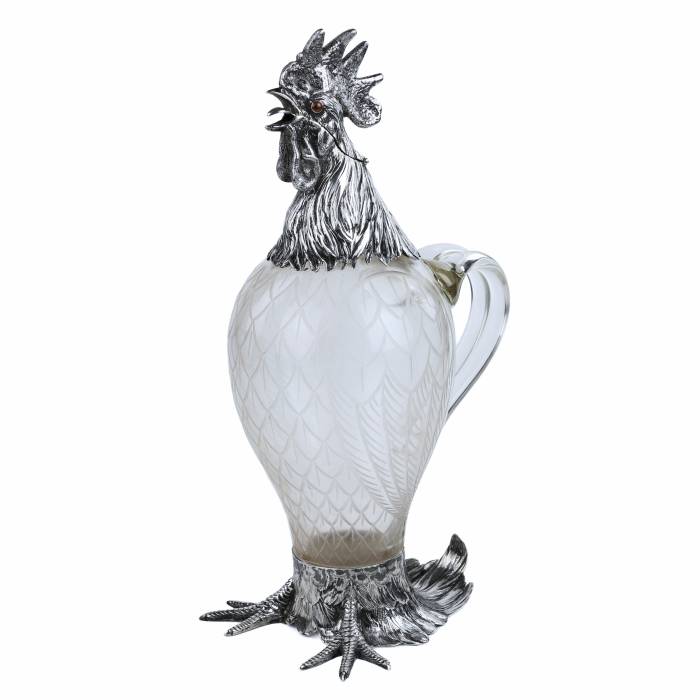
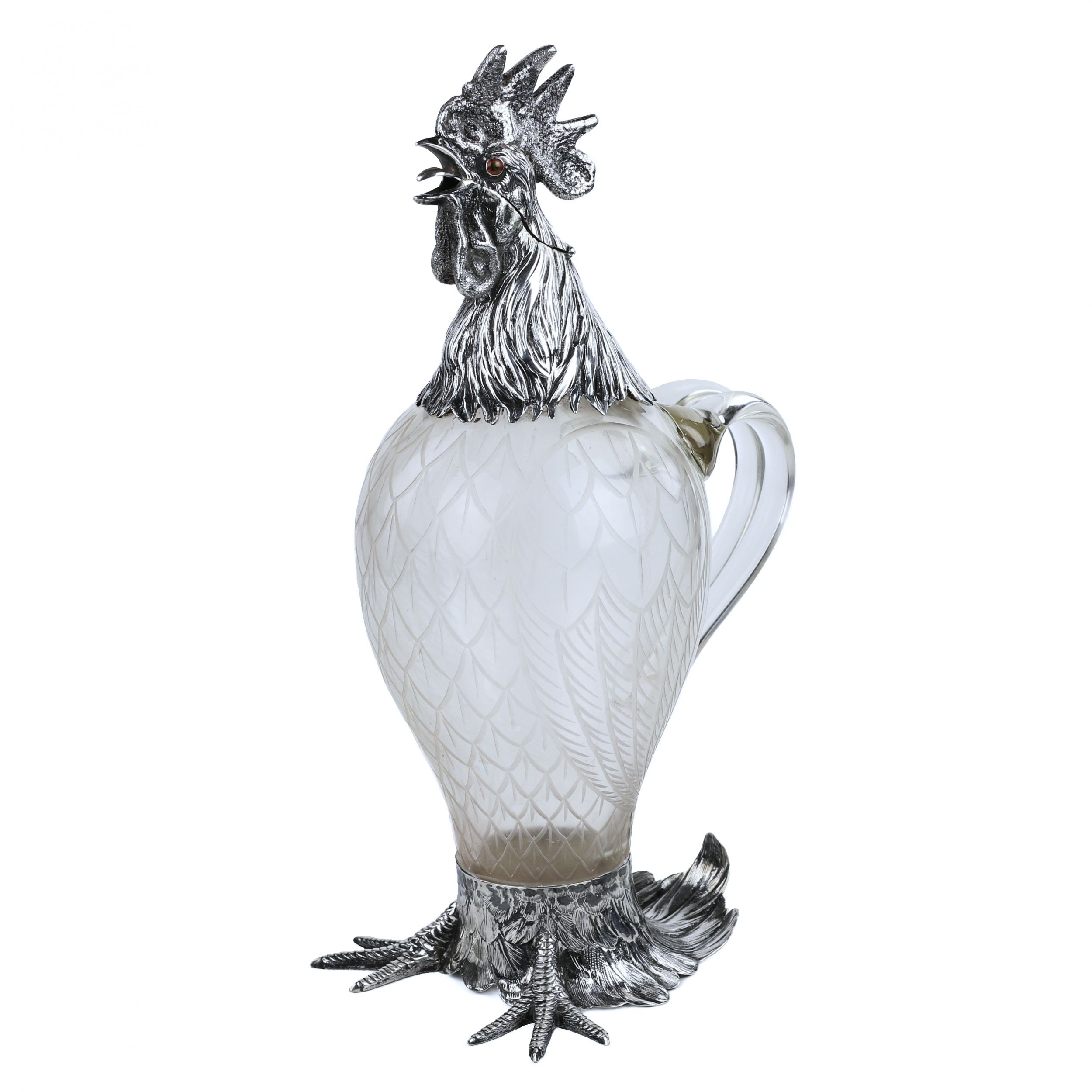
GLASS AND SILVER ROOSTER-FORM JUG. HANAU, J.D. SCHLEISSNER SÖHNE. LATE 19TH CENTURY

GLASS AND SILVER ROOSTER-FORM JUG. HANAU, J.D. SCHLEISSNER SÖHNE. LATE 19TH CENTURY

ID-ANTQ-12309
November 29, 2025 12:00 PM GMT+02:00
Live auction is finished
Estimate
1000 - 1500 EUR
Lot Sold
 
Lot sold
Use our cost calculator

Discover how the value of similar works has evolved over the past 10 years. Art is not only beauty — it's an investment.

Price History

Discover how the value of similar works has evolved over the past 10 years. Art is not only beauty — it's an investment.

Request a Shipping Quote
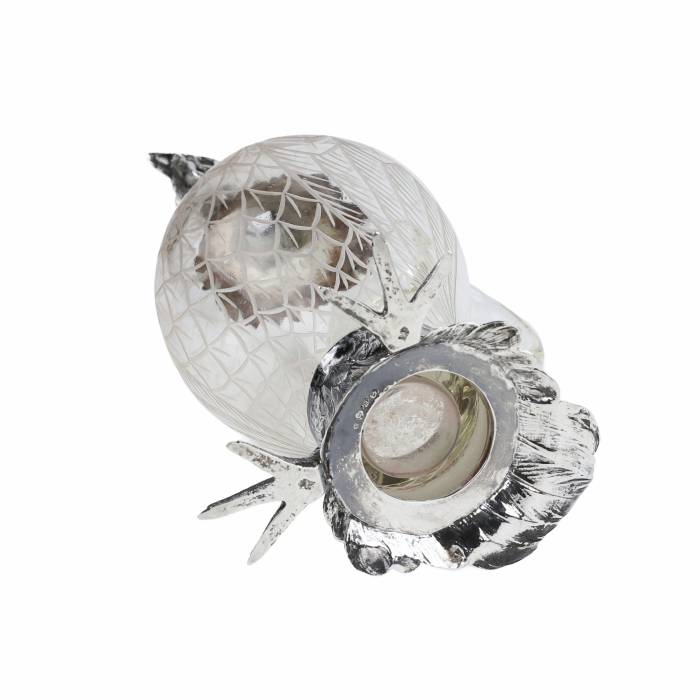
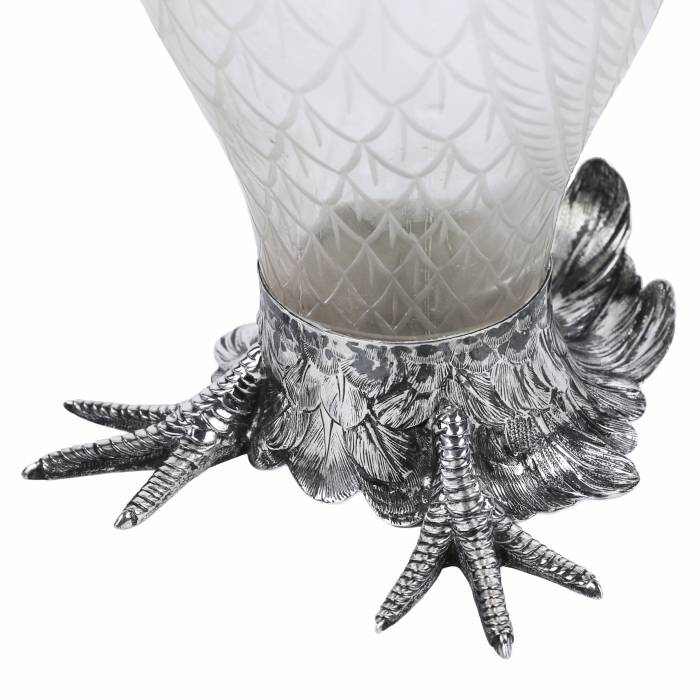
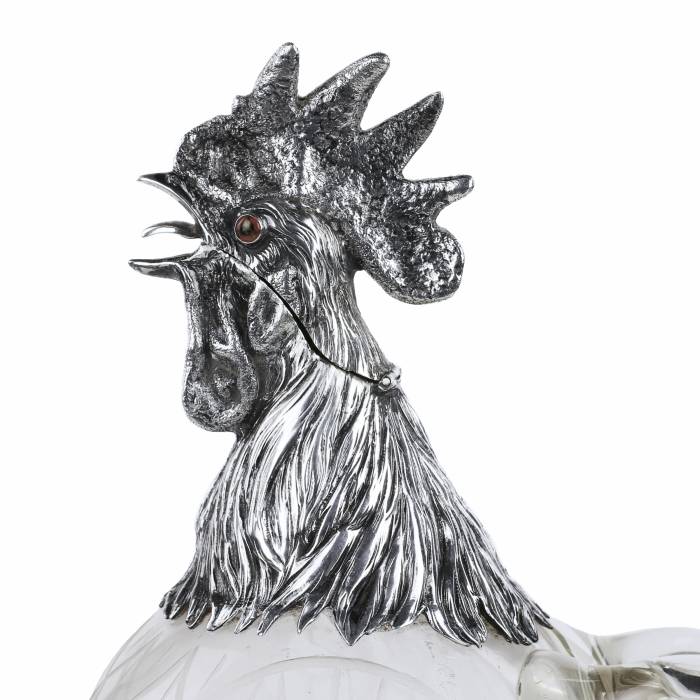
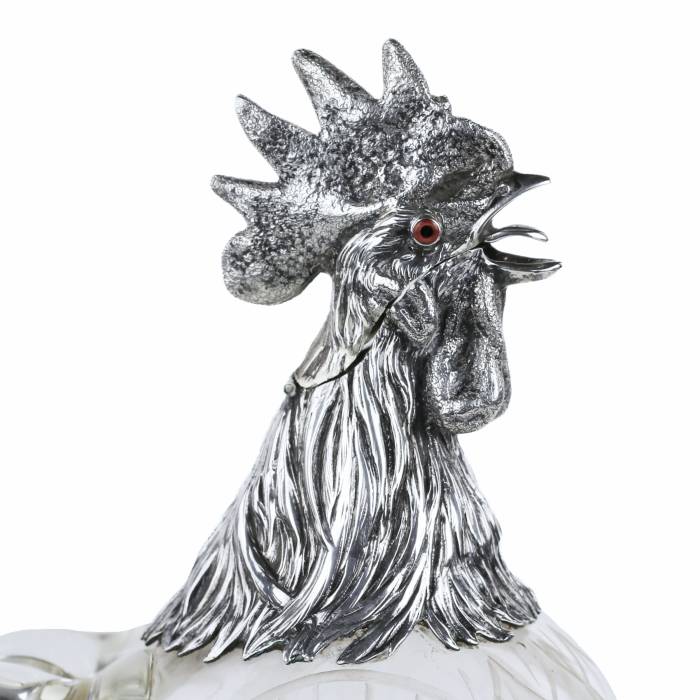
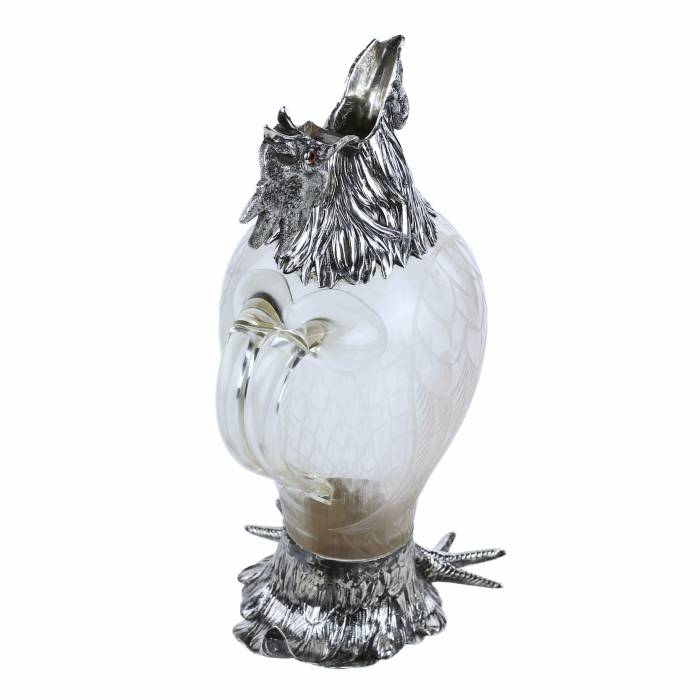
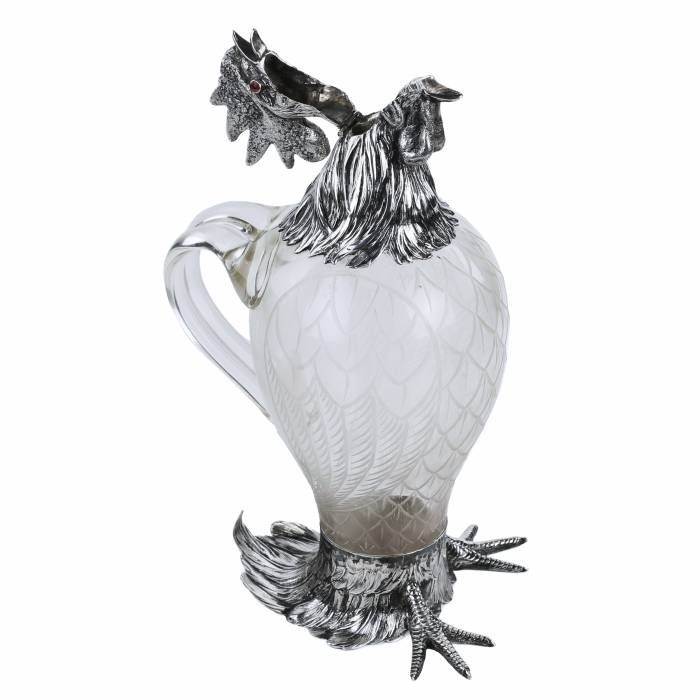
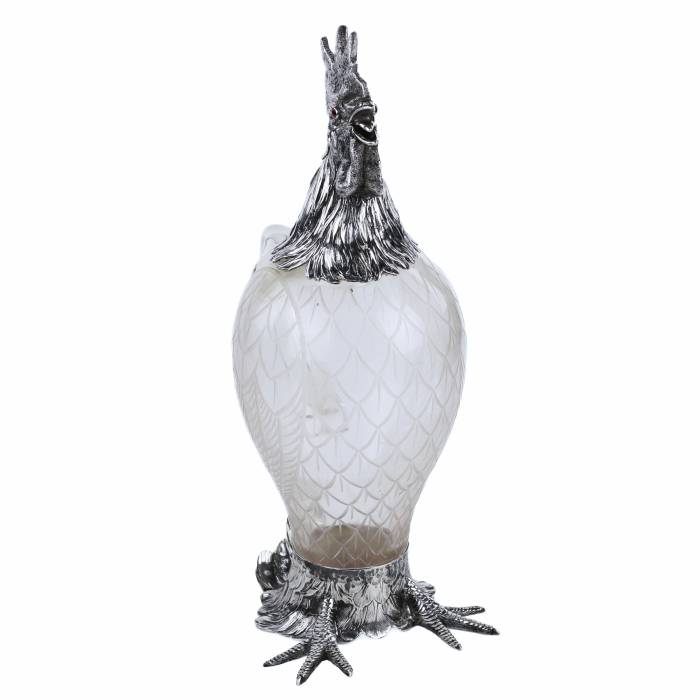
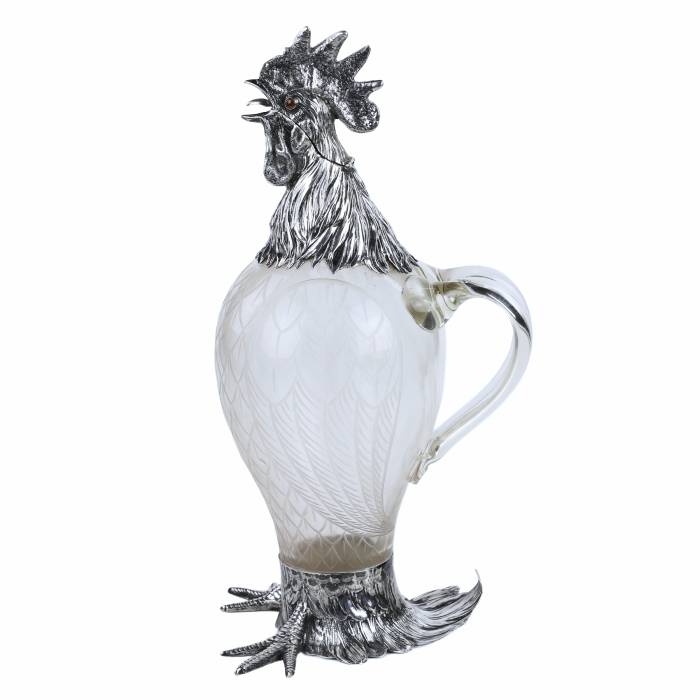
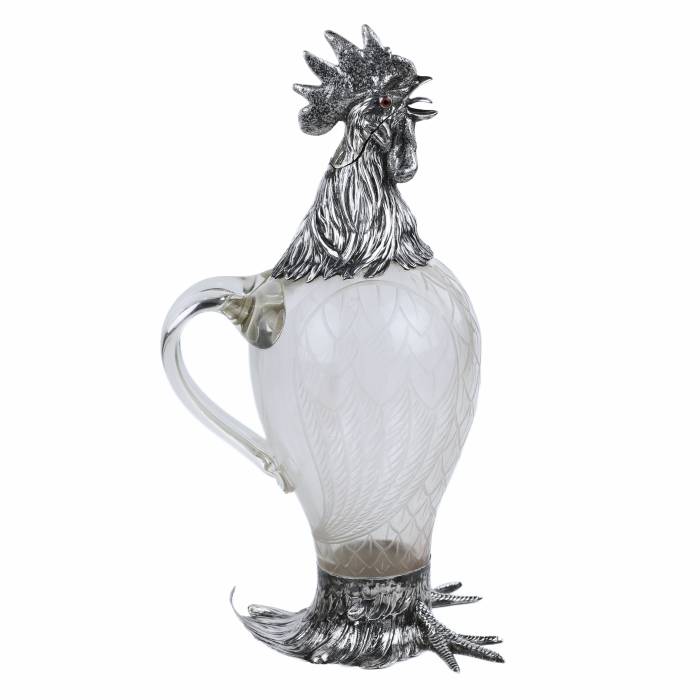
A rare and striking decorative jug in the form of a rooster, combining transparent engraved glass and finely modelled silver mounts of high artistic merit. The upper section is a hinged lid shaped as a rooster’s head, featuring a crisply defined comb and beak, and expressive red glass eyes imitating the lifelike gaze of a bird.The smooth glass body is adorned with engraved feather motifs that enhance the zoomorphic character of the object. The lower section is finished as the bird’s tail and clawed feet, masterfully cast in silver with richly textured detail. The silver base serves not only as a stable support but also as a sculptural culmination of the design. A curved glass handle seamlessly integrates into the silhouette, emphasizing its fluid form.Created by the renowned workshop J.D. Schleissner Söhne in Hanau — a celebrated German centre of historical-style silverware — the piece represents a late 19th-century fascination with fantastical animal forms, admired as symbols of luxury and refined taste.

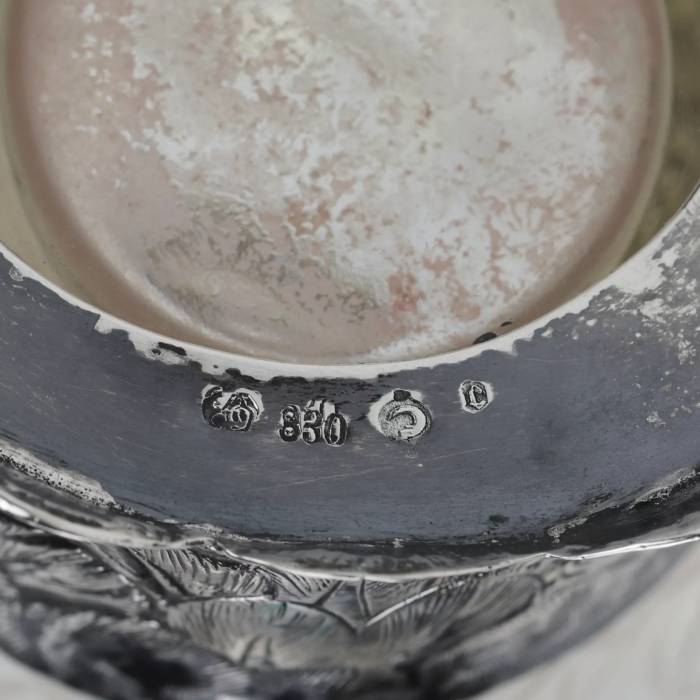
Marks: Bearing the maker’s mark of J.D. Schleissner Söhne and full German hallmarks typical for Hanau in the late 19th century.

Dimensions: Height 31 cm, width 15 cm.

ConditionThe piece is in good condition with minimal signs of age. Silver elements are intact and undistorted; engraving is crisp.

ProvenanceGermany, Hanau, J.D. Schleissner Söhne workshop, late 19th century

Art:
europe
Height:
31 cm
Width:
15 cm
Depth:
10.5 cm
Period:
Late 19th century
Style:
Romanticism
Country:
Germany
Material:
Silver, Glass
Condition:
Revive
Fair
Good
Very good
Like new
The second half of the 19th century witnessed a revival of historical styles in German decorative arts. Hanau emerged as a leading centre for such production, with workshops like J.D. Schleissner Söhne gaining international acclaim for their neo-Rococo, Baroque, and Renaissance-inspired creations. Founded in 1817, Schleissner earned a reputation for excellence in silver craftsmanship, catering to European aristocracy and affluent collectors.

Zoomorphic vessels — including jugs and caskets shaped as animals or birds — became highly desirable as luxurious showpieces, blending artistry with whimsy. This rooster-form jug exemplifies the Gesamtkunstwerk ideal, where glass conveys lightness and transparency, and silver provides sculptural depth and elegance.The rooster, a traditional European symbol of vigilance and awakening, adds allegorical meaning. With red glass eyes and finely engraved plumage, this piece stands as a superb example of late 19th-century decorative fantasy. Comparable works can be found in major museum collections, such as the Victoria and Albert Museum in London and Historisches Museum Frankfurt.

Good condition overall. Silver mounts retain form and detail; glass is clear and intact with no visible chips or cracks. Engraving remains sharp.

The condition report is provided for informational purposes only.

It is not comprehensive and may not reflect all defects, restorations, alterations, or adaptations, as Antiqon does not perform professional conservation-level assessments. The information is based on a qualified, yet subjective, evaluation by our specialists.Before purchasing, we recommend consultation with an independent expert.Please also consult our Terms and conditions and Glossary A-Z, which contain important information on lot characteristics and sale conditions.

J.D. Schleissner & Söhne Factory (1817–1950)
Founded in 1817 in Hanau, Germany, the J.D. Schleissner & Söhne factory became one of the leading representatives of European silverwork in the 19th and 20th centuries. Known for its historicist style, the workshop gained fame for Renaissance- and Baroque-inspired objects, creating highly artistic pieces for courtly and diplomatic purposes. Workshop History The J.D. Schleissner & Söhne factory was established by the silversmith Johann Daniel Schleissner in the historic town of Hanau, which by that time had already earned a reputation as a center of silver production. Management of the workshop later passed to his sons, and the enterprise became known as Schleissner & Söhne. The manufactory remained in continuous operation until 1950, spanning more than a century of uninterrupted activity.The factory reached its peak in the second half of the 19th and early 20th centuries. During this period, Schleissner’s works were presented at international exhibitions and supplied to the courts of leading European monarchies. Particularly significant were commissions for the Austro-Hungarian Empire, Prussia, the Russian Empire, and the United Kingdom. Many pieces were created for official ceremonies, state gifts, and prestigious interiors.The factory’s production was distinguished by its unique stylization of historical periods. Schleissner became one of the foremost producers of so-called “archaeological silver”—objects made in the manner of late Gothic, Renaissance, Rococo, and Baroque styles. These works were characterized by exquisite casting and chasing, rich reliefs, complex forms, and compositions featuring allegorical and mythological themes.Thanks to the precision of execution and attention to historical detail, Schleissner silver was highly valued not only among the aristocracy but also by collectors and official patrons. The workshop successfully combined decorative richness with technical perfection, producing objects that rivaled museum-quality originals from previous centuries. Marking and Attribution The manufactory marked its pieces with the initials J.D.S. or J.D. Schleissner & Söhne, and used symbols typical of the Hanau school, such as stylized crowns, mythical animals, and heraldic shields. Export items often bore fineness designations such as “800,” “Sterling,” or “Germany.”The J.D. Schleissner & Söhne Factory (1817–1950) represents a unique phenomenon in the history of German decorative arts. Its creations reflect a refined synthesis of the traditions and tastes of bygone eras with the craftsmanship of 19th-century German jewelers. These are not merely artisanal products, but artistic documents of an era when silver became a language of historical memory and courtly representation.
... Read More

Stay up to date with new arrivals
Save European silver and we let you know when new listings appears in this category
Save

Related items