×
Create account and receive
15% DISCOUNT
your first acquisition
or
David Rudolph was a jeweller of Danish origin from Copenhagen who worked in Saint Petersburg between 1779 and the 1790s. From 9 December 1779 he was registered as a master of galanterie, and from 1793 he served as guild elder. He specialised in the production of gold snuff boxes and objects of courtly luxury and executed commissions for the Imperial Court of Empress Catherine II.
We will only share latest what our month on the DAVID RUDOLPH.
BIOGRAPHY
David Rudolph originated from Copenhagen and belonged to the circle of foreign masters active in the artistic environment of Saint Petersburg during the second half of the eighteenth century. On 9 December 1779 he was officially registered as a master of galanterie goods. In 1793 he was elected guild elder of the Saint Petersburg guild of gold and silversmiths.
In 1794 and 1796 he had apprentices named S. Wein and H. Brugger. The principal documentary information concerning the master is published in A. E. Fersman’s “Alphabetical Index of Saint Petersburg Goldsmiths, Silversmiths, Jewellers, Engravers and Others, 1714-1814.”
CAREER STAGES
Rudolph’s activity coincided with the reign of Catherine II, when gold snuff boxes formed an essential part of diplomatic and court protocol and were used as honorary and commemorative gifts. The character of the surviving works and their association with the highest courtly circle indicate that he fulfilled commissions for the Imperial Court.
Of particular importance is a snuff box in the collection of Rosenborg Castle, The Royal Danish Collection, attributed as “David Rudolph, St. Petersburg.” According to the museum description, the internal engraving states that it was used daily by Catherine II. This fact confirms the courtly nature of the master’s commissions and his connection with objects intended for the personal use of the Empress.
His appointment as guild elder in 1793 further demonstrates his high professional standing and the stable organisation of his workshop within the structure of the capital’s jewellery production.
STYLE, TECHNIQUE AND DIRECTION
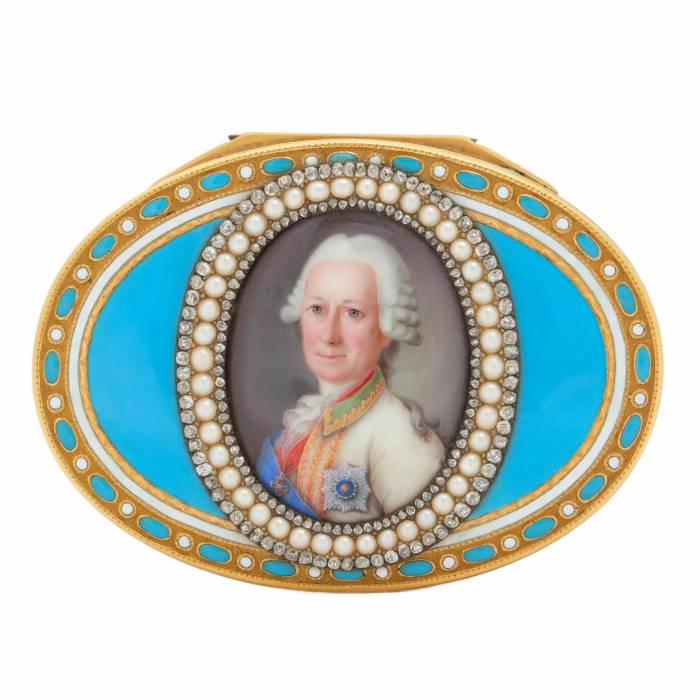
The works of David Rudolph belong to the late Rococo and early Neoclassicism. His boxes are characterised by clearly defined geometric forms, symmetrical lid compositions and a developed system of concentric ornamental bands.
Gold, coloured enamels, portrait miniatures, decorative settings of pearls and diamonds, as well as inlays of Ural and Siberian stones were employed in their decoration. The colour palette includes cobalt, turquoise and multicoloured enamel fields typical of the Saint Petersburg courtly milieu of the 1780s.
LEGACY AND MASTERPIECES
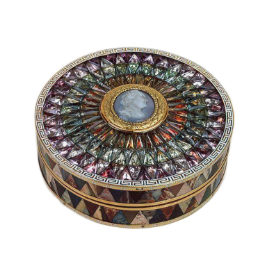
Among the most representative works is the snuff box known as “Siberian Stones” with a portrait of Catherine II. Master D. Rudolph. Height 2.8 centimetres; diameter 8.3 centimetres. State Hermitage Museum. The composition is constructed around the radial arrangement of polished inserts of Ural and Siberian stones surrounding a central medallion with a portrait miniature of the Empress set in gold.
Of particular significance is the snuff box preserved in the collection of Rosenborg Castle, The Royal Danish Collection, attributed as “David Rudolph, St. Petersburg.” According to the museum description, the internal engraving indicates that the object was used daily by Catherine II, confirming its elevated courtly status.
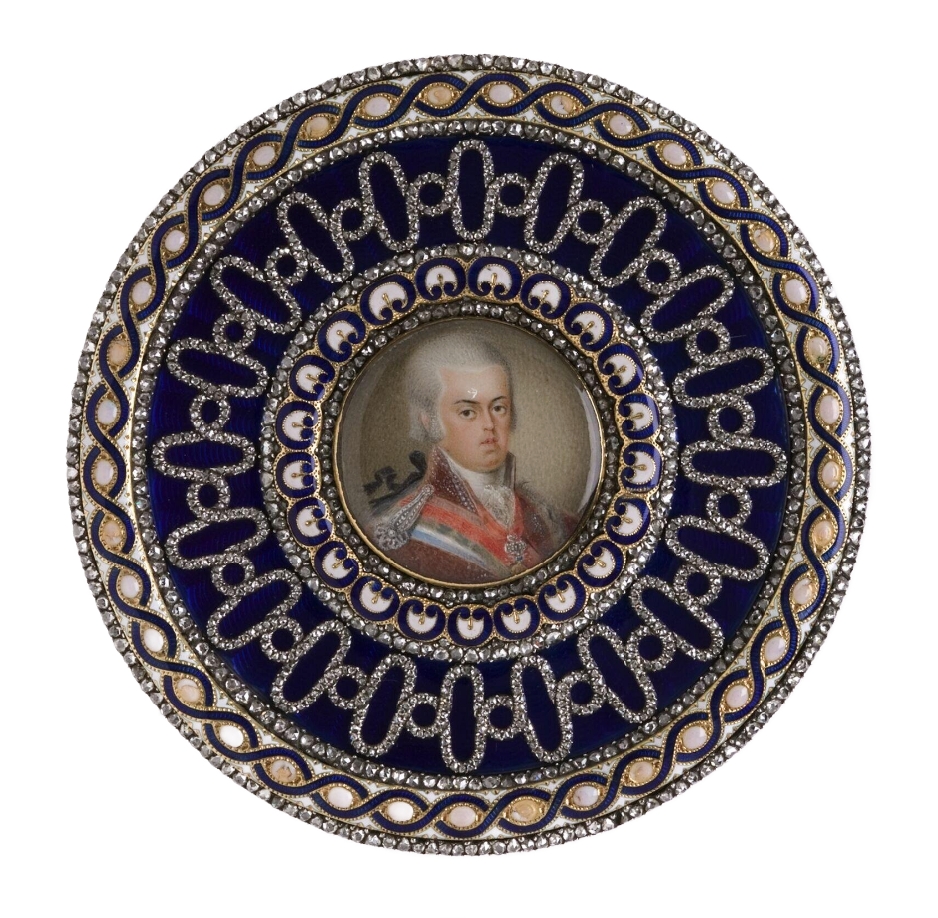
In the collection of the Victoria and Albert Museum there is a bonbonniere made of gold and enamel, decorated with diamonds and an enamel portrait miniature. Saint Petersburg, 1785. This object demonstrates the characteristic features of Saint Petersburg court jewellery of the 1780s and the international recognition of the master’s legacy.