IVAN KONSTANTINOVICH AIVAZOVSKY (1817-1900). “LIGHTHOUSE” RUSSIA, SECOND HALF OF THE 19TH CENTURY
AntiqonART consultant will contact you within one business day after receiving your request.

Discover how the value of similar works has evolved over the past 10 years. Art is not only beauty — it's an investment.
Discover how the value of similar works has evolved over the past 10 years. Art is not only beauty — it's an investment.
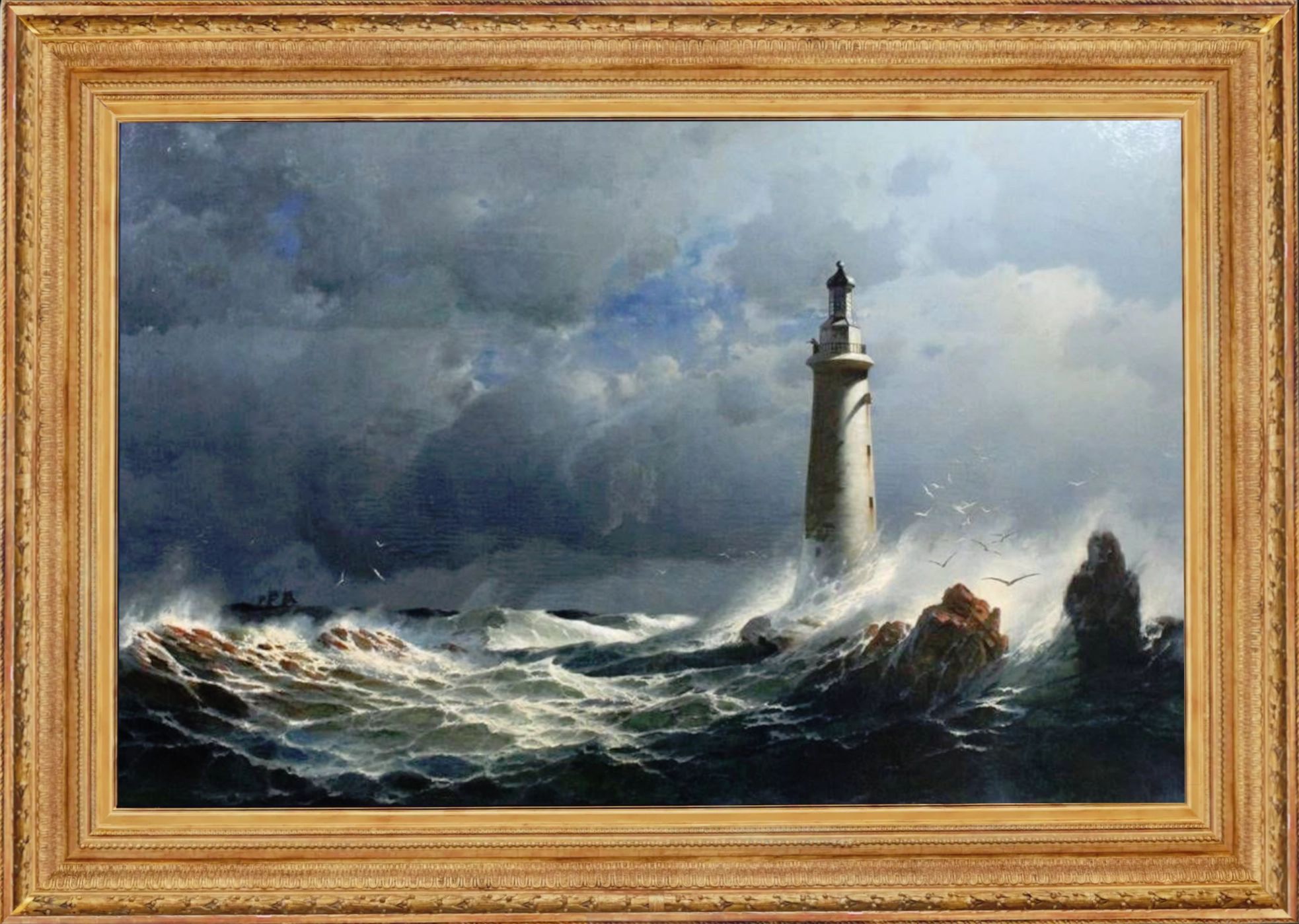
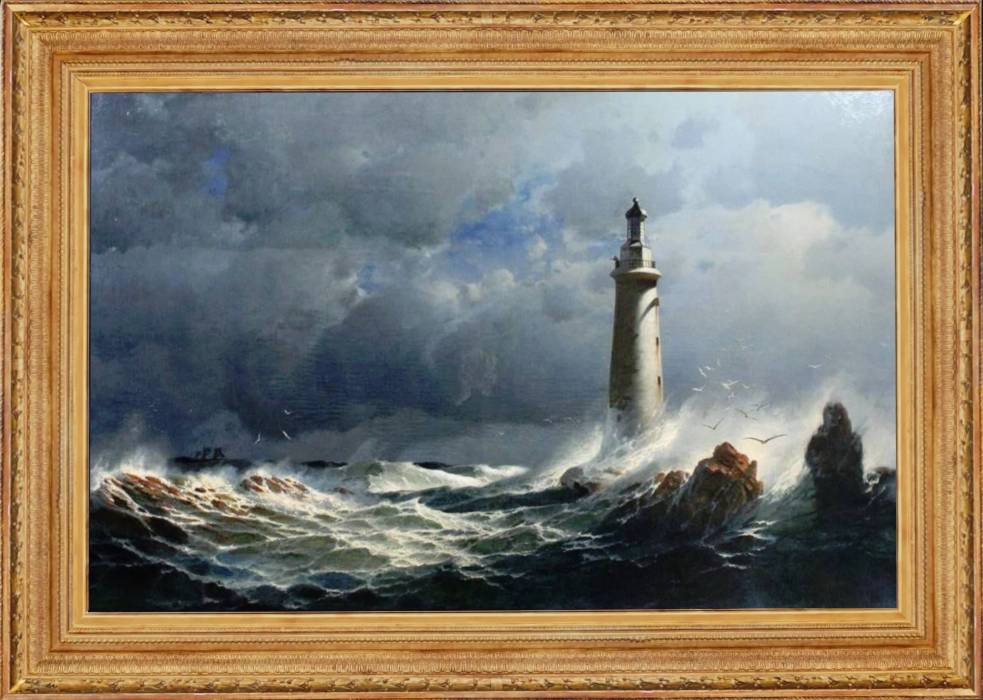
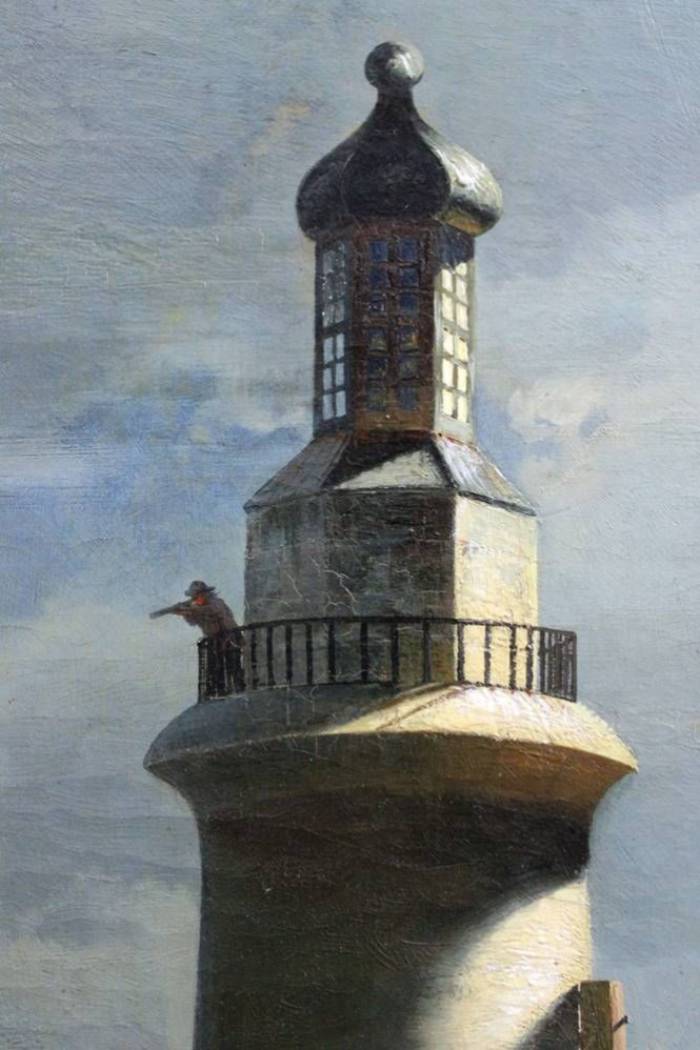
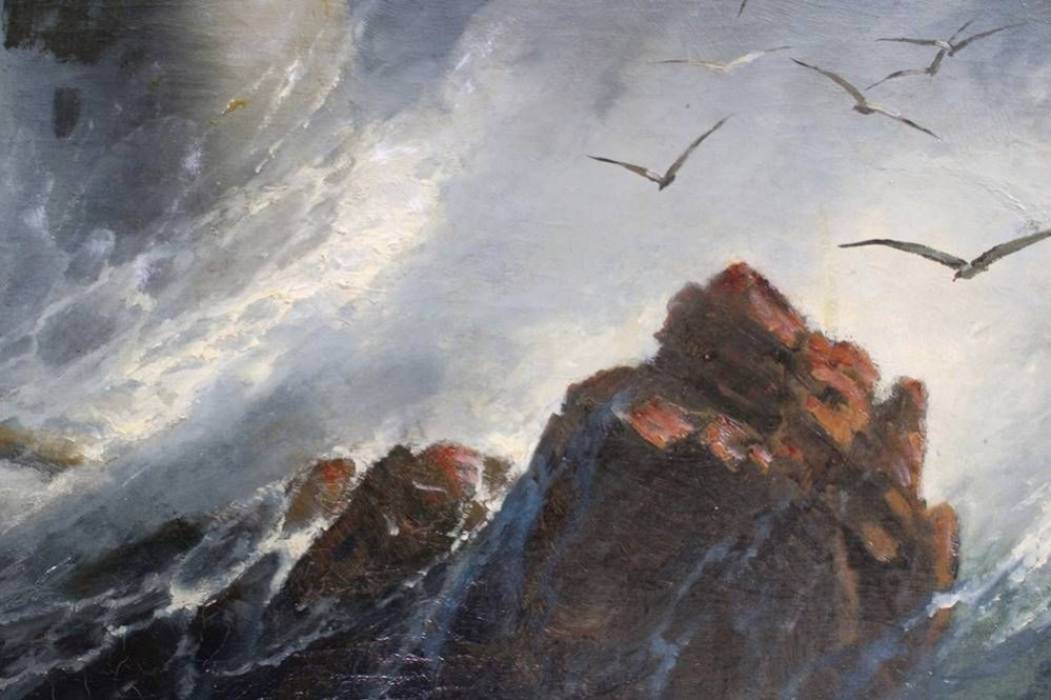
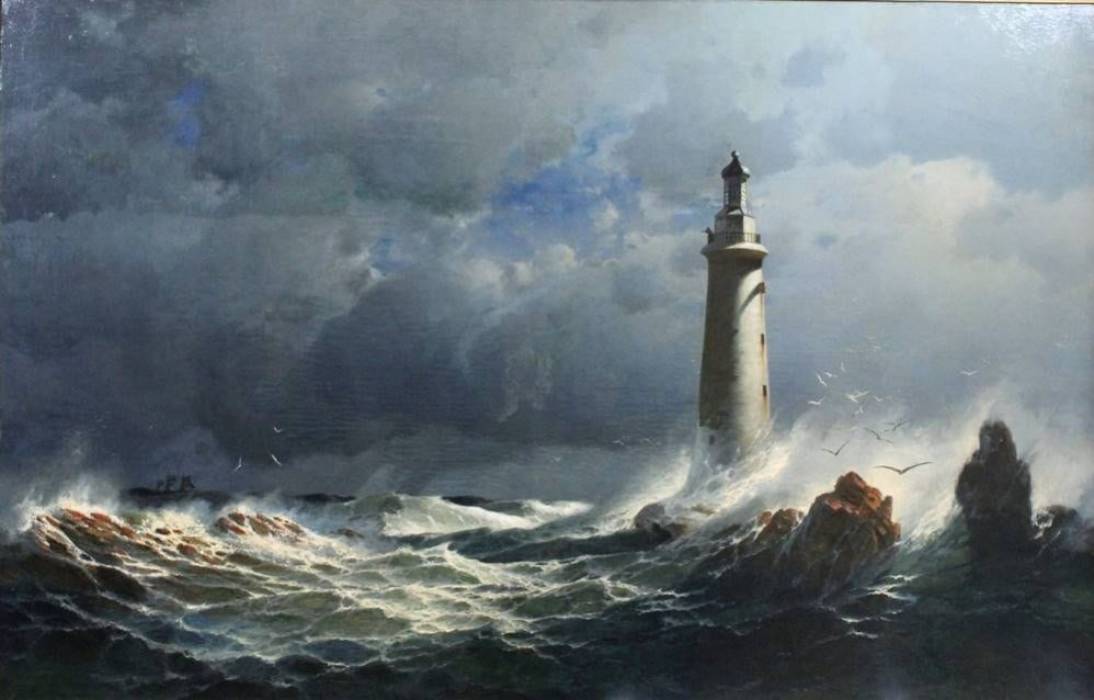
This monumental marine painting, attributed to the greatest Russian seascape master Ivan Konstantinovich Aivazovsky, belongs to the mature period of his artistic career, when the image of the sea acquired philosophical depth and symbolic intensity. The element is depicted in a state of heightened tension: heavy clouds gather above the horizon, and waves, shimmering in cold silvery and steel tones, crash forcefully against the coastal rocks.
The compositional centre is occupied by the tall lighthouse, whose strict verticality stands in contrast to the dynamic mass of water. The lighthouse functions not only as a navigational landmark, but also as a metaphor for stability, reason, and spiritual resilience. Light breaking through the clouds illuminates the crests of the waves, creating a dramatic contrast between darkness and radiance. The beam of light becomes the semantic core of the painting, expressing the idea of salvation and hope.
The spatial structure is built through the diagonal movement of the waves, directing the viewer’s gaze toward the illuminated tower. The foreground retains a denser tonal structure, while the distant light accent enhances the sensation of depth and atmospheric perspective. The sky actively participates in shaping the emotional atmosphere, intensifying the tension and the sense of an approaching storm.
The water is rendered in multilayered glazes characteristic of Aivazovsky’s late manner. Transparent paint layers create the effect of inner luminosity and plastic movement. Light appears to emerge from the very substance of the sea. The artist achieves harmony between material reality and metaphysical meaning, a quality that distinguishes his works of the 1880-1890s.
In this painting, the master’s philosophy is clearly expressed: the sea appears as a spiritualised force of nature, while the lighthouse becomes an image of human steadfastness amidst worldly chaos. The painting is presented in a richly decorated gilded frame, corresponding to the scale and representative character of the work.
Dimensions: 136.5 × 212 cm sight size; 184 × 261 cm framed
Medium: Oil on canvas
Condition: The condition of the work is assessed as good and structurally stable.
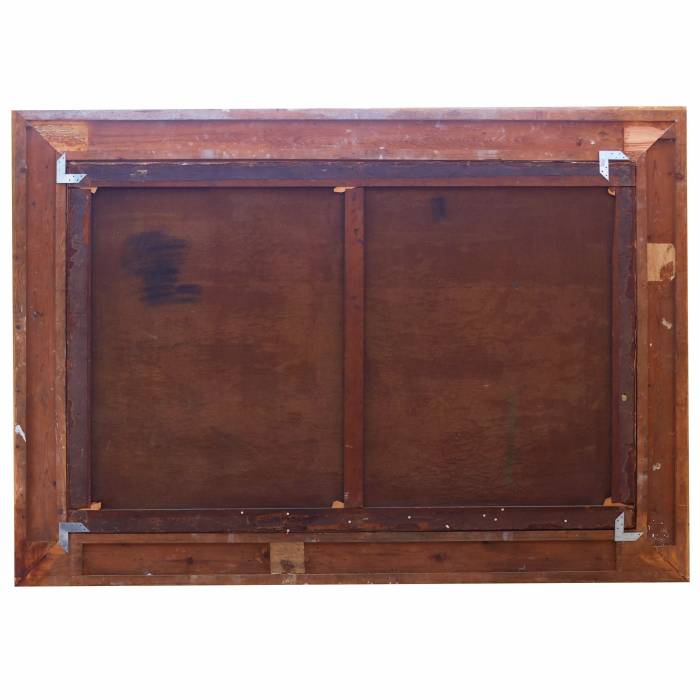
Provenance: Kunstsalon bei Mozarts Geburtshaus, Salzburg; letter of attestation dated 28 June 1970, authored by Dr. Franz Menzel and addressed to Mr. Hellmut Kaelin. Old paper labels and the inscription Middelfart appear on the reverse, likely referring to an early European collection of the painting.
Expert Certificate: Dr. Franz Menzel 1903-1983, Doctor of the University of Vienna, art historian and consultant to museums in Salzburg, Vienna, and Munich, was a recognised specialist in 18th-19th century painting. His certificates, Gutachten, issued for Kunstsalon bei Mozarts Geburtshaus, were distinguished by academic precision, detailed documentation of provenance, and profound knowledge of European artistic schools.
Aivazovsky occupies an exceptional place in the history of 19th century European art. His painting combines the emotional power of Romanticism with observational precision and philosophical depth. The painting “Lighthouse” demonstrates the highest stage of his mastery, where the sea becomes a universal metaphor for life and light its eternal principle.
The image of the lighthouse in the artist’s oeuvre is deeply symbolic. It represents reason, faith, and the human spirit capable of confronting the immense force of nature. The composition is structured upon the tension between the horizontal movement of the waves and the vertical axis of light, revealing the central philosophical idea of the master.
The documented certificate by Dr. Franz Menzel grants the work particular historical and scholarly value. Menzel was one of the few Austrian art historians systematically engaged in the attribution of Russian painting in Europe. His Gutachten on works by Aivazovsky and other masters entered the archives of the Salzburger Museum and the Städtische Galerie im Lenbachhaus in Munich as examples of academic expertise practice in the second half of the 20th century.
A special role in the painting’s history belongs to Kunstsalon bei Mozarts Geburtshaus, one of the oldest art salons in Salzburg, active during the 1950-1970s in the building where Wolfgang Amadeus Mozart was born. The salon was known as a centre of expertise and trade in 19th and early 20th century European painting. Attributions and sales of works from the Russian school were conducted there, including Aivazovsky, Bogolyubov, and Lagorio, whose works were in high demand among European collectors in the post-war period.
The inclusion of the painting “Lighthouse” in the salon’s archival materials testifies to its recognised artistic and collectible status in the Western European art market of the mid-20th century.
From the late 19th century onward, Aivazovsky’s work enjoyed exceptional demand in Europe. His paintings entered collections in Paris, London, Berlin, and Vienna, and in the post-war decades became jewels of Austrian and German private collections. Aivazovsky exerted profound influence on the European marine painting tradition, uniting the Italian culture of light with Northern precision of observation. In his art, the sea resonates like music, and light becomes the language of eternity.
The painting “Lighthouse” represents a rare example of artistic and documentary unity, where the poetics of late Aivazovsky combine with reliably documented European provenance, making it an important testimony to the international history of 19th century Russian art.
The condition of the work is assessed as good and structurally stable. The surface preserves an even patina and natural aged varnish. Previously executed local restoration interventions are noted, including consolidation of the paint layer and partial stabilisation of the ground layer. Minor craquelure consistent with the age of the work is present, as well as moderate age-related shrinkage of the stretcher and slight sagging of the canvas. These characteristics do not affect the overall visual integrity or artistic perception of the painting.
The condition report is provided for informational purposes only.
It is not comprehensive and may not reflect all defects, restorations, alterations, or adaptations, as Antiqon does not perform professional conservation-level assessments. The information is based on a qualified, yet subjective, evaluation by our specialists.Before purchasing, we recommend consultation with an independent expert.Please also consult our Terms and conditions and Glossary A-Z, which contain important information on lot characteristics and sale conditions.