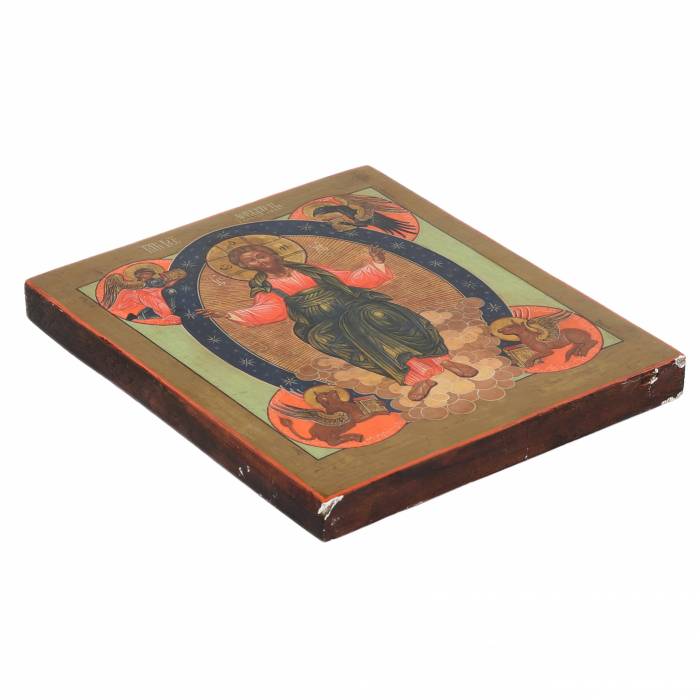
ICON “CHRIST IN GLORY WITH THE SYMBOLS OF THE FOUR EVANGELISTS”. RUSSIA, 20TH CENTURY
AntiqonART consultant will contact you within one business day after receiving your request.
Discover how the value of similar works has evolved over the past 10 years. Art is not only beauty — it's an investment.
Discover how the value of similar works has evolved over the past 10 years. Art is not only beauty — it's an investment.
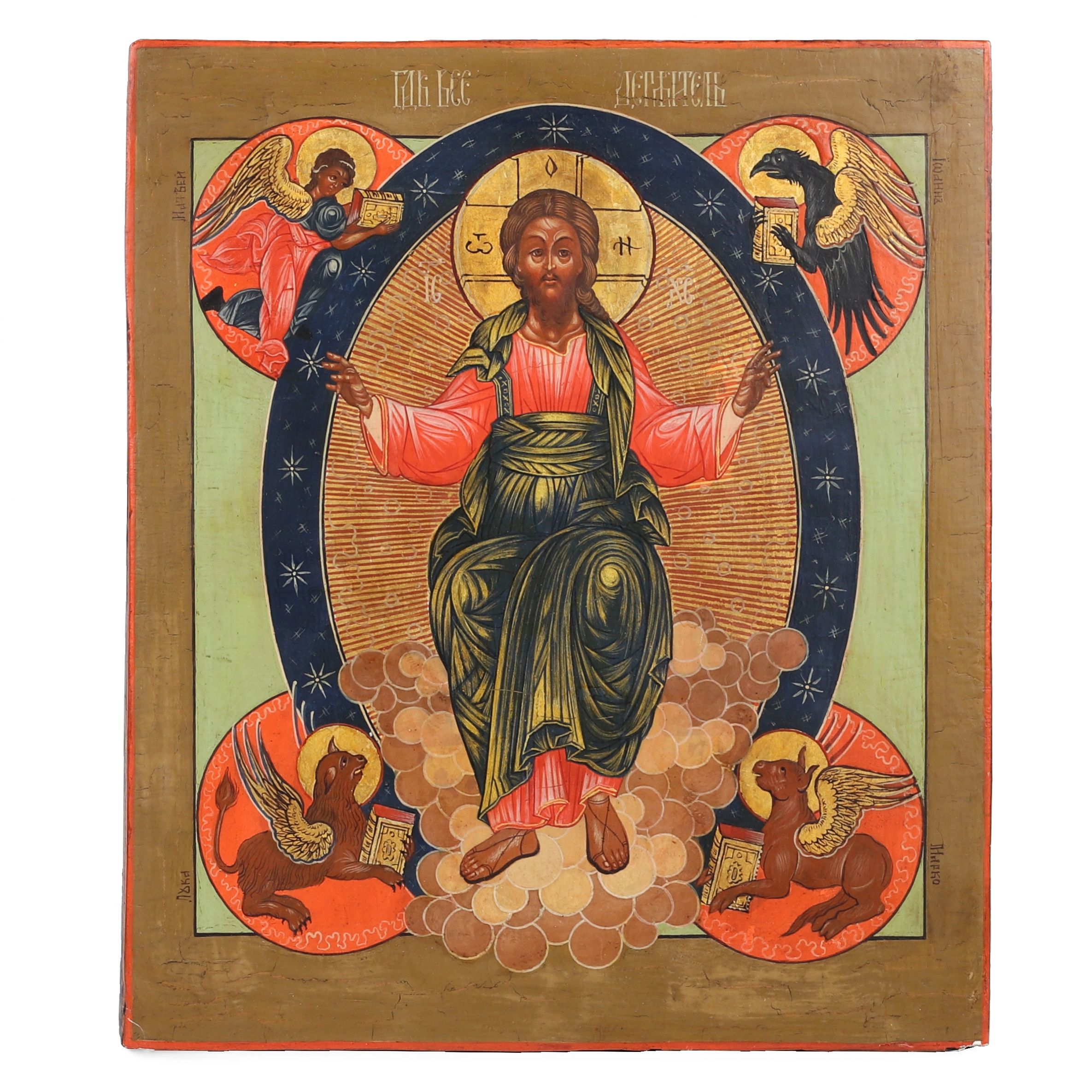
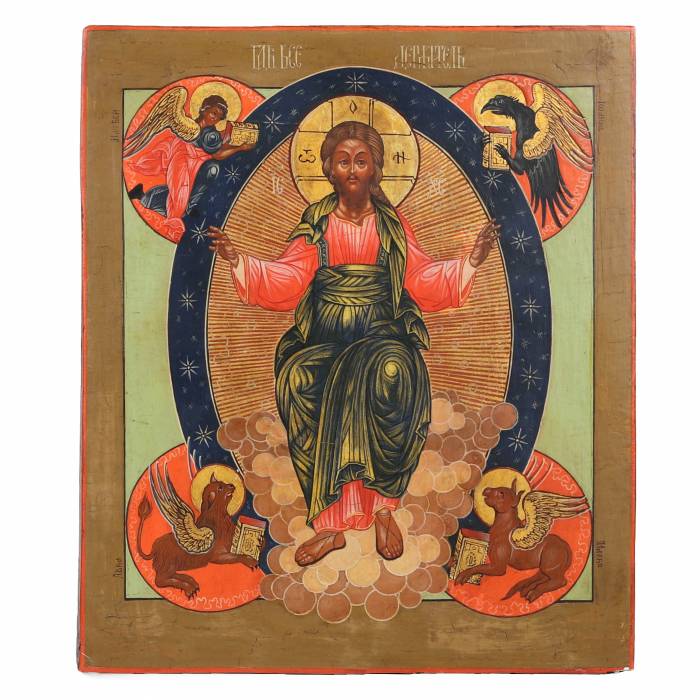
This icon of Christ in Glory is a traditional example of Russian Orthodox iconography, depicting Christ seated in glory on a throne amidst clouds, enclosed in a mandorla adorned with stars. Surrounding Him are the four symbols of the Evangelists: the angel (Matthew), the eagle (John), the lion (Mark), and the ox (Luke), each holding a book representing the Gospels. The composition is painted in tempera with gold leaf on a recessed wooden panel.
The icon emphasizes eschatological themes—Christ as Pantocrator, Judge, and Redeemer—encircled by the apocalyptic tetramorph. The mandorla is painted in deep blue and golden hues, enhancing the divine presence. Inscriptions are in traditional Cyrillic.
Inscriptions
Names of the Evangelists are inscribed in the corners: “Matthew”, “Mark”, “Luke”, and “John”. At the top, the inscription reads: “GOD ALMIGHTY”.
Dimensions
Dimensions: Icon: 23 × 20 × 2 cm
Condition
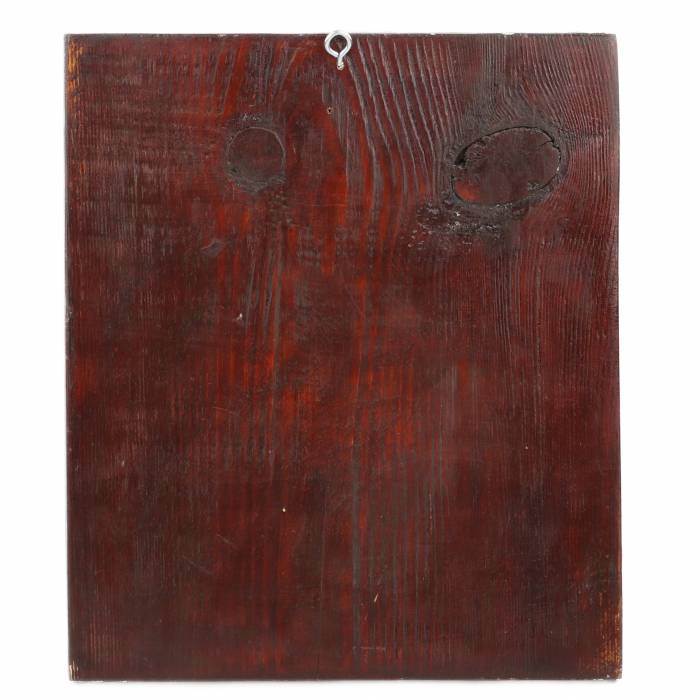
Good overall condition with minor paint losses along the edges and typical age-related surface wear. Backside stained dark, without wooden braces.
Provenance
Russia, first half of the 20th century. From a private collection. No restoration detected.
The “Christ in Glory” icon is a classical representation of the Second Coming in Orthodox art, inspired by the visions of the prophet Ezekiel (ch. 1) and the Apocalypse of John. At the center sits Christ within a mandorla, flanked by the tetramorph—the four symbols of the Evangelists. This composition emerged in Russian iconography in the 12th century and was widely produced in centers like Novgorod, Vologda, and Yaroslavl.
During the 20th century, despite anti-religious campaigns and the destruction of churches, icon painting endured, often surviving in clandestine workshops or commissioned by devout communities. Icons from this period display vivid colors and a strong sense of decorative tradition, typically preserving pre-revolutionary stylistic norms.
This particular icon reflects continuity in spiritual heritage, rooted in Old Believer and traditional ecclesiastical schools. The Evangelist symbols represent the universality of the Gospel and its message reaching the four corners of the world.
Today, icons from this era are not only venerated religious items but also historical documents of cultural resilience and faith.
The condition report is provided for informational purposes only.
It is not comprehensive and may not reflect all defects, restorations, alterations, or adaptations, as Antiqon does not perform professional conservation-level assessments. The information is based on a qualified, yet subjective, evaluation by our specialists.Before purchasing, we recommend consultation with an independent expert.Please also consult our Terms and conditions and Glossary A-Z, which contain important information on lot characteristics and sale conditions.